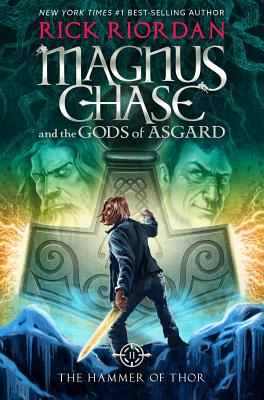
The Hammer of Thor

hammerofthorby Rick Riordan
First Sentence: “Lesson learned: If you take a Valkyrie out for coffee, you’ll get stuck with the check and a dead body.”
Support your local independent bookstore: buy it there!
Others in the series: The Sword of Summer
Content: There’s some violence, a bit of romance. It’s in the YA section (grades 6-8) of the bookstore, but heaven forbid you stop a Riordan fan from reading these.

It’s been a few months since we last saw Magnus, and he’s been managing okay out in Valhalla. But, Loki’s up to his old tricks again, and Thor’s hammer is still missing, and Magnus and his friends are needed to stop him. The problem: Loki has promised the giant Thrym that Sam the Valkyrie (who’s Muslim and engaged already) will marry him. In just over a week. Of course this can’t happen, except for one thing: Thrym happens to have Thor’s hammer. The trick: getting Thrym to give up the hammer, while not releasing Loki from his imprisonment AND having Sam not get married. But, of course Magnus and all his friends — including Alex, a gender fluid character — are up to the challenge. Mostly.

It took me a while to get around to reading this one, mostly because it’s just more of the same. Not that that’s bad; I love being in Riordan’s world when I’m there. But, I’m not as enthralled by Magnus’s part in the larger mythos as I hoped I’d be (I’m more interested in Apollo right now). Not that the story’s bad; it’s not. And Riordan’s fun and funny and maybe a bit too hip and contemporary, but I know (because A’s a huge fan) that the kids eat it up. It’s a good addition to the wider mythos that Riordan’s created, and I do appreciate that he’s definitely trying to be inclusive with his characters these days.

It’s just not my favorite.

Audiobook: Flawed

flawedby Cecelia Ahern
Read by Aysha Kala
Support your local independent bookstore: buy it there!
Review copy provided me by the publisher rep.
Content: There’s a somewhat graphic branding scene, some teen drinking (but the main character doesn’t) and an uncomfortable scene where I was afraid there would be a rape (there wasn’t). It’s in the YA section (grades 6-8) of the bookstore.

First a story: our Macmillan rep is an older gentleman, whose tastes run towards history and thrillers. But, being a good rep, he does read some of the kids stuff (he does both). And, every once in a while, he finds a YA he really likes.  This is the second time I’ve kind of said “yeah, yeah” to one of his recommendations (the first time was Cinder). I was going to get around to this one. Eventually. But then, he was kind, and sent me the audio version (which he REALLY liked) and I figured I should give it a shot.

I just need to learn to trust him: this was really good.

The problem is that it doesn’t really have a good hook. It’s a society (loosely based in England, or that may just have been the narrator’s English accent) in which they’ve developed a court system to judge people’s morality. If they find anyone to be morally or ethically wanting, they deem them Flawed, brand their skin and impose a whole ton of rules on them. They aren’t allowed to have children, they have restricted diets and a curfew, they aren’t allowed to congregate in more than groups of two. They have different restrooms, assigned seats on the bus… you get the picture.

Our main character, Celestine, on the other hand, is perfect. She has the perfect boyfriend (the son of the Flawed Court’s head judge), she has the perfect grades, the perfect family, the perfect clothes, the perfect life. Then, her next door neighbor gets hauled into the court for adhering to her mother’s wishes to be euthanized. Which gets Celestine thinking: maybe there’s something not quite right about the Flawed Court? And so, when she encounters an older Flawed man on the bus having a bad asthma attack, but doesn’t have a place to sit, Celestine helps him. Which lands her in the Flawed Court for aiding a Flawed.

And that’s just the beginning of Celestine’s journey. This is really just a set up for a bigger conclusion (due out in the spring), but it’s a fascinating one. I do have to admit that I was often annoyed with Celestine, especially her dependence on boys, but other than that, it was really good. I loved the comparisons to racism, from the segregation to a riot that broke out near the end of the book. I really liked the world that Ahern built; while it’s vaguely dystopian, it isn’t futuristic or mystical.

It’s definitely worth reading.

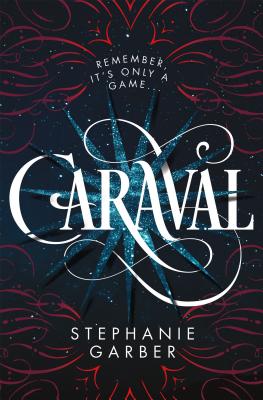
Caraval

caravalby Stephanie Garber
First sentence: “It took seven years to get the letter right.”
Support your local independent bookstore: buy it there!
Release date: January 31, 2017
Review copy provided by the publisher.
Content: There’s some domestic abuse and an almost-rape. If the reader is sensitive to those topics, then this probably isn’t for them. It will be in the YA section (grades 6-8) of the bookstore.

I will say this straight up: this one is a hard book to sum up. There’s devoted sisters, the older — Scarlett — of which will do anything for the younger — Tella. There’s a controlling and abusive father who uses the sisters’ devotion against them. There’s a traveling game, Caraval, that is invitation only and that Scarlett has wanted to attend for years. There’s a history between Caraval’s master, Legend, and Scarlett’s grandmother. And then there’s Scarlett’s impending marriage.

And then Scarlett and her sister get invited to the game, the week before her wedding. And it turns out that finding Tella is the POINT of the game. One in which Scarlett must be prepared to risk everything to win.

I loved this. Seriously. No, it’s not lyrical and the writing isn’t the grandest, but it’s good, solid storytelling with an epic story to be told. I loved that the stakes were high. And the chemistry between Scarlett and Julian? When it was on, it was ON. I liked the use of magic in the game and the way it kept me in suspense about what was real and what wasn’t

I liked that the story wrapped up, mostly suitably, even though there was a bit left undone for a sequel. Definitely worth reading.

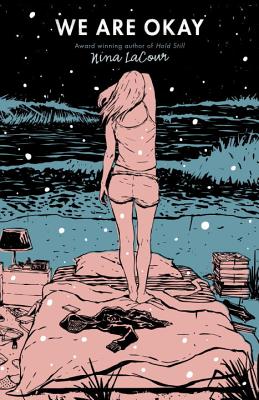
We Are Okay

weareokayby Nina LaCour
First sentence: “Before Hannah left, she asked if I was sure I’d be okay.”
Support your local independent bookstore: buy it there!
Release date: February 14, 2017
Review copy sent by the publisher’s rep, who is my favorite.
Content: There’s one f-bomb, some inferences to sex and a scene where the main character gets drunk. It’ll be in the Teen Section (grades 9+) section of the bookstore.

I know from the outset that I’m not going to do this book justice. Partially because the plot is simple: it’s Christmas break, and college freshman Marin doesn’t want to go home for lots of reasons. The chief one being that right before she left for college, her grandfather — her only living family — died. So her best friend (the one who has been texting and calling and Marin’s not answering) comes to see her. And over the next few days before Christmas, and through a series of flashbacks, we find out the depths of Marin’s grief.

Which is really what this book is “about”: the varied ways we all deal with loss, heartbreak, lonliness, and grief. Some ways are healthier than others. Some have friends who are willing to put in the work to rescue them. And sometimes, distance and time can be both the best and the worst thing.

And LaCour gets all those difficult emotions beautifully. The story unfolds bit by bit, giving us small slices at a time, until we see the whole, heartbreaking picture. It’s a remarkable moment, one which brought tears to my eye. And it’s a universal feeling: we have all wanted to be loved, we have all had heartbreak, we have all had grief and been lonely. It’s beautiful and moving and heartbreaking all at once.

Perfect.

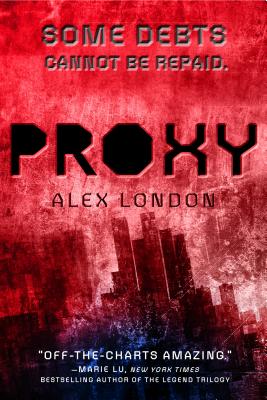
Proxy

proxyby Alex London
First sentence: “Even a perfect machine wasn’t built to go this fast.”
Support your local independent bookstore: buy it there!
Content: There’s a lot of violence, including several deaths that, while not graphic, are a bit shocking. There’s also some futuristic drug use. It’s in the YA section (grades 6-8) of the bookstore.

In this vision of the future, there are those who have and those who have not. Syd is one of those who have not; in order to pay for the debt in incurred by being alive, he was forced to become a proxy for the child of a rich man. It works like this: the rich man takes on Syd’s debt, and in return, Syd takes on the punishments every time the child — Knox — gets in trouble. Seems fair, right? Except, it’s not that simple. It’s people’s lives they’re casually playing with, and Knox is exceptionally reckless. And when he accidentally kills a girl and Syd is condemned to die, Syd’s had enough: he’s going to escape this hellhole. But things aren’t as straight-forward as Syd thinks, either. And soon, Syd and Knox are on the run from a lot of people, and end up way over their heads.

I liked this one. It’s a smart vision of the future — dystopian, yes, but it’s the capitalistic system that’s become the cruel overlord rather than the government. He’s playing with class and debt and the relationships between the two. There’s a bit of chosen-one-ness going on here as well, but I thought London resolved it in a unexpected way. He definitely kept me turning pages, and I found that even the more annoying characters (Knox…) had layers to them. I hadn’t read anything by London before, and this was a great starting place.

And the best thing? I don’t have to wait for the sequel to come out!

Audiobook: Three Dark Crowns

threedarkcrownsby Kendare Blake
Read by: Amy Landon
Support your local independent bookstore: buy it there!
Content: There’s some off-screen sex, and lots and lots of violence. It’s in the Teen section (grades 9+) of the bookstore.

The premise of this one is weird and awesome: on the island of Fennbirn, every generation there is born a set of triplet queens. They are fostered out, according to their “powers”, and each one has an equal chance at becoming queen. The catch? The one who becomes queen has to kill her sisters.

Our queens are Arsinoe, a naturalist, said to have power over nature; Katharine, a poisoner, who can ingest the most lethal poisons and not die; and Mirabella, an elemental, who has control over the weather. Except, things aren’t always as they seem. And those who the queens have been fostered to have much more power than the queens.

It had a really slow start to it; there was a lot of exposition about the magic (which I didn’t mind) and the characters (I liked some better than others). There were a couple of love stories, and a love triangle (of sorts). (I kept rooting for one of the queens to be lesbian; I think one is, but not the one I suspected.) It took a long time to get going, and the only thing that kept me listening was the narrator, who was quite spellbinding. For one, there’s a lot of weird names of people and places in this, and it was nice to have someone else pronounce Arsinoe (ar-sin-oye) and Katharine (cat-er-eene), instead of trying to figure it out on my own. I think Blake tried to balance all three queens’ stories, but she ended up focusing more on Arsinoe more than others. (Or at least I felt she did.)

It wasn’t a stand-alone, as I had hoped. And I called one of the major twists fairly early on. But were a couple of things that surprised me, and I have hopes for the direction that the sequel should go (we’ll see). It wasn’t the best fantasy I’ve read, but it wasn’t bad either.


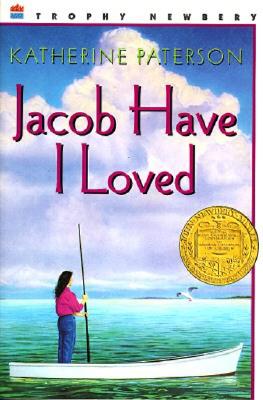
Jacob Have I Loved

jacobhaveilovedby Katherine Patterson
First sentence: “As soon as the snow melts, I will go to Rass and fetch my mother.”
Support your local independent bookstore: buy it there!
Content: It’s slow (it won the 1980 Newbery Award), and there’s not a lot of action. It’s perfect, though, for those 12 or 13-year-old kids who are trying to figure out themselves. And who like historical fiction.

A quick side note: it’s my 12th blogiversary today! I’ve fallen out of the habit of celebrating these, but I carved out this little corner of the internet 12 years ago today. Hard to believe, but there it is.

I wasn’t feeling much like reading new stuff the past couple of weeks, so I turned to a couple of rereads. One was The Blue Sword, which I’ve already given its own review. But the other, I only mentioned briefly, 12 years ago, so I thought it deserved its own post.

Sara Louise has spent her whole life on the small island Rass in the Chesapeake Bay. Her father works the water, crabbing in the summer, and harvesting oysters in the winter; her mother was a former schoolteacher and currently runs the house. Louise is mostly content, except… her younger twin, Caroline. It’s not that Caroline is mean or awful; in fact, it’s the opposite. Caroline is beautiful, Caroline is talented, Caroline is kind. Caroline is the joy of everyone on the island, and Lousie just can’t compete. She knows she should be supportive of her sister, proud of her sister. And she is. But she’s also jealous: she wants to be Noticed. But she’s not. She’s the backbone. The work horse. The awkward child.

There isn’t much of a plot; it’s Louise’s experiences growing up, and her (finally) figuring out what she wants out of life as an adult (which is nice). I spent this reread (it’s been a while) trying to figure out why this moved me as a pre-teen, why I have such a powerful attachment to it. I think it’s because everyone (well… me) can connect to being left out. To being looked over. To working and working and working and never feeling appreciated. To always being on the outside. And Patterson captured that feeling so very perfectly. She captures the awkwardness of the pre-teen years (I really don’t think anyone ever has things together the way Caroline does in the book; I’d love to see this story from Caroline’s point of view. It’d make her more human), the way they Want but don’t quite know how to articulate that want. The up and down feelings, the drama of just Living. It’s a perfect portrait of those years, and I think that’s what resonated.

Does it hold up as an adult? Yes, it does. It’s definitely historical fiction; it’s a picture of a small island in the 1940s, during World War II, and I found that interesting. I wanted to smack Grandma. Seriously, the woman had issues. I wished there was more about Louise’s mom; I would have loved to hear her story. I did enjoy it, even if I didn’t connect to it as deeply as I did when I was a pre-teen.

Definitely still worth reading, though.

Falling Over Sideways

fallingoversidewaysby Jordan Sonnenblick
First sentence: “I’m waiting in the wings, watching all the fathers dancing onstage.”
Support your local independent bookstore: buy it there!
Content: There’s no swearing, drinking, or drugs. There is some talk of crushes. It’s a pretty skinny book, too. It’s in the YA section (grades 6-8) of the bookstore, but I’d give it to a 5th grader who was interested.

Claire is managing 8th grade okay so far. Sure, she’s no longer in the same dance class as her best friends. Sure, the boy at school who’s been mean to her for two years is still there. Sure, she’s still being compared to (and found failing) her Perfect Older Brother. And, sure her science teacher is kind of crazy. But it’s all manageable.

That is, until her father has a serious stroke. And she’s the only one home. She does what she’s supposed to do: calls her mom, calls 911. But it’s left her shaken. And it’s left her dad as a shell of himself. And that means her life has changed, whether she wants it to or not.

And while it’s a tough year for Claire, there are some bright spots. Sonnenblick captures the ordinary incredibly well, finding the joy and heartbreak in the little moments. Claire has a really heartwarming growth arc, as she goes from being afraid of her father in his new condition to being his biggest champion. And she grows with her friendships as well, discovering friends where she didn’t think there were. It’s a heartwarming tale overall (even if the mom starts out as annoyingly perfect and positive), one that will not only resonate with kids whose parents have been ill, but pretty much everyone who’s struggled a bit in their life.

A very, very good read.

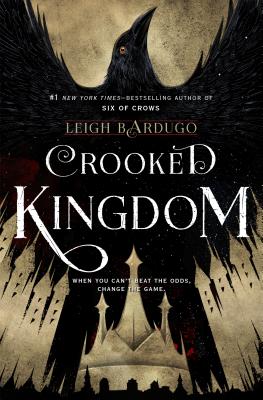
Crooked Kingdom

crookedkingdomby Leigh Bardugo
First sentence: “Retvenko leaned against the bar and tucked his nose into his dirty shot glass.”
Support your local independent bookstore: buy it there!
Others in the series: Six of Crows
Content: There’s violence, and some vague talk about what Inej did in the pleasure house. Nothing graphic, though. It’s in the YA section (grades 6-8) of the bookstore.

There will be spoilers for Six of Crows. Which you really ought to read.

Kaz and his crew have one goal: get Inej back. Sure, that means going up against Van Eck, the most powerful merch in Ketterdam, but they’re invincible, right? Right?

Well… it sounds easier than it is. And, because this is Kaz we’re talking about, he’s playing a much longer game than any one of his crew knows.

And that’s me, not giving too much away. Because it’s best if you don’t know much about this one going in. Know that the whole crew is back — Jesper, Wylan, Nina, Matthais, Inej and, of course, Kaz — and that the cons played here are immensely satisfying with their twists and turns. Know that Bardugo is ruthless with her characters, which just makes me love this book more. Know that the ending is immensely satisfying.

An excellent ending to a fantastic story.


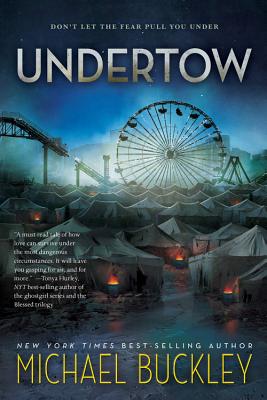
Undertow

undertowby Michael Buckley
First sentence: “You can hear them coming from blocks away, a low thrum like the plucking of a bass string.”
Support your local independent bookstore: buy it there!
Review copy provided by the publisher (I think).
Content: It’s violent. There is an attempt at a sex scene, but it doesn’t get off the ground. There is some domestic abuse. It’s in the YA section (grades 6-8) of the bookstore, but I’d be wary about the 6th grade end of the scale.

In this alternate not-so-distant future, there are these humanoid creatures called the Alpha, which have come out of the ocean and onto the shores near Coney Island, sending the community — and the country — into a tailspin. The Alpha aren’t exactly like humans — they have scales and different coloring, and sword-like things coming out of their arms. It’s not been an easy adjustment for the humans in Coney Island and the surrounding area. In fact, many of them haven’t adjusted at all, choosing instead to fight the “intrusion” of the Alphas on their territory.

For Lyric and her family, the appearance of the Alpha has caused some conflict, because Lyric’s mom is one of them. Sure, she’s been “passing” for 20 years, pretty sure her people abandoned her. But, since their appearance, the other Alphas that have been passing are being targeted. They’re outcasts among their people, and they’re outcasts among the humans as well. And things are getting more complicated: the government is insisting that select Alpha attend school, which just complicates matters more. Especially since Lyric is tapped for one-on-one lessons with the Alpha prince. Fathom.

I’m not doing a very good job describing this one. I suppose it sounds weird, but the thing that struck me most, especially in this political climate, was the whole immigration deal. You could substitute Alpha for any ethnic group, and you’d have a story that’s reflective of the way America currently reacts to immigrants. Sure, it’s exaggerated, but the hate and the discrimination are there. I found it all a fascinating way to deal with the whole issue. Buckley’s also being clever with the Atlantian myths and I thought that the whole Alpha-mythos building was quite unique and clever.

As for the rest of it, it’s a fairly typical YA dystopian. Buckley’s fairly brutal with his characters, which adds a level of intensity. And, sure, there’s a romance and the ending is sufficiently open-ended to make room for the sequel. It was a clever take on this genre, and definitely a fun read.