The Penderwicks at Last

penderwicksatlastby Jeanne Birdsall
First sentence: “Lydia believed in dancing wherever she could — on sidewalks, in supermarket aisles, libraries, swimming pools, parking lots.”
Support your local independent bookstore: buy it there!
Others in the series: The Penderwicks, The Penderwicks on Gardham Street, The Penderwicks at Point Moutte, The Penderwicks in Spring
Release date: May 15, 2018
Content: There’s some romance (all tasteful, of course), and it has a bit of an old fashioned feel. It will be in the Middle Grade (grades 3-5) section of the bookstore.

When we last left the Penderwicks, Batty was in 5th grade and Lydia was two. But since a two year old would make a horrible narrator of a middle grade novel, Birdsall has fast-forwarded time again: Lydia is eleven now, and everyone else is duly older. In fact, Rosalind, the oldest, is about to get married. Which she wants to do at the place where everything started: Arundel. Lydia, Batty (who is 19 now), and the dogs (Sonata and Feldspar, who is the BEST) are the advance guard: heading to the mansion to clean and get ready and hopefully ward off (the awful) Mrs. Tifton. It’s delightful to be back at Arundel, and Birdsall weaves in all the stories from the first Penderwicks book — Lydia has grown up hearing the stories but not seeing the places — which gives the book a sense of nostalgia without just rehashing the same stories. We get to see Cagney again — he’s married with a daughter Lydia’s age — and it’s just absolutely delightful. But then, the Penderwicks usually are. And I loved getting to know Lydia who is simultaneously so very Penderwick but also different because she wasn’t surrounded by sisters the way the others were.

There are, of course, Penderwicks things: an out of control soccer game; lots of music and wandering around outside (no one EVER watches TV!); friendships and family. It’s absolutely delightful and I want to be a Penderwick. I thought it would make me cry to have to say goodbye to this lovely family, but I  didn’t. It was all so perfect, so right, so very comparable to Little Women (but no one dies!), that it just made me happy all over.

This series is such a wonderful modern classic. I’m so glad Birdsall had this story to tell.

Love & Luck

by Jenna Evans Welch
First sentence: “Dear Heartbroken, What do you picture when you imagine traveling through Ireland?”
Support your local independent bookstore: buy it there!
Review copy provided by the publisher.
Content: There is some sexual harassment and mild swearing. It is in the YA section (grades 6-8) of the bookstore.

Addie has been looking forward to the end-of-summer trip to her aunt’s wedding in Ireland. Mostly because she’s going to pop over to Italy afterward (to see Lina from Love & Gelato) but also because it will get her away from the boy who dumped her after their secret summer relationship. She is planning on sitting in the sun and eating gelato and forgetting.

Except, her other brother, Ian (who was supposed to go with Addie to Italy) has other plans: he’s hooked up with an internet friend, Rowan, and they’re going to go on a band-themed road trip in Ireland ending up at the last concert of their favorite band. Addie’s WAY against this (since their parents don’t know), but is convinced to let them drop her off at the airport. But… the car breaks down, the traffic is bad, and she misses her flight. And suddenly, she’s on a road trip with a boy she barely knows and a brother she’s barely speaking to.

I expected this to be a light, fluffy romance, but Welch delivered something… different. Sure there was a small bit of romance, but mostly the book was about bad decisions and healing and forgiveness. It’s a bit much to go into here, but I liked Welch’s descriptions of the sibling relationships, and how hard it is to find out who you are in the middle of a big, boisterous (and loving) family. (It was nice that the parents were actually good parents, too!) I liked the cheesy “travel guide” that is quoted throughout the book, as well; even though it was often corny, there were some good thoughts in it, and yes, it did make me want to go see Ireland.

It wasn’t what I was expecting, but I really liked it.

Bob

by Wendy Mass and Rebecca Stead
First sentence: “I feel bad that I can’t remember anything about Gran Nicholas’s house.”
Support your local independent bookstore: buy it there!
Review copy provided by the publisher.
Content: It’s written perfectly for the younger age group. It is in the middle grade  section (grades 3-5) of the bookstore.

Livy hasn’t been to her grandmother’s house in Australia in five years, when she was five years old. She doesn’t remember much from the last time she was there: not the room or the toys or the landscape, and especially not the green creature in the closet. Bob (the green creature in the closet) remembers Livy though. She told him to stay put, which he did. For five years. In the closet. But now that Livy’s here, he’s sure she can help him find his way home again.

Bob (the book not the character) is a charming little story about friendship and growing up, but also home and family. And it’s a delightful twist on fairy tales. In Mass’ and Stead’s hands, it’s not saccharine, but simple and sweet and tender.  Livy was more complex than I expected, pulled between her childhood self and a desire to be “older” and the responsibility of being a big sister. And Bob was charming and delightfully innocent. I liked that the fairy tale had rules: even though they were never spelled out in the book, Mass and Stead were consistent with who could and could not see Bob. It was incredibly well done, and a delightful read. .


First Sunday Daughter Reviews: May 2018

We’ve hit the lovely month of May: the sun is shining, the weather warming up (though the temps kind of make me wonder if we’re going to have much of a spring, or if we’re going to dive right in to summer…), and SO much going on. Every day, multiple someones have things. And it’s just compounded by the fact that C’s graduating. In a week. (eep!)

Even so, we do manage to squeeze books in.

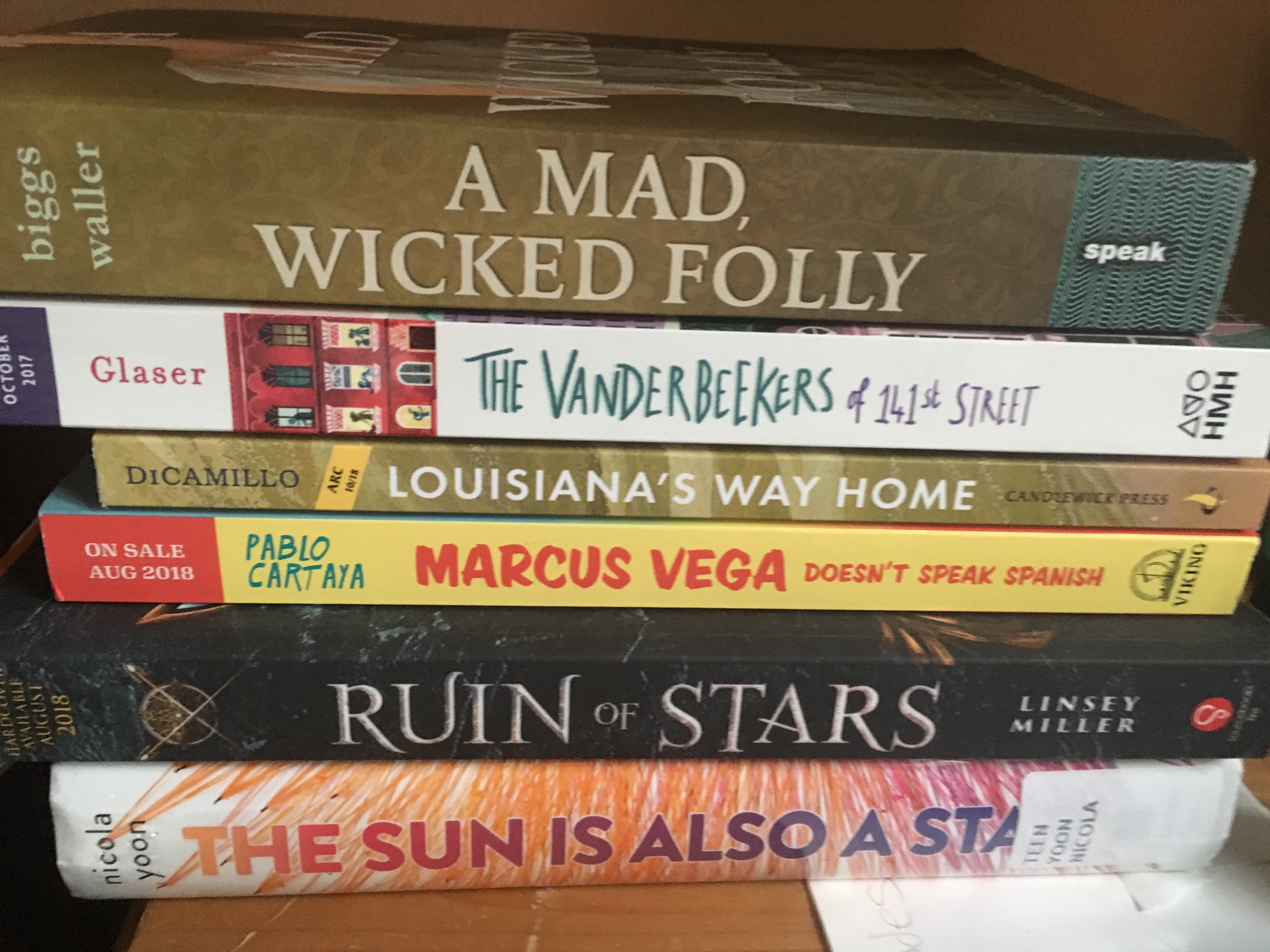
C, in the middle of all the finals and AP tests and concerts and a last show and graduation prep has picked this up again:

I don’t know if her opinion has changed. The only thing she’s mentioned is that it’s very early 2000s.

I picked this up for A last week

 But she’s bogged down in an Animal Farm project and has only been able to read a little bit. Soon, though.

And K’s been plowing through books. She wanted something with NO romance (her biggest beef about Ally Carter books is that they have a great plot and great characters that are ruined by the romance. :-D), so I threw a few at her. She’s read them all.

She really liked Coundown (because it’s a good book!), thought Witness Protection was okay (she didn’t like the ending) and he’s enjoying the Rainforest book.

What are you reading?

Module 15: Flashcards of My Life

Harper, C. M. (2006). Flashcards of my life. New York, N. Y.: Little, Brown, and Company.

Genre: Realistic fiction.

Book Summary: Through a series of flashcards and “diary” entries, Emily tells the story of a couple weeks in a middle school (she’s in 7th grade? I’m not entirely sure). She navigates friendships — her two sets of friends don’t quite get along with each other — and first crushes — does Andrew like her? Does she like Andrew or someone else? — as well as dealing with her parents’ up and down relationship

Impressions: I’ve often said that the reason there are so many bad parents in middle grade is because conflict makes for a good story. This book lacked that in a major way. The stakes — will her friends talk to her? Will the boy like her back? — are really low, and while they are important in many middle school girls’ lives (I do remember 7/8th grade, and yes, those were important questions), they just don’t make for compelling reading. This book lacked any compelling conflict, and any character arc. It really is a slice of life story, and while I don’t want to insinuate that middle school girls lives aren’t worth putting into book form, this just didn’t work for me. Plus, the font drove me nuts. It was meant to reflect handwriting because of the diary-like feel of the book, but it kept pulling me out of the story.

Review: I was able to find a Kirkus review of the book, which was kinder to the book than my reaction. The reviewer wrote “With humor and insight, she focuses on such topics as kissing, embarrassing moments, regrets, talent and dreams. ” However, the final sentence was dismissive: “Emily’s search for the truth about friendship, romance and identity will appeal to ’tween fans of conversational chick-lit.” I dislike the term “chick-lit” because the designation is dismissive, insinuating that a book isn’t “real” literature, but rather something that girls like, which makes it less, somehow. However, it really does fit this book.

Staff. (2006, Jan 1). Flashcards of my life.  Kirkus Reviews, (1). Retrieved from: https://www.kirkusreviews.com/book-reviews/charise-mericle-harper/flashcards-of-my-life/.

Uses: My first reaction was “Please don’t”. If you must, it would work on a display of diary-type books or other middle school relationship books.

Readalikes:

  • Dork Diaries by Renee Russell – The most obvious read-alike, if only because it’s also told in diary format, and details the every-day life of a middle school girl. I’ve never read these, but they seem to be more compelling because there’s 12 (I think?) of them now, and people keep buying them. (Which kind of proves the point that it’s not that middle school girls’ lives are uninteresting, but rather the book.)
  • Invisible Emmie by Terrie Liebensen – This tells a similar story to Flashcards: Emmie is a quiet, unassuming girl who drops a note she had written to her crush, and finds herself less invisible. It’s told in graphic novel form, which helps the story, as does the secondary plotline as Emmie imagines what it must be like to be popular, like Katie.
  • The First Rule of Punk by Celia C. Pérez – Another book about a 7th grader trying to figure out how to fit in, but add Mexican culture and punk rock, and you have a much more compelling book.

The Astonishing Life of Octavian Nothing, Traitor to the Nation: Volume 1

by M. T. Anderson
First sentence: “I was raised in a gaunt houses with a garden; my earliest recollections are of floating lights in the apple-trees.”
Support your local independent bookstore: buy it there!
Content: There’s violence and talk of human bodily functions. It would be in the YA section (grades 6-8) of the bookstore if we had it.

Octavian had an idyllic childhood, growing up in the house with a bunch of rational philosophers (in the Novanglina College of Lucidity) where his every move was studied and cataloged. He was dressed in the finest silks, taught to play the violin and speak Greek and Latin and French. And he had no idea he was black and a slave. That is, until the sponsorship for the society lapsed and they found a new person to sponsor them, someone who felt that Africans were truly less than people. From there, Octavian’s life changes, and not for the better. He escapes, and gets involved in the Revolutionary War.

I heard lots of good things about this one when it first came out, and it won the National Book Award and a Printz honor. I wanted to like it, to understand what all the excitement was about it. But. Times have changed in the past 12 years, and I’ve changed a bit with them, and the one thing I couldn’t get past was that this felt like appropriation. I like Anderson as a writer (for the most part), but to write a slave story just felt… wrong. Yeah, he made some of the white people sufficiently awful (well, one of them anyway), but he also has a literal white savior narrative at the end of the book which really sat poorly with me. And to be honest, I lost interest. I kind of skimmed through the last third of the book, just to see what happened, but I wasn’t engaged.

And I have no interest in reading the second part. I wish I had liked this better.

Dying to Meet You

by Kate Klise, Illustrated by M. Sarah Klise
First sentence: “By turning this page and the pages that follow, you hereby release the compilers of this correspondence from all liability related to thoughts, ruminations, hallucinations, and dreams (good or bad) of or pertaining to ghosts, friendly or otherwise.”
Support your local independent bookstore: buy it there!
Content: So, this is a weird one: the narrator’s an older man and there’s a bit of a love story, but the skill level is beginning chapter plus it’s full of illustrations. My professor has this as a middle school-level book, and the vocabulary level is a bit high, but I’d be tempted to put it in the Beginning Chapter books (Grades 1-3) section of the bookstore.

I’ll say this up front: the best part of this book is the names. Celebrated children’s author I.B. Grumply is looking for a house to rent so he can finish the latest book in his best-selling series. He rents 43 Old Cemetary Road, which is, unfortunately, haunted by the ghost of a librarian and unpublished writer, Olive C. Spence. It also comes with a kid,  Seymour Hope, whose parents (awful as they are) have up and left him. The basic plot is this: I. B. Grumply wants peace and quiet, doesn’t believe there’s a ghost, and rages at Seymour until his convinces Grumply that the ghost is real (and cooks a mean dinner) and then they set about purchasing the house so they can all live happily ever after.

So, this was one of the books in the mystery unit for school, and I have to disagree: there is NO mystery here. It’s a ghost story, plain and simple. And it works as a ghost story. I liked the humor — the names are the best — but otherwise, this one was entirely forgettable.

Monthly Round-up: April 2018

There was a lot of good books this month, but the audio of this one had me completely entranced:

Children of Blood and Bone

It’s a good book in any form, but the audio? That’s excellent.

As for the rest this month…

Middle Grade:

Granted (audiobook)
The Book of Boy
The Wild Robot Escapes
The Case of the Mistaken Identity
Ghost Boys
Rebound
The Maze of Bones
Breathing Room
The Adventures of Captain Underpants
Ivy & Bean
Into the Wild (DNF)

YA Fiction:

Long Way Down
Shine
Anna & the French Kiss (reread, for a class assignment; link to the original review)
Challenger Deep (reread, for book group; link to the original review)
East (reread, for book group; link to the original review)

Graphic Novels:

Be Prepared
All Summer Long
Outlaw: The Legend of Robin Hood (I read this one for class, and didn’t remember that I had until I was done and went to put it in Goodreads. The review I wrote when I first read it still holds!)

Adult Fiction:

Dreadful Young Ladies and Other Stories

Non-Fiction:

Let Me Play
Yes! We are Latinos!

What was your favorite book this month?

Long Way Down

by Jason Reynolds
First sentence: “Don’t nobody believe nothing these days which is why I haven’t told nobody the story I’m about to tell you.”
Support your local independent bookstore: buy it there!
Content: While there isn’t any swearing or on-screen violence, the themes are quite intense. I go back and forth as to where this should go. One of my co-workers insists that 10-year-old kids shouldn’t be reading it, so doesn’t like it when I stick it with the Newbery Books (even though it got an honor). I’m not sure it needs to be in the Teen (grades 9+) section, though, so I may compromise by putting it in the YA (grades 6-8).

Will’s older brother, Shawn, has been shot dead. And so, Will believes, it’s his duty to hunt down the person who shot Shawn (and he’s sure he knows who it is) and kill them. After all, that’s part of the rules: Don’t cry, don’t snitch, and always get revenge. But, on the elevator with a gun tucked in his pants, Will encounters ghosts of his past, every single one of whom has been killed by gunshot.

The ending is left open: will Will follow through, or won’t he? But, it’s these conversations with the ghosts — all told in verse — that left me shook. The toxic masculinity is rampant and obvious (at least to me, an outsider): if someone shoots someone who then shoots someone, then (of course) someone else will have to shoot that someone. It’s a vicious cycle that just leaves everyone dead. (What is that adage? An eye for an eye just leaves everyone blind?) It’s awful. And culture, tradition, racism, oppression, expectations… they don’t let these boys grieve the way they need to grieve. (And don’t get me started on gun culture.) I’m not entirely sure that’s what Reynolds was trying to get across, but that’s what I (again, as an outsider) got out of it.

Hopefully, books like these will help bring awareness to this. And maybe we can all stop killing each other just because of the color of our skin.

Module 14: Yes! We are Latinos!

Ada, A. F. and Campoy, F. I. (2013). Yes! We are Latinos. Watertown, MA: Charlesbridge.

Genre: Poetry with non-fiction mini-essays.

Book Summary: A series of narrative poems, followed by a brief narrative non-fiction essays about different aspects of Latinx history and culture. These are not based on any one person, but are a composite of the different variety within the Latinx world.

Impressions: I loved this one! I don’t often read poetry collections (and when I do, they are usually the humorous ones. My current favorite is I’m Just No Good at Rhyming) and I didn’t quite know what to expect. What I got were some narrative poems, each telling a story about a different child’s Latinx identity. It served as a reminder that even though we (white people, the media, etc.) lump all Latinx people together, there’s a lot of diversity and richness of heritage within the culture. (And, I was reminded, that they don’t all get along!) I really enjoyed the historical information that came after each poem, which told a bit about the history and culture of the person in the poem preceding. I knew quite a bit of the information already, but it was good to be reminded of the history (and some of it recent history) and how much of the United States was originally Spanish. (And that the Brits weren’t the only oppressive colonizers in the world.) Definitely a highly recommended collection.

Review: While the review was short and more oriented to the plot than any opinions about the book, Leon-Barrera did remark that the book was “refreshing” especially because of the vast representation from the Latinx world. She also wrote, “The vignettes also help to illustrate the meaning of being mestizo–the blending of indigenous, African, and Spanish lineage-mentioned in the introduction and explored throughout.” This was something I noticed but didn’t realize was as important as it is. She also commented on the inclusion of Asians in Latin America, which, she wrote, “is often overlooked in children’s literature”.

Leon-Barrera, M. (2013). Yes! We are Latinos.  School Library Journal. 59 (8), 94.

Uses: This was used as part of our city’s Big Read a few years back. It could also be used in a poetry writing workshop for middle or high schoolers, since these are all accessible, free-verse, narrative poems.

Readalikes:

  • Enchanted Air by Margarita Engle – This is the most obvious read-alike, as it is a non-fiction memoir in verse about Engle’s childhood and her family in Cuba.
  • The Epic Fail of Arturo Zamora by Pablo Cartaya – Another Cubano novel, this one focusing on the struggle to keep history and culture and family together in America. It’s also a David vs. Goliath book, in that a big developer wants to take out Arturo’s family’s restaurant in order to put in a huge multiplex.
  • Gabi a Girl in Pieces by Isabel Quintero – A young adult book about Mexican-American culture and the struggles between older generations and their traditions and younger generations.