Monthly Round-up: May 2018

This month flew by! May is always so busy… and this was no exception. I have another month break before class starts up again, so I have another month to read what I want. Yay!

My favorite this month:

The Penderwicks at Last

Such a very fitting ending.

And the rest:

Middle Grade:

Dying to Meet You
Flashcards of My Life
Bob
Amal Unbound
The Adventures of a Girl Called Bicycle

YA:

The Astonishing Life of Octavian Nothing, Volume 1
Love & Luck
Legendary
Bronx Masquerade

Graphic Novels:

My Hero Academia
March Book 2 and 3

Non-Fiction:

Escape! The Story of the Great Houdini
Imprisoned

What were some of your favorites this month?

Bronx Masquerade

by Nikki Grimes
First sentence: “I ain’t particular about doing homework, you understand.”
Support your local independent bookstore: buy it there!
Content: There’s some tough situations, but nothing “objectionable”. The format — short stories with poetry — is great for reluctant readers, as well. It would be in the young adult (grades 6-8) section of the bookstore.

I read this back during my poetry section of class and was expecting a novel in verse. While I don’t think it’s that, it is a fascinating look into the power of poetry. Set in the Bronx (obviously), the book follows a group of students in an English class as they study the Harlem Renaissance, and then decide they want to try writing poetry themselves. That turns into an Open Mike Friday once a month, which morphs into once a week, as the various students — black, Latnix, and white — learn to express themselves and understand other people throughout the year. Interspersed with commentary from our “narrator” Tyrone, it’s a good look at how poetry not only can help people express ideas and feelings they couldn’t otherwise, it also is a way to understand other people.

I liked how we got a peek into a bunch of different lives, even if that meant we didn’t get to delve deeply into one person. I think the purpose of the novel was to explore connections that poetry makes, not so much to explore one person, and once I realized that, I was able to enjoy the book more. I’ve never read anything by Nikki Grimes before, though I’ve heard a lot about her, and this made me curious. I’ll definitely have to check more of it out.

The Adventures of a Girl Called Bicycle

by Christina Uss
First sentence: “The front door to the Mostly Silent Monastery was missing.”
Support your local independent bookstore: buy it there!
Review copy provided by the publisher.
Release date: June 5, 2018
Content: It’s got a few fantasy elements, but is more realistic fiction. It’s probably longer than emerging readers can mange, but I think it’d make a great read-aloud. It will be in the middle grade section (grades 3-5) of the bookstore.

This book, for a myriad of reasons, is highly implausible. A 12 year old girl biking alone across the country? Making friends with  a ghost? Ending up with a super high-tech bicycle? Attending the Kentucky Derby for free? All probably not going to happen. However, that doesn’t mean this first book by Uss, an avid biker herself (she biked across the U. S.!) any less enjoyable. Bicycle is a delightful character to spend a book with as she branches out (maybe in an overly extreme way) and tries to make friends and experience things for herself. Though, to be fair, I wouldn’t want to be sent to the Friendship Farm, either. It’s incredibly charming and ultimately heart-warming and inspiring as Bicycle (and Uss) finds the best parts of this vast country.

(One small quibble: if Bicycle was going through Kansas in late May/early June, she wouldn’t pass fields of sunflowers… that’s more an August/September thing. At least it wasn’t corn fields, though.)

Hand this to anyone who wishes they had the time and freedom to see the country the slow way.


March (Book Two and Three)

by John Lewis, Andrew Aydin, and Nate Powell
First sentence: “Brother John — Good to see you.”
Support your local independent bookstore: buy it there (book 2, book 3).
Others in the series: March (Book One)
Content: There is a lot of violence, and use of the n-word. It’s in the non-fiction area of the graphic novel section of the bookstore.

This picks up where March (Book One) leaves off. Lewis is part of student non-violent protests in Nashville in the early 1960s, but soon leaves that to join the Freedom Riders: a group of African Americans who, in 1961-1962, put supposed desegregation to the test. They rode Greyhound buses though the south, stopping at cities in Virginia, Georgia, Alabama, and Mississippi, with — as you would guess — pretty disastrous results. They were yelled at, beaten, arrested, thrown in jail, loaded up in cars and left in Klan territory, and the buses were blown up… let’s just say that, in short, white people in the south were TERRIBLE people.

All through this, Lewis (and others) preached the gospel of non-violence (which just makes white people look like terrorists. Really.): they didn’t fight back, they didn’t talk back, they just exercised their right (!) to do what they feel they had a right to do.

The book also follows Lewis through the March on Washington in 1963. (I didn’t know he was there, or even that he spoke! In fact, there’s a side note by him that out of everyone who spoke, he was the only one still living.) It was fascinating, learning about the politics behind that march, and about Robert Kennedy’s change of heart as well.

It’s a well-done graphic novel, one that is still very timely to read. As a white person, it definitely made me more aware of what people went through in the 1960s to get just basic rights, and I’m more aware now of how those rights aren’t still completely equal

March (Book Three) picks up after the church bombing the beginning of 1964 and goes through the march from Selma to Birmingham. My thoughts are pretty much the same as after reading book two: white people are so entrenched in their “way of life” that they can’t abide by change at all. And the thing I kept coming back to was that, in the intervening 54 years, that white people are still entrenched in their “way of life”, we just call it by different things now. It’s still racism. And it still is wrong. This one was difficult to read, and made me think, over and over, that an eye for an eye just makes everyone blind. I hope I’d have the courage to stand up to those who use their power to make others “less than”, those who call others “animals” or “dirty” or “from s-hole countries”, those who want to abuse their power to keep themselves in power… even if it means sacrificing my life. John Lewis and all those who stood by him are true heroes, and I wish there were more people like them now.

Excellent.

My Hero Academia

by Kohei Horikoshi
Support your local independent bookstore: buy it there!
Content: There’s some violence. And it’s a manga, so you have to read it backwards which might be a bit of a challenge (it was for me). It would be in the manga part of the graphic novel section of the bookstore, if we carried it.

K has been obsessed with My Hero Academia (though she watches the anime version and reads them online) for a while now, and when I had a chance to read graphic novels for my class, she talked me into reading this.

It’s basically an alternative Japan where everyone has “quirks” (think X-men mutant-type quirks; in fact one of the reviews I read criticized this for being an X-men knock off, which I can see). Everyone, that is, except Izuku, a 15-year-old quirkless kid… who wants to be a hero. He wants to get into the top school — U. A. High School for heroes — he wants to have a quirk. He wants to be like his personal hero, All Might. Except he can’t without a quirk. Things change for him, though, when he does a selfless act, and All Might — who in real life is completely wasted away — gives Izuku his powers. Which means two things: Izuku gets in to U. A…. but he doesn’t quite know how to control his powers. Yet.

This was so much fun! (Once I got the hang of reading a manga. K had to explain it to me.) Seriously. I loved Izuku and some of the other kids he met at U. A.  Horikoshi has created some fun characters, and I’m curious to see what they will be doing next, since volume 1 was just Izuku (called Deku by his friends) getting his powers and getting into school. The whole series was a bit cheeze-tastic, which I don’t mind at all. In fact, I found it charming.

And I think I might pick up the next one. (K’s urging me to do it!)

Legendary

by Stephanie Garber
First sentence: “While some rooms on the estate had monsters hiding beneath the beds, Tella swore her mother’s suite concealed enchantment.”
Support your local independent bookstore: buy it there!
Review copy provided by the publisher.
Others in the series: Caraval
Content: There’s some violence and intense moments. It will be in the Teen section (Grades 9+) of the bookstore.

Spoilers for the first one, obviously.

I had high hopes for this one, even though it’s been a long time since I’ve read Caraval and admittedly I don’t remember much. And while Legendary was good, I don’t know if it lived up to my high hopes.

It’s shortly after the Caraval that Scarlett won, and Legend has already set up another one. This one is  in the capital city, and it’s Tella’s turn to play. The prize? Legend’s name. The cost? Tella’s mother’s life. She’s made a bargain with a criminal: the location of her mother in exchange for Legend’s name. She has to win, but at what cost?

I did find this one engrossing; Graber has created a very unique world, full of magic and deception. But, maybe because it wasn’t new like it was in Caraval, I just wasn’t that thrilled by it. It could be that Tella’s journey wasn’t as interesting as Scarlett’s or that I just didn’t find the villain of the book that enticing, or even the final reveal all that shocking. I definitely found the ending unsatisfying. I probably just wanted… more.

It’s not that it’s a bad book; it’s not. And maybe if you read it right after Caraval, it would come off as better. Whatever the reason, I was a little disappointed.

Amal Unbound

by Aisha Saeed
First sentence: “I watched from the window as the boys tumbled out of the brick schoolhouse across the field from us.”
Support your local independent bookstore: buy it there!
Review copy provided by the publisher.
Content: There is some violence. It’s in the middle grade (grades 3-5) section of the bookstore.

Amal has a goal: she loves school, and wants to go to college and become a teacher. It seems simple, but for a 12-year-old girl in a Pakistani village, it’s means everything, She sees her future before her, and feels like she can make a difference.

That is, until one day she decides to stand up for herself… with the wrong person. Jawal Sahib is a member of the Khan clan, the people with the most money and influence in the region. And he’s not a person you cross. So, the next thing Amal knows, her father’s debts have been called in (he took out loans to cover his orange groves), and he can’t pay. So Jawal Sahib takes Amal as “payment”. She’s put to work in the household as a personal servant for Jawal Sahib’s mother, Nasreen Baji. It’s not something Amal wants, but she has no choice. And so, she tries to make the best of a (very bad) situation.

There’s more to the story than that; Saeed not only deals with involuntary servitude but also the treatment and education of women, she touches on corruption in politics and commerce in Pakistan; the Khans are so influential because they have bribed so many people. It’s enough that Jawal Sahib feels that he is above the law, and everyone beneath him is resigned: that’s just the way things are.

It’s a very stark picture of what life can be like in Pakistan, and how many people are just scraping by while a few get rich off their backs. But it’s not a depressing one: Amal is an incredible character to spend a book with, one who really does find ways to make life bearable and who tries to make a difference wherever she goes.

And Saeed knows how to tell a story that will keep younger readers engaged as well.

Excellent.

Escape! The Story of the Great Houdini

by Sid Fleischman
First sentence: “I have been a fiction writer by choice and instinct for a long professional life.”
Support your local independent bookstore: buy it there!
Content: There are some risque photos (Houdini did a lot of his tricks in the nude for honesty’s sake) and some intense moments. It would be in the middle reader biography section of the bookstore, if we had it.

I’ll be honest: while I enjoy illusions, I’m not obsessed with it, and while I knew who Houdini was, I really didn’t know much about his life or his magic tricks. So, when my class hit a biography section and this was on the list, I figured why not read a kids’ biography on Houdini.

(First: are kids still interested in Houdini? Hubby saw this on my nightstand and remarked “I adored Houdini as a kid.” Does that still happen?)

I learned that Houdini was a workaholic, a bit of a jerk, and definitely competitive. He’d put himself in pretty much any situation to prove that he could do whatever it was that was put before him (challenges were his favorite thing!) regardless of personal safety. Fleischman, a fellow Jew and magician, is incredibly enthusiastic about Houdini (even though he keeps the actual secrets of how Houdini performed his tricks, well, secret) and that comes through in the biography. I don’t know if it’s something I’d refer kids to in order to do research on Houdini (though maybe: Fleischman does work to debunk some of the myths surrounding Houdini, ones that Houdini himself perpetuated), but it does make for entertaining reading.

Imprisoned: The Betrayal of Japanese Americans During World War II

by Martin W. Sandler
First sentence: “It was a heroic achievement.”
Support your local independent bookstore: buy it there!
Content: There are some difficult moments, especially for younger readers. It would be in the middle grade history section of the bookstore.

I’ve known vaguely about the Japanese internment that happened during World War II for a while now (though it wasn’t something that was taught in school), but I had never read anything that detailed the actual experience of Japanese Americans in America.

My thoughts? White people are awful. (This is not a new realization. Just an additional confirmation.) My reservations about this book? It’s written by a (very nice) white guy. The book — which goes through the experiences of Japanese in America from the turn of the 20th century through World War II and afterward — seems really well-balanced and fair, and Sandler has done his research. I just couldn’t shake the feeling that this is a story that would be better told by someone who had gone through the experience, by someone who could first-hand explain the experiences of racism they had while they were trying to make a living here. Sandler doesn’t really hold those in charge accountable (really: what were the politicians thinking?!) and while he is sympathetic to the plight of the Japanese and forthright about the conditions they lived in, it lacks the emotional punch a Japanese writer could most likely give it.

Still, not a horrible book.

State of the TBR Pile: May 2018

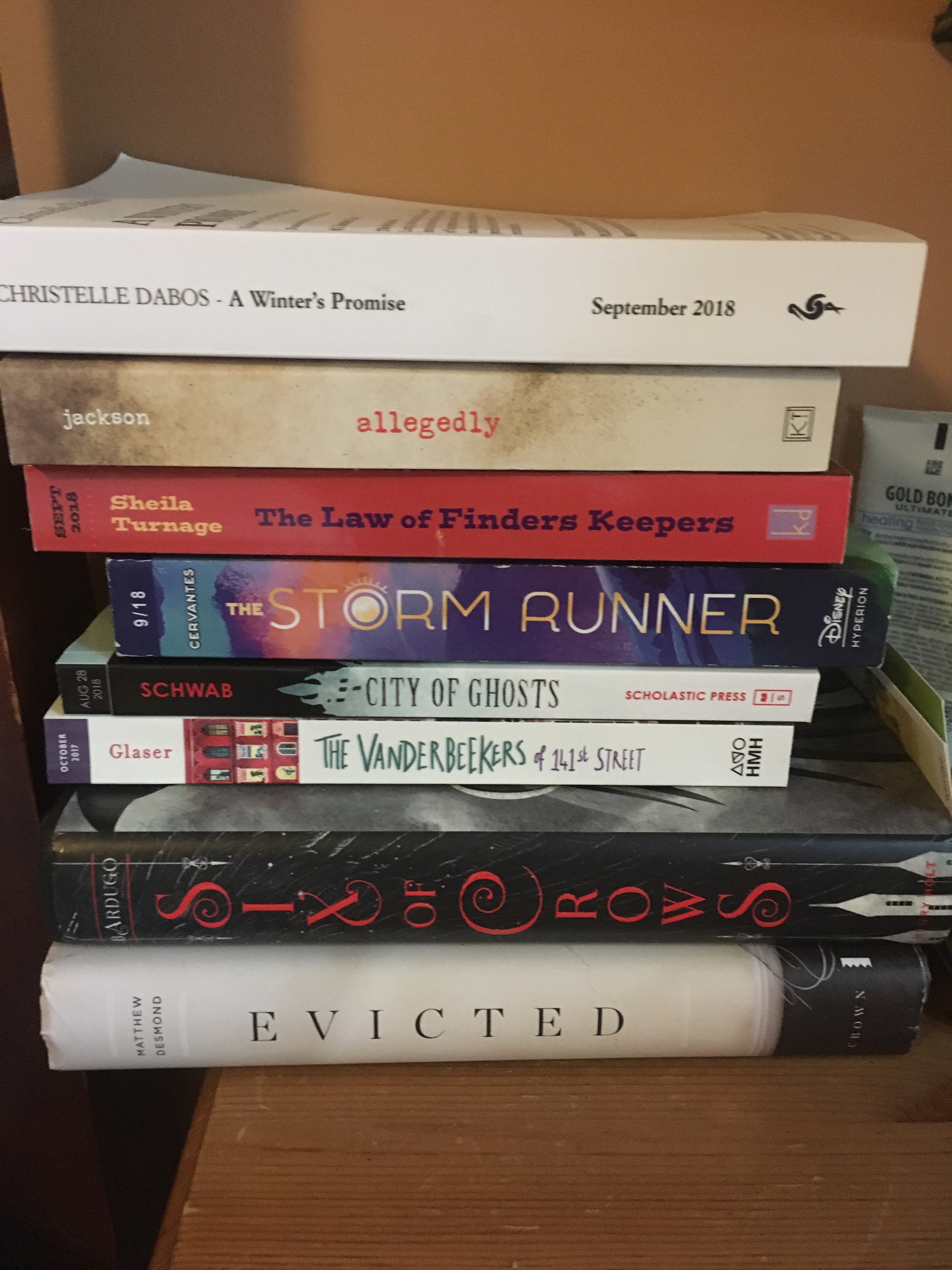
Class is over (yay!), so I get to read the books I want to (for now):

The first five are for my middle reader book club this summer, the rest are for fun.

The Secret of the Old Clock by Carolyn Keene
Encyclopedia Brown by Donald Sobol
The Westing Game by Ellen Raskin
The Great Shelby Holmes by Elizabeth Eulberg
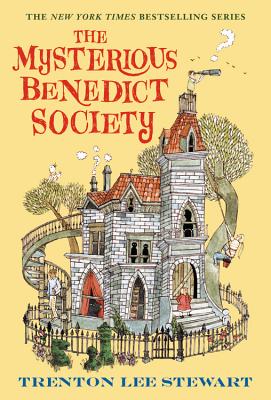
The Mysterious Benedict Society by Trenton Lee Stewart
The Way You Make Me Feel by Maureen Goo
The Bird and the Blade by Megan Bannen
March, Book 3 by John Lewis

What’s on your TBR pile that you are looking forward to?