Tess of the Road

by Rachel Hartman
First sentence: “When Tessie Dombegh was six and still irrepressible, she married her twin sister, Jeanne, in the courtyard of their childhood home.”
Support your local independent bookstore: buy it there.
Others in the series: Seraphina, Shadow Scale
Content: There are many allusions to sex (including rape). It’s in the Teen section (grades 9+) of the bookstore.

As a head’s up, while this one references Seraphina and Shadow Scale, it’s a completely separate story, and you can probably get away without reading them if you’re not interested. (I didn’t re-read them, and so really didn’t remember much, and still enjoyed Tess.)

Let me say this at the start: I love Hartman’s writing. It’s not elegant like Laini Taylor or Maggie Stiefvater, but Hartman knows how to tell a story in such a way that you lose yourself in it. Tess is a human girl — Seraphina’s half sister — who just wants to be intellectually challenged. But raised in a strict household (they’re paying for Seraphina’s “sin” of being a dragon), what’s expected of her is to marry well. But Tess messes that up when she gets pregnant (at age 14!) and has a baby. And now, when she’s 17, faced with the prospect of raising her twin sisters children or going to a convent she does the unthinkable: she disguises herself as a boy and takes to walking the road, ostensibly to help her quigutl (a sub-species of dragon) friend find the World Serpent.

This is such a remarkable book: a heartfelt and emotional tale as Tess’s story unfolds through a series of flashbacks, but also an adventurous one, as we experience Tess and Pathka’s adventures on the road. It’s a deeply feminist book as well, as Hartman explores the consequences of not teaching your kids sex ed or discouraging girls from getting an education, if they want. It’s all about expressing anger and compassion and helping others out along they way and redemption and forgiveness.

And it’s left open-ended, so we may (or may not) get to join Tess for more adventures.

It’s wonderful.
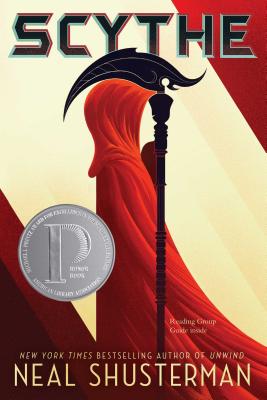
Scythe

by Neal Shusterman
First sentence: “We must, by law, keep a record fo the innocents we kill.”
Support your local independent bookstore: buy it there!
Content: There is, by the very nature of the book, violence. Some of it is graphic. There is also mild swearing. It’s in the YA section (grades 6-8) of the bookstore, but, like Hunger Games, I’d be wary about giving it to overly sensitive kids.

My co-workers have been on my case to read this since it first came out. A couple of them love it (and Shusterman), but I just didn’t have time. (Sometimes, when I need to sell a book at work, I rely on other people’s opinions rather than just reading it myself, since I won’t have time to read all the books. Unfortunately.) But then, it won a Cybils award, and was picked for my online book club (and then they picked it for one of my in-person book clubs), so I figured it was about time I read this.

And, oh wow, everyone was right. This is an excellent piece of speculative fiction.

The basic premise is this: in the future we will have figured out how to defeat disease and death, thereby becoming immortal (pretty much). However, the earth couldn’t handle the subsequent population growth, so a group of people — called scythes — were organized to deal with that. They have a set of commandments, are outside the general law, and basically get to decide when people should die. There are rules governing that, as well — they have quotas they have to meet and can’t go over, and they can’t do it with forethought or malice. The book follows two teenagers, Citra and Rowan, who were chosen as a scythe’s apprentices. As it follows them through the year of their apprenticeship, it’s fascinating reading about their scythe and his philosophies, and then the difference between scythe philosophies (including a radical one who was just horrid). There is a bit of a romance(ish), but that didn’t really go anywhere (thankfully). Mostly it’s about humanity and the meaning of immortality, and how one deals with the power over life and death. There is definitely much to think about and talk about in this book.

Legendary

by Stephanie Garber
First sentence: “While some rooms on the estate had monsters hiding beneath the beds, Tella swore her mother’s suite concealed enchantment.”
Support your local independent bookstore: buy it there!
Review copy provided by the publisher.
Others in the series: Caraval
Content: There’s some violence and intense moments. It will be in the Teen section (Grades 9+) of the bookstore.

Spoilers for the first one, obviously.

I had high hopes for this one, even though it’s been a long time since I’ve read Caraval and admittedly I don’t remember much. And while Legendary was good, I don’t know if it lived up to my high hopes.

It’s shortly after the Caraval that Scarlett won, and Legend has already set up another one. This one is  in the capital city, and it’s Tella’s turn to play. The prize? Legend’s name. The cost? Tella’s mother’s life. She’s made a bargain with a criminal: the location of her mother in exchange for Legend’s name. She has to win, but at what cost?

I did find this one engrossing; Graber has created a very unique world, full of magic and deception. But, maybe because it wasn’t new like it was in Caraval, I just wasn’t that thrilled by it. It could be that Tella’s journey wasn’t as interesting as Scarlett’s or that I just didn’t find the villain of the book that enticing, or even the final reveal all that shocking. I definitely found the ending unsatisfying. I probably just wanted… more.

It’s not that it’s a bad book; it’s not. And maybe if you read it right after Caraval, it would come off as better. Whatever the reason, I was a little disappointed.

Bob

by Wendy Mass and Rebecca Stead
First sentence: “I feel bad that I can’t remember anything about Gran Nicholas’s house.”
Support your local independent bookstore: buy it there!
Review copy provided by the publisher.
Content: It’s written perfectly for the younger age group. It is in the middle grade  section (grades 3-5) of the bookstore.

Livy hasn’t been to her grandmother’s house in Australia in five years, when she was five years old. She doesn’t remember much from the last time she was there: not the room or the toys or the landscape, and especially not the green creature in the closet. Bob (the green creature in the closet) remembers Livy though. She told him to stay put, which he did. For five years. In the closet. But now that Livy’s here, he’s sure she can help him find his way home again.

Bob (the book not the character) is a charming little story about friendship and growing up, but also home and family. And it’s a delightful twist on fairy tales. In Mass’ and Stead’s hands, it’s not saccharine, but simple and sweet and tender.  Livy was more complex than I expected, pulled between her childhood self and a desire to be “older” and the responsibility of being a big sister. And Bob was charming and delightfully innocent. I liked that the fairy tale had rules: even though they were never spelled out in the book, Mass and Stead were consistent with who could and could not see Bob. It was incredibly well done, and a delightful read. .


Audiobook: Children of Blood and Bone

by Tomi Adeyemi
Read by: Bahni Turpin
Support your local independent bookstore: buy it there!
Listen to it on Libro.fm
Content: There’s a lot of violence, some of it intense. It’s in the YA section (grades 6-8) of the bookstore.

Imagine a world in which magic existed, but the non-magic users (who happened to be in power) were afraid of what magic can do, so they (well, he: the king) did everything they could to stamp it out. They killed the magi — adults who were at full power — and suppressed the children of the magi. These children, Diviners, were never able to fully come into their power, they were discriminated against, and their families taxed beyond what they can afford.

This is the world that Zélie, a Diviner, was raised in. She remembered the raids, when her mother was taken and killed and her father (who is not a magi) beaten. She remembers the stories her mother told about magic and the gods, and has all but lost her faith that it can ever come back. That is, until she meets Amari, the daughter of the king that ordered the raids. Amari has stolen a magic scroll, an artifact that, in the right hands, can bring magic back. And she’s on the run. She teams up with Zélie and Zélie’s brother, Zane. And together they are determined to bring magic back.

Except it’s not as easy as that. Amari’s brother, the crown prince Inan, is on their tale, determined to stop them. And nothing — NOTHING — goes to plan.

It’s a huge book, but it’s a fast-paced one; Adeyemi definitely knows how to plot to keep a reader engaged and the pages turning. Or, in my case, a listener listening. It helps that my favorite narrator, Turpin, read this book, and as always, was fantastic at it. It’s such an excellent performance, one that immersed me into the world of Orïsha (and it helped with all the foreign names and places too!) and the story.

And what a story! There were moments that I was afraid Adeyemi would disappoint me (especially toward the end), but she pulled off a spectacular ending, and still left enough undone for a sequel (which I can’t wait for).

Remarkable. And definitely worth the hype.

Dreadful Young Ladies and Other Stories

by Kelly Barnhill
First sentence: “The day she buried her husband — a good man, by all accounts, though shy, not given to drink or foolishness; not one for speeding tickets or illegal parking or cheating on his taxes; not one for carousing at the county fair, or tomcatting with the other men from the glass factory; which is to say, he was utterly unkonwn in town: a cipher; a cold, blank space — Agnes Sorensen arrived at the front steps of Our lady of the Snows.”
Support your local independent bookstore: buy it there!
Review copy provided by the publisher.
Content: There are more mature themes and some swearing (though I’m not remembering any f-bombs). It’s in the Science Fiction/Fantasy section of the bookstore.

I have a tortured history with short stories. I want to like them, but I find them much like poetry: I don’t get them. They’re words, and often pretty words, but I just don’t… well… understand them. (Even Neil Gaiman’s stories, which I seem to have a bit more affinity for.) And this collection was more of the same: I liked the stories, but I need someone else to read them and then explain them to me. (Especially the title story. I know it’s a metaphor, and I’m sure I’ll smack my head when someone tells me what it’s a metaphor for, but right now, I’m a bit lost.)

Barnhill is a gorgeous crafter of sentences, and this is no exception. She has a beautiful way with words, and it does pull you into the story. I especially liked the final story, which is more of a novella (which could be why), because the world that Barnhill built — a comet flies by once every 25 years and endows pre-born children with magical powers which a minister then harnesses for his own means — was so fascinating, but also because the writing was just so beautiful.

And maybe, someday, I’ll figure out how to read short stories and actually understand.

The Wild Robot Escapes

by Peter Brown
First sentence: “Our story begins in a city, with buildings and streets and bridges and parks.”
Support your local independent bookstore: buy it there!
Review copy provided by the publisher.
Others in the series: The Wild Robot
Content: Same as the first one: short chapters, large print, illustrations. It’s in the middle grade (grades 3-5) section of the bookstore. This one, like the first, would also make a good read-aloud.

Spoilers for the first one, obviously.

When we left our fair robot Roz, she was being airlifted off her beloved island and transported back to the city. She was reprogrammed, and then sent out to be a farm robot, helping a family. Except, she wasn’t reprogrammed enough: she remembered her life on the island and her son, Brightbill, and while she wasn’t entirely unhappy at the farm — cows are good conversationalists and Roz had a lot to do — she missed her, well, home. So, she sets out to escape, which leads her on a whole adventure trying to get back to her island.

It’s much of the same as the first book here: intrusive narrator (but again, not so much that it was bothersome) and Roz is a very sweet character to root for. I liked her adventure this time, and the different things she saw and how her story spread out and paved the way for her to get back. The ending was sweet and satisfying at the same time, which was nice.

It really is a delightful story.

Audiobook: Granted

by John David Anderson
Read by Cassandra Morris
Support your local independent bookstore: buy it there!
Listen at Libro.fm
Content: I listened to it (it makes a great read aloud), but I’m guessing that it’s formatted pretty well for the younger readers. There are short chapters, a lot of action, and any big words are explained really well. It’s in the middle grade (grades 3-5) section of the bookstore.

Opheila Delphinium Fidgits is one of the few fairies in the Haven who has been tasked with the most special of jobs: that of being a Granter. Wishes from humans come in all the time, but the great tree only allows for a few to be granted, and Ophelia is one of those who gets to go out and make the wish come true. Except that she hasn’t… yet. Then her day comes and she sets out to fulfill what should be a routine wish: find the coin, grant the girl a bicycle. Except everything (and I mean EVERYTHING) goes wrong. And what happens changes, well, everything.

I loved listening to this one, though it took a bit to get into it. That’s partially the story’s fault: Anderson is very thorough in his world-building, and felt a need to take us all through the Haven and Ophelia’s world before sending her out into ours. But once she got into our world, the story picked up. The best character, though, was Sam the Dog. Probably mostly because of the way the narrator voiced him, but also because… well, who doesn’t love a wonderful, sweet, loveable, sometimes stupid dog character?

It really was a charming book, and a unique look at the fairy world. Quite good.


Gregor the Overlander

by Suzanne Collins
First sentence: “Gregor had pressed his forehead against the screen for so long, he could feel a pattern of tiny checks above his eyebrows.”
Support your local independent bookstore: buy it there!
Content: There are a couple of battles and some tense moments. It is in the middle grade (grades 3-5) section of the bookstore.

First a story: M read this when she was about 10 or 11 years old, and told me that it was SO good and that I needed to read it. I balked: Gregor goes underground and goes on a quest with talking cockroaches?! Ew. (I loathe cockroaches. Ugh.) She finally, after years of bugging me, gave up and moved on. However, when I saw it on the list for the science fiction/fantasy module in my children’s lit class, I remembered M’s urging and I picked it up (finally!).

And you know what? She was right. (Not the first time.) The basic premise is that Gregor, whose father has been missing for 2 years, falls into the Underland, a world where there are some humans who live in an uneasy peace with giant spiders, cockroaches, and bats, and whose mortal enemies are the giant rats. (And yes, all the animals talk.) Once there, Gregor finds out that he may be/is the Warrior who would fulfill the prophecy, perhaps bringing peace between the humans and the rats. And, oh by the way, the rats have his dad, so maybe they can rescue him, too.

Yeah, it sounds trite: there are talking animals and a prophecy (they’re all the rage!) but Collins is quite masterful in telling a story. She keeps the action moving, she makes us care about Gregor and all the other Underlanders and she even gives us a nice twist at the end that careful readers will see coming (I didn’t guess, but I wasn’t surprised). And she included Gregor’s 2-year-old sister, Boots, who is literally the best character ever. She’s funny and charming, and provides a humanity to the other characters that otherwise wouldn’t be there.

Oh, and this is a bit of a spoiler: I cried when one of the cockroaches died.

It’s just that good.

Aru Shah and the End of time

by Roshani Chokshi
First sentence: “The problem with growing up around highly dangerous things is that after a while you just get used to them.”
Support your local independent bookstore: buy it there!
Release date: March 27, 2018
Review copy provided by the publisher.
Content: There are some complex names, a little violence, and hints of crushes, but I’d give it to anyone reading the Percy Jackson series. It will be in the Middle Grade (grades 3-5) section of the bookstore.

When we saw Rick Riordan, and he was talking about his imprint, Rick Riordan Presents, one of my husband’s concerns is that the writers of these books on this imprint will just basically be telling Percy Jackson stories, superimposed on people of color and their mythologies.

And, after finishing Aru Shah and the End of Time — with its Hindu mythology — I can say that’s partly true. Aru Shah felt like a Percy Jackson book: a girl finds out she’s the daughter of a god (in this case, Indra, the god of Thunder), goes on a quest with a new-found friend and a sidekick to save the world (from the demon The Sleeper, which has awoken) , in a book full of humor, pop culture references, and non-stop action. So, yeah, in a sense that’s true. But Aru Shah is also wholly its own thing. Aru is more conflicted than Percy ever was: she, inadvertently sets off the crisis she has to save the world from, which fills her, not unexpectedly, with guilt. And while the quest part feels the same, there are notable differences: primarily being the mythology; there are a ton of stories in Hindu lore, and while I’m not familiar with all of them, I do know some, and I liked the spin that Chokshi put on them. I liked that Aru and her friend Mini’s relationship was complicated: they were reincarnated souls of former brothers, which makes them sisters, though they have different god fathers and different families in the human world. It gave a deeper, richer layer to their relationship, which I really enjoyed. Everyone in the book seemed more complex and mulit-faceted than I was expecting, which was nice.

In short, while this does feel familiar, and will to anyone who has read the Percy Jackson books, Choski has also put her stamp on the stories, which is a refreshing, welcome thing.