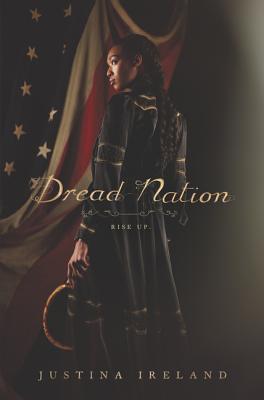
Dread Nation

by Justina Ireland
First sentence: ” The day I came squealing and squalling into the world was the first time someone tried to kill me.”
Support your local independent bookstore: buy it there!
Content: There’s a lot of violence and some swearing and some references to the sex trade. It’s in the Teen section (grades 9+) but I think it’d be good for a younger reader, if they were interested. 

It’s the 1880s, and America is still trying to overcome the zombie — they call them shamblers — infestation that began during the Civil War. Sure, the war kind of petered out, but the south is pretty much wiped out, given over to shamblers. And the east coast is partially fortified, but mostly because the government ships blacks and native peoples into schools where they get training to be, well, shambler killers. 

Our main character is Jane McKeene, a half-black girl from a plantation in Kentucky, who has attended Miss Preston’s School of Combat in Baltimore. She’s set to graduate and become an Attendant, protecting some rich white woman, when she discovers the seedy underbelly of the city. Which puts her into some definite hot water. And lands her in the West, where there are no rules. Especially for someone like her. 

I loved this one. Seriously. It’s a lot of fun, first of all (and I don’t really read zombie books), and I really liked the alternative history that Ireland created. It felt like it could have been a real history, just with zombies. But, I also really liked that it wasn’t all fluff and nonsense, that there were some real issues of racism and sexism and even zealotry in there. Things that would make for a good book discussion. 

And while there will most likely be a sequel, the story did come to a satisfactory conclusion. Which is always nice. 

A really really good book. 

Evicted

evictedby Matthew Desmond
First sentence: “Jori and his cousin were cutting up, tossing snowballs at passing cars.”
Support your local independent bookstore: buy it there!
Content: It’s a work of non-fiction and Desmond doesn’t hold any punches. There is talk of drug use, swearing, and some violence. It’s in the Sociology section of the bookstore.

I’ve been meaning to read this one since it came out a few years ago, but let other things get in the way until we picked it for my in-person book group. And, just like I thought, I found it to be difficult to read and yet incredibly important at the same time.

Desmond, a professor of Social Science, moved to Milwaukee, Wisconsin for a year to study the effects of poverty in the inner city, particularly through the process of evictions. And what he found is sobering. He goes into a lot of detail, following both black and white renters as well as landlords over the course of the year (though I think it may be longer), but it boils down to two things: capitalism isn’t good for everyone, and it’s important to have a stable home in order to succeed in life. The first one is this: there are lot of people getting rich off the backs of poor people. Not just the landlords, who buy the property for practically nothing and then raise the rent so it’s almost more than the renters can pay. There’s also the “business” of evictions: moving companies, storage places, and so on. Not to mention the city process: there is a whole court system to deal with this (I didn’t know that). It’s insane, and a product of our ethos here in America that believes if you can’t make it on your own, then it’s your own fault.

The second part may be obvious: constant moving is hard on children and adults. It’s hard to start over when you have to move once a year (as we did when my oldest was young), but moving two, three, four times in a school year makes it impossible for kids to keep up. And it goes for adults too. Many of the people Desmond was writing about were drug addicts (their own choice, sure), but he followed a couple of them as they tried to get out, and once they had a stable home, a secure environment, in a neighborhood that supported them, they were able to turn their lives around. I found that interesting that a home — someplace a person could come to that was secure and not falling apart, where there was heat and electricity — could mean that much. I guess, since it’s always something I’ve had, I took it for granted.

Perhaps the most interesting part of the book was the author’s note, where he talked about his methodology. He doesn’t have many answers, except that poor people are paying too much of their income in rent (more than 2/3 of their income! Which is why they get behind!) and that we (the government? non-profits? private corporations?) should invest in some stable housing for poor people. In our book group discussion, we talked about how Utah has dealt with the problem of homlessness. Maybe more cities/states can take note and move in that direction. Because, honestly, more good, stable housing for our poorest people is good for everyone.

Dear Martin

dearmartin.jpgby Nic Stone
First sentence: “From where he’s standing across the street, Justyce can see her: Melo Taylor, ex-girlfriend, slumped over beside her Benz on the damp concrete of the FarmFresh parking lot.”
Support your local independent bookstore: buy it there!
Content: There is some teenage drinking, talk of sex, swearing, and violence. It’s in the Teen section (grades 9+) of the bookstore.

Justytce is a scholarship student at one of the most prestigious prep schools in Atlanta. He’s smart, he’s observant, he definitely deserves to be there.

Except. He’s one of only three black students in the school. And when he was arrested for trying to help his drunk ex-girlfriend (so she wouldn’t drive drunk!) right before his senior year, he starts to notice things he’s let slide before. Like how his best friend’s (who’s also black) friends are, well, racist. Like how cops seem to get a pass when dealing with black people (especially men). And he tries, through writing letters to Martin Luther King, Jr, to understand they way black people are treated, and tries to understand how to do the, well, “right” thing.

It’s not easy. Justyce says at one point in the book that it’s tough being in his position: he’s got white people at his school questioning whether he deserves to be there (or to get into Yale) and then black people in his mother’s neighborhood trying to pull him back and making fun of him and his aspirations. It’s unfair, to say the least.

And then, in one fateful afternoon, his whole life changes: his best friend is shot and killed in a traffic altercation with an off-duty cop. And Justyce — who was also in the car – – is caught in the cross hairs, and blamed for everything.

It’s a short novel — just over 200 pages — but it packs a punch. The takeaway? White people are awful. We have to work really hard at not being awful, because we take so much for granted. It was definitely eye-opening.

Pair it with The Hate U Give and Ghost Boys, and if you’re white, remind yourself of the privilege you have every day of your life.

Allegedly

by Tiffany D. Jackson
First sentence: “Some children are just born bad, plain and simple.”
Support your local independent bookstore: buy it there!
Content: There’s a lot going on here: drug use, (tasteful) sex, lots and lots of swearing, not to mention more mature themes. It’s in the teen section (grades 9+) of the bookstore.

Mary Beth Addison was convicted at 9 years old for the murder of a baby, Alyssa. She never said a word in her interviews with detectives, and was convicted in the court of public opinion: some children, Mary being one of them, was just Bad. It didn’t help that the baby was white, and Mary is black.

Six years later, she’s out from “baby jail” (her words) on good behavior, and in a group house with five other teenage girls, convicted of crimes, some more major than others. She was just trying to survive until she met Ted and got pregnant. When she realizes that the state could take her baby away from her, she decides to take action: she wants to go to college, so she attempts to take the SATs. But, mostly, she finds her voice and decides to tell people what really happened the night Alyssa died.

This books was… a lot. Seriously. A LOT. So much to take in: a critique on parenting and poverty and the justice system and white privilege and teenage pregnancy and and and… It’s SO well written and so compelling, that even in its worst moments, when I, as a white woman, had to look at it and realize just how far from my lived experience this book was, and realize that there are people — KIDS — out there LIVING this experience, I could NOT put it down. It has a good mystery element to it as well — what really happened the night Alyssa was killed, and how can we really believe anyone’s testimony — but, as social critique, it’s superb. And it’s a great story as well. Jackson had me totally won over to Mary’s side, and yet left questions and doubts and open ends all the way to the very end.

Incredible.

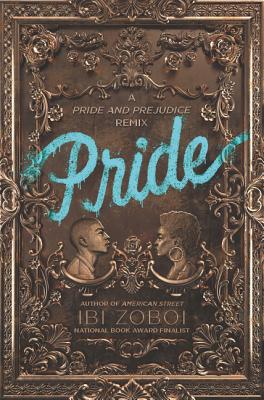
Pride

by Ibi Zoboi
First sentence: “It’s a truth universally acknowledged that when rich people move into the hood, where it’s a little bit broken and a little bit forgotten, the first thing they want to do is clean it up.”
Support your local independent bookstore: buy it there!
Review copy provided by the publisher.
Release date: September 18, 2018
Content: There is swearing, including a few f-bombs. It will be in the Teen section (grades 9+) of the bookstore, but I think a 7th/8th grader who was interested would like it, as well.

I’ll admit this up front: I’m a sucker for Jane Austen retelings. I adore them, especially when they’re well-done. And this one, set in Brooklyn with class tensions (but not race) and feisty girls who speak their mind, this one is extremely well done.

The fun thing about this is that if you know Pride and Prejudice, you smile as Zoboi hits all the notes of the original. A rich family moves into the neighborhood where the Benitez family — of Dominican/Hatian blend — live. The family — the Darcys — are well-off African Americans, and they completely re-do the house all fancy. Because they can. And yeah, they look down their noses at the Benitezes, with their loud, immigrant ways and their spicy immigrant food, and well… everything. Zuri is the second daughter of this crazy family, and is about to start her senior year in high school. She is fiercely proud of her neighborhood and her family, and she doesn’t want a snotty rich brat, no matter how fine he is, stomping on her turf.

And, if you know the original, you know how it turns out. What I loved was that Zoboi paid homage to Austen while making the story thoroughly her own, and thoroughly modern. While I could sense the Austen book in the background, the everything felt organic and natural, and the characters more than just caricatures. Even if you don’t know the original, the plot made sense on its own, and I loved that Zoboi was able to do that. And I thought it was interesting for her to highlight the class differences within the African American community; it gave the book a depth it wouldn’t have if she had gone with a rich white/poor black narrative. And I appreciated that.

It was a delightful dip into a story I love but looking at it in a whole new light.

145th Street

by Walter Dean Myers
First sentence: “The way I see it, things happen on 145th Street that don’t happen anywhere else in the world.”
Support your local independent bookstore: buy it there!
Content: There’s violence but the stories are short and to the point. It’s in the YA section (grades 6-8) of the bookstore.

I’ll be honest here. I’m not a fan of short stories, and I had to read one for class, and I’ve never read Walter Dean Myers, so I picked this one. All the stories surround people on this street in New York (in Harlem?), their lives and experiences. But, as I sit back and think about this, what comes to mind are the stories in Bronx Masquerade. Which means this one just kind of went in but slid right out. I’m pretty sure I looked at the words and turned the pages, but I can’t, for the life of me, remember what I read.

I’m sure that’s not because Myers isn’t a good writer. It’s more I’m not a great reader of short stories.

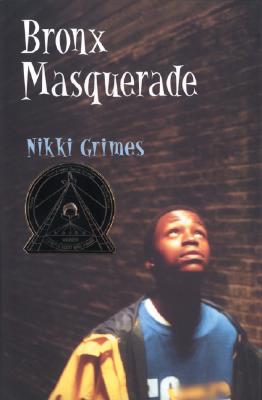
Bronx Masquerade

by Nikki Grimes
First sentence: “I ain’t particular about doing homework, you understand.”
Support your local independent bookstore: buy it there!
Content: There’s some tough situations, but nothing “objectionable”. The format — short stories with poetry — is great for reluctant readers, as well. It would be in the young adult (grades 6-8) section of the bookstore.

I read this back during my poetry section of class and was expecting a novel in verse. While I don’t think it’s that, it is a fascinating look into the power of poetry. Set in the Bronx (obviously), the book follows a group of students in an English class as they study the Harlem Renaissance, and then decide they want to try writing poetry themselves. That turns into an Open Mike Friday once a month, which morphs into once a week, as the various students — black, Latnix, and white — learn to express themselves and understand other people throughout the year. Interspersed with commentary from our “narrator” Tyrone, it’s a good look at how poetry not only can help people express ideas and feelings they couldn’t otherwise, it also is a way to understand other people.

I liked how we got a peek into a bunch of different lives, even if that meant we didn’t get to delve deeply into one person. I think the purpose of the novel was to explore connections that poetry makes, not so much to explore one person, and once I realized that, I was able to enjoy the book more. I’ve never read anything by Nikki Grimes before, though I’ve heard a lot about her, and this made me curious. I’ll definitely have to check more of it out.

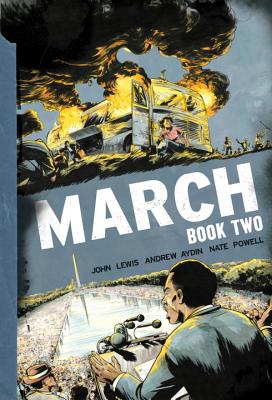
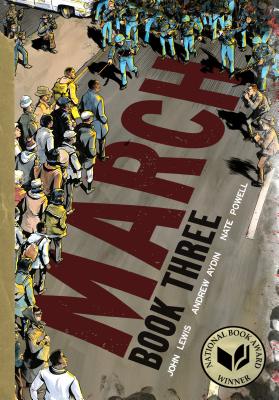
March (Book Two and Three)

by John Lewis, Andrew Aydin, and Nate Powell
First sentence: “Brother John — Good to see you.”
Support your local independent bookstore: buy it there (book 2, book 3).
Others in the series: March (Book One)
Content: There is a lot of violence, and use of the n-word. It’s in the non-fiction area of the graphic novel section of the bookstore.

This picks up where March (Book One) leaves off. Lewis is part of student non-violent protests in Nashville in the early 1960s, but soon leaves that to join the Freedom Riders: a group of African Americans who, in 1961-1962, put supposed desegregation to the test. They rode Greyhound buses though the south, stopping at cities in Virginia, Georgia, Alabama, and Mississippi, with — as you would guess — pretty disastrous results. They were yelled at, beaten, arrested, thrown in jail, loaded up in cars and left in Klan territory, and the buses were blown up… let’s just say that, in short, white people in the south were TERRIBLE people.

All through this, Lewis (and others) preached the gospel of non-violence (which just makes white people look like terrorists. Really.): they didn’t fight back, they didn’t talk back, they just exercised their right (!) to do what they feel they had a right to do.

The book also follows Lewis through the March on Washington in 1963. (I didn’t know he was there, or even that he spoke! In fact, there’s a side note by him that out of everyone who spoke, he was the only one still living.) It was fascinating, learning about the politics behind that march, and about Robert Kennedy’s change of heart as well.

It’s a well-done graphic novel, one that is still very timely to read. As a white person, it definitely made me more aware of what people went through in the 1960s to get just basic rights, and I’m more aware now of how those rights aren’t still completely equal

March (Book Three) picks up after the church bombing the beginning of 1964 and goes through the march from Selma to Birmingham. My thoughts are pretty much the same as after reading book two: white people are so entrenched in their “way of life” that they can’t abide by change at all. And the thing I kept coming back to was that, in the intervening 54 years, that white people are still entrenched in their “way of life”, we just call it by different things now. It’s still racism. And it still is wrong. This one was difficult to read, and made me think, over and over, that an eye for an eye just makes everyone blind. I hope I’d have the courage to stand up to those who use their power to make others “less than”, those who call others “animals” or “dirty” or “from s-hole countries”, those who want to abuse their power to keep themselves in power… even if it means sacrificing my life. John Lewis and all those who stood by him are true heroes, and I wish there were more people like them now.

Excellent.

The Astonishing Life of Octavian Nothing, Traitor to the Nation: Volume 1

by M. T. Anderson
First sentence: “I was raised in a gaunt houses with a garden; my earliest recollections are of floating lights in the apple-trees.”
Support your local independent bookstore: buy it there!
Content: There’s violence and talk of human bodily functions. It would be in the YA section (grades 6-8) of the bookstore if we had it.

Octavian had an idyllic childhood, growing up in the house with a bunch of rational philosophers (in the Novanglina College of Lucidity) where his every move was studied and cataloged. He was dressed in the finest silks, taught to play the violin and speak Greek and Latin and French. And he had no idea he was black and a slave. That is, until the sponsorship for the society lapsed and they found a new person to sponsor them, someone who felt that Africans were truly less than people. From there, Octavian’s life changes, and not for the better. He escapes, and gets involved in the Revolutionary War.

I heard lots of good things about this one when it first came out, and it won the National Book Award and a Printz honor. I wanted to like it, to understand what all the excitement was about it. But. Times have changed in the past 12 years, and I’ve changed a bit with them, and the one thing I couldn’t get past was that this felt like appropriation. I like Anderson as a writer (for the most part), but to write a slave story just felt… wrong. Yeah, he made some of the white people sufficiently awful (well, one of them anyway), but he also has a literal white savior narrative at the end of the book which really sat poorly with me. And to be honest, I lost interest. I kind of skimmed through the last third of the book, just to see what happened, but I wasn’t engaged.

And I have no interest in reading the second part. I wish I had liked this better.

Long Way Down

by Jason Reynolds
First sentence: “Don’t nobody believe nothing these days which is why I haven’t told nobody the story I’m about to tell you.”
Support your local independent bookstore: buy it there!
Content: While there isn’t any swearing or on-screen violence, the themes are quite intense. I go back and forth as to where this should go. One of my co-workers insists that 10-year-old kids shouldn’t be reading it, so doesn’t like it when I stick it with the Newbery Books (even though it got an honor). I’m not sure it needs to be in the Teen (grades 9+) section, though, so I may compromise by putting it in the YA (grades 6-8).

Will’s older brother, Shawn, has been shot dead. And so, Will believes, it’s his duty to hunt down the person who shot Shawn (and he’s sure he knows who it is) and kill them. After all, that’s part of the rules: Don’t cry, don’t snitch, and always get revenge. But, on the elevator with a gun tucked in his pants, Will encounters ghosts of his past, every single one of whom has been killed by gunshot.

The ending is left open: will Will follow through, or won’t he? But, it’s these conversations with the ghosts — all told in verse — that left me shook. The toxic masculinity is rampant and obvious (at least to me, an outsider): if someone shoots someone who then shoots someone, then (of course) someone else will have to shoot that someone. It’s a vicious cycle that just leaves everyone dead. (What is that adage? An eye for an eye just leaves everyone blind?) It’s awful. And culture, tradition, racism, oppression, expectations… they don’t let these boys grieve the way they need to grieve. (And don’t get me started on gun culture.) I’m not entirely sure that’s what Reynolds was trying to get across, but that’s what I (again, as an outsider) got out of it.

Hopefully, books like these will help bring awareness to this. And maybe we can all stop killing each other just because of the color of our skin.