Love & Luck

by Jenna Evans Welch
First sentence: “Dear Heartbroken, What do you picture when you imagine traveling through Ireland?”
Support your local independent bookstore: buy it there!
Review copy provided by the publisher.
Content: There is some sexual harassment and mild swearing. It is in the YA section (grades 6-8) of the bookstore.

Addie has been looking forward to the end-of-summer trip to her aunt’s wedding in Ireland. Mostly because she’s going to pop over to Italy afterward (to see Lina from Love & Gelato) but also because it will get her away from the boy who dumped her after their secret summer relationship. She is planning on sitting in the sun and eating gelato and forgetting.

Except, her other brother, Ian (who was supposed to go with Addie to Italy) has other plans: he’s hooked up with an internet friend, Rowan, and they’re going to go on a band-themed road trip in Ireland ending up at the last concert of their favorite band. Addie’s WAY against this (since their parents don’t know), but is convinced to let them drop her off at the airport. But… the car breaks down, the traffic is bad, and she misses her flight. And suddenly, she’s on a road trip with a boy she barely knows and a brother she’s barely speaking to.

I expected this to be a light, fluffy romance, but Welch delivered something… different. Sure there was a small bit of romance, but mostly the book was about bad decisions and healing and forgiveness. It’s a bit much to go into here, but I liked Welch’s descriptions of the sibling relationships, and how hard it is to find out who you are in the middle of a big, boisterous (and loving) family. (It was nice that the parents were actually good parents, too!) I liked the cheesy “travel guide” that is quoted throughout the book, as well; even though it was often corny, there were some good thoughts in it, and yes, it did make me want to go see Ireland.

It wasn’t what I was expecting, but I really liked it.

The Astonishing Life of Octavian Nothing, Traitor to the Nation: Volume 1

by M. T. Anderson
First sentence: “I was raised in a gaunt houses with a garden; my earliest recollections are of floating lights in the apple-trees.”
Support your local independent bookstore: buy it there!
Content: There’s violence and talk of human bodily functions. It would be in the YA section (grades 6-8) of the bookstore if we had it.

Octavian had an idyllic childhood, growing up in the house with a bunch of rational philosophers (in the Novanglina College of Lucidity) where his every move was studied and cataloged. He was dressed in the finest silks, taught to play the violin and speak Greek and Latin and French. And he had no idea he was black and a slave. That is, until the sponsorship for the society lapsed and they found a new person to sponsor them, someone who felt that Africans were truly less than people. From there, Octavian’s life changes, and not for the better. He escapes, and gets involved in the Revolutionary War.

I heard lots of good things about this one when it first came out, and it won the National Book Award and a Printz honor. I wanted to like it, to understand what all the excitement was about it. But. Times have changed in the past 12 years, and I’ve changed a bit with them, and the one thing I couldn’t get past was that this felt like appropriation. I like Anderson as a writer (for the most part), but to write a slave story just felt… wrong. Yeah, he made some of the white people sufficiently awful (well, one of them anyway), but he also has a literal white savior narrative at the end of the book which really sat poorly with me. And to be honest, I lost interest. I kind of skimmed through the last third of the book, just to see what happened, but I wasn’t engaged.

And I have no interest in reading the second part. I wish I had liked this better.

Long Way Down

by Jason Reynolds
First sentence: “Don’t nobody believe nothing these days which is why I haven’t told nobody the story I’m about to tell you.”
Support your local independent bookstore: buy it there!
Content: While there isn’t any swearing or on-screen violence, the themes are quite intense. I go back and forth as to where this should go. One of my co-workers insists that 10-year-old kids shouldn’t be reading it, so doesn’t like it when I stick it with the Newbery Books (even though it got an honor). I’m not sure it needs to be in the Teen (grades 9+) section, though, so I may compromise by putting it in the YA (grades 6-8).

Will’s older brother, Shawn, has been shot dead. And so, Will believes, it’s his duty to hunt down the person who shot Shawn (and he’s sure he knows who it is) and kill them. After all, that’s part of the rules: Don’t cry, don’t snitch, and always get revenge. But, on the elevator with a gun tucked in his pants, Will encounters ghosts of his past, every single one of whom has been killed by gunshot.

The ending is left open: will Will follow through, or won’t he? But, it’s these conversations with the ghosts — all told in verse — that left me shook. The toxic masculinity is rampant and obvious (at least to me, an outsider): if someone shoots someone who then shoots someone, then (of course) someone else will have to shoot that someone. It’s a vicious cycle that just leaves everyone dead. (What is that adage? An eye for an eye just leaves everyone blind?) It’s awful. And culture, tradition, racism, oppression, expectations… they don’t let these boys grieve the way they need to grieve. (And don’t get me started on gun culture.) I’m not entirely sure that’s what Reynolds was trying to get across, but that’s what I (again, as an outsider) got out of it.

Hopefully, books like these will help bring awareness to this. And maybe we can all stop killing each other just because of the color of our skin.

Audiobook: Children of Blood and Bone

by Tomi Adeyemi
Read by: Bahni Turpin
Support your local independent bookstore: buy it there!
Listen to it on Libro.fm
Content: There’s a lot of violence, some of it intense. It’s in the YA section (grades 6-8) of the bookstore.

Imagine a world in which magic existed, but the non-magic users (who happened to be in power) were afraid of what magic can do, so they (well, he: the king) did everything they could to stamp it out. They killed the magi — adults who were at full power — and suppressed the children of the magi. These children, Diviners, were never able to fully come into their power, they were discriminated against, and their families taxed beyond what they can afford.

This is the world that Zélie, a Diviner, was raised in. She remembered the raids, when her mother was taken and killed and her father (who is not a magi) beaten. She remembers the stories her mother told about magic and the gods, and has all but lost her faith that it can ever come back. That is, until she meets Amari, the daughter of the king that ordered the raids. Amari has stolen a magic scroll, an artifact that, in the right hands, can bring magic back. And she’s on the run. She teams up with Zélie and Zélie’s brother, Zane. And together they are determined to bring magic back.

Except it’s not as easy as that. Amari’s brother, the crown prince Inan, is on their tale, determined to stop them. And nothing — NOTHING — goes to plan.

It’s a huge book, but it’s a fast-paced one; Adeyemi definitely knows how to plot to keep a reader engaged and the pages turning. Or, in my case, a listener listening. It helps that my favorite narrator, Turpin, read this book, and as always, was fantastic at it. It’s such an excellent performance, one that immersed me into the world of Orïsha (and it helped with all the foreign names and places too!) and the story.

And what a story! There were moments that I was afraid Adeyemi would disappoint me (especially toward the end), but she pulled off a spectacular ending, and still left enough undone for a sequel (which I can’t wait for).

Remarkable. And definitely worth the hype.

Rebound

by Kwame Alexander
First sentence: “It was the summer when Now and Laters cost a nickel and The Fantastic Four, a buck.
Support your local independent bookstore: buy it there!”
Others in the series: Crossover
Review copy provided by the publisher.
Content: There’s some drug dealing and stealing, but it’s all incidental to the plot. There’s a wee bit of romance. Crossover is in the Newbery section, and so I might put this one next to Booked in the Middle grade (grades 3-5 section) or I might move it to the YA section (grades 6-8) where it feels like it should go.

Even though this one is a pre-quel to Crossover, you really should read that one first.

It’s 1988 and Charlie Bell, the father of the characters in the Crossover, has just lost his father to a major heart attack. It’s the end of his 7th grade year and the loss — and the subsequent grief of both him and his mother — has put Charlie at odds with the world. He doesn’t want to deal with school or friends or his mother, even though he tries to put his father’s death out of his head; all he wants to do is sit and read his comic books. But then, he gets mixed up a bit with his friends older brother, and gets caught stealing (nothing major though), so his mom ships him off to DC to his grandparents (his father’s parents) for the summer.

It’s there that he learns how to deal with his dad’s death, and finds a passion for basketball that stays with him the rest of his life.

I’ve become a fan of Alexander’s in the years since his Newbery win, and this is no exception. It’s a lot geekier than his other books — there are comic poems, to reflect Charlie’s love of the comic book, and he’s not a suave as his kids turn out to be. But, it still has Alexander’s signature poetic style, and it tells the story of a kid coming to terms with his grief extremely well. I loved the 1980s references (throwback to high school!) and I thought Alexander handled the girl characters much better in this one (in fact, Charlie’s cousin, Roxie, is pretty amazing!).

An excellent read.

Shine

by Lauren Myracle
First sentence: “Patrick’s house was a ghost.”
Support your local independent bookstore: buy it there!
Content: This one has drug use and drinking by teenagers and a pretty graphic rape scene. It would be in the Teen (grades 9+) section of the bookstore if we had it.

Cat’s former best friend, Patrick, has been found at the local convenience mart beaten and tied up to a gas pump, left for dead. The local sheriff is calling it a hate crime, since Patrick is gay, and that it was probably some out of towners who did it. He was right about the hate crime part, but Cat’s convinced it’s someone in the small, southern town of Black Creek, North Carolina. So, she sets out to find out who, which means facing her brother’s friends and her past.

Oh, this was a hard book. It’s a mystery — sort of — but more, it’s a portrayal of what poverty and toxic masculinity can do to people. It turns them to meth, makes them suspicious of each other, makes them feel like they can just take things without any sort of consequences. There’s rape in this — and that was SUCH a difficult scene to get through — and just plain hopelessness. I think Myracle gave it a happy-ish ending in order to alleviate a lot of the general bleak feel of the novel (I certainly was expecting a different ending). I did figure out who committed the crime a little more than halfway through, and I even figured out why, but I kept reading because I wanted to see how it all would play out. Myracle did an excellent job with Cat’s character development — she went from a hurt, scared girl into a more confident one, facing down the boy who raped her and her brother’s friends for their various “boys will be boys” infractions.

It’s just a very hard read, emotionally.

A Wizard of Earthsea

by Urusla K. LeGuin
First sentence: “The island of Gont, a single mountain that lifts its peak a mile above the storm-racked Northeast Sea, is a land famous for wizards.”
Support your local independent bookstore: buy it there!
Content: There’s nothing objectionable, but it has an “older” feel to it. It’s in the YA sections (grades 6-8) of the bookstore. (I think. It might be in the Science Fiction/Fantasy section…)

I read this a long time ago — not as a kid, but before I started keeping a blog — and was underwhelmed. Since LeGuin recently passed away, I thought I’d give it another try.

And… I was still underwhelmed. The basic plot is the journey of a boy, Ged, becoming a wizard. He goes to school, unleashes a demon, fights a dragon, runs from said unleashed demon for years, until he finally faces his inner darkness and becomes a powerful wizard. Voila!

And that’s the problem with this book. Maybe it was the style of fantasy writing in the 1960s, but now? It just feels all surface and no depth. This happens and then that happens and we never really get to know Ged. We just follow him on his adventures. So when there’s this huge climax at the end where Ged fights the demon and names him and it’s all supposed to be so powerful, it’s just… not. I can see the influence she had on other writers: definitely Gaiman and it felt a little like Dianna Wynne Jones as well.

But, the afterword? The afterword that was written in 2012 was fantastic. LeGuin’s personal voice is smart and sassy and gave insights that I know I missed when I was reading it. So, maybe what I need to do is pick up some of LeGuin’s essays.

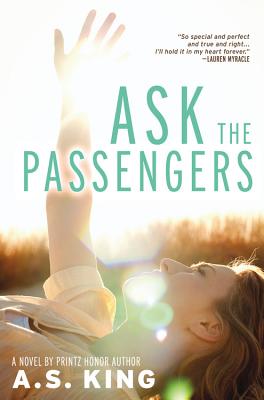
Ask the Passengers

by A. S. King
First sentence: “Every airplane, no matter how far it is up there, I send love to it.”
Support your local independent bookstore: buy it there!
Content: There’s almost sex, references to pot smoking (by an adult), and a number of f-bombs. It’s in the Teen section (grades 9+) at the bookstore.

Astrid Jones’ parents moved her from New York City to Union Valley, a wealthy small town somewhere in Pennsylvania (or Ohio; I never quite figured it out) when she was 10. In the seven years since, Astrid has felt like an outsider, and so, as her family slowly dissolves — her father off smoking his pot, her mother to her job, her sister to being popular — Astrid spends her time surviving, trying to figure out if she’s gay, and sending her love to the airplanes that fly above.

Of course there’s more to the story than that: Astrid has a girlfriend she’s keeping secret from everyone, she and her friends get busted for being underage at a gay bar, she explores the philosophy of Socrates, and she and her family try to (maybe) figure out how to be a family.

The thing that struck me most — and this is just because of who I am and my personal experiences — is that King nailed the feeling of being on the outside. Especially when you’re on the outside in a small, conservative, wealthy town. Where everyone knew each other from the time they were little and then you move in and they never really — even if you do have a couple of friends — accept you for who you are because you don’t fit their idea of “acceptable”. There was  LOT in here about appearances and labels and fitting in and caring what other people think of you, and that’s what resonated. I think, especially since this was published seven years ago, that our ideas of LGBT and labels about sexuality have changed (mine have,  at least) and so the fact that Astrid felt that she needed to come out as definitely gay was a bit off-putting: everyone around her pushed her to label herself, whereas I think now we might be more open to her saying “I’m in love with a girl” and not making her label herself as “gay” because of that. But maybe I’m wrong.

At any rate, this gave me a lot to think about. I loved it.

Not If I Save You First

by Ally Carter
First sentence: “Dear Maddie, There’s a party at my house tomorrow night.”
Support your local independent bookstore: buy it there!
Review copy provided by the publisher.
Release date: March 27, 2018
Content: There’s some tense moments, and a couple people die, but it’s not graphic. It will be in the YA section (grades 6-8) of the bookstore.

Ally Carter has a distinct talent for writing girls who are smart, capable, and more than willing to save themselves from whatever situation they find themselves in. Sure, it may be implausible (I mean, a 16-year-old spy or art thief?) but it’s always fun.

This time she gives us Maddie: the daughter of former Secret Service agent who suddenly retired (after thwarting a kidnapping attempt of the First Lady by some Russians) to the middle of nowhere, Alaska. She’s been living there for six years, homeschooling, cutting word, learning how to survive in the Alaskan wilderness. So, when her former best friend (emphasis on former, since he never wrote her back!), the president’s son, shows up on her and her father’s doorstep, she knows she’s going to kill him. That is, until he’s kidnapped by some Russians while her father’s away, and so it’s up to her to, well, save him.

And thus follows a very intense and gripping girl-against-nature book. She’s smart, she knows her terrain, and it’s fascinating (and okay, I admit, quite fun) to watch Maddie outwit the kidnappers, navigate the wilderness, use her know-how and skills to get her and Logan (who isn’t as helpless as he first appears) out of the scrapes they got into. Which makes for a delightfully fun (and that includes the bit of romance thrown in) book to read.

Oh, and for the record: I saw Logan as black, and you won’t convince me otherwise.

Highly recommended.

Does My Head Look Big in This?

by Randa Abdel-Fattah
First sentence: “It hit me when I was power walking on the treadmill at home, watching a Friends rerun for about the ninetieth time.”
Support your local independent bookstore: buy it there!
Content: There is some mild swearing. It would be in the YA section (grades 6-8) of the bookstore, if we had it.

Amal is an Australain-Muslim-Palestinian girl attending a prep school for her 11th grade year, and she has just made a big decision: she is a faithful Muslim, and she wants to express that faith by wearing the hijab full time. Except. She’s the only Muslim in her school, it’s right after 9/11, and, well, let’s say that people, even in Melbourne, aren’t that open-minded.

But Amal is determined to make it work. She faces down the disapproval of her headmistress, the questions of her (non-Muslim) friends, the bullying and badmouthing of the close-minded, and she comes out much better for the experience.

It’s a simple plot; no massive twists or turns, no real huge conflict with a tear-jerker reveal. Just a simple, true-to-life story about a religious girl trying to live her life. And I loved it. I loved Amal and the way she made the decision, but the way she kept having to reaffirm the decision to herself. Being religious in a secular world isn’t always easy, and Abdel-Fattah reflected that. I also loved how she wrote about Amal’s faith. It’s hard to put into words, but I felt that she got what it means to be religious. (I’m sure she does.) The book did feel a little dated; it’s set in 2002 and was written in 2005, but I think it’s still necessary. And it’s really a charming story.