Muse of Nightmares

by Laini Taylor
First sentence: “Kora and Nova had never seen a Mesarthim, but they knew all about them.”
Support your local independent bookstore: buy it there!
Release date: October 2, 2018
Others in the series: Strange the Dreamer
Content: There’s references to sex and rape, and there’s violence. It’s in the teen section (grades 9+) of the bookstore.

Spoilers for Strange the Dreamer, of course.

This one picks up immediately after Strange ends. Lazlo is now one of the gods. Sarai is dead. And neither one knows what’s going to happen next. And what does happen next — which takes place over mere hours, it feels like — is completely unlike anything they expected.

Interspersed with flashbacks, where Taylor introduces a couple of new characters and explains how the gods came to be over Weep, Taylor looks at tragedy, occupation, and the choices we make when faced with fear and rage and love.

I actually think I liked this one better than Strange, primarily because it didn’t feel like  retread of old ground for Taylor. She’s come up with some interesting world-building, and even though the “bad guy” — in this case the one who started all the horror — has been long dead, his presence was still made known in the book. Taylor’s exploring — I think — the aftermath of occupation and how, even if the occupiers are long gone, there are still scars that need to be healed. On both sides, really. It’s a much more introspective book than her other ones , or at least it feels that way. There is some action, and Sarai really does play an important role in the end, but mostly it’s exploring character’s feelings of bias and prejudice and hate and revenge, and, ultimately, forgiveness.

I’m not sure this duology is for everyone, but I thoroughly enjoyed it.

Rules for Thieves

by Alexandra Ott
First sentence: (I’d put it here, but I’ve misplaced my copy of the book!)
Support your local independent bookstore: buy it there!
Content: There’s some intense moments. It’s in the middle grade (grades 3-5) section of the bookstore.

Twelve-year-old Alli Rosco has a problem: she’s in an orphanage (which she hates and has tried — unsuccessfully — to escape from) and doesn’t want to be adopted (she tried that, too, and ran away because the family was so awful). So, when faced with another adoption day, she takes the most reasonable alternative: she runs away (again). And gets caught (again)… but this time, things go differently. She gets hit with a magic curse, and then a boy helps her escape. His name is Beck, and he tells her that 1) the curse she was hit with is deadly, and that she has about 10 days to live and 2) the Thieves Guild is real and can help get her the money it will take to heal her curse.

The catch? She has to pass a trial to become part of the Guild.

The other catch? She’s not a great thief to begin with.

But, with Beck and the Thieves Guild, she finds a family that she can be a part of, and even though the trial is obscenely difficult, she is game to do the best she can for her friends.

The thing that impressed me most about this was the world building. Ott created something familiar, yet wholly its own with patron saints and 53-day months, and unusual creatures and technology and magic. It sucked me into the story, which I also enjoyed. Alli is a headstrong character, willing to go out on a limb for those she came to care about, and willing to risk everything to save her own life. It’s a decent heist and a good adventure story, and it wraps up quite nicely at the end, while leaving a thread open for the sequel. I’m definitely interested in where Alli’s story is going.

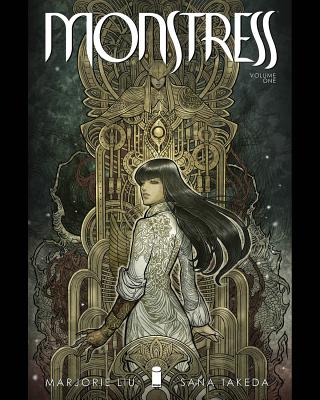
Monstress: Awakening

by Marjorie Liu and Sana Takeda
Support your local independent bookstore: buy it there!
Content: Lots of f-bombs and graphic violence and some nudity. It’s in the graphic novels section of the bookstore.

I really had no idea what to expect when going into this one; I just knew that Liu had won the Eisner for writing and I figured I should give the story a try.

It’s… a lot.

It’s set in this world where humans have been at work with Arcanics, who are a human/animal mix. It’s a racial war: the humans feel the Arcanics are sub-human and are trying to wipe them out. Throw into the mix the Cumaea — witch women who aren’t on anyone’s side, but use the Arcanics for their own purpose (and who I kept calling chimera) and you’ve got a hot mess of violence. Maika Halfwolf is our main character, possibly an Arcanic, but also possibly something else, who breaks into the Cumaea stronghold and (after killing pretty much everyone) absconds with a mask that awakens a demon she barely can control, in hopes to sway the tide of this war.

I think.

As I said, it’s a lot. I’m not entirely sure if I got all the plot or even the people straight. I don’t know if I liked it, but I’m not sure this one is meant to be liked. It’s super feminist — a ton of female characters of all shapes and sizes and stripes and in positions of power and not, and there are very few male characters at all. And it’s super pretty to look at; the art is gorgeous and elaborate and incredible. There is a lot to think about: it’s dealing with slavery and power and racism and seclusion and what circumstances can do to individuals.

But…

I don’t know. I’ve thought about it quite a bit over the time since I finished it, so that’s definitely something. It’s definitely one of the more unique and challenging graphic novels I’ve read recently.

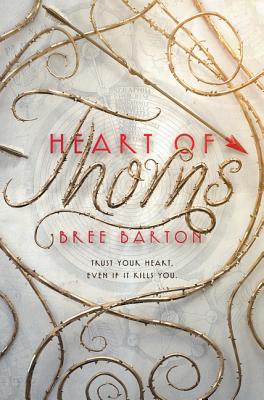
Heart of Thorns

by Bree Barton
First sentence: “On the eve of her wedding to the prince, Mia Rose ought to have been sitting at her cherrywood dresser, primping her auburn curs and lacing her whalebone corset.”
Support your local independent bookstore: buy it there!
Review copy provided by the publisher.
Content: There is an on-screen almost rape, some talk about other rapes, and a lot of violence. It’s in the YA section (grades 6-8) of the bookstore, but I’d probably be a little hesitant giving it to the younger end of the age range.

MIa has spent her whole life believing two things: 1) any woman could be a Gwyrach – a witch, who can (and will) kill anyone they touch  and 2) Gwyraches are evil and must be eradicated. So, when on the day of her (forced) marriage to Prince Quin, Mia discovers that she’s a Gwyrach, her whole world’s foundation is shattered. If she’s a Gwyrach, that must mean her beloved (dead) mother must have been a Gwyrach. And since a Gwyrach killed her mother, what did that mean? And does that mean that Mia is evil?

On the run from assassins with the prince, Mia sets out to figure out answers to all the questions she now has, and to rethnink everything she has believed her whole life.

Okay, yes, this is probably more than a little tropey. It was pretty obviously “HEY LOOK AT ME, I”M FEMINIST”. But, even though the parallels were kind of obvious, I still really liked this book. I thought Barton created some interesting characters, and Mia’s journey was a fascinating one (especially since I like character growth arcs). I thought the magic system Barton dreamt up was a good one, and I liked the world she built. I wouldn’t mind spending more time in the different countries (which is good, since the  book leaves things hanging) and I want to see how Mia and Quin develop. It was a solid debut book, and not a bad fantasy, even if it was a bit heavy handed with the metaphors.

Arrows of the Queen

by Mercedes Lackey
First sentence: “A gentle breeze rustled the leaves of the tree, but the young girl seated beneath it did not seem to notice.”
Support your local independent bookstore: buy it there! (Though, to be honest, you’ll probably have to buy it used.)
Content: There is some violence, and some (tasteful) attempted sex. It would be in the YA section (grades 6-8) of the bookstore, if we had it.

Talia is a young, sheltered girl in a Holding that is super patriarchal, giving all the power to men and making women either wives or nuns in service to the Goddess. But Talia dreams of something more: she wants to be a Queen’s Herald. She’s secretly read tales of the Heralds, with the horse-Companions and the adventures, and longs to be one of them. She has no idea how one becomes a Herald, but when she turns 13 and her elders start talking about marrying her off, she runs off. And is chosen by one of the Companions, Roland. From there, Talia is thrust into a whole new world, one of classes and work and acceptance and challenges and friends. At first, she is hesitant, but as the months and (eventually) years go on, she becomes more confident with her role not only as a Herald, but as the Queen’s Own.

I’ve read Lackey before, but not in a while, and not very much. I like her style, though there seems to be a lot more exposition than either action or dialogue. Perhaps that was part of the style when this was written in 1987, but it did drag the story down. That, and Talia was super perfect. I liked her — I mean you have to be heartless if you don’t — but she wasn’t the most interesting character. She was always stalwart, always likable, and always had the answers to her problems. It got old pretty quickly.

Even so, I liked her adventures and the world that Lackey built, and I’m not sorry I dipped into this one.

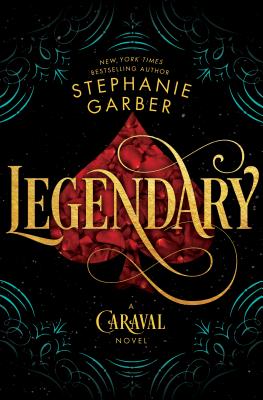
Legendary

by Stephanie Garber
First sentence: “While some rooms on the estate had monsters hiding beneath the beds, Tella swore her mother’s suite concealed enchantment.”
Support your local independent bookstore: buy it there!
Review copy provided by the publisher.
Others in the series: Caraval
Content: There’s some violence and intense moments. It will be in the Teen section (Grades 9+) of the bookstore.

Spoilers for the first one, obviously.

I had high hopes for this one, even though it’s been a long time since I’ve read Caraval and admittedly I don’t remember much. And while Legendary was good, I don’t know if it lived up to my high hopes.

It’s shortly after the Caraval that Scarlett won, and Legend has already set up another one. This one is  in the capital city, and it’s Tella’s turn to play. The prize? Legend’s name. The cost? Tella’s mother’s life. She’s made a bargain with a criminal: the location of her mother in exchange for Legend’s name. She has to win, but at what cost?

I did find this one engrossing; Graber has created a very unique world, full of magic and deception. But, maybe because it wasn’t new like it was in Caraval, I just wasn’t that thrilled by it. It could be that Tella’s journey wasn’t as interesting as Scarlett’s or that I just didn’t find the villain of the book that enticing, or even the final reveal all that shocking. I definitely found the ending unsatisfying. I probably just wanted… more.

It’s not that it’s a bad book; it’s not. And maybe if you read it right after Caraval, it would come off as better. Whatever the reason, I was a little disappointed.

Escape! The Story of the Great Houdini

by Sid Fleischman
First sentence: “I have been a fiction writer by choice and instinct for a long professional life.”
Support your local independent bookstore: buy it there!
Content: There are some risque photos (Houdini did a lot of his tricks in the nude for honesty’s sake) and some intense moments. It would be in the middle reader biography section of the bookstore, if we had it.

I’ll be honest: while I enjoy illusions, I’m not obsessed with it, and while I knew who Houdini was, I really didn’t know much about his life or his magic tricks. So, when my class hit a biography section and this was on the list, I figured why not read a kids’ biography on Houdini.

(First: are kids still interested in Houdini? Hubby saw this on my nightstand and remarked “I adored Houdini as a kid.” Does that still happen?)

I learned that Houdini was a workaholic, a bit of a jerk, and definitely competitive. He’d put himself in pretty much any situation to prove that he could do whatever it was that was put before him (challenges were his favorite thing!) regardless of personal safety. Fleischman, a fellow Jew and magician, is incredibly enthusiastic about Houdini (even though he keeps the actual secrets of how Houdini performed his tricks, well, secret) and that comes through in the biography. I don’t know if it’s something I’d refer kids to in order to do research on Houdini (though maybe: Fleischman does work to debunk some of the myths surrounding Houdini, ones that Houdini himself perpetuated), but it does make for entertaining reading.

Audiobook: Children of Blood and Bone

by Tomi Adeyemi
Read by: Bahni Turpin
Support your local independent bookstore: buy it there!
Listen to it on Libro.fm
Content: There’s a lot of violence, some of it intense. It’s in the YA section (grades 6-8) of the bookstore.

Imagine a world in which magic existed, but the non-magic users (who happened to be in power) were afraid of what magic can do, so they (well, he: the king) did everything they could to stamp it out. They killed the magi — adults who were at full power — and suppressed the children of the magi. These children, Diviners, were never able to fully come into their power, they were discriminated against, and their families taxed beyond what they can afford.

This is the world that Zélie, a Diviner, was raised in. She remembered the raids, when her mother was taken and killed and her father (who is not a magi) beaten. She remembers the stories her mother told about magic and the gods, and has all but lost her faith that it can ever come back. That is, until she meets Amari, the daughter of the king that ordered the raids. Amari has stolen a magic scroll, an artifact that, in the right hands, can bring magic back. And she’s on the run. She teams up with Zélie and Zélie’s brother, Zane. And together they are determined to bring magic back.

Except it’s not as easy as that. Amari’s brother, the crown prince Inan, is on their tale, determined to stop them. And nothing — NOTHING — goes to plan.

It’s a huge book, but it’s a fast-paced one; Adeyemi definitely knows how to plot to keep a reader engaged and the pages turning. Or, in my case, a listener listening. It helps that my favorite narrator, Turpin, read this book, and as always, was fantastic at it. It’s such an excellent performance, one that immersed me into the world of Orïsha (and it helped with all the foreign names and places too!) and the story.

And what a story! There were moments that I was afraid Adeyemi would disappoint me (especially toward the end), but she pulled off a spectacular ending, and still left enough undone for a sequel (which I can’t wait for).

Remarkable. And definitely worth the hype.

Dreadful Young Ladies and Other Stories

by Kelly Barnhill
First sentence: “The day she buried her husband — a good man, by all accounts, though shy, not given to drink or foolishness; not one for speeding tickets or illegal parking or cheating on his taxes; not one for carousing at the county fair, or tomcatting with the other men from the glass factory; which is to say, he was utterly unkonwn in town: a cipher; a cold, blank space — Agnes Sorensen arrived at the front steps of Our lady of the Snows.”
Support your local independent bookstore: buy it there!
Review copy provided by the publisher.
Content: There are more mature themes and some swearing (though I’m not remembering any f-bombs). It’s in the Science Fiction/Fantasy section of the bookstore.

I have a tortured history with short stories. I want to like them, but I find them much like poetry: I don’t get them. They’re words, and often pretty words, but I just don’t… well… understand them. (Even Neil Gaiman’s stories, which I seem to have a bit more affinity for.) And this collection was more of the same: I liked the stories, but I need someone else to read them and then explain them to me. (Especially the title story. I know it’s a metaphor, and I’m sure I’ll smack my head when someone tells me what it’s a metaphor for, but right now, I’m a bit lost.)

Barnhill is a gorgeous crafter of sentences, and this is no exception. She has a beautiful way with words, and it does pull you into the story. I especially liked the final story, which is more of a novella (which could be why), because the world that Barnhill built — a comet flies by once every 25 years and endows pre-born children with magical powers which a minister then harnesses for his own means — was so fascinating, but also because the writing was just so beautiful.

And maybe, someday, I’ll figure out how to read short stories and actually understand.

A Wizard of Earthsea

by Urusla K. LeGuin
First sentence: “The island of Gont, a single mountain that lifts its peak a mile above the storm-racked Northeast Sea, is a land famous for wizards.”
Support your local independent bookstore: buy it there!
Content: There’s nothing objectionable, but it has an “older” feel to it. It’s in the YA sections (grades 6-8) of the bookstore. (I think. It might be in the Science Fiction/Fantasy section…)

I read this a long time ago — not as a kid, but before I started keeping a blog — and was underwhelmed. Since LeGuin recently passed away, I thought I’d give it another try.

And… I was still underwhelmed. The basic plot is the journey of a boy, Ged, becoming a wizard. He goes to school, unleashes a demon, fights a dragon, runs from said unleashed demon for years, until he finally faces his inner darkness and becomes a powerful wizard. Voila!

And that’s the problem with this book. Maybe it was the style of fantasy writing in the 1960s, but now? It just feels all surface and no depth. This happens and then that happens and we never really get to know Ged. We just follow him on his adventures. So when there’s this huge climax at the end where Ged fights the demon and names him and it’s all supposed to be so powerful, it’s just… not. I can see the influence she had on other writers: definitely Gaiman and it felt a little like Dianna Wynne Jones as well.

But, the afterword? The afterword that was written in 2012 was fantastic. LeGuin’s personal voice is smart and sassy and gave insights that I know I missed when I was reading it. So, maybe what I need to do is pick up some of LeGuin’s essays.