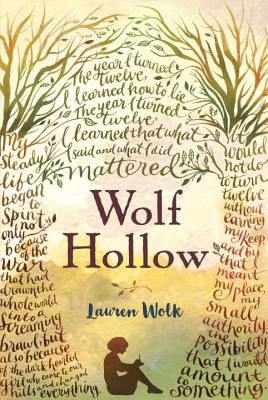
Wolf Hollow

wolfhollowby Lauren Wolk
First sentence: “The year I turned twelve, I learned how to lie.”
Support your local independent bookstore: buy it there!
Release date: May 3, 2016
Content: There’s some death and bullying and one pretty intense injury scene. Probably not for the younger set. It will probably go in the YA section (grades 6-8) of the bookstore.

It’s the fall of 1943, and Annabelle is living a happy, quiet life on her farm in Pennsylvania. Sure, the war in Germany is raging, seemingly without end, but it doesn’t really touch Annabelle’s life. What does touch her is Betty, the new girl who has moved in with her grandparents. Betty has decided that Annabelle is her target, and demands things from her. And when Annabelle refuses to give in, Betty turns her ire on bigger targets. Like Toby, the World War I veteran who Annabelle’s family has taken care of for the past few years. And so when Betty goes missing, it’s Toby who gets blamed.

On the one hand, this really grew on me. It took about 100 pages, but I finally got to where I was invested in Annabelle’s story, and curious about the direction it was taking. The writing is excellent; Wolk really does know how to spin a story. And I thought that, even though it’s a work of historical fiction, the themes of acceptance of others and defending the innocent were incredibly timely.

My problem with it? It’s not really a children’s book. Our narrator is reflecting back on her childhood, so everything is kind of infused with adult sensibilities. (At least: I thought so.) I appreciated that the parents were good parents, helping out when Annabelle confessed the bullying to them. But, it just doesn’t feel like a book I can give to a kid (maybe that special, precocious kid? The 9-year-old who likes Harper Lee, maybe.). Maybe I’m being too sensitive, dumbed down by Diary of a Wimpy Kid-like books. Maybe this is like Pax, which I had a viciously violently negative reaction to, but it turned out it was just me.

Though I didn’t have a negative reaction to this. I liked it, I thought it was well-written and the story incredibly powerful. I just don’t think it’s really a kids’ book.

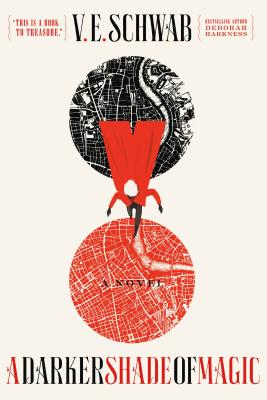
A Darker Shade of Magic

darkershadeby V. E. Schwab
First sentence: “Kell wore a very peculiar coat.”
Support your local independent bookstore: buy it there!
Content: There are three f-bombs, some reference to sex (but none actual) and a lot of violence. That said, I think it’d be a good crossover for the high school set. It’s in the Science Fiction/Fantasy section of the bookstore.

I want you to know up front that whatever I write here won’t do this book any sort of justice. I really do need to work on an elevator speech for this one at work, because it really is THAT good, and I’d love it if more people read it. But, summing up the plot? Not as easy as it sounds.

Kell is many things: a brother, a prince, a magician, a smuggler. He lives in what he calls “Red” London, a world of magic and opulence, where the Thames runs red with blood. The reason he needs to give it a marker other than the city name is because Kell is one of the few people (well, really only two) who can travel between worlds. He moves through doors of his own making to “Grey” London (ours, set in the early-1800s) to “White” London (an incredibly violent and vicious place), but never, ever to Black London. That’s been sealed off from the other worlds after the magic there went bad and began killing people. However, when Kell accidentally brings a token from Black London back into his world, he discovers that he’s created a problem almost too big for him to handle.

I didn’t even mention Lila… a thief and pirate wannabe that Kell picks up in Grey London, who ends up being more than a sidekick.

Seriously: I don’t know where to start with this. It feels like a Gaiman novel, rich and opulent with its world-building, and yet Schwab never forgets the plot (not to mention the palpable tension when Kell’s life is on the line, multiple times). It twists and turns and weaves and is just unputdownable.

It’s also nice that it comes to a conclusion (albeit a bit rushed, but that’s often the case for me in fantasy novels), while leaving the door open for the sequel. Which, of course, I can’t wait to get my hands on.

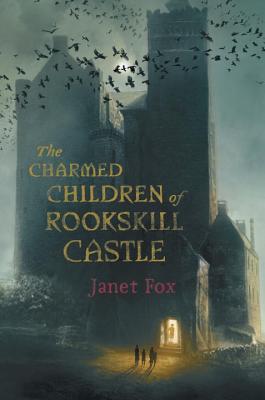
The Charmed Children of Rookskill Castle

charmedchildrenby Janet Fox
First sentence: “It is 1863.”
Support your local independent bookstore: buy it there!
Review copy provided by the publisher.
Release date: March 15, 2016
Content: There’s some scary imagery, and the narrative is a bit confusing. I’d give it to a precocious 3rd grader, but definitely 4th and up. It will be in the Middle Grade (grades 3-5) section of the bookstore.

At first glance (at least for me), this looks like a kind of off-beat historical fiction. It’s the middle of WWII, and the children in London are being sent out to the countryside in order to escape the bombing. Kat and her siblings Robbie and Amelie are among those kids sent away, in this case to a castle in Scotland where a boarding school of sorts has been set up.

But things aren’t always what they seem. Including this book.

Rookskill Castle is a dark place (and not just because fall in Scotland is dreary), and the lady of the castle is up to something. Kat is sensible and practical, and not at all inclined to believe that what it going on could be dark magic.

And yet.

I loved this book, with reservation. On the one hand, the story was compelling — by the end, I was flying through it — and I adored Kat. She was practical, mechanically-minded and good at math, all things you don’t usually get from fantasy heroines. She was also willing to admit when she’s scared, and the boys were mostly willing to support her in the decisions that had to be made.

However,  I have issues when I know more than the characters. Fox flits back and forth through time, from WWII backwards to the mid-1800s, in order to give the reader the backstory of the castle. I’m not the most careful reader, and so I was able to piece things together before the characters did. I’ll admit it kind of heightened the tension — I wanted Kat to figure things out before they got too bad — but I was also annoyed that it took her so long. In the end, I found I didn’t mind so much, but it did niggle at the back of my mind while I was reading,.

The magic, however, was great. I loved the way Fox wove good vs. dark magic, and how it was a very practical sort of magic as well. That much — plus the  general, overall creepiness — definitely nakes the book worth reading.

Audiobook: School for Brides

schoolforbridesby Patrice Kindl
Read by Bianca Amato
Support your local independent bookstore: buy it there!
Others in the series: Keeping the Castle
Content: Nothing objectionable, but a working knowledge of Regeny manners is helpful. It’s in the YA section (grades 6-8) of the bookstore.

Set a year after Keeping the Castle (but you don’t need to read that one first), the Winthrop Hopkins Female Academy has one purpose: to educate young ladies to make smashing matches. The problem, however, is that in Lesser Hoo, Yorkshire, there is exactly one bachelor, who isn’t exactly everyone’s idea of eligible. How are eight young women supposed to find their matches if there isn’t any eligible young men around?

Thus begins the very charming A School for Brides (which was a delight to listen to). Things begin to look up when a young man breaks his leg while in the country and is put up at the school to heal. His friends come calling, and suddenly everything is looking a lot more complicated. Several of the girls are simply delightful (plus the instructor, Miss Quince; I adored her), being that excellent cross between feminist and historical, saucy and authentic. There were so many delightful characters (though sometimes I wished I was reading it so I could keep track of who was who) doing so many delightful things. There were also ones to loathe, so it wasn’t a perfect froth.

As I was reading, I realized it’s a homage to Jane Austen’s work, but it’s also a parody. That feeling kind of increased when I did some looking at how to spell the names and discovered that Miss Foll-ee-ut (which is how the reader was pronouncing it) is spelled Pffolliott. Definitely a send up to the silliness that goes on in historical England. (Leave it to Psmith, anyone?)

Amato was also delightful, capturing the spirit of the book in her narration as well as the essence of each character, which is a trick since there’s so many. It’s definitely a fun read.

Salt to the Sea

salttotheseaby Ruta Sepetys
First sentence: “Guilt is a hunter.”
Support your local independent bookstore: buy it there!
Review copy provided by the publisher.
Content: There are some disturbing elements — it is the horrors of WWII, after all — including violence and rape, though none of it is graphic. It’s in the Teen (grades 9+) section of the bookstore, but I’d give it to an interested 7th- or 8th-grader.

One of the things I really admire about Sepetys is her willingness to tell the untold story. The story that’s been buried or neglected because of the way history has been told. The story that’s difficult to face or bear. She looks at them unflinchingly, and compels us to bear this hard history with her. It’s a difficult thing, but she does it so eloquently we just can’t look away.

This time around she tackles the sinking of the Willhelm Gustloff, a Nazi ship that was carrying 10,000+ refugees that was sunk by the Soviets near the end of the war. We follow four young adults (they range in age from 15 to 21) — Emelia, a pregnant Polish refugee; Florian, a Prussian who’s on the run with a stolen secret; Joana, a Lithuanian nurse who’s been able to repatriate into Germany, and who’s searching for her mother; and Alfred a young Nazi recruit who is a bit… off — as they head toward the ship in the dead of winter. The chapters are short, almost poetic, and they intertwine in compelling ways. It propels you forward, in spite of the horrors (perhaps because of them?). The minor characters — the orphan boy Joana finds, as well as the shoemaker they travel with, among others — are just as fleshed out and real as the main characters. Sepetys didn’t cut corners, and I appreciated that.

It’s exactly what I’ve come to expect from her. And that’s the best thing.


These Shallow Graves

theseshallowgravesby Jennifer Donnelly
First sentence: “Josephine Montfort stared at the newly mounded grave in front of her and at the wooden cross marking it.”
Support your local independent bookstore: buy it there!
Content: There’s some mild swearing, murder, and some questionable situations. It’s in the Teen (grades 9+) section of the bookstore, but I’d give it to a 7th or 8th grader, who was interested.

Josephine is a thing that an 1890s socialite isn’t supposed to be: curious. She’s supposed to obey her parents, be elegant and ladylike, and marry a wealthy, eligible bachelor of her parent’s choosing. But, when her father unexpectedly turns up dead, supposedly having shot himself, Josephine won’t — can’t — settle for that. She heads out, teaming up with a reporter by the name of Eddie Gallagher, to find the Truth.

Thus starts a winding, sometimes scary, path that will lead Josephine down paths that would scandalize her family if they knew, but ultimately opens Josephine’s eyes and changes her forever.

I’ll be honest: the mystery was kind of predictable. I guess who it was fairly early on, as well as guessing the “big secret”. I didn’t have the how and why, but eventually, I figured out that too. The thing that kept me reading was Jo herself. I enjoyed the push and pull she had with Upper Crust New York Society, how she was willing to go against the expectations of her family. I found it all fascinating, and found Jo a character worth spending time with this.

Which made it worth reading.

Lilliput

lilliputby Sam Gayton
First sentence: “All down the pebble path to the beach, Lily sulked about her iron shoes.”
Support your local independent bookstore: buy it there!
Content: There’s some abuse and danger, and there are some larger words, but for the most part, this one is suitable for grades 3 and up. It’s in the Middle Grade (grades 3-5) section of the bookstore.

Lily is a young child in the land of Lilliput when this big giant, Gulliver, comes and snatches her away. He takes her back to London to serve as “proof”. It seems, his stories of his travels have been dismissed as fake and so for the sake of his pride, he kidnapped Lily. He has her in a cage while he finishes his book. Lily, however, just wants to be free. Her life span is a lot shorter than Gulliver’s, and she’s spent half of her life in this cage. She needs to be free.

So, she keeps trying to escape. And eventually, she finds some humans who are willing to help her.

It’s an interesting take on Gulliver’s travels, and I enjoyed having it from the point of view of Lily. There’s some nice subtle commentary on the ethics of taking people from their homeland as well as the conditions which children often found themselves in, both in orphanages as well as in apprenticeships. It was a nice change to have the Spanish character be the “good” guy (in addition to him being the stay-home dad while his wife traveled the world).

But, while it all added up to something nice, it wasn’t overwhelmingly compelling, in my view. And that’s too bad.

(Just for the record: because this is a Cybils nominee, I’ve been asked to make sure y’all know this is my opinion only, and not that of the panel.)

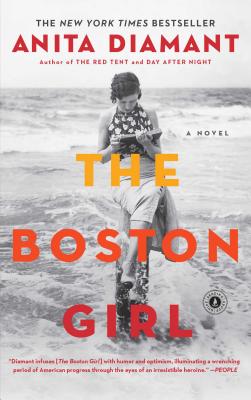
Audiobook: The Boston Girl

bostongirlby Anita Diamant
Read by: Linda Lavin
Support your local independent bookstore: buy it there!
Content: There are some mild swear words and references to drinking and smoking. It’s in the adult fiction section of the bookstore.

Addie Baum is the daughter of Eastern European immigrants, who came to American when the persecution became too bad back home. Addie was born in 1900 in Boston, and grew up in a world wholly different from that her parents, and even her older sisters (the youngest who was 14 years older than Addie), knew. It was a world where Addie went to school instead of getting married young and having babies. A world where she held a job and chose love for herself. A fascinating, modern world, but one that put her at odds with her parents — especially her mother — and the way of life they had always known.

I loved this one from the start. It begins as a series of reflections of an 85-year-old Addie in response to the question asked by her 22-year-old granddaughter: “How did you get to be the woman you are today?” The whole novel felt like a personal history, complete with asides that a grandmother would say in the telling. And while it covered Addie’s whole life, the focus was on her formative years from when she was 15 until she met and married her husband. The opportunities she had (because of the people she met), her struggles with family and religion and men, her jobs and the experiences she had because of them. It was a fascinating slice of life.

And the narrator was perfect. She caught that personal history vibe and ran with it; so very often I could almost see Addie, sitting in her living room, telling this story to an interested granddaughter. No, she didn’t do voices, though she had a good Boston accent overall, but I don’t think it was needed for this. The way Lavin read it was just perfect.

As was this story.

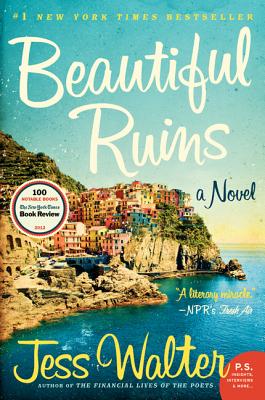
Audiobook: Beautiful Ruins

beautiful ruinsby Jess Walter
Read by: Edoardo Ballerini
Support your local independent bookstore: buy it there!
Content: There is a bit of sex, and a lot of swearing, including a bunch of f-bombs. It’s in the adult section of the bookstore.

It’s April 1962, and Pasquale has just returned home to his small seaside village of Porto Vergogna to run his deceased father’s hotel, Hotel Adequate View. It’s a nothing of a hotel in a nothing of a village, and he pretty much feels like he’s at a dead end. Then the beautiful American actress Dee Moray shows up on Pasquale’s doorstep.

Thinking she has cancer, Dee’s on leave from the Richard Burton/Elizabeth Taylor production from Cleopatra. She takes refuge at Pasquale’s hotel while he tries to figure out who sent her and why she was there.

Flash forward fifty years, when Pasquale shows up in Hollywood at the famous producer Michael Dean’s office, looking for Dee. And in and around those two events there is a story. Between flashbacks and flash forwards and a few side trips, Walter spills out Dee and Pasquale’s story, from his affair with an older woman (that resulted in a child) to her affair with Richard Burton (that resulted in a child) and the consequences of their decisions.

It was a bit more meandering than I like my books to be. There were several sections that if I had read this in print, I would have skipped. And so, listening to it on audio, I kind of got impatient. However, the narrator was brilliant. Didn’t matter the accent, he was there and so, so good. In fact, it’s what kept me listening throughout the book. Eventually, I did bail, during the epilogue-like part because I just lost interest.

There were parts that I did enjoy, threads of the larger story that I did connect with. But mostly, other than the narrator, I wasn’t that thrilled with the book. It’s just wasn’t my sort of story.

Curiosity House: The Shrunken Head

curiosityhouseby Lauren Oliver (and H. C. Chester)
First sentence: “Ladies and gentlemen, boys and girls: step right up and don’t be shy.”
Support your local independent bookstore: buy it there!
Review copy pilfered off the ARC shelves at my place of employment.
Content: There’s murder and some adult smoking and drunkenness. It’s in the middle grade section (grades 3-5) of the bookstore.

Orphans Philippa, Sam, and Thomas have basically grown up in Dumfrey’s Dime House, a place where unusual kids like them — Philippa is a mentalist, Sam is a strong man, and Thomas is a super-math-genius — are welcome. But, soon after Max (knife thrower extraordinaire) arrives, Mr. Dumfrey’s prize shrunken head goes missing and then people around the city start dying. It’s up to the four kids to figure out what is going on. And, in the process, figure out who they Really Are.

I found the mystery end of this delightful. I thoroughly enjoyed the four kids as they learned to work together and puzzle out who exactly was the person behind the killings. I figured it out before they did, but not much before, and I loved that the clues were there for anyone to pick up. Even the big twist ending wasn’t a huge surprise. It’s only vaguely speculative fiction (mentalist abilities and all that), so it’s perfect for those who don’t want much magic or ficitonal places. The only complaint is one I remember Ms. Yingling having: I wish the historical context was more explicitly put out there. Like her, I was able to figure it out, but I’m not sure that kids would get it (in fact I know so: this is one that my kid review group at work read and they didn’t even notice). Though that’s probably not something that would bother them.

At any rate, it’s a lot of fun.

(Just for the record: because this is a Cybils nominee, I’ve been asked to make sure y’all know this is my opinion only, and not that of the panel.)