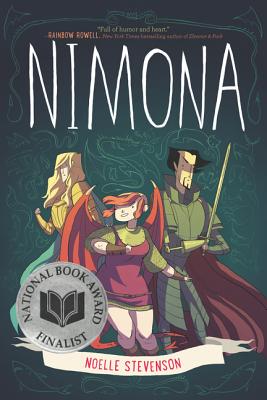
Nimona

nimonaby Noelle Stevenson
Support your local independent bookstore: buy it there!
Content: There’s violence and some more mature content. I’d give it to a 5th grader if they asked, though. It’s in the teen graphic novel section of the bookstore.
I’ve been  meaning to get to this one for ages, and being shorlisted for the Graphic Novels Cybils kind of gave me the push. That, and Alyssa over at Everead told me I wouldn’t regret buying it.

She’s right: I don’t regret it at all. It really is that good. (Well, I do regret it a little, because now I have to wait for a copy to come back in so I can put it on my recommends shelf.)

It’s hard to write about this one, though. Mostly because not knowing a whole lot is part of the fun. Know this: it’s a unique fantasy world, both high- and low-tech at the same time. It’s about heroes and villains and what it means to be both. It’s about sidekicks and friendship and Being True to Yourself.

What it’s not: Trite.

Nimona is a fantastic character, fully her own person, beating her own drum, and all the other cliches. Except this feels like the furthest things from a cliche there is. She’s incredibly compelling (though not always likable) to read about. Sir Blackheart, the villain to whom Nimona is sidekick, is also incredibly fascinating. As is Ambrosious, Sir Blackheart’s nemesis. There’s so much going on here that it’s hard to do it justice.

So, just do yourself a favor an read it. You won’t regret it.

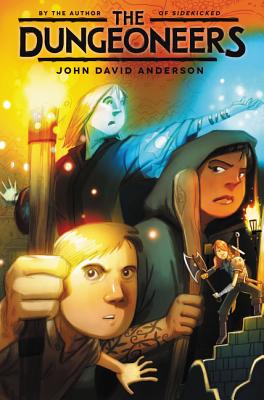
The Dungeoneers

bdungeoneersy John David Anderson
First sentence: “Colm Candorly had nine fingers and eight sisters.”
Support your local independent bookstore: buy it there!
Content: There’s some violence and it’s a little thick and somewhat intimidating for reluctant readers. It’s in the middle grade (grades 3-5) section of the bookstore.

Colm is the son of a cobbler in a small town in this world. They’re struggling for money (9 kids is no walk in the park) and one day, Colm decides that he’s going to help out. He heads to the town square and proceeds to pickpocket those who look like they could afford it. His father is (rightly) appalled, and heads out to talk to the magistrate. Instead, he brings back Finn Argos, a rogue and a teacher at the training school for Thwodin’s Legions, a band of dungeoneers — those who raid the hoards of elves, dwarves, and orcs for treasure.

I really, really , really wanted to like this one. It’s essentially a Dungeons & Dragon’s adventure in novel form. In Colm’s little group where he’s the rogue, there’s a mage, a druid, and a barbarian (she’s pretty awesome) and together they work to become awesome. There’s another group that bullys Colm’s, and there’s predictable ups and downs at school. I ended up skimming the last third, because I just got bored with it. It wasn’t doing anything new and the characters weren’t enough to keep my interest. Which was disappointing.

(Just for the record: because this is a Cybils nominee, I’ve been asked to make sure y’all know this is my opinion only, and not that of the panel.)


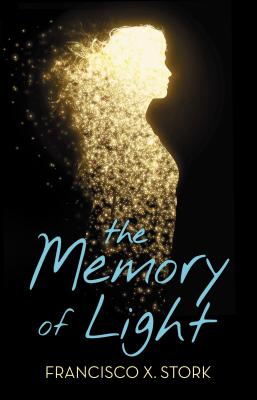
The Memory of Light

by Francisco X. Stork
First sentence: “Nana, I tried to write you in Spanish by my Espanol no es muy bueno en este momento.”
Support your local independent bookstore: buy it there!
Release date: January 26, 2016
Review copy provided by the publisher.
Content: There’s frank talk of depression and suicide, a few mild swear words, one (maybe two?) f-bombs, and some indirect drug use. Nothing too bad, though, so it’ll probably be in the YA (grades 6-8) section at the bookstore.

Vicky should have the perfect life. Her father is a high-powered Latino businessman, so she’s never wanted for anything. She goes to a high-powered private school, she has a popular boy who likes her. But. She doesn’t feel like anything’s worth living for. Her Nana is being sent back to Mexico, in spite of having been a part of the family since before Vicky was born. Vicky’s constantly being compared to her “perfect” older sister; she’s never quite good enough, smart enough, driven enough. So, one night, she decides to take her own life.

Except, it doesn’t work. She finds herself in the mental ward of a hospital, walking to a therapist and a group of other mentally ill teenagers — bi-polar, anger management, schizophrenic — wondering if there is a way to have depression rather than to be depressed.

I can’t tell you how much I loved this book. I am SO glad that there is a book out there about depression and suicide that isn’t depressing as well. Yes, Vicky is sad, a sadness that is impossibly empty, but the book itself finds hope and healing in it. Slowly, Vicky finds reasons to live, she finds her voice, she finds friends, she finds a community to connect with, and she figures out ways to deal with this depression she has. On top of that, in Stork’s hands this story — which is personal for him, since he suffers from depression as well — has a heart and soul that reached out and grabbed me. He’s so good a portraying pain, but he’s also incredible at portraying healing and friendship, all of which I needed at this point in my life.

Excellent.

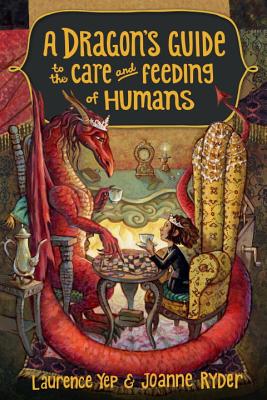
A Dragon’s Guide to the Care and Feeding of Humans

dragonsguideby Laurence Yep and Joanne Ryder
First sentence: ”
Support your local independent bookstore: buy it there!
Content: It’s short, there are lots of pictures, and the words aren’t terribly difficult. It’s a great bridge book between beginning chapter and middle reader, and good for ages 7 and up. It’s in the middle reader (grades 3-5) section of the bookstore.

Miss Drake, a dragon who has been around a long time, is happy with her lifestyle. Sure her “pet”, a human she calls Fluffy, recently died and she is grieving that. But when another human, the 10-year-old great-niece of Fluffy (aka Great-Aunt Amelia), comes into her life, she is not at all happy with it.

And thus begins the relationship between Miss Drake and Winnie. Sure, there’s a little adventure with a magical sketchbook and a rabid magic-eating monster, but mostly it’s about overcoming grief of the death of a loved one (Winnie’s father has recently passed away as well) and making friends.

My favorite thing is that it’s written from the dragon’s point of view. Beginning each chapter is a word of “advice” to magical creatures about how to deal with their “pets”, but the narrative is from the point of view of a very old, somewhat cranky dragon. It’s a clever take. That, and it’s blissfully short. Yep and Ryder know their audience, get to the point, and don’t bother putting in a whole lot of backstory. There are clues here and there about Miss Drake’s former pets and Winnie’s family (I’d like to read more about them in other books!), but there are no long-winded passages, no extra words. It’s refreshing.

My  only complaint is that while there is a child character, the protagonist (and the one who propels the action, in the end) is the dragon. And that felt a little off. But other than that, it’s an enjoyable story.

(Just for the record: because this is a Cybils nominee, I’ve been asked to make sure y’all know this is my opinion only, and not that of the panel.)

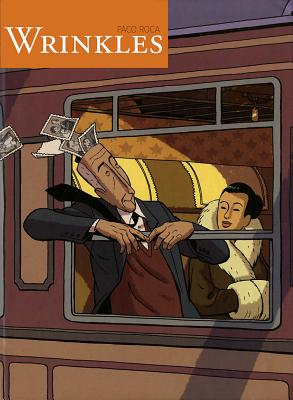
Wrinkles

wrinklesby Paco Roca
Support your local independent bookstore: buy it there! (Kind of; it’s not available in the States, yet.)
Content: There’s really nothing objectionable, content-wise. The subject matter is older adults in a retirement home, so if you’re interested in that, go for it. The book would be in the Graphic Novel section of the bookstore.

One of the members of my in-person book group is a gerontologist, and reads a TON of literature on the subject. She’s always digging up unusual and interesting books that feature older adults and their life experiences, partially for her work, but mostly because it fascinates her. She didn’t pick this book for our discussion however, one of the other members did, hoping that our gerontologist hadn’t read it yet. (She hadn’t, but had seen the movie based on it.)

It’s a very European book, written by a Spanish author and set in France. It’s the story of one gentleman, Ernest, who is suffering from Alzheimer’s and whose children can no longer care for him, so he ends up in a care facility. He’s a bit confused and hurt that he ended up there, so he’s initially resistant to settling in. His roommate, Emile,  is more than welcoming, however. He takes Ernest under his wing and shows him around the home, introducing him to all the people who live there.

It’s their story, of their friendship, of the living they do from day-to-day, of the small joys and the larger hardships, of the inevitability of age. There’s a lot to think about, and even though it made me sad — getting old is not for wimps — I thoroughly enjoyed reading this story.

Upside Down Magic

upsidedownby Sarah Mynowski, Lauren Myracle, and Emily Jenkins
First sentence: “Nory Horace was trying to turn herself into a kitten.”
Support your local independent bookstore: buy it there!
Review copy pilfered off the ARC shelves at my place of employment.
Content: It’s simple enough for the younger set; probably good for advanced 2nd graders and up. It’s in the middle grade (grades 3-5) section of the bookstore.

Nory has a problem. She’s a witch, and she wants to get into the prestigious magic school that her super stuffy, absent father is head of. All she needs to do is turn into a kitten and hold that form for a few minutes. The problem is that she can’t do it. Well, she can turn into a kitten, but it never is just a kitten: it’s a beaver-kitten, or a dragon-kitten, or some other awful, terrible combination.

sOf course she doesn’t get into the school, and ends up going to a public magic school (the horror) and put in a class for those with “wonky” magic. There’s a kid who floats but can’t come down, another kid who turns into a rock, one who makes it rain inside and another one who is terrifying to animals. They are working to not only accept their magic as valid (in this society, those with wonky magic are Outcasts) and work together to make their magic do something incredible.

I think there’s a certain sort of kid who would love this kind of book. The kind of kid who likes magic stories, who likes an underdog story, and who doesn’t want to smack the adults in the book. I, unfortunately, am not that kid. I was annoyed at the predictable storyline and wanted to smack both the dad (the aunt who Nory ends up with is okay) and the mean girl at the new school. I understand I’m not the intended audience, so even though I didn’t care for it much, I realize that there are kids out there who will. And so I’m glad I read it for that reason.

(Just for the record: because this is a Cybils nominee, I’ve been asked to make sure y’all know this is my opinion only, and not that of the panel.)

The Porcupine of Truth

by Bill Konigsburg
First sentence: “The Billings Zoo has no animals.”
Support your local independent bookstore: buy it there!
Content: There’s a lot of swearing, including multiple f-bombs. It’s in the Teen (grades 9+) section of the bookstore.

Carson Smith has drawn the short stick for the summer: he’s stuck in Billings, Montana with his mom. They’ve moved back to take care of his dying, alcoholic father whom Carson hasn’t seen in 14 years. It’s not exactly the Ideal Summer at all.

Then Carson, completely by chance, meets Aisha and strikes up a friendship. No romance here: Aisha’s a lesbian who has been kicked out of the house by her super religious dad. She’s having a winner of a summer too, so she moves in with Carson and his parents. Everything is shaping out to be a complete Win until Carson and Aisha start nosing through boxes in the basement and uncover some clues to Carson’s grandfather’s disappearance back in the early 1980s. One thing leads to another and soon Carson and Aisha are on a road trip to find Carson’s grandfather.

This was a hard book for me to read, as a religious person. Mostly because Carson and Aisha are incredibly hostile — for good reason, I think — toward organized religion. I can understand why: too often people hide behind Religion, using it to justify their prejudices and to promote hate. But not everyone does, and I was made uncomfortable by the broad strokes: all people who are “religious” are bigots.

Thankfully, there is growth with these characters, and I appreciated that. I appreciated that, overall, Konigsberg treated everything thoughtfully and carefeull. Which meant that no one was truly black and white and that both Carson and Aisha learned things along the way.

There’s a lot to think about in this book, and I do think it’s a story, with all its broken people and hurtful relationships, that needs to be told. I just wish religion and religious people came off better.

A quick aside: Konigsberg stopped by the store as part of his Porcupines for Trevor tour. While it wasn’t super well-attended, we got a small crowd and we sat in a circle talking about religion and the LGBTQ community. It was a very interesting (and civil) discussion, one that I was glad we had.

Also: we took a selfie. He was very kind, and very, very tired.

Jinx’s Fire

by Sage Blackwood
First sentence: “Sticking to the path won’t always take you where you need to go.”
Support your local independent bookstore: buy it there!
Others in the series: Jinx, Jinx’s Magic
Review copy pilfered off the ARC shelves at my place of employment.
Content: There are some scary moments, but mostly it’s good for the fourth-grade and up crowd. It’s in the middle grade section (grades 3-5) of the bookstore.

Things aren’t looking good for Jinx and his friends. The Urwald is surrounded by warring armies — one of which is headed up by Jinx’s former friend, Reven. The Bonemaster is up to something, but Jinx doesn’t know what. And Simon is still trapped in goo, and it’s not looking good. The question is: how will Jinx solve everything and keep the Urwald (and the trees) safe, especially when he’s not very good at diplomacy?

Sometimes, an ending comes along that is just. so. perfect. that you have to love it. While it took me a bit to get into this one (being quite a long time since I’d read the other two), once I did, I fell again into loving the world that Blackwood created. I love Jinx and his grumpy demeanor. I love his friends, especially Elfwyn. I love the adventures that Jinx went on and the way Blackwood had him solve the problems he created. I adore the magic and the way Blackwood used it.

But, mostly I loved how Blackwood wrapped everything up, satisfyingly but not so neatly that it was implausible.

This series is definitely worth reading.


The Odds of Getting Even

by Sheila Turnage
First sentence: “Mr. Macon Johnson’s kidnapping trial snatched Tupelo Landing inside out sharp as Miss Rose snaps a pillowcase before she pins it to her wash line.”
Support your local independent bookstore: buy it there!
Review copy snagged from the ARC shelves at the bookstore.
Others in the series: Three Times Lucky, The Ghost of Tupelo Landing
Content: There’s some intense situations, but nothing too scary (and only mildly life-threatening). It’s in the middle grade (grades 3-5) section of the bookstore.

Mo and Dale are back again! I can’t tell you how happy this makes me. (I adore Tupelo Landing and want to live there.)

Dale’s no-good daddy is on trial for kidnapping (and other charges), when he disappears from the jail on the way to the trial. If that’s not bad enough, things start happening — break-ins, vandalism, attempted murder — in Tupelo Landing, and everyone (including Mo) is blaming it on Macon. Dale’s the only one who knows his daddy well enough to think that he’s being framed. And it’s up to him (and Mo and Harm) to figure it all out.

First, I’m glad this is solidly back in realistic mystery territory. No more ghosts, thank you. Secondly: the charm of these books is much less the mystery (I kind of figured it out, though not completely) and much more the, well, charm of the characters. Mo’s delightful. Dale’s sweet. Harm even grew on me. There was much less Miss Lana and the Colonel than I would like, but the kids were so delightful that I really didn’t care.

I am completely infatuated with this series and I don’t think I’ll ever get enough.

Audiobook: My Brilliant Friend

by Elena Ferrante
Translated by: Ann Goldstein
Read by: Hillary Huber
Support your local independent bookstore: buy it there!
Content: There’s a few mild swear words and some frank talk about not-quite sex. It’s incredibly slow with a lot of narration rather than dialogue, but I’d give it to a high schooler who was interested in historical fiction. It’s in the adult section of the bookstore.

I picked this one up because I’ve heard good things about Ferrante from our translation book club (they only read works in translation), and because I needed a book in translation for my bingo card.  (Which I’m going to end up being three squares short from getting a blackout. I read a lot.) I didn’t know much about it, going in, so I didn’t think I had any expectations. (I did however, expect to really enjoy the narrator, which I did.)

What it turned out to be was a very slow, intricate, detailed portrait of a girl, Elena, in a neighborhood in Naples, Italy, and her (somewhat obsessive) relationship with her best friend, Lila. This first book is a lot of set up: their lives — Lila is the daughter of a shoe repairman; Elena the daughter of a porter, whose mother has a wandering eye and limp and is cruel — and their relationship — mostly competitive, mostly on the side of Elena — to each other. They meet in elementary school, where Lina is the smartest and the best. But because she is poorer than Elena and because her parents won’t be bullied by the teacher (there was a lot of bullying by people in this), Lina drops out of school while Elena continues.

And yet, everything Elena does is because she wants to seem important to Lina. She wants Lina to look at her and feel like she Needs Elena in her life. And yet, for the most part, she doesn’t.

I’m still not sure how I feel about this one. On the one hand, I adored Huber’s narration, the way she embodied the characters (and how effortlessly the Italian names and places came off her tongue). She really is a talented reader, and I love listening to her. But, I’m not sure I figured out what was so great about the novel. I was interested enough to keep reading; the character’s lives were intriguing and, yeah, I guess I did want to hear what Elena and Lina would do next. But, in the end, I don’t know if I cared. I finished the book and kind of went, “Huh.” Maybe it’s because I don’t read a lot of books like this (both translated as well as adult fiction), but it just kind of washed over me.

Not that it was bad. It just wasn’t something I was terribly enthusiastic about.