145th Street

by Walter Dean Myers
First sentence: “The way I see it, things happen on 145th Street that don’t happen anywhere else in the world.”
Support your local independent bookstore: buy it there!
Content: There’s violence but the stories are short and to the point. It’s in the YA section (grades 6-8) of the bookstore.

I’ll be honest here. I’m not a fan of short stories, and I had to read one for class, and I’ve never read Walter Dean Myers, so I picked this one. All the stories surround people on this street in New York (in Harlem?), their lives and experiences. But, as I sit back and think about this, what comes to mind are the stories in Bronx Masquerade. Which means this one just kind of went in but slid right out. I’m pretty sure I looked at the words and turned the pages, but I can’t, for the life of me, remember what I read.

I’m sure that’s not because Myers isn’t a good writer. It’s more I’m not a great reader of short stories.

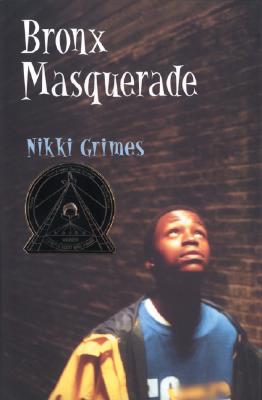
Bronx Masquerade

by Nikki Grimes
First sentence: “I ain’t particular about doing homework, you understand.”
Support your local independent bookstore: buy it there!
Content: There’s some tough situations, but nothing “objectionable”. The format — short stories with poetry — is great for reluctant readers, as well. It would be in the young adult (grades 6-8) section of the bookstore.

I read this back during my poetry section of class and was expecting a novel in verse. While I don’t think it’s that, it is a fascinating look into the power of poetry. Set in the Bronx (obviously), the book follows a group of students in an English class as they study the Harlem Renaissance, and then decide they want to try writing poetry themselves. That turns into an Open Mike Friday once a month, which morphs into once a week, as the various students — black, Latnix, and white — learn to express themselves and understand other people throughout the year. Interspersed with commentary from our “narrator” Tyrone, it’s a good look at how poetry not only can help people express ideas and feelings they couldn’t otherwise, it also is a way to understand other people.

I liked how we got a peek into a bunch of different lives, even if that meant we didn’t get to delve deeply into one person. I think the purpose of the novel was to explore connections that poetry makes, not so much to explore one person, and once I realized that, I was able to enjoy the book more. I’ve never read anything by Nikki Grimes before, though I’ve heard a lot about her, and this made me curious. I’ll definitely have to check more of it out.

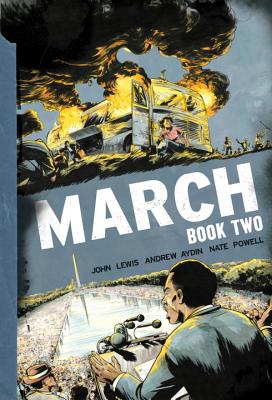
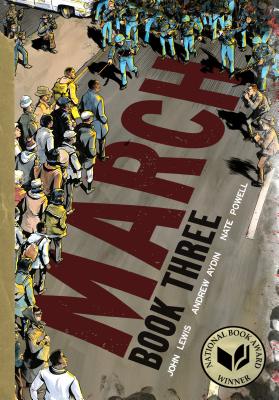
March (Book Two and Three)

by John Lewis, Andrew Aydin, and Nate Powell
First sentence: “Brother John — Good to see you.”
Support your local independent bookstore: buy it there (book 2, book 3).
Others in the series: March (Book One)
Content: There is a lot of violence, and use of the n-word. It’s in the non-fiction area of the graphic novel section of the bookstore.

This picks up where March (Book One) leaves off. Lewis is part of student non-violent protests in Nashville in the early 1960s, but soon leaves that to join the Freedom Riders: a group of African Americans who, in 1961-1962, put supposed desegregation to the test. They rode Greyhound buses though the south, stopping at cities in Virginia, Georgia, Alabama, and Mississippi, with — as you would guess — pretty disastrous results. They were yelled at, beaten, arrested, thrown in jail, loaded up in cars and left in Klan territory, and the buses were blown up… let’s just say that, in short, white people in the south were TERRIBLE people.

All through this, Lewis (and others) preached the gospel of non-violence (which just makes white people look like terrorists. Really.): they didn’t fight back, they didn’t talk back, they just exercised their right (!) to do what they feel they had a right to do.

The book also follows Lewis through the March on Washington in 1963. (I didn’t know he was there, or even that he spoke! In fact, there’s a side note by him that out of everyone who spoke, he was the only one still living.) It was fascinating, learning about the politics behind that march, and about Robert Kennedy’s change of heart as well.

It’s a well-done graphic novel, one that is still very timely to read. As a white person, it definitely made me more aware of what people went through in the 1960s to get just basic rights, and I’m more aware now of how those rights aren’t still completely equal

March (Book Three) picks up after the church bombing the beginning of 1964 and goes through the march from Selma to Birmingham. My thoughts are pretty much the same as after reading book two: white people are so entrenched in their “way of life” that they can’t abide by change at all. And the thing I kept coming back to was that, in the intervening 54 years, that white people are still entrenched in their “way of life”, we just call it by different things now. It’s still racism. And it still is wrong. This one was difficult to read, and made me think, over and over, that an eye for an eye just makes everyone blind. I hope I’d have the courage to stand up to those who use their power to make others “less than”, those who call others “animals” or “dirty” or “from s-hole countries”, those who want to abuse their power to keep themselves in power… even if it means sacrificing my life. John Lewis and all those who stood by him are true heroes, and I wish there were more people like them now.

Excellent.

Amal Unbound

by Aisha Saeed
First sentence: “I watched from the window as the boys tumbled out of the brick schoolhouse across the field from us.”
Support your local independent bookstore: buy it there!
Review copy provided by the publisher.
Content: There is some violence. It’s in the middle grade (grades 3-5) section of the bookstore.

Amal has a goal: she loves school, and wants to go to college and become a teacher. It seems simple, but for a 12-year-old girl in a Pakistani village, it’s means everything, She sees her future before her, and feels like she can make a difference.

That is, until one day she decides to stand up for herself… with the wrong person. Jawal Sahib is a member of the Khan clan, the people with the most money and influence in the region. And he’s not a person you cross. So, the next thing Amal knows, her father’s debts have been called in (he took out loans to cover his orange groves), and he can’t pay. So Jawal Sahib takes Amal as “payment”. She’s put to work in the household as a personal servant for Jawal Sahib’s mother, Nasreen Baji. It’s not something Amal wants, but she has no choice. And so, she tries to make the best of a (very bad) situation.

There’s more to the story than that; Saeed not only deals with involuntary servitude but also the treatment and education of women, she touches on corruption in politics and commerce in Pakistan; the Khans are so influential because they have bribed so many people. It’s enough that Jawal Sahib feels that he is above the law, and everyone beneath him is resigned: that’s just the way things are.

It’s a very stark picture of what life can be like in Pakistan, and how many people are just scraping by while a few get rich off their backs. But it’s not a depressing one: Amal is an incredible character to spend a book with, one who really does find ways to make life bearable and who tries to make a difference wherever she goes.

And Saeed knows how to tell a story that will keep younger readers engaged as well.

Excellent.

Long Way Down

by Jason Reynolds
First sentence: “Don’t nobody believe nothing these days which is why I haven’t told nobody the story I’m about to tell you.”
Support your local independent bookstore: buy it there!
Content: While there isn’t any swearing or on-screen violence, the themes are quite intense. I go back and forth as to where this should go. One of my co-workers insists that 10-year-old kids shouldn’t be reading it, so doesn’t like it when I stick it with the Newbery Books (even though it got an honor). I’m not sure it needs to be in the Teen (grades 9+) section, though, so I may compromise by putting it in the YA (grades 6-8).

Will’s older brother, Shawn, has been shot dead. And so, Will believes, it’s his duty to hunt down the person who shot Shawn (and he’s sure he knows who it is) and kill them. After all, that’s part of the rules: Don’t cry, don’t snitch, and always get revenge. But, on the elevator with a gun tucked in his pants, Will encounters ghosts of his past, every single one of whom has been killed by gunshot.

The ending is left open: will Will follow through, or won’t he? But, it’s these conversations with the ghosts — all told in verse — that left me shook. The toxic masculinity is rampant and obvious (at least to me, an outsider): if someone shoots someone who then shoots someone, then (of course) someone else will have to shoot that someone. It’s a vicious cycle that just leaves everyone dead. (What is that adage? An eye for an eye just leaves everyone blind?) It’s awful. And culture, tradition, racism, oppression, expectations… they don’t let these boys grieve the way they need to grieve. (And don’t get me started on gun culture.) I’m not entirely sure that’s what Reynolds was trying to get across, but that’s what I (again, as an outsider) got out of it.

Hopefully, books like these will help bring awareness to this. And maybe we can all stop killing each other just because of the color of our skin.

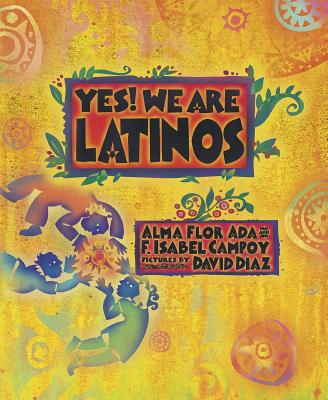
Module 14: Yes! We are Latinos!

Ada, A. F. and Campoy, F. I. (2013). Yes! We are Latinos. Watertown, MA: Charlesbridge.

Genre: Poetry with non-fiction mini-essays.

Book Summary: A series of narrative poems, followed by a brief narrative non-fiction essays about different aspects of Latinx history and culture. These are not based on any one person, but are a composite of the different variety within the Latinx world.

Impressions: I loved this one! I don’t often read poetry collections (and when I do, they are usually the humorous ones. My current favorite is I’m Just No Good at Rhyming) and I didn’t quite know what to expect. What I got were some narrative poems, each telling a story about a different child’s Latinx identity. It served as a reminder that even though we (white people, the media, etc.) lump all Latinx people together, there’s a lot of diversity and richness of heritage within the culture. (And, I was reminded, that they don’t all get along!) I really enjoyed the historical information that came after each poem, which told a bit about the history and culture of the person in the poem preceding. I knew quite a bit of the information already, but it was good to be reminded of the history (and some of it recent history) and how much of the United States was originally Spanish. (And that the Brits weren’t the only oppressive colonizers in the world.) Definitely a highly recommended collection.

Review: While the review was short and more oriented to the plot than any opinions about the book, Leon-Barrera did remark that the book was “refreshing” especially because of the vast representation from the Latinx world. She also wrote, “The vignettes also help to illustrate the meaning of being mestizo–the blending of indigenous, African, and Spanish lineage-mentioned in the introduction and explored throughout.” This was something I noticed but didn’t realize was as important as it is. She also commented on the inclusion of Asians in Latin America, which, she wrote, “is often overlooked in children’s literature”.

Leon-Barrera, M. (2013). Yes! We are Latinos.  School Library Journal. 59 (8), 94.

Uses: This was used as part of our city’s Big Read a few years back. It could also be used in a poetry writing workshop for middle or high schoolers, since these are all accessible, free-verse, narrative poems.

Readalikes:

  • Enchanted Air by Margarita Engle – This is the most obvious read-alike, as it is a non-fiction memoir in verse about Engle’s childhood and her family in Cuba.
  • The Epic Fail of Arturo Zamora by Pablo Cartaya – Another Cubano novel, this one focusing on the struggle to keep history and culture and family together in America. It’s also a David vs. Goliath book, in that a big developer wants to take out Arturo’s family’s restaurant in order to put in a huge multiplex.
  • Gabi a Girl in Pieces by Isabel Quintero – A young adult book about Mexican-American culture and the struggles between older generations and their traditions and younger generations.

Audiobook: Children of Blood and Bone

by Tomi Adeyemi
Read by: Bahni Turpin
Support your local independent bookstore: buy it there!
Listen to it on Libro.fm
Content: There’s a lot of violence, some of it intense. It’s in the YA section (grades 6-8) of the bookstore.

Imagine a world in which magic existed, but the non-magic users (who happened to be in power) were afraid of what magic can do, so they (well, he: the king) did everything they could to stamp it out. They killed the magi — adults who were at full power — and suppressed the children of the magi. These children, Diviners, were never able to fully come into their power, they were discriminated against, and their families taxed beyond what they can afford.

This is the world that Zélie, a Diviner, was raised in. She remembered the raids, when her mother was taken and killed and her father (who is not a magi) beaten. She remembers the stories her mother told about magic and the gods, and has all but lost her faith that it can ever come back. That is, until she meets Amari, the daughter of the king that ordered the raids. Amari has stolen a magic scroll, an artifact that, in the right hands, can bring magic back. And she’s on the run. She teams up with Zélie and Zélie’s brother, Zane. And together they are determined to bring magic back.

Except it’s not as easy as that. Amari’s brother, the crown prince Inan, is on their tale, determined to stop them. And nothing — NOTHING — goes to plan.

It’s a huge book, but it’s a fast-paced one; Adeyemi definitely knows how to plot to keep a reader engaged and the pages turning. Or, in my case, a listener listening. It helps that my favorite narrator, Turpin, read this book, and as always, was fantastic at it. It’s such an excellent performance, one that immersed me into the world of Orïsha (and it helped with all the foreign names and places too!) and the story.

And what a story! There were moments that I was afraid Adeyemi would disappoint me (especially toward the end), but she pulled off a spectacular ending, and still left enough undone for a sequel (which I can’t wait for).

Remarkable. And definitely worth the hype.

Rebound

by Kwame Alexander
First sentence: “It was the summer when Now and Laters cost a nickel and The Fantastic Four, a buck.
Support your local independent bookstore: buy it there!”
Others in the series: Crossover
Review copy provided by the publisher.
Content: There’s some drug dealing and stealing, but it’s all incidental to the plot. There’s a wee bit of romance. Crossover is in the Newbery section, and so I might put this one next to Booked in the Middle grade (grades 3-5 section) or I might move it to the YA section (grades 6-8) where it feels like it should go.

Even though this one is a pre-quel to Crossover, you really should read that one first.

It’s 1988 and Charlie Bell, the father of the characters in the Crossover, has just lost his father to a major heart attack. It’s the end of his 7th grade year and the loss — and the subsequent grief of both him and his mother — has put Charlie at odds with the world. He doesn’t want to deal with school or friends or his mother, even though he tries to put his father’s death out of his head; all he wants to do is sit and read his comic books. But then, he gets mixed up a bit with his friends older brother, and gets caught stealing (nothing major though), so his mom ships him off to DC to his grandparents (his father’s parents) for the summer.

It’s there that he learns how to deal with his dad’s death, and finds a passion for basketball that stays with him the rest of his life.

I’ve become a fan of Alexander’s in the years since his Newbery win, and this is no exception. It’s a lot geekier than his other books — there are comic poems, to reflect Charlie’s love of the comic book, and he’s not a suave as his kids turn out to be. But, it still has Alexander’s signature poetic style, and it tells the story of a kid coming to terms with his grief extremely well. I loved the 1980s references (throwback to high school!) and I thought Alexander handled the girl characters much better in this one (in fact, Charlie’s cousin, Roxie, is pretty amazing!).

An excellent read.

Ghost Boys

by Jewell Parker Rhodes
First sentence: “How small I look.”
Support your local independent bookstore: buy it there!
Review copy provided by the publisher.
Release date: April 18, 2018
Content: There are some tough issues here, but all the violence is either handled delicately or is off stage. The publisher has it for 10 and up, so I will probably shelve it in the YA section (grades 6-8) at the bookstore, but it would be good for curious 4th and 5th graders.

Twelve-year-old Jerome is shot by a white police officer while playing in the park. He had a toy gun, and the officer thought he was being threatened and therefore shot Jerome. If that sounds familiar, it’s intentional.

The book isn’t about the shooting, exactly. It’s told from Jerome’s perspective, after his death. He’s a ghost, hanging around, angry he is dead, and wondering what his purpose is. From there, we learn in flashbacks how he came to be shot, as well as following the preliminary hearing (in which the white officer gets off), and learn about Emmett Till’s murder in Mississippi in 1955. The point of the novel, however, isn’t about the story. It’s about the feelings this kind of murder generate. The sadness and anger in Jerome’s family. The questioning by the daughter of the officer. The sheer number of black boys that have been murdered. But also hopeful feelings: the friendships that come out of a tragedy like this.

While it’s a bit on the heavy-handed side, I think that was done intentionally. Rhodes wants to get her readers — many of whom are young — thinking about why this happens. About underlying racism. About seeing the “other” as, well, not “other”. And I think she wants to get a dialogue going, because if we don’t talk about these things, our culture won’t change and black men and boys will keep getting murdered.

It’s a quick read, and definitely a worthwhile one for kids (and adults!) to read.

Aru Shah and the End of time

by Roshani Chokshi
First sentence: “The problem with growing up around highly dangerous things is that after a while you just get used to them.”
Support your local independent bookstore: buy it there!
Release date: March 27, 2018
Review copy provided by the publisher.
Content: There are some complex names, a little violence, and hints of crushes, but I’d give it to anyone reading the Percy Jackson series. It will be in the Middle Grade (grades 3-5) section of the bookstore.

When we saw Rick Riordan, and he was talking about his imprint, Rick Riordan Presents, one of my husband’s concerns is that the writers of these books on this imprint will just basically be telling Percy Jackson stories, superimposed on people of color and their mythologies.

And, after finishing Aru Shah and the End of Time — with its Hindu mythology — I can say that’s partly true. Aru Shah felt like a Percy Jackson book: a girl finds out she’s the daughter of a god (in this case, Indra, the god of Thunder), goes on a quest with a new-found friend and a sidekick to save the world (from the demon The Sleeper, which has awoken) , in a book full of humor, pop culture references, and non-stop action. So, yeah, in a sense that’s true. But Aru Shah is also wholly its own thing. Aru is more conflicted than Percy ever was: she, inadvertently sets off the crisis she has to save the world from, which fills her, not unexpectedly, with guilt. And while the quest part feels the same, there are notable differences: primarily being the mythology; there are a ton of stories in Hindu lore, and while I’m not familiar with all of them, I do know some, and I liked the spin that Chokshi put on them. I liked that Aru and her friend Mini’s relationship was complicated: they were reincarnated souls of former brothers, which makes them sisters, though they have different god fathers and different families in the human world. It gave a deeper, richer layer to their relationship, which I really enjoyed. Everyone in the book seemed more complex and mulit-faceted than I was expecting, which was nice.

In short, while this does feel familiar, and will to anyone who has read the Percy Jackson books, Choski has also put her stamp on the stories, which is a refreshing, welcome thing.