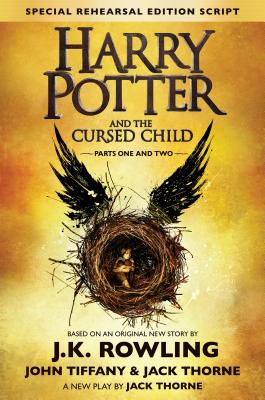
Harry Potter and the Cursed Child

cursedchildby J. K. Rowling, John Tiffany, and Jack Thorne
First sentence: “A busy and crowded station.”
Support your local independent bookstore: buy it there!
Content: There’s nothing “objectionable” for all the Harry Potter fans out there, but know that 1) the format may make it challenging for some kids and 2) the book has adult sensibilities — even though the protagonists are 14-year-olds, there’s a lot about parent-child relationships. Even so, I’ll probably put it in the YA section (grades 6-8) with all the other Harry Potter books.

No spoilers, just thoughts.

  1. Like I’ve read just about everywhere: it was nice to revisit this world. I missed the world building that Rowling did with her prose. Rather, I spent the time wondering how on earth they were going to stage this thing and wishing I could see it live.
  2. I enjoyed the exploration of what being the child of a very famous person could be like. And how parents too often project their wants and desires onto their children. The tension between Harry and Albus, while not really explored too much, was interesting.
  3. The plot itself was kind of silly. It really was just a way to have yet another magical adventure in the world that Rowling created. Real life is kind of boring (don’t we all know), and it was fun to dream up another adventure for Harry and crew, but, yes, it was silly.
  4. M had a problem with the portrayal of Ron, and I agree: he’s not just there for laughs.
  5. I really enjoyed Albus’ and Scorpious’s friendship. I wish that were explored more, outside of a silly time traveling adventure.

So, final thoughts? It’d be a blast to see, it was fun to read, but there’s a large part of me that wishes Rowling would go back and do prequels instead of keeping up with Harry. A Maurader’s book? I’d totally be on board with that.
With Malice

withmaliceby Eileen Cook
First sentence: “I’m not a morning person.”
Support your local independent bookstore: buy it there!
Review copy provided by the publisher.
Content: There’s a handful (less than six) of f-bombs, some reference to teen drinking and sex. It’s in the Teen section (grades 9+) of the bookstore.

Jill wakes up in a hospital, with no memory of anything in the past two months. She’s told two things: she was in a car accident on her school trip in Italy and her best friend, Simone, is dead. Oh: and she’s being investigated with murder.

It’s a simple plot, as we go through Jill’s recovery and her attempts to reclaim her memory. We read through police interviews with people who were close to both Jill and Simone and with those who were on the Italy trip with them. We go through blog posts for people who believe that Jill is guilty, and see the spin that the expensive lawyer Jill’s dad hires puts on everything. What we don’t have is Jill’s experience in Italy.

Which means, while this book doesn’t have much going for it with plot, it’s still incredibly gripping. Even though it’s a first person narrative, because of the accident, you don’t know what’s truly a “memory” for Jill, and what she’s just recreated from what other people have told her. It really is left up to the reader to decide guilt or innocence, and it’s a fascinating experience.

I couldn’t put it down.

The Ask and the Answer

askandanswerby Patrick Ness
First sentence: “‘Your noise reveals you, Todd Hewitt.'”
Support your local independent bookstore: buy it there!
Others in the series: The Knife of Never Letting Go
Content: There’s some violence, but nothing gory, and there’s a few mild swear words. It is, however, not for the faint of heart. It’s in the Teen section (grades 9+) of the bookstore.

Spoilers for the first one. You’ve been warned.

Todd and Viola thought they were going to find relief in Haven when they got there. What they found, though, was that Mayor Prentiss had beat them there, taken over the town in a bloodless coup, and is in power. Scary.

He separates Todd and Viola, taking him under his wing and threatening her life if he doesn’t comply. He sends Viola to live with the women in the healing houses. Where she meets the leader of the resistance, Mistress Coyle, and becomes involved with them. Neither one knows, for a good portion of the book, whether the other is alive. The only thing they do know is that they can’t trust anyone.

It’s a harrowing book: there are abuses towards women and towards the alien Spackle. And I can see what Ness is doing here: how many people do what their awful leaders tell them to do just because it’s the path of least resistance. And whether or not people fighting against a dictator can be consider terrorists. Like the first one, there’s a lot to think about. And even though it’s good, I found it hard to get through. Mayor Prentiss is a despicable character (maybe not as bad as Leck, but close) who does awful things and it made this book difficult to read, emotionally.

Which means, I think, that Ness did his job. And I’m wondering where the last book will go.

And I Darken

andidarkenby Kiersten White
First sentence: “Vlad Dracul’s heavy brown descended like a storm when the doctor informed him that his wife had given birth to a girl.”
Support your local independent bookstore: buy it there!
Content: There’s a lot of violence, an almost-rape, and some round-about talk of sex. It’s in the Teen (grades 9+) section of the bookstore, but I would give it to a 7th or 8th grader who was interested in historical fiction.

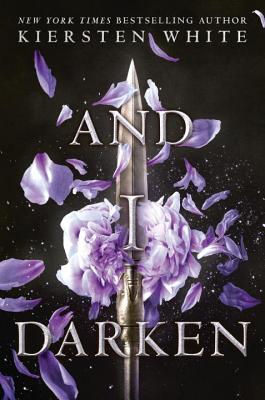
Historical fiction, set in the 15th century, isn’t always something that jumps off the shelf at me. But the cover of this one was SO pretty… And, I admit: I was expecting a fantasy. What I got was a sweeping history of the Ottoman empire, of two siblings — children of the Dracul line — and the paths they forged for themselves against odds.

What I got was a fascinating love triangle (brother and sister in love with the same man), one that was built on friendship and trust and where none of them could be entirely happy. It was the story of a girl who refused to be coddled and took power for herself — Lada is nothing if not fierce — in unique and interesting ways. It’s a story of forced immigration and learning to be at home in a new place. (Or not.) It’s fascinating.

But it was also long; the book begins with Lada’s birth and goes for twenty years. It’s sprawling, complex, and not a little meandering. There were a ton of characters to keep a handle on, most of which I didn’t care about. I didn’t care about the campaigns and there wasn’t enough of the politics I found fascinating. Perhaps I’ll read the second (yeah, this is a first in a series), but I don’t know.

There was much to like about this book. I’m just not sure if it was enough.

The Knife of Never Letting Go

knifeofneverby Patrick Ness
First sentence: “The first thing you find out when yer dog learns to talk is that dogs don’t got nothing much to say.”
Support your local independent bookstore: buy it there!
Content: There’s the anxiety factor plus a lot of violence plus the f-bomb a couple of times (though the main character says “eff” a lot). It’s in the Teen (grades 9+) section of the bookstore.

Todd is the last boy in Prentisstown in the New World. He’s waiting for his thirteenth birthday, which will come soon, and then he will become a man and join the other men in the town (and there’s only men). It’s an interesting place, this New World — there’s a virus that makes men’s thoughts (and only men, not women) audible, so not only is there no secrets, it’s chaotic hearing everyone else’s thoughts. But, as Todd is out gathering apples in the swamp, he encounters something he’s never experienced before: silence. Quiet. A gap in the Noise which turns out to be a girl.

Viola is part of a new wave of settlers to the New World, on the initial scouting ship. Her parents died in a crash, and when she finds Todd, she’s on the run from Aaron, who is Prentisstown’s fanatic religious leader. Then Todd is sent into exile and he and Viola are on the run, one step ahead of not only the insane Aaron, but the controlling mayor of Prentisstown and his army of fanatics.

There’s way too much to unpack in this novel in a blog post. Seriously. I’m glad I’m reading this as part of a book group, because I don’t think I could even begin to process it on my own. It’s a weird sort of mix between old-timey (the book is in a sort of dialect) Western and science fiction-y futuristic. It’s a survival story with a hint of dystopian. It’s weird and wild and gave me anxiety over and over again (!) and I practically read the whole 480 page book in two sittings. It’s engrossing and there’s so much to discuss. And even though it was written eight years ago, it’s still so very relevant.

My only complaint? The cliffhanger ending. ARGH. I’m just glad I can pick the next book up and read it right away, and I don’t have to wait for it to come out.

If I Was Your Girl

ifiwasyourgirlby Meredith Russo
First sentence: “The bus smelled of mildew, machine oil, and sweat.”
Support your local independent bookstore: buy it there!
Review copy pilfered off the ARC shelves at my place of employment.
Content: There’s some almost sexytimes, teen pot smoking and drinking, and a few instances of the f-bomb. It’s in the Teen (grades 9+) section of the bookstore.

I’m going to get this out of the way, first. Whether or not this book is Good, it’s Important. It’s a book about a trans teenage girl written by a trans woman, and that perspective is invaluable. Period.

It’s an interesting plot, though, focusing not on the act of transitioning, or the reasons of transitioning (those come through flashbacks throughout the story), but the after-effects of the transition. Andrew grew up knowing he was a girl, and that he was just in the wrong body. And after a suicide attempt, his mother approved his transitioning — not just in name, Amanda now, but fully, with hormones and surgery. So, when she’s beaten up by a man for using the “wrong” restroom (because she was known in the their town; also, how very timely…) she heads to rural Tennessee to live with her father, who bailed on the family when Andrew began his transition to Amanda.

The goal is to pass: she is beautiful, and no one really can “tell” she wasn’t always biologically a young woman. And, at first, it all goes well. Sure, she’s hiding her past, but she’s living as her truest self, so it all seems like it will be okay. She has friends for the first time in a long time. She has a boyfriend. The problem is that even though she’s living as her truest self, keeping her past a secret isn’t always a comfortable thing.

(I hope I’m writing about this right.)

What this gave me, as a cisgender straight woman, was perspective. I did enjoy the romance; Amanda and Grant were super cute together and Russo does know how to write some good almost sexytimes. But what I found I enjoyed more was the understanding, the humanizing of Amanda. I’ve said that books are an excellent way to gain empathy for those who are different from you, and this was no exception. I feel like, through Amanda, I got to know one trans person’s story. And while that’s not to be taken as Everyperson’s story — as Russo points out in the note at the beginning of the book  — it’s a start. It made Amanda’s hopes, dreams, and feelings real to me, and that’s important.

So, even if this book wasn’t any Good (and it was very well written; Russo does know her South!), it’s Important. And that counts for a lot.

Outrun the Moon

outrunthemoonby Stacy Lee
First sentence: “In my fifteen years, I have stuck my arm in a vat of slithering eels, climbed all the major hills of San Francisco, and tiptoed over the graves of a hundred souls.”
Support your local independent bookstore: buy it there!
Review copy provided by the publisher.
Content: There’s some violence (done my Mother Nature) and some horrible people saying horrible things. Also, an illusion to sex (by minor adult characters). It’s in the YA section (grades 6-8) of the bookstore.

Mercy Wong has Aspirations and Goals. She wants out of Chinatown, where the whole of San Francisco in 1906 wants to keep her and her family. She wants more than marriage (though she does like Tom, the son of a respected apothecary). She wants to Be Somebody. And, she’s decided that St. Clair’s School for Girls is the way to get it. She bargains her way in, and discovers that things aren’t always as simple as they seem. Then the earthquake hits, and when everything comes crashing down around Mercy, she discovers that perhaps the best things in life are friends and a bit of determination.

This really was a nice combination of historical — the dresses and rules of etiquette and restrictions on women — and modern, with Mercy’s progressive ideas and determination to do things without the permission of authority figures. Lee did a great job balancing the two, so it never felt too modern, nor too old-fashioned. I appreciated seeing San Francisco through a Chinese girl’s point of view, and Mercy really is one of those characters you just want to root for. I liked that while there was a romance, it didn’t dominate the story, and that Mercy was enough of her own person to make the romance believable rather than sappy.

I should go back and read Lee’s first book; I’ve heard good things about it. And if it’s anything like this one, it’s sure to be good.

Summer Days and Summer Nights

summerdaysedited by Stephanie Perkins
First sentence: “There were a lot of stories about Annalee Saperstein an d why she came to Little Spindle, but Gracie’s favorite was the heat wave.”
Support your local independent bookstore: buy it there!
Content: Some stories are sweary (including f-bombs), some have drinking. I don’t think there’s any sex (maybe some references to it, but none actual.) It’s in the teen section (grades 9+) of the bookstore.

Short story collections are hard books to talk about. Do you talk about the theme as a whole — ah, swoony summer romance, how wonderful it is? Or do you talk about individual stories, and how they resonate with you? (And how hard it is to actually read short stories? You get going and settled in the story and then it ends. *sigh*)

I did love that the stories by authors I knew absolutely fit them: Libba Bray of course would write a story about a haunted classic movie. Stephanie Perkins’, Nina LaCour’s, and Jennifer Smith’s stories felt like their books. Cassandra Clare’s was kind of lame (it was supernatural, sure, but underdeveloped). Some were definitely better than others: I really like Brandy Colbert’s story as well as Lev Grossman’s.  And surprisingly, Veronica Roth’s story made me tear up.

Is it something I’m going to come back to over and over again? No. But that’s the nature of short stories: they’re there, and they disappear as quickly as they come. But, I did enjoy the time I spent with it.

When Friendship Followed Me Home

whenfriendshipby Paul Griffin
First sentence: “You’d have to be nuts to trust a magician.”
Support your local independent bookstore: buy it there!
Review copy provided by the publisher.
Content: It’s not a difficult read, and there’s nothing objectionable, but the subject matter is probably more serious than your average 8- or 9-year-old will want. That said, if they’re interested, I’d give it to them. It’s in the YA section (grades 6-8) of the bookstore.

Ben has had a rough life. He was dropped off at a group home when he was a baby, abandoned by his mother. He made friends, but one of them died after an accident. That lead to him meeting a social worker, an older woman whose partner had died, and him being adopted by her. Everything was looking up, especially after he found a stray dog (who ended up being the dog of a woman who had recently become homeless) and met a new friend, Halley, who is in remission from a rare cancer.

If you’ve read ANY middle grade/YA books, you know where this one is headed.

On some level, I wanted to be annoyed with this book. I felt like Griffin employed every single cliche out there: Manic Pixie Dream Girl, Dead Parents, Bad Parents, Cancer Book, it’s all in there. I wanted to be annoyed at it. I was a little frustrated when I realized the direction it was taken. But… I didn’t hate it. I didn’t.

Partially, it’s because it’s self-aware. There’s one quote, early on when Ben and Halley are talking about a story they’re writing, where Halley says, “Well, you have to get rid of [parents] somehow, and that is the most merciful yet expeditious way. Otherwise how do you turn her into an orphan? This is a middle grade story, for like ages ten to fourteen, and the rule is you need an orphan.”

I laughed, and as the book went on, I realized that Griffin knew what he was doing. He was Making Points, but subtly, and I didn’t hate him for his messages. I liked Ben and Halley and Flip the dog, among other characters, so I could get past the messages. And even though I wasn’t Moved by the book, I did enjoy reading the stories. And it was, in fact, written well.

So, I’m torn. I didn’t Love it like I wanted, but I didn’t loathe it either.

The Museum of Heartbreak

museumofheartbreakby Meg Leder
First sentence: “In her junior year of high school, Penelope Madeira Marx, age sixteen going on seventeen, experienced for the first time in her young life the devastating, lonely-making, ass-kicking phenomenon known as heartbreak.”
Support your local independent bookstore: buy it there!
Review copy provided by the publisher.
Content: Lots and lots of swearing. So much that it landed itself in the teen (grades 9+) section of the bookstore.

Penelope has been friends with Audrey and Eph for forever. They’ve been a trio, with traditions and in-jokes, and Penelope loves it that way. She loves the consistency, the predictability, the comfort of it all. Except, in their junior year, things aren’t right. Audrey has been going off with another girl, one who is mean to Penelope, and Eph is, well , increasingly distant. Things just aren’t the same.

The best thing about this book (well, aside from Pen and Eph; they’re both fantastic characters) is the format. Every chapter starts with an “artifact” from Pen’s friendship history. A sweatshirt, a piece of paper, a toy. A memory, a connection. It’s very much a book about things falling apart, about changes that are spiraling out of control. The format fit the theme of the book, which I found wonderfully delightful.  (Even the douchebag characters who totally deserved everything.)

In fact, I found the whole thing delightful. A perfect summer read.