Module 8: The Drowned Cities

Bacigalupi, P. (2012). The Drowned Cities. New York, NY: Little, Brown and Co.

Genre: Speculative fiction: science fiction, post-apocalyptic/dystopia, Earth’s future.

Book Summary: “War maggots” Mahlia and Mouse have their existence in the jungles of a war-torn future America figured out: Mahlia has apprenticed herself to a pacifist doctor and even though the villagers don’t particularly like her, she makes do. And Mouse, who saved her life once, is her faithful sidekick. That is, until a bioengineered war creature called Tool escapes his prison and ends up in Mahila and Mouse’s neck of the woods. Suddenly their life is gone: Mouse is taken by the soldiers and Mahlia escapes with Tool. From there, both friends will do what they need to survive, but perhaps the cost of  maintaining their is too high?

Impressions: This was fascinating. It took me a while to get into the book, mostly because I haven’t read Ship Breaker, but eventually I got hold of the world that Bacigalupi has built and fell into the book. It’s not a happy book though: Bacigalupi is very frank about the effects of war, and what that does to everyone: civilians, soldiers, leaders. It wasn’t a bleak, hopeless view though: Bacigalupi makes the reader care about his characters, and gives them — even Tool — a humanity that transcends the situations. I was a bit worried about 3/4 of the way through, wondering how he was going to wrap it up (and, to be fair, there is a proper sequel to this one — Tool of War — that properly finishes the story), but he managed very well. It was a satisfying ending, and while it left things open for the next story, it wraps this one up quite nicely. It’s definitely beautifully written, and it nails a lot of current issues — of violence and tribalism, especially — on the head.

Review: The reviews I read praised the world building and the action of the series, as well as Bacigalupi’s frankness when it comes to war. The staff review writes, “Beautifully written, filled with high-octane action, and featuring badly damaged but fascinating and endearing characters, this fine novel tops its predecessor and can only increase the author’s already strong reputation.”

Staff. (2012). Children’s reviews. Publisher’s Weekly. 259 (11), n.a.

Library Uses: This would go great on a “books about climate change” display, as well as a general speculative fiction display. It also needs to be in a book group; there is so much to discuss!

Readalikes:

  • The Knife of Never Letting Go by Patrick Ness: This one is aliens rather than post-apocalyptic, but it has the same themes of tribalism, war, and understanding the “other”. Also, everyone should just read it.
  • Undertow by Michael Buckley: In this near-future, some humanoid creatures have come out of the ocean and tried to settle on land. There is tension (obviously) between them and the humans. This explores the tribalism angle as well.
  • The Fog Diver by Joel Ross: An environmental Earth future mashed with steampunk: Earth was destroyed through chemicals, which produced a “fog” that covered the world, so humans moved to the skies. Some fantastic action.
  • And, obviously, Mockingjay by Suzanne Collins: This is the closest read alike to The Drowned Cities, but I think Bacigalupi does what Collins was trying to do SO much better.

Ninth Ward

by Jewell Parker Rhodes
First sentence: “They say I was born with a caul, a skin netting covering my face like a glove.”
Support your local independent bookstore: buy it there!
Content: There are some intense moments, but it’s written very simply. It’s in the middle grade (grades 3-5) section of the bookstore.

Lanesha lives in New Orleans’ Ninth Ward, one of the poorest sections of the city, with her Mama Ya-Ya, who is the woman who delivered her, because Lanesha’s mother has passed on and her extended family doesn’t want her. But, even though they’re poor, Lanesha’s happy. That is, until a storm — Hurricane Katrina — comes riding in. Mama Ya-Ya passes on in the middle of the storm, and Lanesha is left to figure out how to ride out the flooding that came after the hurricane by herself.

I adore Rhodes, and the way she takes tough issues and makes them really accessible to younger readers. She knows her audience, knows how to talk to her audience, and knows how to make difficult subjects into a gripping, interesting, compelling story. This one is no exception (I hadn’t read it before!). The only difference with this one is that it has ghosts. Lanesha has the ability to see those who have passed on, and can even talk to them. (Which makes me wonder why this one ended up in the “realistic fiction” section of my children’s lit class…) Even so, the ghosts don’t seem out of place; it is New Orleans after all. And even though the ghosts play a role in resolving the ultimate conflict, I think Rhodes did an excellent job in making this a real middle grade novel, with the action being propelled forward by the children.

Excellent. But that’s no surprise.

Midwinterblood

by Marcus Sedgwick
First sentence: “The sun does not go down.”
Support your local independent bookstore: buy it there!
Content: There is some violence, and it’s a complicated story. It would be in the Teen section (grades 9+) of the bookstore, if we had it.

This one is SO hard to describe. Possibly because I think it really is best if you don’t know very much going in.

So know this: the stories are connected, going backward in time. Not directly connected; that tripped me up in the beginning – I kept expecting people to be related, but they’re not. The names are similar, the setting — the Blessed Island, a mysterious place somewhere in the northern ocean — is the same. But, while the stories are connected, it’s not a direct connection.

Also know this: how confused you are, how strange you think it is, you need to stick it through all the way to the end. Do that, and you will be rewarded. It will all make sense, it will all pull gloriously together, and it will be worth it.

I’ve never read anything like this before, and I’m sure this one will stick with me for a long time.

Daughter of the Siren Queen

by Tricia Levenseller
First sentence: “The sound of my knife slitting across a throat feels much too loud in the darkness.”
Support your local independent bookstore: buy it there!
Review copy provided by the publisher.
Release date: February 27, 2018
Others in the series: Daughter of the Pirate King
Content: There is violence, obviously, and a LOT of sexual tension and kissing, but nothing ever happens. It’ll be in the the YA section (grades 6-8) of the bookstore.

Spoilers for Daughter of the Pirate King, obviously.

Picking up where we left off, Alosa has a copy of the map to the secret Isla del Canta, where the legendary treasure of the sirens lay. Initially, she plans to help her father find it, and then help rule the seas with him. Except, when she and her crew show up at the keep, Alosa discovers a secret that turns everything upside down. Suddenly, Alosa and her crew are no longer working with her father, they’re racing against him. And it will take everything that Alosa has to beat him to the island, and ultimately, defeat him.

Again: So. Much. Fun. There really isn’t a whole lot more to these (except for a very woke love interest), but man, female pirates are fun. Alosa is a great character, and I loved her relationship with Riden and with her crew. I loved that Levenseller was ruthless; she killed characters I thought were safe, which upped the ante and made the tension that much greater. I have a slight quibble with the end, but I’m going to let it go because it really was just fun to read.

And… it’s only a duology! So the story wrapped up. YAY! That said, I wouldn’t mind spending more time with Alosa and her crew again.

Module 4: The Grey King

Cooper, S. (1975). The Grey King. New York, NY: Scholastic.

Genre: Fantasy, Newbery winner. Definitely fantasy, as it pulls from mythology and uses magic. And a good example of a Newbery winner.

Book Summary: Will, who in an earlier book in the series realized he was an Old One, and tasked with protecting the world from the rising forces of the Dark, is convalescing in Wales, recovering from a bout of hepatitis. While there, he meets Bran, a strange local boy who helps Will fulfill part of a prophecy by stopping the Grey King from garnering his forces and waking the Sleepers in preparation for the final battle.

Impressions: This is the fourth in a series, so reading it as a stand-alone probably isn’t recommended. However, I routinely re-read the second, The Dark is Rising (which, incidentally, does work as a stand-alone), so I felt comfortable dipping into this world out of order. However, for those who approach this as a stand-alone will probably be lost. There is a lack of character development, especially with Will (because you’re already supposed to be familiar with him), but also Bran, though he has a greater character arc. Cooper is a master storyteller, deftly weaving personal concerns — the neighbor who is convinced that Will’s uncle’s dogs are killing his sheep — with a greater sense of menace and tension. There is a moment when Bran’s dog is killed, and the tension between Bran and Will is palpable, especially because, as a reader, you can relate to Bran’s frustration with being a player in a higher plan and struggling with a sense of a loss of freedom because of that. Cooper’s writing is tight and elegant as well, accessible enough for younger readers (though probably not as young as eight), but smart enough to keep an adult turning pages. My only issue is that in spite of the “lesson” on speaking Welsh, I know I still don’t pronounce the names right in my head. But that’s a minor quibble. It is also one of those Newbery winners that not only deserves the award — it really is an excellently written book — but has held up as a timeless story over the past 40 years.

Review: The School Library Journal wrote that, in spite of lacking in character development, the book added much to the high fantasy genre, with the  most intriguing thing being the dichotomy between the plain lives of the Welsh sheepmen and the higher, mythical role the land — and Will — plays around them.

Wilton, S. M. & Gerhardt, L.N. (1975, October). Book reviews. School Library Journal, 22 (2). 104-105.

Library Uses: I would put this one on a display of fantasy books, series books, or older Newbery winners that are still great to read.

Readalikes:

  • Before I give other recommendations, I ought to recommend the most obvious and suggest reading the rest of this series: Over Sea, Under Stone; The Dark is Rising; Greenwitch; and Silver on the Tree.
  • The Prydian Chronicles, beginning with The Book of Three, by Lloyd Alexander: While not specifically set in Wales, this series is probably the most like Susan Cooper’s books. It has the Welsh feel, the struggle between Dark and Light, and a male main character who finds out he is More than he originally thought.
  • The Raven Cycle, beginning with The Raven Boys, by Maggie Stiefvater: This one is loosely based on Welsh mythology, though Stiefvater says that Cooper’s books were an inspiration for it. A group of four boys and one girl, the daughter of psychics, set out looking for a dead Welsh king in the hills of Virginia. Conflict, magic, and epic writing follow.
  • The Merlin Saga, beginning with The Lost Years, by T. A. Barron: I found there is a lack of Welsh fantasy books for kids (though there is more for adults), so I tapped into the Arthurian side of Cooper’s books. Barron’s series is the definitive works for kids interested in Merlin and Arthurian legend. The books follow Merlin as he becomes a powerful wizard.

The Belles

by Dhonielle Clayton
First sentence: “We all turned sixteen today, and for any normal girl that would mean raspberry and lemon macarons and tiny pastel blimps and pink champagne and card games.”
Support your local independent bookstore: buy it there!
Release date: February 6, 2018
Content: There is some physical and emotional abuse and an attempted rape scene, but it’s not overly graphic. It will probably be in the YA section (grades 6-8) of the bookstore.

Camille is one of the Belles, the only people in the kingdom of Orléans who was born with color and who have the ability to manipulate the bodies of everyone else, and she is determined to be the favorite of the Queen. This means she’s the best, the chosen, the, well, favored.  Only she’s not chosen to be the favorite… and from there, she starts unraveling the mystery that is the Belles, and discovers the lengths that the royals will go to keep the Belles in their control.

So the tagline on the ARC was “the revolution is here” which is REALLY misleading, so I’m glad they changed that. This is a very long (almost overlong), very opulent, set up to whatever is going to happen in the next. There’s a lot of world-building here, and quite of bit of it leaves questions hanging. We discover things as Camille discovers them, which means we are left as frustrated and impatient as she is. I liked the world and I liked the characters… for me the downfall was just the descriptions. Everything was food (buttercream, chocolate, caramel, honey) and fabric, and I felt almost smothered in it all. Underneath, I could sense a criticism of plastic surgery, of the desire to change one’s appearance, but I’m not sure I could find it underneath all the clothes and makeup. But that’s just me (though I do admit that I’m curious about the sequel). There will be readers who gobble this up and love every minute. I’m just not one of them.

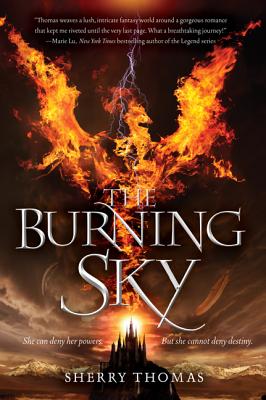
The Burning Sky

by Sherry Thomas
First sentence: “Just before the start of Summer Half, in April 1883, a very minor event took place at Eton College, that venerable and illustrious English public school for boys.
Support your local independent bookstore: buy it there!
Content: There is some violence and some mild swearing. It’s in the YA section (grades 6-8) of the bookstore.

Iolanthe was enjoying a quiet life with her guardian, Master Heywood, in a small town, when her life gets turned upside down. It was simple enough: she was trying to salvage a ruined light elixer, and brought down lightning from the sky. That simple (well, maybe not) thing brought not only the crown prince, Titus, to her doorstep, but the dreaded Inquisitor, and sent Iolanthe into hiding with Titus as she learned her True Purpose: to overthrow Atlantis and kill the Bane, Atlantis’s unkillable leader.

It’s pretty by-the-numbers — of course Titus and Iolanthe are taking on the Big Bad Guys, of course they fall in love. But, I still found myself enjoying this. Perhaps because it’s kind of a reverse Harry Potter — Iolanthe and Titus come from the magical world to go to school at Eaton where they not only have to pass as non-magical but Iolanthe also has to pass as a boy. It’s an interesting world Thomas has built, with the elemental vs. subtle (learned) magic, with dragons and wyverns and wands and potions. I liked it quite a bit. Maybe not enough to continue on with the series, but still. It’s an intriguing start to a series.

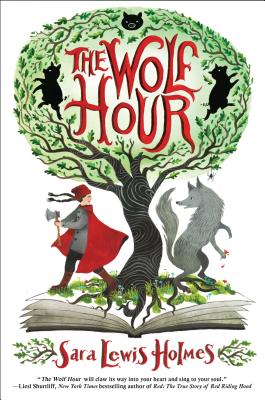
Audio book: The Wolf Hour

by Sarah Lewis Holmes
Read by David de Vries; Thérèse Plummer
Support your local independent bookstore: buy it there!
Listen at Libro.fm
Content: There is violence, though none of it is graphic. There are some biggish words, as well. It’s in the Middle Grade (grades 3-5) section of the bookstore.

Magia lives on the edge of the Puszcza — a huge, dark, magical forest — with her woodcutter father, mother, and siblings. Her mother has big dreams for everyone: Magia’s sister is going to be a healer, her brother a solder. And her mother wants Magia to be a singer. Except Magia wants to be a woodcutter like her father. But, she’s a good daughter, so she goes to music lessons with Miss Grand… and gets stuck in a story. And not a happy one at that.

I really liked this play and mashing of the Red Riding Hood and Three Little Pigs fairy tales. Actually, what I think I liked was the narration by deVries and Plummer. I loved listening to this one; it had the feel of an oral tale, and I loved how deVries and Plummer interpreted the text. Their narration kept me engaged with a text that I probably would have dismissed otherwise. But, because of that, I stuck through it. And while I wondered if there would be a happy  (or even hopeful) ending because Holmes kept the tension in the story going for a lot longer than I expected, it all does resolve well. Which was a nice touch.

In the end: surprisingly good.

The Cruel Prince

by Holly Black
First sentence: “On a drowsy Sunday afternoon, a man in a long coat hesitated in front of a house on a tree-lined street.”
Support your local independent bookstore: buy it there!
Review copy provided by the publisher.
Content: It’s violent. And dark. It’s in the Teen section (grades 9+) of the bookstore, but I’d give it to a willing 7th grader.

Jude has lived in Faerie ever since she was 10, when her mother’s first husband, a faerie general named Madoc, came to the human world and slaughtered her parents, and spirited away her, her twin sister, Taryn, and her mother’s first child, Vivian. It’s not been a comfortable life, being a human in Faerie, but Jude had made do. In fact, she’s done better than that: in spite of her terror at everything (because her life is constantly in danger), she has learned to fight, to strategize, and to, well, thrive.

And so when, as Faerie prepares to crown a new High King, she gets involved in the Court drama, she feels capable of handling what’s thrown at her. Except, things don’t quite go the way she thinks.

I loved this one. I like faerie stories generally, and Holly Black’s are particularly gorgeously told. I loved the dark undertones, and I loved the way Jude worked with her limitations and made the best of her situations, the way she played the situation. And, since this is the first in a series, I can’t wait to see how it all will play out in the next one.

Cybils Reading Round-Up, Part 2

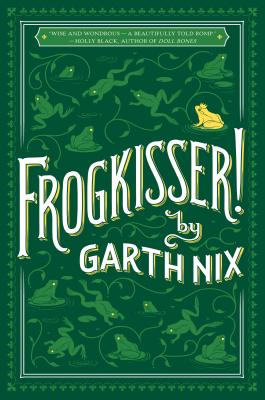
Frogkisser!
by Garth Nix
First sentence: “The scream was very loud and went on for a very long time.”
Support your local independent bookstore: buy it there!
Content: There’s really nothing “objectionable”, but it just feels… older. It’s in the YA section (grades 6-8) of the bookstore, but I’m sure a fifth grader who really likes quests and/or fairy tales would enjoy it too.

Anya is a princess in a minor kingdom, whose parents have died and left her and her older sister to be raised by her stepmother (who is off doing…something) and her husband (whom Anya calls her “stepstepfather”), who is trying to take over the kingdom. So, Anya is sent on a Quest, nominally to find the ingredients to make a lip balm to turn Prince Duncan back from a frog, but ultimately, for control of her kingdom.

It’s a charming little tale; I enjoyed the fairy tale references (Snow White is a male wizard, etc.) and it was mildly funny, but honestly, it was just too long. I lost interested about 23 of the way through, and skipped to the end to find out how it all finished, and I don’t feel like I missed much. I’m sure it’s enjoyable; I just don’t have the patience for it right now.

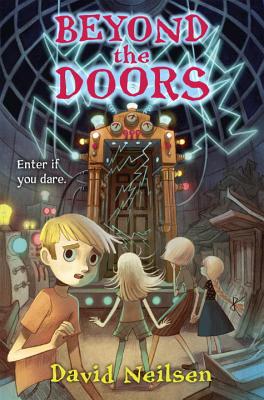
Beyond the Doors
by David Neilsen
First sentence: “Edward Rothbaum was in a grumpy mood.”
Support your local independent bookstore: buy it there!
Content: It’s a bit odd; it’s long, but there are interior illustrations, so it’s like the publisher (what’s up Random House?!) couldn’t figure out if it was for the younger or older end of the middle grade spectrum. It’s in the Middle Grade (grades 3-5) section of the bookstore.

The Rothbaum’s mom has been missing for years, and then a freak fire leaves their dad in a coma. So they’re bundled off to their (previously unknown) Aunt Gladys’s house, where there are no doors and nothing to eat but cereal. And Gladys is a bit… off… as well. Through some digging, the Rothbaums discover the real secret: their grandfather discovered an ability to jump into memories, and has gotten stuck there. And it’s up to the kids to figure out how to solve the problem.

This was fun. Nothing super brilliant, but I liked the kids and the idea of memory jumping is a clever one.

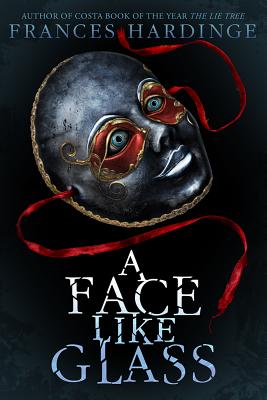
A Face Like Glass
by Frances Hardinge
First sentence: “One dark season, Grandible became certain that there was something living in his domain within the cheese tunnels.”
Support your local independent bookstore: buy it there!
Content: It’s long and slow moving. So, maybe not for a reluctant reader. It’s in the Young Adult section (grades 6-8) of the bookstore.

Neverfell is an outsider in the world of Caverna, an abomination… because you can see her emotions on her face. So, when Neverfell gets caught up in court politics, the fate of Caverna lies within her hands.

I usually like Hardinge’s books, but this one just fell flat for me. I wanted to like it, and I liked parts of it, but it was just… too long. And it didn’t hold my interest. I would put it down for days and just not care enough to pick it back up. (I would have abandoned it, except for the Cybils.) It’s not that it was badly written, or a bad story… it just didn’t hold my interest. So maybe it was more me than anything else.

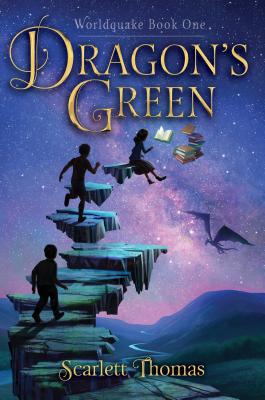
Dragon’s Green
by Scarlet Thomas
First sentence: “Mrs. Breathag Hide was exactly the kind of teacher who gives children nightmares.”
Support your local independent bookstore: buy it there!
Content: There are a few scary bits. It’s in the middle grade (grades 3-5) section of the bookstore.

Effie Trulove’s grandfather spent time teaching her about the magical world, and even though she’s not quite sure she believes him, it was spending time. But, he’s passed on, and suddenly Effie’s thrown into situations where she comes to realize that, yes, her grandfather wasn’t making things up: there really is magic. So with the help of her trusty new friends, she can defeat the Bad Guys (who are out to steal all the magic books), and figure out her place in the magic world.

I said, once, that silly names and magic don’t a fantasy make. And I think that holds here. The names bugged me (so very much), as did the gendering of  the friends (the boys were the Warrior and Scholar, the girls were the Witch and the Healer, though Effie was the Hero). I thought it would have more of a D&D feel, and be predictable that way, but it veered a bit from that, which was nice. It just… bugged me, in the end. I’m not sure I can really put my finger on why. But this was was most definitely not for me.