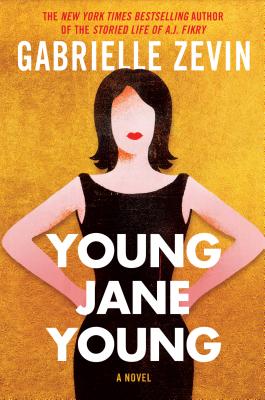
Young Jane Young

by Gabrielle Zevin
First sentence: “My dear friend Roz Horowitz met her new husband online dating, and Roz is three years older and fifty pounds heavier than I am, and people have said that she is generally not well preserved, and so I thought I would try it even though I avoid going online too much.”
Support your local independent bookstore: buy it there!
Review copy provided by the publisher.
Content: There’s swearing, including several f-bombs, as well as some off-screen sex. It will be in the adult fiction section of the bookstore.
Release date: August 22, 2017

The relationship between mothers and daughters (and between women in general) is not a new topic for fiction. It’s been Done.  And yet, Zevin — through this tale of an intern, Aviva, who has an affair with her boss, who just happens to be a congressman — manages to make this tired trope fresh. We get the story from four perspectives: Rachel, Aviva’s mother ; Aviva — both then and now, as Jane; Ruby, the intern’s daughter; and the congressman’s wife. It’s a unique way of telling the story, in bits and pieces (you don’t get Aviva’s then perspective until the very end, and it comes as a sort of “choose your own adventure” tale, one in which she wishes she could change her decisions), and from different perspectives. Choices have consequences, more so for women in these situations (so, whatever did happen to Monica Lewinsky?) than for men. It’s a fascinating study of our scandal-obsessed culture (really, are famous people’s private lives really news?) and how we’re much more willing to forgive men than we are women. (I think that’s the most biting thing: that Aviva is much more harshly judged than the congressman ever was.) And how relationships between mothers and daughters are not always straightforward. And what one person says isn’t always what the other person hears.

I love the way Zevin spins a story, and the way she is able to make characters pop to life. She doesn’t dumb down the kids (or make them too precocious; Ruby was the right balance of nerdy and eager), and she makes everyone sufficiently complicated.

Definitely highly recommended.

A Man Called Ove

by Fredrik Backman
First sentence:”Ove is fifty-nine.”
Support your local independent bookstore: buy it there!
Content: There’s swearing, including some f-bombs. It’s in the adult fiction section of the bookstore.

Ove’s beloved wife died six months ago. And he’s been at a loss ever since. He’s gone to work, but since he was terminated, he’s really lost all purpose. So, he’s decided to kill himself. That is, until his new neighbors — Parvanah and her husband and children — decide to nose their way into Ove’s life.

It’s a simple plot, but it’s not the plot that makes this this book a good one. I have one HUGE quibble with it though: Ove is NOT fifty-nine. I know it says that in the first sentence, but he doesn’t act like a 59-year-old. he acts like mt grandpa did when he was 85 or so. So, once I aged Ove up about 20 years in mt mind, I was able to sit back and enjoy the story. I loved Parvanah, and her big heart and stubborn refusal to leave Ove alone. Ove reminded me of my grandpa, and so I knew there was a good heart under his crusty exterior, but I enjoyed the unfolding of the story, and the way those in his life included him. It was heart-warming and a lovely reminder that there are good people out there.

A very good story.

A Conjuring of Light

by V. E. Schwab
First sentence: “Delilah Bard – always a thief, recently a magician, and one day, hopefully, a pirate — was running as fast as she could.”
Support your local independent bookstore: buy it there!
Others in the series: A Darker Shade of Magic, A Gathering of Shadows
Content: Swearing (including f-bombs) and violence mostly. It’s in the Science Fiction/Fantasy section of the bookstore.

Spoilers for the other two, obviously.

When I finished the second book, I told one of my co-workers, who is also in love with this series, that I wasn’t as happy with the second book. But, I said, it’s a middle book in a trilogy. I bet (I hope!) the third will be great.

And it is.

One of the Antari (those are blood magicians, of which there are only three… now…), Holland, has unleashed a bit of sentient magic on the Londons. It came from Black London (and it’s Kell’s fault as well, thinking Holland was dead and pushing him into Black London), and it’s possessed Holland and taken over White London. And now it — Osaran is its name — has it’s sights on Red London. And maybe even Gray. And it’s up to Kell, Lilah, Rhy, and everyone, really, to stop it. If it CAN be stopped.

It’s a long book — 600 pages — but it flies by, and Schwab spares no one. It’s vicious and emotional and heartbreaking and exciting. It’s just a sweeping epic story, (mostly) well-told, and definitely one I’d recommend.


The Light We Lost

by Jill Santopolo
First sentence: “We’ve known each other for almost half our lives.”
Support your local independent bookstore: buy it there!
Review copy provided by the publisher.
Release date: May 9, 2017
Content: There’s a lot of swearing, including a bunch of f-bombs. Plus sexytimes, though tasteful. It’s in the adult fiction section of the bookstore.

When she was 21, on 9/11, Lucy met the person she thought would be her True Love. Her one and only. The person she would spend the rest of her life with. And for a while, she and Gabe were happy. They were together, enjoying each other, being in love. And then their interests diverged: Lucy was working on a children’s TV show based in New York, and Gabe got a job with the Associated Press to travel the world into war zones and take pictures. And suddenly, their lives weren’t headed in the same direction.

Lucy was heartbroken.

But then she met Darren, someone who she realized she could build a life with. She’s moved on. Until, Gabe shows up again in her life. And something drastic happens, and she has to make a life-altering decision.

I’ve had a difficult time writing this one. Partially because it left me without words. It’s well-written, but it’s not brilliant, partially because it’s cut through with New York-ness, which wore on me after a bit. It does hit all my buttons, and Santopolo does know how to write about heartbreak and loss and captured the excitement of first love, and how difficult it is to let that go.

But even so, it’s not something that will stay with me.

Homegoing

by Yaa Gyasi
First sentence: “The night Effia Otcher was gorn into the musky heat of Fanteland, a fire raged through the woods just outside her father’s compound.”
Support your local independent bookstore: buy it there!
Content: There’s non-graphic sex, a lot of swearing, violence, and general difficult situations. It’s in the adult fiction section of the bookstore.

A good, powerful look at two sisters, separated at birth — one eventually sold into slavery in America, and the other remaining in Africa — and the subsequent generations. It’s a powerful look at choices (made by and for individuals) and how those can affect not only individual lives but also generations. It’s a unique way to tell a story — every chapter is a different person, progressing through the generations — and both the writing and the actual storytelling are excellent.

It’s a haunting read, but a good one.

Small Gods

by Terry Pratchett
First sentence: “Now consider the tortoise and the eagle.”
Support your local independent bookstore: buy it there!
Content: It’s kind of stream of consciousness, without any chapters… but if you’re okay with that, then there’s nothing else to stop you. It’s in the Science Fiction/Fantasy section of the bookstore.

Outside of the Tiffany Aching books, I’ve never spent anytime in Discworld. I knew about it, of course, but I’ve never read any of the other ones. And this seemed like, well, a decent enough place to start.

It’s slow to start, and took a very meandering route to a plot. (I’m not entirely sure it really HAD a plot…)  There’s a god, Om, who used to be a Big Deal, and while he has a lot of followers (there’s a whole country and a citadel and a whole religion), he doesn’t have a lot of, well, belief. And so, he’s been relegated to being a turtle for a few years. That is, until he’s accidentally dropped by an eagle into the citadel gardens and meets Brutha. Who is just a simple novice. And who can hear Om talking in his head.

And he goes on an adventure (of sorts) to figure things out.

There’s a bit more to it than that, but it’s all a bit complex and somewhat convoluted. I will say this: it’s not Tiffany Aching, but Pratchett makes a person care about the characters. I loved Om and Brutha, and even some of the other characters. And he gently pokes fun at religion and theocracies and philosophy. It’s not my favorite Pratchett (give me the Nac Mac Feegle any day), but it was an enjoyable one to read.

A Study in Scarlet

studyinscarletby Arthur Conan Doyle
First sentence: “In the year 1878 I took my decree of Doctor of Medicine of the University of London, and proceeded to Netley to go through the course prescribed for surgeons in the Army.”
Support your local independent bookstore: buy it there!
Content: There’s some mild swearing, violence (but most of it just talked about), and some, well, murder. It’s in the mystery section of the bookstore.
So, for  book group this month, we didn’t really want to read something long (it’s a busy month for all of us), and we were thinking classics, and I hit upon the idea of each of us reading a different Sherlock Holmes short story (or two). I decided to start at the beginning (mostly because I’ve read short story knock offs of this, and I wanted to see how Sherlock’s Study in Pink held up) and read “A Study in Scarlet”.

I have read many of these stories before, though it’s been a long (!) time, and I can’t be considered a fan of Doyle’s or Holmes’s. Which means, I don’t remember the stories. At all.

Things that struck me: Holmes is much less of a jerk than he is in the BBC series. (I think he was arrogant in the old Jeremy Brett series — it’s been forever since I’ve watched those — but he wasn’t insufferable.) He’s smarter than you, but he’s not insufferable about it. He calmly explains his methodology to Watson not because Watson is stupid but because Holmes wants him to understand how he does things. He does thing Lestrade and Gregson are stupid, but that’s because they’re police and they aren’t putting the time that Holmes is in learning how to be a good detective.

Doyle also explains EVERYTHING. It wasn’t so much a mystery for the reader to solve but rather explains everything in detail, including things Holmes could never know. (See: the first five chapters of part 2.) I wanted to be able to at least attempt to solve it myself, but I guess standards for mysteries were different in the 19th century. Which leads me to the ridiculous anti-Mormon chapters. (See: the first five chapters of part 2.) They were SO pointless (except, as Hubby tells me, sensational anti-Mormon literature was in vogue in London during that time), and even though it eventually wound its way back to the story, they really didn’t serve ANY purpose. (Not to mention being wildly inaccurate: at one point, Doyle had the characters fleeing Salt Lake City headed toward Nevada and going through deep gorges and tall canyons. Hon, if you’re headed out of Salt Lake and you’re going through canyons, you’re going toward Wyoming. Toward Nevada, you’ve got nothing but desert. And that’s just the geography. I won’t even get into the religion part.)

So, did I like it? Well, it was okay. It wasn’t bad, but it didn’t knock my socks off. Maybe it was the wrong one to randomly pick (I think I like Study in Pink better….), but it wasn’t terrible, either. Maybe I’ll read another one just to see if they get any better.

Exit West

exitwestby Mohsin Hamid
First sentence: “In a city swollen by refugees but still mostly at peace, or at least not yet openly at war, a young man met a young woman in a classroom and did not speak to her.”
Support your local independent bookstore: buy it there!
Review copy floating around the office and got passed in my direction.
Content: There are a half dozen or so f-bombs, and some sort-of sex. It’s in the adult fiction section of the bookstore.

This one has got the entire staff of the bookstore all a twitter. Seriously. They LOVED it. It’s SO good. You HAVE to read it. So, when they threw it my direction, I decided to give it a try.

It’s nominally the story of a couple, Saeed and Nadia, who meet in a country that’s on the brink of a civil war. It vaguely feels middle eastern, but I don’t know if that’s because that’s me projecting, or if it’s what the author intended, but it’s what I saw. Their relationship is a fitful one at the start, but as the insurgents and rebels move into their city, their relationship picks up speed. And when Saeed’s mother is killed, they decide to leave together, to find any way out.

But it’s not really about the plot or the characters with this one. No, this is about the words. And they are gorgeous. It’s a slim novel, which shows that no word is wasted. And it feels that way, too. Every word is important, every line leads somewhere else. It is something to sink oneself into, enjoying the words on the page.

I’m usually a plot and character person, so it’s different for me to give myself over to something that’s so wholly, well, not. I enjoyed this one. Hamid gave faces and stories to refugees, to people who are fleeing their home and trying to find a new place and the way that changes a person.

It makes it worth reading.

Audiobook: Victoria

victoriaby Daisy Goodwin
Read by : Anna Wilson-Jones
Support your local independent bookstore: buy it there!
Content: There’s some illusions to sex and scandal, but mostly it’s a pretty straight-up historical fiction. Good for those who are interested in England and/or queens and/or history. It’s in the adult fiction section of the bookstore.

I have always had a bit of a weakness for historical fiction when it comes to royalty. I ate up the Phillipa Gregrory books about the Tudors back in the day, and I’m sure there’s more than I’m forgetting. I’ve had my eye on this one since it came out back in November, mostly because the cover is so pretty (and we all know I’m a sucker for pretty covers). I didn’t quite know what to expect about the book, though.

For the most part, I enjoyed it. Taking place over the first year or so of Victoria’s reign, it deals with her conflicts with her mother and her mother’s “companion” Conroy, with learning how to govern (and her dependence on, and infatuation with which was heavily played up, Lord Melbourne), and with finding her feet. It ends just as she meets and marries Albert, so there’s very little of the Victoria she came to be.

But the thing that kept me listening was the narrator. She was FANTASTIC. All the perfect inflections for every character, and she kept me wanting to know more about the characters and the story. I’m sure I would have enjoyed this one in print; Goodwin is an excellent writer, and she knew how to balance the personal aspects of Victoria’s story with the political ones to keep it intriguing. But, listening to it gave it the push it needed for me to really enjoy the book.


Billy Lynn’s Long Halftime Walk

billylynnby Ben Fountain
First sentence: “The men of Bravo are not cold.”
Support your local independent bookstore: buy it there!
Content: Oh, the swearing! Lots and lots and lots. It’s in the adult fiction section at the bookstore.

This one is going to be tricky to sum up. It takes place over several hours, during a Thanksgiving day Dallas Cowboys football game in 2004. But, it’s more than that. It’s the story of the Bravo team in the Army who are on a Victory Tour after a battle in Al-Ansakar, in which one of their members was killed. It’s the story of Billy, a 19-year-old who enlisted after he was arrested for smashing out the windows of his sister’s awful boyfriend. (It was either the Army or jail.) It’s the story of Billy’s relationship to his family, and the people who are concerned about him going back to the war. It’s the story of a post 9/11 America, of the people who were so patriotic and so gung-ho about the war and the conflict between their vision of the war and the reality that Bravo experiences.

I’m not entirely sure how accurate it is in portraying a military experience, but I found it fascinating. I enjoyed getting to know Billy and the Bravos (I especially liked their sergeant, Dime.) and learning Billy’s backstory (his father was especially awful). I was fascinated by the contradiction between military life and civilian life; those of us not in the military really do take things for granted, and no amount of  patriotic “I support the troops” will change that. I don’t know if Fountain’s objective was to make that division clear, but that’s what came through to me. That all the things we, as civilians, usually do to call ourselves patriotic (flying the flags, saying we support the troops, etc.) pales in comparison to what those who actually join the military do. They’re the ones who put their lives on the line, every day. And flying the flag and saying we love the USA is nothing in comparison.

It got me thinking, anyway, which is a hallmark of a good book.