Enchantress of Numbers

by Jennifer Chiaverini
First sentence: “A piteous mewling jolts Lady Annabella Byron from her melancholy contemplation of the fire fading to embers though the evening is still young.”
Support your local independent bookstore: buy it there!
Content:

I picked this up because I think Ada Lovelace is the BEST, and there needs to be more about her. And so I was excited that Chiaverini wrote this historical fictional biography of her. Except. This wasn’t the biography I wanted.

This follows Ada Byron from her mother’s short marriage to Lord Byron through to… well… I don’t know because I didn’t finish it. I wanted to, I kind of liked what I was reading, but honestly? It wasn’t that great. It wasn’t bad. It was just long. And kind of boring. And I don’t know why I didn’t bail on it sooner. I guess I hoped it would get better. But, it didn’t, and even though I love Ada and think she’s a mathematical genius, I just didn’t like this book.

Oh, well. Can’t win them all.

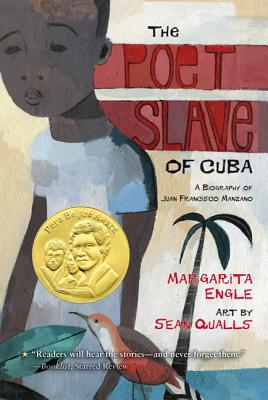
The Poet Slave

by Margarita Engle
First sentence: “My mind is a brush made of feathers”
Support your local independent bookstore: buy it there!
Content: There is talk of torture and beatings, but nothing graphic. It would be in the middle grade (grades 3-5) section of the bookstore.

This slim novel (sort-of; it’s touted as a biography, and it is biographical, but I’m not sure it really counts as a “biography”) depicts the childhood and early life of noted Cuban poet Juan Francisco Manzano, who was, for much of his life, a slave. Although the verse is spare, Engle doesn’t hold anything back: Juan was not only taken from his parents to be a pet of his first master, he was denied his freedom (his first master willed him his freedom at her death) and sold to a horrible woman who beat, tortured, and nearly killed Juan. The poems/chapters are told from varying points of view: Juan, his parents, his owners, and one of his master’s sons. They tell of his desire to learn, to express himself, and the punishments he received because of them. It’s heartbreaking.

Engle has captured not only the difficulties that Juan faced in his life, but his capacity for hope, for happiness, and for creativity. Her poetry is beautiful, and she allows Juan’s story to come through.

Definitely recommended.

On Diverse Books

So, we’re doing a unit on the other ALA awards (not the Newbery and Caldecott), and one of the questions was whether or not the “ethnic” awards divide us. A woman in the class answered and said that while she likes having a diverse selection in her library, as long as it’s mixed in with the other books (most of my classmates are either teachers or working librarians; I think I’m a strong minority in not being either), she wonders where/if all the highlighting of diversity will stop. Besides, she said, wouldn’t there be an uproar if there was a “Caucasian” award?

I responded to this by saying, essentially, let’s give All the Awards. It allows space for voices to be heard at the table of children’s literature, especially since, for so many years, the authors who won the Newbery and Caldecott were white. Why not let other groups have a voice, let them highlight the awards.

She responded by saying that that’s all fine and good, but (for argument’s sake…), it’s not fair that minority authors get to “double dip” and can win not only, say, the Coretta Scott King Award, but also the Newbery and/or Caldecott. (Or in the Case of Crown, get an honor in all three!) and white people can’t. Because there would be a backlash if there was a white-only award.

This was my response:

To be honest, my reaction to the idea of minority authors “double dipping” is “So?” But let me try to back up with some data why I think having awards specifically geared toward minority authors/books is a good thing.

I think it may boil down to fairness, equality, and the purpose of the awards. No, it’s not “fair” that minority authors could possibly double (or triple) dip in the awards. If everything were fair, there would be one award, it would be given to the best book, and everyone would be happy.

But, we’re not starting with a level playing field to begin with: in 2016, according to the Cooperative Children’s Book Center (CCBC) at the University of Wisconsin, out of 3400 books published that year, only 94 were by African Americans, (2.7%), 23 by First Nations/Native Peoples (.67%), 217 by Asian/Pacific Islanders (6.4%), and 104 by Latinx authors (3.05%). That doesn’t even come close to reflecting the population demographics  of those groups. So, if we’re going to be fair and have just one award to determine the best book, then we need to do better publishing more books by authors of color.

So, we need to make things more equal — in this case defined as giving all authors, regardless of ethnicity, a voice — we need awards to highlight different authors. Why, you might ask? Because I think it’s important for all readers to see themselves in literature. It’s important for the black child in school to have a book that reflects her lived experience. And while she might like Diary of a Wimpy Kid or the latest Newbery winner, it is not *her* experience. And, while reading is reading is reading, there is a value added — one of belonging and experience and representation — to an African American girl who is able  read a book by an African American author.

But, you might say, what if white authors just write books with characters that are multicultural? Do we still need to highlight, to focus on, minority authors? Won’t kids see themselves in books as long as the characters aren’t all white? To which I say, no, they won’t. It really is about representation. Minority children *need* to see authors who look like them, to read stories about characters who are like them. And white people — even if we do research and have sensitivity readers and check all the boxes — just can’t *get* what it means to be black, or Latinx, or a member of a first people’s tribe.

Which is another reason why we need these awards: to make white people more aware of these books. Would you have picked up a book by an African American or Latinx or disabled author without this module? (if yes, then great!) I know I tend toward books by authors who are like me: a white woman. I have to challenge myself to read outside that comfort zone. These awards help me know where to start. Help me find new authors and help me stretch my understanding of the world. Which, in turn, helps me become more empathetic to those who are not like me.

So, yeah, maybe someday everything will be fair and the best book, regardless of the color of the author’s skin or subject of the author’s book, will be chosen for an award. But, until that day comes — and it may be a long time coming — I think having awards that highlight all the different aspects of children’s literature is a good thing.

What do you think? I’d love any/all input and thoughts on this.

Module 5: All American Boys

Reynolds, J. and Kiely, B. (2015). All American Boys. New York, NY: Atheneum Books for Young Readers.

Genre: Realistic fiction, Coretta Scott King Honor. Realistic fiction because it is set in contemporary times with no magic or other speculative elements.

Book Summary: All Rashad wants to do is pop into a convenience store and pick up some chips on his way to a party on a Friday night. What happens, though, changes everything. Rashad bends down to pick out his cell phone from his bag, a woman trips over him, and the next thing he knows, a cop has him handcuffed and is beating him. He ends up in the hospital, and — subsequently — the subject of discussion of police brutality in the community, even though Rashad isn’t comfortable with being the center of attention.

Quinn, a member of the basketball team, witnesses Rashad being beaten, and is friends with officer, who has been like a second father to Quinn, since his father’s death. Quinn’s struggle is a decision whether or not he wants to become political and speak out against his friend.

Impressions: Oh, wow. I’d been putting this book off for years, mostly because I thought it was a football book. (Shows you what I know!)  But, this one — especially in the light of all the books dealing with police brutality in the wake of Ferguson (among others) — really packs a punch, especially for me as a white person. I really appreciated the dichotomy between Rashad — who is just grateful to be alive and who is trying to figure out answers why — and Quinn — who has a much more passive decision to make, in whether or not he wants to speak out about what he saw. It really does provide a lot of food for thought, and brings forward white privilege in a way that I don’t think I’ve seen before. While this book was hard to read — both Reynold and Kiely are masters of getting across emotion in as few words as possible — it is an important one.

Review: Magoon praises the book, reflecting on the dissonance between the white and black characters and praising it for the questions it raises with readers. Her final thoughts were: “It is perhaps too easy to call this worthy book timely and thought-provoking. Let us reach beyond simple praise and treat it instead as a book to be grappled with, challenged by, and discussed.”

Magoon, K. (2015, December 8). ‘All American Boys’ by Jason Reynolds and Brendan Kiely. The New York Times [New York]. Retrieved from:  https://www.nytimes.com/2015/12/20/books/review/all-american-boys-by-jason-reynolds-and-brendan-kiely.html.

Library Uses: I would put this one on a display of either books about African American life, Coretta Scott King award winners, or books reflecting the issues in the news. This would also be fantastic for a book group.

Readalikes:

  • The Hate U Give by Angie Thomas: This book is written from the point of view of the friend of a boy who was shot by police. She was a witness to the event, and because of that, her grief was made political. It touches on the topic of police brutality as well as systematic racism in the country.
  • Dear Martin by Nic Stone: Through letters to Martin Luther King Junior, the main character looks at race relations in America — he is Ivy League-bound — and the judgement of the media after he has a run-in with a white, off-duty officer.
  • Ghost Boys by Jewell Parker Rhodes: This one is written for a slightly younger audience, but touches on the topic of police violence as well. The main character is shot by an officer, and spends the rest of the book as a ghost as he watches his family and friends deal with his death.

Daughter of the Siren Queen

by Tricia Levenseller
First sentence: “The sound of my knife slitting across a throat feels much too loud in the darkness.”
Support your local independent bookstore: buy it there!
Review copy provided by the publisher.
Release date: February 27, 2018
Others in the series: Daughter of the Pirate King
Content: There is violence, obviously, and a LOT of sexual tension and kissing, but nothing ever happens. It’ll be in the the YA section (grades 6-8) of the bookstore.

Spoilers for Daughter of the Pirate King, obviously.

Picking up where we left off, Alosa has a copy of the map to the secret Isla del Canta, where the legendary treasure of the sirens lay. Initially, she plans to help her father find it, and then help rule the seas with him. Except, when she and her crew show up at the keep, Alosa discovers a secret that turns everything upside down. Suddenly, Alosa and her crew are no longer working with her father, they’re racing against him. And it will take everything that Alosa has to beat him to the island, and ultimately, defeat him.

Again: So. Much. Fun. There really isn’t a whole lot more to these (except for a very woke love interest), but man, female pirates are fun. Alosa is a great character, and I loved her relationship with Riden and with her crew. I loved that Levenseller was ruthless; she killed characters I thought were safe, which upped the ante and made the tension that much greater. I have a slight quibble with the end, but I’m going to let it go because it really was just fun to read.

And… it’s only a duology! So the story wrapped up. YAY! That said, I wouldn’t mind spending more time with Alosa and her crew again.

Lincoln: A Photobiography

by Russell Freedman
First sentence: “Abraham Lincoln wasn’t the sort of man who could lose himself in a crowd.”
Support your local independent bookstore: buy it there!
Content: It’s written for a slightly older audience, maybe 4th grade and up. It would be in the middle grade biography section if we had it in the bookstore.

Since everyone knows all about Lincoln — seriously: I didn’t learn anything new — I’m just going to stick with my impressions here.

First: I’m not sure why it’s called “A Photobiography”, unless — and this may be the case — biographies before this didn’t include pictures and documents. BUT, everything I’ve read that’s come out recently pretty much follows this format. So, if this was the first one, then I’m glad Freedman changed it! It makes for a much more interesting biography then just text, especially for kids.

Second: this read a lot like Steve Sheinkin’s work. It was simply written, but not condescending to its readers, and included fascinating facts and information told in a way that would compel a kid to keep reading.

It was a good, quick read, even if I didn’t learn anything.

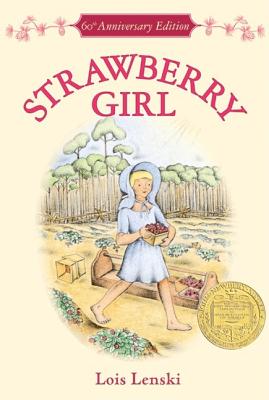
Strawberry Girl

by Lois Lenski
First sentence: “‘Thar goes our cow, Pa!’ said the little girl.”
Support your local independent bookstore: buy it there!
Content: It’s written in dialect, which might throw some readers off. It’s in the Newbery award section at the bookstore.

I remember reading this one when I was really young, maybe 2nd or third grade, when I was going through my pioneer stage. I was fascinated with old fashioned life, and the way settlers lived, and this one, though set in the early 1900s, fit that bill.

Birdie and her family have bought a house and land in mid-Florida, intending to start a strawberry farm and orange orchard. Their neighbors, the Slaters, who have lived on the land for several generations (though probably squatting, technically), have issues: they don’t like Birdie’s families uppity ways, their fences, their ambition. It’s only through long-suffering, hard work, and kindness that Birdie and her family make it through their first year,

Honestly, I think this one holds up pretty well. Lenski interviewed a lot of “Crackers”, original white settlers in Florida, and used their stories as a basis for this book, which gives it an understanding that would be missing if she hadn’t. I liked Birdie, her fire and her determination, and I was surprised at just how spiteful the Slaters were towards these outsiders. There’s also a strong class division running through the book — one I’m sure I didn’t pick up on as a kid — with Birdie’s family being able to afford nice things because they were disciplined. This plays into the “American dream” narrative — if you just work really hard, you’ll be rich — which I’m not sure is a good narrative to have around anymore. And the ending was surprisingly religious: you find God, you can be saved and change your evil ways. Even so, it was a sweet little book.

State of the TBR Pile: February 2018

I have discovered something about my class: when it’s a picture book week, I have extra time to read something fun. When it’s not, and especially if I’m busy, I don’t have much extra time to read much of anything. That said, what I’m reading for class is fun, so it doesn’t really matter, does it?

That said, only two of these are “MUST reads” (The Poet Slave of Cuba and Midwinterblood — we’re doing a unit on other ALA prize-winners); the rest are “I really wish I had a time turner so I could read” books. I like looking at them there on my pile, though.

The Poet Slave of Cuba by Margarita Engle
Refugee by Alan Gratz
Midwinterblood by Marcus Sedgwick
A Wizard of Earthsea by Ursula LeGuin
The Penderwicks at Last by Jeanne Birdsall
Children of Blood and Bone by Tomi Adeyemi
The Book of Boy by Catherine Gilbert Murdock
Orphan Monster Spy by Matt Killeen
The Hanging Girl by Eileen Cook
Tess of the Road by Rachel Hartman

What are you looking forward to reading?

Module 4: The Grey King

Cooper, S. (1975). The Grey King. New York, NY: Scholastic.

Genre: Fantasy, Newbery winner. Definitely fantasy, as it pulls from mythology and uses magic. And a good example of a Newbery winner.

Book Summary: Will, who in an earlier book in the series realized he was an Old One, and tasked with protecting the world from the rising forces of the Dark, is convalescing in Wales, recovering from a bout of hepatitis. While there, he meets Bran, a strange local boy who helps Will fulfill part of a prophecy by stopping the Grey King from garnering his forces and waking the Sleepers in preparation for the final battle.

Impressions: This is the fourth in a series, so reading it as a stand-alone probably isn’t recommended. However, I routinely re-read the second, The Dark is Rising (which, incidentally, does work as a stand-alone), so I felt comfortable dipping into this world out of order. However, for those who approach this as a stand-alone will probably be lost. There is a lack of character development, especially with Will (because you’re already supposed to be familiar with him), but also Bran, though he has a greater character arc. Cooper is a master storyteller, deftly weaving personal concerns — the neighbor who is convinced that Will’s uncle’s dogs are killing his sheep — with a greater sense of menace and tension. There is a moment when Bran’s dog is killed, and the tension between Bran and Will is palpable, especially because, as a reader, you can relate to Bran’s frustration with being a player in a higher plan and struggling with a sense of a loss of freedom because of that. Cooper’s writing is tight and elegant as well, accessible enough for younger readers (though probably not as young as eight), but smart enough to keep an adult turning pages. My only issue is that in spite of the “lesson” on speaking Welsh, I know I still don’t pronounce the names right in my head. But that’s a minor quibble. It is also one of those Newbery winners that not only deserves the award — it really is an excellently written book — but has held up as a timeless story over the past 40 years.

Review: The School Library Journal wrote that, in spite of lacking in character development, the book added much to the high fantasy genre, with the  most intriguing thing being the dichotomy between the plain lives of the Welsh sheepmen and the higher, mythical role the land — and Will — plays around them.

Wilton, S. M. & Gerhardt, L.N. (1975, October). Book reviews. School Library Journal, 22 (2). 104-105.

Library Uses: I would put this one on a display of fantasy books, series books, or older Newbery winners that are still great to read.

Readalikes:

  • Before I give other recommendations, I ought to recommend the most obvious and suggest reading the rest of this series: Over Sea, Under Stone; The Dark is Rising; Greenwitch; and Silver on the Tree.
  • The Prydian Chronicles, beginning with The Book of Three, by Lloyd Alexander: While not specifically set in Wales, this series is probably the most like Susan Cooper’s books. It has the Welsh feel, the struggle between Dark and Light, and a male main character who finds out he is More than he originally thought.
  • The Raven Cycle, beginning with The Raven Boys, by Maggie Stiefvater: This one is loosely based on Welsh mythology, though Stiefvater says that Cooper’s books were an inspiration for it. A group of four boys and one girl, the daughter of psychics, set out looking for a dead Welsh king in the hills of Virginia. Conflict, magic, and epic writing follow.
  • The Merlin Saga, beginning with The Lost Years, by T. A. Barron: I found there is a lack of Welsh fantasy books for kids (though there is more for adults), so I tapped into the Arthurian side of Cooper’s books. Barron’s series is the definitive works for kids interested in Merlin and Arthurian legend. The books follow Merlin as he becomes a powerful wizard.

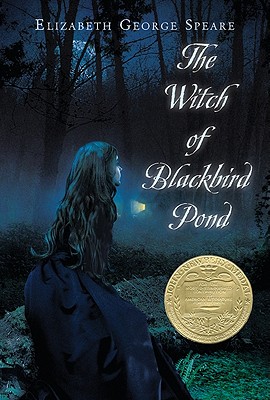
The Witch of Blackbird Pond

by Elizabeth George Speare
First sentence: “On a morning in mid-April 1687, the brigantine Dolphin left the open sea, sailed briskly across the Sound to the wide mouth of the Connecticut River and into Saybrook harbor.”
Support your local independent bookstore: buy it there!
Content: There’s some violence, but it’s off screen. It’s in the Newbery Medal section of the bookstore.

I adored this book when I was a teenager. I don’t remember how I got this book, or why I got it, but I do remember reading and re-reading it endlessly. In fact, my copy, which I still have, is quite battered. I’m knee-deep in a Newbery Medal section of my class, and I thought I’d take the opportunity to see if this story held up to my recollections of it (and if I could remember why I liked it so much).

Kit Tyler is in a precarious position: raised by her grandfather on Barbados after her parents’ deaths, she is left penniless and mostly without family after his death. So, she throws everything on traveling to America, to live with her mother’s sister, whom she’s never met, in a Puritan Connecticut settlement. For most of the book, it’s a fish-out-of-water story: Kit tries and fails to fit into this strict religious community. She’s flashy, she’s never worked (they had slaves; I found some of the dichotomy between the British slave-owners in the Caribbean and the land owners in America to be interesting), she, of course is always in trouble. But Kit’s growth arc in this book is significant: after meeting Hannah, a Quaker who is ostracized from the community because she doesn’t attend Puritan services and branded a “witch”, Kit learns that having friends and helping others really is the best thing. Oh, and then there’s Nat.

Actually, I think, in the end, it was the love story between Kit and Nat that I liked as a teenager. I liked the push and pull of their relationship, how neither of them quite figured out they were Meant To Be until it was almost too late. It was very satisfying, to say the least. The other thing I got out of this was that Puritans were Awful.  At least in historical fiction. They are quick to judge, closed-minded, insular, and set on being against everything that is different or not plain. I don’t think Speare set out to condemn them; they’re not wholly bad as a group and there are some redeemable characters. But as a whole, Purtians are definitely awful.

In the end, I’m not sure I liked it as much as I did when I was younger, but I do see why I liked it so much. And it’s a good book, overall.