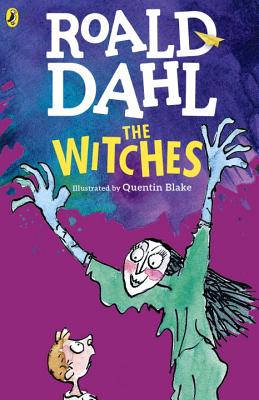
The Witches

witchesby Roald Dahl
First sentence: “In fairy-tales, witches always wear silly black hats and black cloaks, and they ride on broomsticks.”
Support your local independent bookstore: buy it there!
Content: It’s not as scary as I thought it would be, and surprisingly simple for the size. Heads up, though: grandma smokes a cigar. It’s in the middle grade (grades 3-5) section of the bookstore.

So, I remember reading this one at some point, and I had a violently negative reaction to it. I HATED it. So, I was a bit wary going in this time. But, since I picked this for the Roald Dahl book club, I needed a re-read going in.

And it’s…. weird. I was asked if it was “good”, and I said “It’s weird.” “Does that mean it’s bad? ” Nope. Just weird.

The basic plot? There are witches out there, and they look like us. Except they always wear gloves, and a wig (to cover their bald heads) and the have no toes. They hate children and make them disappear. They are, at all costs, to be avoided. So when our narrator (whose childhood sounds suspiciously like Dahl’s), accidentally ends up in a ballroom full of witches, he’s (understandably) terrified. Especially after he hears their master plan for the children of England: make a time-release mouse potion, put it in candy, and voila! No more children. They’ll all be mice.

Except our narrator doesn’t make it out in one piece: he’s caught and turned into a mouse. But, he can talk and he can still think like himself so he goes and convinces his grandma that he’s still her grandson. And informs her of the Grand Plan. Which they, unbelievably, thwart. But our narrator remains a mouse, which is just fine with him because then he won’t outlive his grandma.

Weird.

There are the usual Dahl themes: adults hating kids, and good kids being bullied (by the witches). But it really feels different from the other ones I’ve read. Matilda is darker, and Charlie is more didactic. I’m not quite sure what The Witches is other than… weird.  Was it supposed to scare kids? Was it supposed to just be amusing? (It wasn’t.)

This one’s going to be an interesting discussion at book group.
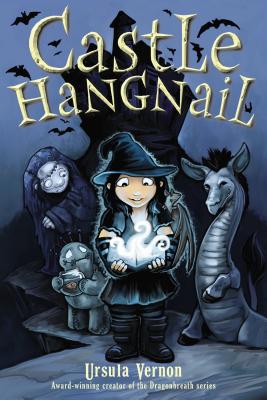
Castle Hangnail

castlehangnailby Urusla Vernon
First sentence: “It was a marvelously dark and dour twilight at the castle.”
Support your local independent bookstore: buy it there!
Content: There’s nothing in here that a third-grader (and up) wouldn’t enjoy. Plus lots of white space and illustrations for the reluctant readers. It’s in the middle grade (grades 3-5) section of the bookstore.

Molly is a 12-year-old twin with a knack for magic. So when her friend Eudaimonia gets an invite to become the Master of Castle Hangnail, a kind of small, run down castle in need of some sort of Wicked/Evil Master in the middle of nowhere, Molly jumps at the chance. Perhaps, if she can learn to become a Master of a castle, she can get the respect she’s been wanting.

However, Molly finds it’s not as easy as saying she’d do it. The Board of Magic has several tasks that she needs to accomplish (among them: securing and defending the castle, committing acts of smiting and blighting, and winning the hearts/minds of villagers by any means necessary) before she can truly be called the Master. Plus there’s the small feat of getting the minions in Castle Hangnail on her side. Not to mention that her parents (and “good” twin sister) think she’s just away at summer camp…

Oh, this book was delightful. So, so very delightful. The tone is a lot like Terry Pratchett’s Tiffany Aching series: a smart, no-nonsense girl who figures out how to be a “wicked” witch with some hilarious side-kicks and a lot of snide asides. There’s so much to love. From the goldfish who always thinks she’s dying to the steam fairy who doesn’t deal with cold well, to the plumber who  “when he knelt to work on the boiler, you sall rather more of Harry than you wanted.” The tone, the characters, even the bullying (which it was, even if it never was called that) were all spot-on and made this book absolutely enjoyable to read.

(Just for the record: because this is a Cybils nominee, I’ve been asked to make sure y’all know this is my opinion only, and not that of the panel.)

Spelled

by Betsy Schow
First sentence: “
Support your local independent bookstore: buy it there!
Review copy picked up at CI3 and signed by the author, who was a delightful person to talk to.
Content: Language-wise, it’s probably more advanced than the younger middle grade set can handle (unless they’re precocious), but content-wise there’s nothing. It’s in the YA section (grades 6-8), but it’d be good for a 4th or 5th grader as well.

You know, living in Kansas there’s one thing we get a lot around here: Oz stories. Seriously. It has its own section in the bookstore. And every time a spinoff comes (or a new reissue of the classic story, or a book about the film), we all kind of roll our eyes, knowing that we’ll have customers who just eat this stuff up.

This book is no exception.

It’s basically a twist on the Oz tale: Dorothy (Dorothea in this version) is a princess in the Emerald tower, and she’s kept captive because of a curse that was placed on her when she was born. As she’s gotten older, she’s grown to hate the restrictions on her life, and so she breaks the protection spell…. and all havoc breaks loose. Magic is turned upside down, the wicked witches are let loose, and suddenly Dorothea, her maid Riz, and her fiance (it happened very suddenly) are on an adventure to set things right.

If you know the plot of the book (or the movie for that matter). you’ll recognize the arc of Dorothea’s quest. And that’s okay. Schow was riffing on the well-known story, adding her own elements (having Ozma be the Hydra and turn into Baba Yaga was a nice tough). But, it was really just okay. The humor was okay. The romance was okay. The twist at the end was… okay. It never really became more than just “this is a decent book.” Which isn’t bad. And I’m sure fans of Oz will really like this one.

I suppose I was just hoping for more than okay.

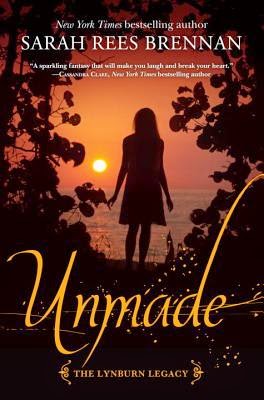
Unmade

by Sarah Rees Brennan
First sentence: “Kami Glass was standing to close to the fire.”
Support your local independent bookstore: buy it there!
Others in the series: Unspoken, Untold
Content: There’s a lot of violence, some of it brutal, plus some almost sexytimes. Not enough, however, to move it from the YA section (grades 6-8) of the bookstore.

Remember last time when I said the book was a bit of a middle book, and that the ending had me excited for the conclusion? (No? Well, neither did I?) Even so, I was able to fall back into Sorry-in-the-Vale with the Lynburns and Kami Glass with all her snarky confidence and contagious hope with ease.

Rob Lynburn has all the cards, all the power. And that has made Jared and Ash and Kami and their “side” quite desperate. Desperate enough to do desperate and dangerous things. This is an epic battle, a long, slow buildup to an intense climax. And interspersed in all that is heartache and love, loss and life, and a lot of heart.

This is a series, I think, that demands to be binge-read. And, thankfully, now you can. Sit down over a long weekend (like… Thanksgiving!) and immerse yourself in this deep, complex, wonderful world Brennan has created. Enjoy the characters, the good vs evil, the humor, the mystery, all at once without the wait.

I wish I could have. I enjoyed this book, but I think I would have enjoyed it SO much more had I read them all at once.

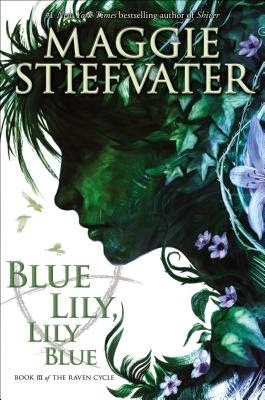
Blue Lily, Lily Blue

by Maggie Stiefvater
First sentence: “Persephone stood on the bare mountaintop, her ruffled ivory dress whipping around her legs, her masses of white-blond curls streaming behind her.”
Support your local independent bookstore: buy it there!
Release date: October 21, 2014
Others in the series: The Raven Boys, The Dream Thieves
Content: There’s swearing, lots of it, including f-bombs, but nothing felt gratuitous. There’s also violence and some adult drinking. Plus, it’s a complicated story arc that may prove confusing for younger readers. It will be in the Teen section (grades 9+) of the bookstore.

I’m always at a bit of a loss when dealing with this series. I just want to throw it at everyone (especially people who come in the store. WHY WON’T THEY BUY THIS BOOK?) and say “READ THIS! THIS IS WHAT STORYTELLING AND WRITING IS.” It really doesn’t matter that I love the characters (“What [Orla] didn’t realize about Blue and her boys was that they were all in love with one another.” Count me in on that.), and I am intrigued and fascinated by the people they meet. In this book, most especially, it was Jesse Dittley, the man who took care of the cave in the hills, who talked in ALL CAPS and called Blue an ANT. He was wonderful.

The basic plot that Stiefvater weaves is that Blue, Gansey, Adam, and Ronan are getting closer to waking their unknown king, Glendower. Blue’s mom, Maura is missing, gone off on a quest of her own. And Mr. Gray’s employer, Greenmantle (“Greenmantle had always liked the idea of being a mysterious hit man, but that career goal invariably paled in comparison with his enjoyment of going out in the town and having people admire his reputation and driving his Audi with its custom plate (GRNMNTL) and going on cheese holidays in countries that put little hats over their vowels like so: ê.”), has shown up in town, furious at Mr. Gray for defying him, determined to make him pay.

But, things don’t necessarily go right. (There is one more book, after all.) And Blue and the boys are possibly in deeper than they can handle.

What I love most (as evidenced by the frequency of quotes already), however, is the writing. It’s so drop-dead gorgeous. Stiefvater is a poet here, capturing so much — mood, character, events — with so little (even her use of swearing has Meaning.), it’s breathtaking.

If you haven’t picked these up yet, the series is almost done. Now is a good time to start. You won’t regret it.

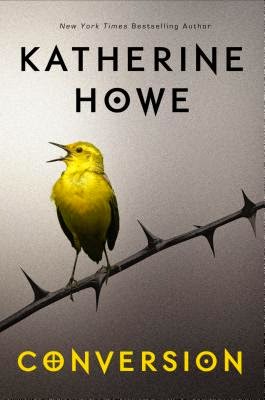
Conversion

by Katherine Howe
First sentence: “How long must I wait?”
Support your local independent bookstore: buy it there!
Review copy downloaded from Edelweiss
Content: There is some mild swearing, and talk of sex, but nothing actual. It’d be happy in the YA section (grades 6-8) of the bookstore, but I might put it in Teen (grades 9+) so I can get the adult crossover.

Colleen Rowley is a senior at St. Joan’s Academy, a high-profile, all-girls school in Danvers, Massachusetts. Everything is going great… mostly. Colleen is a tenth out of valedictorian position, something which stresses her out because her college acceptance to Harvard (only one of many Ivy League schools that have wait-listed her) is hinging on her senior year academic performance. She’s not the only one under pressure; all of her friends and many of her classmates are as well.

And then something strange happens: Colleen’s classmates, one by one, succumb to a mysterious illness that pulls them out of school. Some develop Turette’s Sydrome-like tics, others loose the use of their legs; still others’ hair is falling out. It’s an epidemic. Except Colleen, spurred on by some anonymous texts, is suspicious. And when she starts looking into the real events behind The Crucible, which they’re studying, especially Ann Putnam’s story, she finds that there is possibly a connection to what’s happening in Danvers now, and what happened in Salem back then.

Told in alternating storylines, Howe gives us both the story of the girls of St. Joan’s and Ann Putnam’s confession about the incident that began what came to be called the Salem Witch trials. She doesn’t spell things out for the reader; instead, she trusts our intelligence and in our ability to draw parallels between the two stories. And although the characters — especially Colleen and her friends — are quite sympathetic, it’s finding the parallels and solving the mystery that fascinated me most about this book.

Unfortunately, the ending didn’t hold up to the rest of the book. Howe kind of goes off into muddle-land, and doesn’t hold up to the suspense that the book built. Even so, it wasn’t enough to completely kill the book for me (it was more of a “HUH?” moment). And it’s made me curious about Howe’s adult books, which is a good thing.

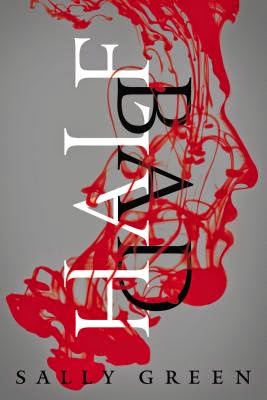
Half Bad

by Sally Green
First sentence: “There’s these two kids, boys, sitting close together, squished in by the big arms of an old chair.”
Support your local independent bookstore: buy it there!
Review copy pilfered from the ARC shelves at my place of employment
Content: There’s talk of imagined sex (none actual), and some (mostly mild) swearing. But the talk of the abuse Nathan takes is hard to get though, even for me as an adult. It’s in the teen section  (grades 9 and up) because of that. Be wary of giving this one to an overly-sensitive person.

I was talking this book up in January to a group of educators, saying to look for it, that Green turns the whole “white=good and black=bad” thing upside down. How little did I know.

It does do that: sure. But to say that’s all this first in a trilogy does is to woefully underestimate it.

Nathan is the illegitimate child of a White Witch — his mother — and the baddest of all Black witches. Marcus, Nathan’s father, has alluded the White Hunters for years. And so, to say that having his kid in their midst irks them is a gross understatement. So the council imposes Codes — restrictions — on all Half Bloods. They start mild, with yearly assessments, but get increasingly more restrictive as Nathan gets older. It ends with him being held in a cage for two years. This is partially because of a vision Marcus saw that Nathan would kill him. The White Hunters want to make that happen: he’s ostensibly being “trained” to murder his father. Not that he has any say in the matter.

So, yes, Greene is turning good and evil upside down; how can the “good” people treat someone who is different from them so atrociously. (And believe me, it’s worse than bad.) But, the black witches don’t fare so well, either. Marcus, from all reports (granted, they’re  untrustworthy) is a despicable person. And the one time we see him, he doesn’t entirely acquit himself either. And the only other black witches we see aren’t that much better. Perhaps it’s more a treatise on how power corrupts, and how differences become so ingrained that we can’t see those who aren’t the same as us.

And even though it was difficult at times to get through, emotionally, it did give me a lot to think about. I’m quite interested to see where she goes with this series, and if she can keep up the complex nature of the characters.

Dorothy Must Die

by Danielle Page
First sentence: “I first discovered I was trash three days before my ninth birthday — one year after my father lost his job and moved to Secaucus to live with a woman named Crystal and four years before my mother had the car accident, started taking pills, and begin exclusively wearing bedroom slippers instead of normal shoes.”
Support your local independent bookstore: buy it there!
Review copy handed to me by my manager who said “Get on this.”
Content: A pregnant teenager, a moderate amount of swearing including a few f-bombs, and some violence. The book belongs in the store’s teen section (grades 9+).

At first glance, the idea of this book is awesome: Dorothy from Wizard of Oz, didn’t want to be in Kansas after she went home, and found a way back to Oz, where she has taken over and is not only a tyrant, but she’s a bully. And she’s draining Oz of its magic. It is going to take another girl from Kansas — Amy, of the trailer park — who finds her way to this new and drained Oz, to kill the tyrant and save Oz from certain ruin.

See? Sounds pretty cool, right?

Well, not so much.

It’s not that this one was Horrible, per se. There were a lot of things to like about it, starting from the cool idea. I liked the way that Page developed the magic in the world, and made the Wicked Witches if not the good guys, at least the better ones. I liked Amy, and her willingness to try even though the odds were against her.

But that was about it. I won’t delineate my entire complaints (which include having Amy say “I was used to cornfields back in Kansas..” UM, where??), but rather my main one, this: why is this book not a stand-alone? There really was nothing in this book that either 1) warranted that it be 460 pages or 2) meant for it to go longer than one book. I think with some better plotting and editing (and less of the pregnant bully in the beginning) this could have been a tight, fun, cool romp in a unique version of Oz.

I guess I’m a bit miffed that it’s not, and that’s effecting how I see the book. Others (who don’t mind the whole drawn-out-ed-ness of this one) may find it more enjoyable. Part of me hopes she finds success with this, because it’s a really cool idea.

I just wish the execution was better.

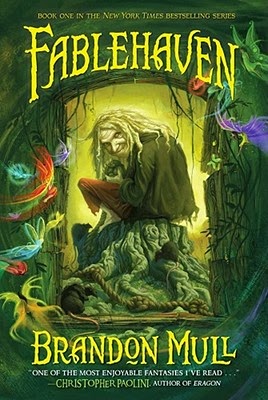
Fablehaven

by Brandon Mull
First sentence: “
Support your local independent bookstore: buy it there!
Review copy sent by the publisher because this is my January book group pick at work.
Content: Some mild fantasy violence, and one intense scene. Resides happily in the middle grade (3-5th grade) section of the store, though the language may be a bit difficult for the younger end of the spectrum.

People have been telling me for YEARS that I need to read Fablehaven. That they LOVE Fablehaven. That it’s brilliant. So I jumped at the chance to pick it for my 3-5th grade book group.

Seth and Kendra are off to spend a couple of weeks at their grandparents’ house while their parents are off on a cruise. The thing is: this is the side of the family they don’t know very well (you know there’s always one). Their grandparents are reclusive, and they’ve hardly seen them. In fact, their mom had to beg and plead in order to get them to let Seth and Kendra to stay there. So no one is really expecting things to go well. This feeling is exacerbated when, upon arriving, Seth and Kendra are shuttled off to the attic and told to stay either there or in the yard.

(Complaint #1: REALLY?  I’ve heard of controlling parents, but controlling grandparents is a first. I wanted to smack Grandpa for this. “It’s for your safety.” BAH. It’s a middle grade fantasy novel. Lighten up. Also: if that’s the way he treats the creatures in Fablehaven, I’m not surprised at the way he treats his grandkids.)

The kids are complete opposites. Kendra follows everything to. the. letter while Seth is the macho end of things and completely disregards Grandpa’s rules. (Complaint #2: why is it that 11-year-old boys are often
 portrayed as brats? I don’t have a son, so I don’t know if it’s typical. But I wanted to smack. the. kid. I also wanted to shake Kendra: lighten up a little, girl.) This not only leads to the discovery that Grandpa’s house (Grandma’s “missing”; she turns up later, just in time to help save the day. Which leads to Complaint #3: while Seth did a grand job creating conflict, the kids did very little in solving it. Sure, they were there, and they helped, but they didn’t DO much of anything.) is full of fairies and mythical creatures, but also to Seth creating a whole bunch of havoc.

And the book is already half done.

(Complaint #4: It seems like authors use series books to be lazy with world building. They take half the book SETTING THINGS UP and then hurry to wrap things up — or not — in the second half. *sigh*)

I wasn’t much interested in Seth or Kendra much after the halfway point. They did some stuff, they got Grandpa into deeper hot water, they rescued Grandma, blah, blah, blah.

I just didn’t care.

Perhaps this was a victim of high expectations. Or maybe it was reading it after reading So Many Cybils books (it wouldn’t have made my shortlist!). Or maybe it was lousy world building, with obnoxious characters, excessively floral language, and an uninteresting plot.

But it could be me.

The Garden Princess

by Kristin Kladstrup
First sentence: “Princess Adela laced her fingers under a clump of creeping Charlie and pulled, enjoying the satisfying crackle of roots ripping free of soil.”
Support your local independent bookstore: buy it there!
Content: Aside from your usual witches being Bad and princesses not wanting to be princesses and talk of Marriage for a 16-year-old, there’s not much here. It’d happily belong in the middle grade (3-5) section of the bookstore.
Review copy sent to me by the publisher for the Cybils

Adela, like many princesses in books like these, does not like being a princess. She would much rather muck around in the garden, creating landscapes, finding new plants. So, when the handsome gardener (whom she prefers hanging out with) gets invited to a garden party thrown by Lady Hortensia, Adela finagles her way along, mostly so she can see Hortenisa’s famed gardens. However, when she gets there, she finds that the gardens aren’t, well, normal. And Hortensia’s a witch, something Adela thought didn’t exist. It turns out that Hortensia’s plants are all actually beautiful girls. And Adela’s determined to set them all free.

So far, so good. It’s pretty run-of-the-mill, but nothing horrible. I actually kind of like Adela, and it’s not very often you get a princess obsessed with gardening. But, once at the garden, it went south for me. It got very lecture-y about Outer Beauty (which is bad!) and Inner Strength (which is good!), but I could deal with that. No, my problem came with the climax. See, Adela, for all her Heroism, doesn’t actually Solve the Problem. Nope, that goes to the guy/love interest in the story. And that bothered me. I wanted Adela to be Strong Enough and Smart Enough to beat the evil witch, but it turned out that she was only Good Enough to inspire the guy into figuring things out.

*sigh*

But other than that, it was a perfectly fine little fantasy.

(Just for the record: because this is a Cybils nominee, I’ve been asked to make sure y’all know this is my opinion only, and not that of the panel.)