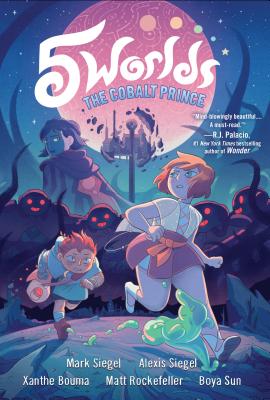
5 Worlds: The Cobalt Prince

cobalt princeby Mark Siegel, Alexis Siegel, Xanthe Bouma, Matt Rockefeler, and Boya Sun
Support your local independent bookstore: buy it there!
Others in the series: The Sand Warrior
Content: There is some fantasy violence. It’s in the middle grade graphic novel section of the bookstore.

Picking up where the first book left off, we get more of Oona’s backstory as she tries to figure out how to light the rest of the sand beacons and change the fate of the five worlds. The Cobalt Prince is the leader of the blue planet, Toki, which conquered the sand planet, and destroyed the sand castle. Turns out, though, that he has been taken over by the Mimic, an evil spirit that wants to gain control of the universe. Oona finds her sister there, working with the Cobalt Prince. Can she figure out her past, and save her sister and stop the mimic?

I put off reading this but honestly, I shouldn’t have. This is such a great series. I like the art, and while there’s a huge cast of characters, I think the authors juggle everything incredibly well. I also like how each individual one has it’s own arc while being a part of the larger whole; it makes it so each can be read as a stand-alone, which is nice.

Here’s to waiting for the next one!

Reign the Earth

reigntheearthby A. C. Gaughen
First sentence: “There was a scorpion in my tent.”
Support your local independent bookstore: buy it there!
Content: There’s violence, including spouse abuse (both verbal and physical). Also, though the main character is 17, she marries a man 10 years older than her. It’s in the teen section (grades 9+) of the bookstore.

The basic plot: a desert girl, whose nomadic country has been at war with a bigger, more powerful, oppressive country, is married off to the king of the country in order to achieve peace. Said peace is only tentative as long as the king is happy (and he’s not often happy, for many reasons) and as long as desert girl keeps her magic powers a secret from her husband.

There’s more to it: including a prophecy and a resistance and a secret love, but really, that’s it.

I’m being a little snarky, but I did like this enough to finish it. I did have a big issue with this: the main character is married to an abusive man. It starts out with him raping her on their wedding night (he kind of couches it in “I don’t want you to be uncomfortable” but he doesn’t really take her comfort into mind) and it just escalates from there. Granted, our main character does, eventually, stand up to him (and he is the “bad guy” of the story), but I couldn’t help but wonder: is this really a book for teens? I don’t mind darkness in books, or even dealing with issues like abusive relationships, but this one felt more… adult than usual. I know the marriage has something to do with it, but I’m not sure that’s all. I don’t know if I can put my finger on it exactly.

Also: I feel like this one could have been better if it were an own voices story. Again, I’m probably nit-picking, but I felt like it was just “desert girl saves white oppressed culture” and not much else.

So, while I liked it enough to finish it, I didn’t love it.

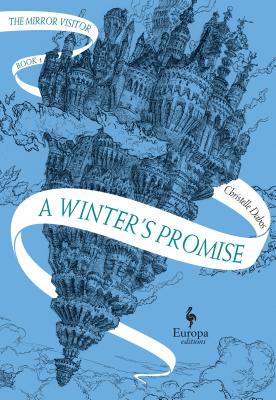
A Winter’s Promise

winterspromiseby Christelle Dabos
Translated by Hildegarde Serle
First sentence: “It’s often said of old buildings that they have a soul.”
Support your local independent bookstore: buy it there!
Review copy provided by the publisher.
Content: The main character is engaged, but other than that there’s nothing “objectionable” (at least that I read). It’s in the teen section (grades 9+) but if a 6-8th grader is interested, I’d give it to them.

When my rep for Europa pitched this book, the first thing I told him was “the cover is awful”. Yes, it fits with the other Europa titles, but, really: what kid is going to want to pick up this book?

But it’s a huge deal in France, he countered. And it’s supposed to be sweeping and epic. So I picked up a few for the store, if only to support Europa’s first foray into young adult fiction. And then I nominated it for the Cybils, so I’d force myself to read it.

And…

Well…

I’m sorry. It’s awful.

I liked Dabos’ world building: she’s imagined a world where there are a bunch of floating “arks” populated by different families with different magical skills. I really  liked our main character, Opheilia’s, magical skill at reading items — she can tell the history of the owner through their items, and she wears gloves so she doesn’t accidentally read other people’s histories without their permission. But, Opheila herself was a huge pushover. I think she was supposed to be cheerily mousy, but instead I just got annoyingly wimpy. She’s been given in an arranged marriage (arranged by the heads of her family, I assume?) to Thorn, who is from the Polar ark (I think), and whose family’s skill has to do with illusion. Except, once on their ark, Sophie finds out that everyone is at each other’s throat and she’s in the middle of it.

At this point, I was more than 200 pages into a nearly 500 page book, and I bailed. It was just going nowhere too slowly for me. The only thing that was holding my attention was the world, and there wasn’t enough of that to make me care enough to keep reading. (And I thought Rowling was overly wordy!) So, I bailed.

But, I suppose, if large, very French, fantasies are your thing, then this one will be perfect. They’re just not my thing.

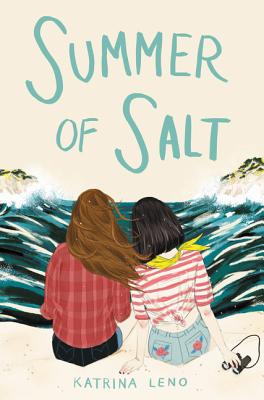
Summer of Salt

summerofsaltby Katrina Leno
First sentence: “On the island of By-the-Sea you could always smell two things: salt and magic.”
Support your local independent bookstore: buy it there!
Content: Lots and lots and lots of swearing, including f-bombs (which seemed really out of place to me; I don’t know why) and some teenage drinking. It’s in the Teen section (grades 9+) of the bookstore.

Georgianna and Mary are twins that have grown up on the island By-the-Sea, daughters of the Fernweh line of women who have, well, magic. It usually manifests at birth, but sometimes takes longer. One of their great-grandmothers, Annabella, has turned into a bird, and comes back every summer to nest and attempt to hatch babies. Except this year.

This is the year that Georgianna and Mary turn 18, the summer before they are destined to leave the island. And everything seems to be going wrong. It won’t stop raining. Mary’s acting strange. And Annabella hasn’t shown up. And Georgianna’s magic won’t manifest itself.

This was an odd book — more magical realism than anything else — but I found myself enjoying it. I loved the matriarchal family, I loved the little island and it’s support of the weirdness that is the Fernweh women. I loved the magic, and now ordinary it was. And I just enjoyed the way Leno told the story.

It was all very charming.

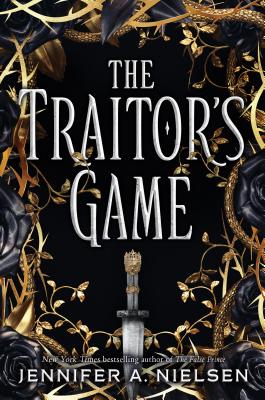
The Traitor’s Game

traitorsgameby Jennifer Nielsen
First sentence: “The truth of where I’d been for the past three years wasn’t what anyone believed.”
Support your local independent bookstore: buy it there!
Review copy provided by the publisher.
Content: There are some intense situations and violence. It’s in the young adult (grades 6-8) of the bookstore.

Kestra Dallisor is the daughter of the second most powerful person in the land. Which makes her highly valuable. She survived a kidnapping attempt three years ago, and has been in exile ever since. Now, as she is summoned back to Antora by her father, she is faced, yet again, with an impossible situation: she’s been kidnapped by rebels, her beloved guard held hostage, and they’ve laid before her an impossible challenge: recover the Olden Blade, the only thing that can kill the immortal dictator of Antora. And do it in three days.

She complies, of course, but not willingly. And the things she discovers as she searches for the Blade are going to turn her world upside down.

I thought this one was a lot of fun! I enjoyed Kestra’s determination and stubbornness and her desire to receive affection from her father. She’s smart and capable and it was quite delightful reading her banter with the other characters (no one was safe from her sarcasm). And there were a couple of twists in there that caught me off guard (happily so) and led the story in interesting directions. It’s the first in a series, so while it has a conclusion, it leaves it open for the story to take off in intriguing directions.

Highly recommended.

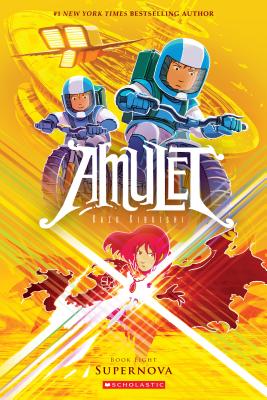
Amulet: Supernova

supernovaby Kazu Kibuishi
First sentence: “Mind if I join you, Traveler?”
Support your local independent bookstore: buy it there!
Others in the series: The Stonekeeper, The Stonekeeper’s CurseThe Cloud SearchersThe Last CouncilPrince of the ElvesEscape from Lucien, Firelight

First: I would highly suggest you read (or re-read) the other seven books in the series before tackling this one. It’s been more than two years since the last book came out, and if you’re anything like me, you won’t remember what’s going on. Also: it’s a fantastic experience reading one right after the other, seeing how Kibuishi has fit everything together and foreshadowed events throughout the series.

That said, there really isn’t much to say.  The resistance is fighting an Incredible Battle Against Impossible Odds. Emily is fighting for control with the Voice of the Amulet. Everything seems dire. And, no, it doesn’t quite end here. There’s one more (it does say “to be concluded in book nine” at the end). But, Kibuishi’s art is still amazing, and the story telling still spot-on. And the characters still worth adventuring with.

I will be incredibly sad to see this come to an end after so many years, but I’m sure it will be completely worth it.

Muse of Nightmares

by Laini Taylor
First sentence: “Kora and Nova had never seen a Mesarthim, but they knew all about them.”
Support your local independent bookstore: buy it there!
Release date: October 2, 2018
Others in the series: Strange the Dreamer
Content: There’s references to sex and rape, and there’s violence. It’s in the teen section (grades 9+) of the bookstore.

Spoilers for Strange the Dreamer, of course.

This one picks up immediately after Strange ends. Lazlo is now one of the gods. Sarai is dead. And neither one knows what’s going to happen next. And what does happen next — which takes place over mere hours, it feels like — is completely unlike anything they expected.

Interspersed with flashbacks, where Taylor introduces a couple of new characters and explains how the gods came to be over Weep, Taylor looks at tragedy, occupation, and the choices we make when faced with fear and rage and love.

I actually think I liked this one better than Strange, primarily because it didn’t feel like  retread of old ground for Taylor. She’s come up with some interesting world-building, and even though the “bad guy” — in this case the one who started all the horror — has been long dead, his presence was still made known in the book. Taylor’s exploring — I think — the aftermath of occupation and how, even if the occupiers are long gone, there are still scars that need to be healed. On both sides, really. It’s a much more introspective book than her other ones , or at least it feels that way. There is some action, and Sarai really does play an important role in the end, but mostly it’s exploring character’s feelings of bias and prejudice and hate and revenge, and, ultimately, forgiveness.

I’m not sure this duology is for everyone, but I thoroughly enjoyed it.

Rules for Thieves

by Alexandra Ott
First sentence: (I’d put it here, but I’ve misplaced my copy of the book!)
Support your local independent bookstore: buy it there!
Content: There’s some intense moments. It’s in the middle grade (grades 3-5) section of the bookstore.

Twelve-year-old Alli Rosco has a problem: she’s in an orphanage (which she hates and has tried — unsuccessfully — to escape from) and doesn’t want to be adopted (she tried that, too, and ran away because the family was so awful). So, when faced with another adoption day, she takes the most reasonable alternative: she runs away (again). And gets caught (again)… but this time, things go differently. She gets hit with a magic curse, and then a boy helps her escape. His name is Beck, and he tells her that 1) the curse she was hit with is deadly, and that she has about 10 days to live and 2) the Thieves Guild is real and can help get her the money it will take to heal her curse.

The catch? She has to pass a trial to become part of the Guild.

The other catch? She’s not a great thief to begin with.

But, with Beck and the Thieves Guild, she finds a family that she can be a part of, and even though the trial is obscenely difficult, she is game to do the best she can for her friends.

The thing that impressed me most about this was the world building. Ott created something familiar, yet wholly its own with patron saints and 53-day months, and unusual creatures and technology and magic. It sucked me into the story, which I also enjoyed. Alli is a headstrong character, willing to go out on a limb for those she came to care about, and willing to risk everything to save her own life. It’s a decent heist and a good adventure story, and it wraps up quite nicely at the end, while leaving a thread open for the sequel. I’m definitely interested in where Alli’s story is going.

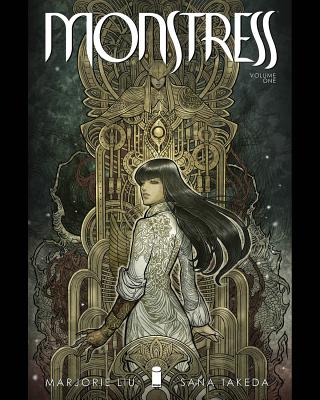
Monstress: Awakening

by Marjorie Liu and Sana Takeda
Support your local independent bookstore: buy it there!
Content: Lots of f-bombs and graphic violence and some nudity. It’s in the graphic novels section of the bookstore.

I really had no idea what to expect when going into this one; I just knew that Liu had won the Eisner for writing and I figured I should give the story a try.

It’s… a lot.

It’s set in this world where humans have been at work with Arcanics, who are a human/animal mix. It’s a racial war: the humans feel the Arcanics are sub-human and are trying to wipe them out. Throw into the mix the Cumaea — witch women who aren’t on anyone’s side, but use the Arcanics for their own purpose (and who I kept calling chimera) and you’ve got a hot mess of violence. Maika Halfwolf is our main character, possibly an Arcanic, but also possibly something else, who breaks into the Cumaea stronghold and (after killing pretty much everyone) absconds with a mask that awakens a demon she barely can control, in hopes to sway the tide of this war.

I think.

As I said, it’s a lot. I’m not entirely sure if I got all the plot or even the people straight. I don’t know if I liked it, but I’m not sure this one is meant to be liked. It’s super feminist — a ton of female characters of all shapes and sizes and stripes and in positions of power and not, and there are very few male characters at all. And it’s super pretty to look at; the art is gorgeous and elaborate and incredible. There is a lot to think about: it’s dealing with slavery and power and racism and seclusion and what circumstances can do to individuals.

But…

I don’t know. I’ve thought about it quite a bit over the time since I finished it, so that’s definitely something. It’s definitely one of the more unique and challenging graphic novels I’ve read recently.

Heart of Thorns

by Bree Barton
First sentence: “On the eve of her wedding to the prince, Mia Rose ought to have been sitting at her cherrywood dresser, primping her auburn curs and lacing her whalebone corset.”
Support your local independent bookstore: buy it there!
Review copy provided by the publisher.
Content: There is an on-screen almost rape, some talk about other rapes, and a lot of violence. It’s in the YA section (grades 6-8) of the bookstore, but I’d probably be a little hesitant giving it to the younger end of the age range.

MIa has spent her whole life believing two things: 1) any woman could be a Gwyrach – a witch, who can (and will) kill anyone they touch  and 2) Gwyraches are evil and must be eradicated. So, when on the day of her (forced) marriage to Prince Quin, Mia discovers that she’s a Gwyrach, her whole world’s foundation is shattered. If she’s a Gwyrach, that must mean her beloved (dead) mother must have been a Gwyrach. And since a Gwyrach killed her mother, what did that mean? And does that mean that Mia is evil?

On the run from assassins with the prince, Mia sets out to figure out answers to all the questions she now has, and to rethnink everything she has believed her whole life.

Okay, yes, this is probably more than a little tropey. It was pretty obviously “HEY LOOK AT ME, I”M FEMINIST”. But, even though the parallels were kind of obvious, I still really liked this book. I thought Barton created some interesting characters, and Mia’s journey was a fascinating one (especially since I like character growth arcs). I thought the magic system Barton dreamt up was a good one, and I liked the world she built. I wouldn’t mind spending more time in the different countries (which is good, since the  book leaves things hanging) and I want to see how Mia and Quin develop. It was a solid debut book, and not a bad fantasy, even if it was a bit heavy handed with the metaphors.