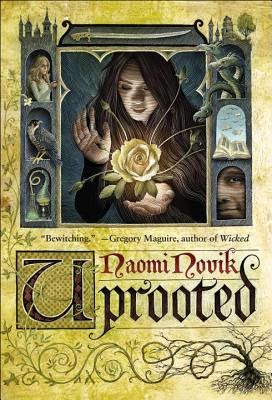
Uprooted

by Naomi Novik
First sentence: “Our Dragon doesn’t eat the girls he takes, no matter what stories they tell outside our valley.”
Support your local independent bookstore: buy it there!
Review copy given to me by the publisher rep.
Content: There’s one graphic, but not explicit, sex scene. It’ll be in the science-fiction/fantasy section of the bookstore.

I picked this one up because our Random House rep said it was based on Beauty and the Beast, and we all know how much I love a fairy tale retelling. But, I didn’t count on how engrossing this book would be.

The rep was right: it is loosely based on Beauty and the Beast, but it’s so much more than that. In this valley in Polyna, their resident wizard, who goes by the Dragon, takes one girl every ten years to his tower. When he’s done with them, they don’t come back to the villages, so everyone (of course) assumes the worst. This year, a picking year, everyone guesses that he will take Kasia, our narrator’s, Neishka, best friend. But the Dragon comes, and he picks Neishka instead.

At first, this is terrifying: Neishka isn’t refined, she isn’t skilled for much of anything (except getting dirty), and she doesn’t want to be in the castle with this scary magician. But, as the book goes on, she discovers hidden talents inside herself: she’s a witch, one that is just as powerful as the Dragon, albeit wielding a different sort of magic from him. And its the combination of their magic that is able to confront the real evil in their country: the Wood.

I don’t want to give away much more than that, because this one is best discovered page by page. Novik has a way of pulling one into the story; this started out as a treadmill book (read twice a week for a half hour), but soon became the one I was spending all my time with. I wanted to experience Neishka’s story as it unfolded, with all the twists and turns and slow reveals and intricate pay offs.

M texted, recently, looking for a “Laini Taylor-esque” book, and honestly, this is what I thought of when she asked for that. Novik’s world-building is solid and always in the service of the story, rather than something separate. And, while her words aren’t gorgeous or lyrical, they’re more than pedestrian. They serve the characters and the plot, and make the whole work together just marvelously.

Just about perfect.

Circus Mirandus

by Cassie Beasley
First sentence: “Four small words.”
Support your local independent bookstore: buy it there!
Review copy provided by the publisher. (Plus: popcorn!)
Release date: June 2, 2014
Content: It’s kind of slow, and definitely heavy on the exposition, which may make more reluctant readers, well, reluctant to give it a try. But I’m assuming there will be gorgeous art throughout (I haven’t seen it yet), and so there’s that to give it a boost with those who like pictures with their books. It’ll be in the middle grade (grades 3-5) section of the bookstore.

Micah has been raised by his grandfather since his parents died when he was young. He’s had a good life; his grandfather is one of those Good people who know how to be happy. He was also a storyteller, raising Micah on stories of the grand Circus Mirandus and the Lightbender, who promised Micah’s grandfather a miracle.  Now, when grandfather’s health is failing, he calls in the Lightbender’s miracle. But getting that isn’t as easy as all that. And it’s up to Micah (and his friend Jenny Mendoza) to help grandfather get the miracle he deserves.

I am not a critical reader. I fall head first into stories, and they either work for me or they don’t. I don’t stop to think much about a deeper meaning, or issues, or (sadly) stereotypes and cliches. I like characters (or not), I like the plot (or not), I like the writing (or not). And so, I find myself loving books and not having a real “reason” for it.

This is one of those books. I loved it. Wholly and unabashedly. I fell into the magic and the suspension of disbelief. I understood the magic and the story that Beasley was trying to tell. I cried at the end. I am not sure I’ve felt this in love with a book since I read the first Penderwicks. This book? This book is my people.

I loved it. I loved the Big Fish-esque feel of the story. I loved Micah and his grandpa’s relationship. I loved the flashbacks to grandpa’s time with the circus. Yeah, so some of the characters — Aunt Gertrudis, especially — were pretty much caricatures, but so is Trunchbull in Matilda, and no one complains about that. I loved that Jenny was smart, and that they were just friends and that she wasn’t a romantic interest. I loved her skepticism, and her belief in her friend (if not in the magic). I loved the whimsy of the book. But most of all, I loved the heart of it. It has such a big heart.

I’m sure there are drawbacks, and people who this book won’t speak to. But, for me, this was a little slice of perfection.

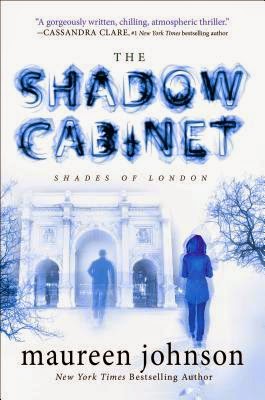
The Shadow Cabinet

by Maureen Johnson
First sentence: “The curtains at 16 Hyssop Close hadn’t been opened all day.”
Support your local independent bookstore: buy it there!
Review copy snagged from the box from the publisher rep.
Others in the series: The Name of the Star, The Madness Underneath
Release date: February 10, 2015
Content: There’s a lot of murder in this one, some of it gory, but never graphic. Other than that, it’s just intense. The series is in the Teen section (grades 9+) of the bookstore, but I wouldn’t oppose giving it to a younger kid who was interested in ghost stories.

First off: spoilers for the other two books, obviously. You’ve been warned. (And if you haven’t read them, you really should. They’re excellent.)

Two years is a long time to wait for a book. And in the process, I’ve forgotten all the anxiousness I experienced when I finished the last one. So I do have to admit, that this one took a little bit of time to get back into the swing of things.

It begins forty years ago, with the grisly murder of 10 teenagers by a pair of odd, unusual twins named Sid and Sadie (though in my mind, Sadie was always the Thrilling Adventure Hour Sadie…). It’s a violent way to begin a book (then again, they are murder mysteries) and it’s important, though it doesn’t come to fruition until the end. The main story is the two prongs leftover from Madness: trying to figure out what happened to Stephen when he died and trying to figure out where crazy Jane took Charlotte. Both of those lead Rory and the rest of the ghost team: Thorpe, Boo, and Callum down increasingly crazy paths.

Things I really liked: I loved the addition of Freddie, a new ghost hunter. She was spunky and funny and a breath of fresh air in the midst of Rory’s loss. And I loved that MJ brought back Jerome from book one. Even though he’s mostly kept in the dark, he plays an important role in all of the crazy that follows.

It’s as good as Name of the Star, I think. And it sets up an epic conclusion (I hope). Now, it’s just waiting until that conclusion comes.

The Iron Trial

by Holly Black and Cassandra Clare
First sentence: “From a distance, the man struggling up the white face of the glacier might have looked like an ant crawling slowly up the side of a dinner plate.”
Support your local independent bookstore: buy it there!
Content: There’s some intense violence at the start, but nothing worse than, say, Harry Potter. It’s in the middle grade (grades 3-5) section of the bookstore. We’ll see how the series goes; it might change.

Callum has grown up believing that magic is bad, that the mages at the Magisterium only put their interests in front of the students, that his leg which was injured as a baby and never healed right was the fault of the mages. His father — once a mage himself — has told Call this among other things. So when Call gets summoned for the Iron Trial — the selection process for the Magesterium — his father tells him to throw the entry. And, because Call is only 12 years old, he tries. And fails. He gets into the Magesterium and is exposed not only to the dreaded magic, but also the story of his past that his father never told.

I’m just going to come out and say it: it’s Harry Potter. The similarities are really numerous — a boy raised as an outsider finds out he’s magic, he has a special calling, he was at the death/disappearance of the Enemy and has a connection to him (um… bit of a spoiler, there. Sorry.), the story takes place over a school year, he has two friends (a boy and a girl), there’s a rich snob bully boy, and on and on.

Except, for all the similarities, it works. I’ve been looking for a (good) Harry Potter read-alike for years, and this one — Black and Clare are superb writers in their own right — fills the bill. The world building is solid, the magic interesting. And there’s a bit of a twist that caught me off guard. So, even though there’s solid Harry Potter similarities, it’s definitely worth reading.

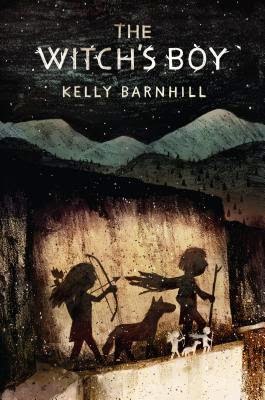
The Witch’s Boy

by Kelly Barnhill
First sentence: “Once upon a time there were two brothers, as alike to one another as you are to your own reflection.”
Support your local independent bookstore: buy it there!
Review copy snagged from the ARC shelves at my place of employment.
Content: There really isn’t anything objectionable. The pacing is slow, however, which is something that might turn more reluctant readers off. It’s in the middle grade (grades 3-5) section of the bookstore.

Ned has been “the wrong boy” since the fateful day when he and his twin brother, Tam, tried to sail to the sea and ended up drowning in the river. Or nearly drowning, in Ned’s case. See: his mother is the witch of the village, and she has been the keeper of the magic — dangerous, unruly magic which Ned is never to touch — for most of Ned’s life. And although she couldn’t save Tam, she saved Ned… by sewing Tam’s soul inside of Ned.

Fast forward a few years — ones in which Ned doesn’t have much strength, where he has a stutter, and where he can’t read — to when the Bandit King comes into their lives with the intention to steal the magic for his own. This is where Ned does something remarkable: he takes the magic into himself, and sets off on an adventure. One in which he’ll meet a friend — his first since his brother died — and change the course of the world.

It’s a slow, quiet book; one that reminded me strongly of Anne Ursu’s books. That’s a good thing, except it’s not one for people who are expecting Grand Action and Adventure. Much of the book is spent inside Ned’s head (mostly because he can’t talk, though I did like Barnhill’s methods for portraying Ned’s stutter), which doesn’t lend itself to fast reading. That said, given time, this book is really a fantastic read. I loved how Barnhill portrayed the magic; it had its own personality, one that can be controlled by it’s “owner”, provided the person is strong enough. And I really enjoyed seeing Ned come into his own. Yes, he was pushed around by (some of) the adults in his life (I loved his mother; she’s fantastic), but it’s a true middle grade novel in that Ned (and his new friend, Áine) face the conflict on their own, without adult help.

Speaking of Áine: she’s a remarkable character, too. Self-sufficient, yes, and strong, but she also finds it in her heart to be a friend and a true companion.

I think this is one that will stay with me for a while.

The Glass Sentence

by S. E. Grove
First sentence: “It happened long ago, when I was only a child.”
Support your local independent bookstore: buy it there!
Review copy provided by the publisher.
Content: There’s nothing objectionable or scary. It is, however, nearly 500 pages and it’s small type and that can be intimidating. (A was initially intimidated. I think I’ve convinced her to read it.) It’s also kind of slow-moving, with a lot of tricky names, so probably not the best book for a reluctant reader.

I think the best place to start with this one is Megan Whalen Turner’s quote on the back cover: “Not since Philip Pullman’s The Golden Compass have I seen such an original and compelling world built inside a book.”

That’s quite a lot for a book to live up to (MWT! Philip Pullman! Original! Compelling!) but you want to know something? She was right. So very, very right.

In 1799, something happened, and the whole world shifted. It came to be known as the Great Disruption, and what it did was cause different parts of the globe to be in different time periods. Europe was stuck in the middle ages, the Northwest Territory in a prehistoric ice age. What we know as the 13 colonies stayed in linear time, for the most part, though they never developed much farther than that. Past the Mississippi River and into Mexico is what is known as the Baldlands, a hodgepodge of raiders and outlaws, except for three cities which are known as the Triple Era, with people and creatures spanning 3000 years in the same place.

Pretty cool, no?

It’s no wonder that in this world explorers and map-makers are held in the highest esteem. And Sophie Tam’s uncle, Shadrack Elli, is one of the best. He’s been raising his niece ever since her parents — also explorers — disappeared. She’s learned to live without knowing about her parents, and she’s learned how to read the maps that Shadrack makes. So when he’s kidnapped, she’s really the only person who can save him.

The world is brilliant, and the use of maps and magic (of sorts, though kind of not really “magic” as you’re thinking about it; it’s more future techonology) are refreshingly unique. But, once the plot starts going (which, admittedly takes a while), it picks up and becomes one of those books you can’t put down. I was thrilled with the world, with Sophie and her friend Theo and their increasingly intense and urgent adventure. I thought that Grove captured an interesting balance between the older people — like Shadrack — and their expertise and the younger ones — like Sophie — who were able to see things in a new and different light. I loved the use of time and Ages and invented words; I haven’t seen this kind of  creativity in naming things since Harry Potter. I also loved that the “bad guy” wasn’t wholly evil. That while they did some morally questionable things, it wasn’t a pure black and white thing. There’s layers here: yes, it’s a middle grade fantasy adventure, but it’s also so much more.

I can’t wait for the sequel.

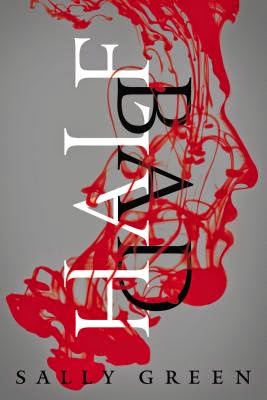
Half Bad

by Sally Green
First sentence: “There’s these two kids, boys, sitting close together, squished in by the big arms of an old chair.”
Support your local independent bookstore: buy it there!
Review copy pilfered from the ARC shelves at my place of employment
Content: There’s talk of imagined sex (none actual), and some (mostly mild) swearing. But the talk of the abuse Nathan takes is hard to get though, even for me as an adult. It’s in the teen section  (grades 9 and up) because of that. Be wary of giving this one to an overly-sensitive person.

I was talking this book up in January to a group of educators, saying to look for it, that Green turns the whole “white=good and black=bad” thing upside down. How little did I know.

It does do that: sure. But to say that’s all this first in a trilogy does is to woefully underestimate it.

Nathan is the illegitimate child of a White Witch — his mother — and the baddest of all Black witches. Marcus, Nathan’s father, has alluded the White Hunters for years. And so, to say that having his kid in their midst irks them is a gross understatement. So the council imposes Codes — restrictions — on all Half Bloods. They start mild, with yearly assessments, but get increasingly more restrictive as Nathan gets older. It ends with him being held in a cage for two years. This is partially because of a vision Marcus saw that Nathan would kill him. The White Hunters want to make that happen: he’s ostensibly being “trained” to murder his father. Not that he has any say in the matter.

So, yes, Greene is turning good and evil upside down; how can the “good” people treat someone who is different from them so atrociously. (And believe me, it’s worse than bad.) But, the black witches don’t fare so well, either. Marcus, from all reports (granted, they’re  untrustworthy) is a despicable person. And the one time we see him, he doesn’t entirely acquit himself either. And the only other black witches we see aren’t that much better. Perhaps it’s more a treatise on how power corrupts, and how differences become so ingrained that we can’t see those who aren’t the same as us.

And even though it was difficult at times to get through, emotionally, it did give me a lot to think about. I’m quite interested to see where she goes with this series, and if she can keep up the complex nature of the characters.

Dorothy Must Die

by Danielle Page
First sentence: “I first discovered I was trash three days before my ninth birthday — one year after my father lost his job and moved to Secaucus to live with a woman named Crystal and four years before my mother had the car accident, started taking pills, and begin exclusively wearing bedroom slippers instead of normal shoes.”
Support your local independent bookstore: buy it there!
Review copy handed to me by my manager who said “Get on this.”
Content: A pregnant teenager, a moderate amount of swearing including a few f-bombs, and some violence. The book belongs in the store’s teen section (grades 9+).

At first glance, the idea of this book is awesome: Dorothy from Wizard of Oz, didn’t want to be in Kansas after she went home, and found a way back to Oz, where she has taken over and is not only a tyrant, but she’s a bully. And she’s draining Oz of its magic. It is going to take another girl from Kansas — Amy, of the trailer park — who finds her way to this new and drained Oz, to kill the tyrant and save Oz from certain ruin.

See? Sounds pretty cool, right?

Well, not so much.

It’s not that this one was Horrible, per se. There were a lot of things to like about it, starting from the cool idea. I liked the way that Page developed the magic in the world, and made the Wicked Witches if not the good guys, at least the better ones. I liked Amy, and her willingness to try even though the odds were against her.

But that was about it. I won’t delineate my entire complaints (which include having Amy say “I was used to cornfields back in Kansas..” UM, where??), but rather my main one, this: why is this book not a stand-alone? There really was nothing in this book that either 1) warranted that it be 460 pages or 2) meant for it to go longer than one book. I think with some better plotting and editing (and less of the pregnant bully in the beginning) this could have been a tight, fun, cool romp in a unique version of Oz.

I guess I’m a bit miffed that it’s not, and that’s effecting how I see the book. Others (who don’t mind the whole drawn-out-ed-ness of this one) may find it more enjoyable. Part of me hopes she finds success with this, because it’s a really cool idea.

I just wish the execution was better.

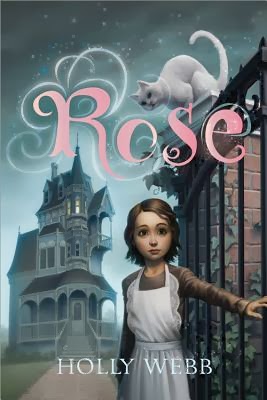
Rose

by Holly Webb
First sentence: “Rose peered out the corner of the window at the street below, watching interestedly as two little girls walked past with their nursemaid.”
Support your local independent bookstore: buy it there!
Review copy sent to me by the publisher for the Cybils.
Content: Aside from the creepy person kidnapping orphans (but it’s really not that scary), there isn’t anything untoward in this book. It would happily sit in the middle grade (3-5th grade) section of the bookstore.

Rose lives in St. Bridget’s Home for Abandoned Girls in London, with no idea, really, where she came from or who she is. (She’s named after the rose bush that was blooming the day she was found in a fish basket in the churchyard.) She really doesn’t have much hope of ever being adopted, so she trudges on, one day after another. Then one day, a housekeeper for a wealthy alchemist/magician arrives, and Rose ends up as a maid in the house. And she discovers that she has a talent for magic. It turns out, too, that orphan children are disappearing from the London streets. No one is really concerned — they’re orphans, after all — but when a friend of hers from St. Bridget’s goes missing, Rose knows she has to do something. And with the help of the magician’s apprentice, maybe she can.

This is, in many ways, a book that’s already been written. Orphan? Check. Plucky lower class girl outsmarting the gentry? Apprentice story? Check. Check. Evil magician stealing children? Check. It should have been by-the-numbers boring.

And yet, it wasn’t. Partially because of the writing — Webb does know how to keep the pages turning — but mostly because Rose is such an endearing character. She’s neither snarky nor plucky. She just does what Needs To Be Done. She’s hardworking, but doesn’t have any desire to be Great. She’s not terribly smart — she has no idea how she’s doing what she’s doing — but she is willing to learn. And she is, above all, loyal to those she calls her friends.

She is, for all purposes, a Hufflepuff.

And that is why I loved her. The story is good, as well. I think this is a first in a series, but it doesn’t need to be. I can see a lot of kids loving it — boys too, if they can get past the title and cover — because it’s quite accessible.

A true winner. (Go Hufflepuff!)

(Just for the record: because this is a Cybils nominee, I’ve been asked to make sure y’all know this is my opinion only, and not that of the panel.)

Magic Marks the Spot

The Very Nearly Honorable League of Pirates, Book 1

by Caroline Carlson
First sentence: “Ever since the letter had arrived from Miss Pimm’s, Hilary had spent more and more time talking to the gargoyle.”
Support your local independent bookstore: buy it there!
Review copy provided by the publisher for the Cybils
Content: There’s a couple of swordfights where no one gets injured. For a pirate book, it’s really quite tame. It’s shelved in the middle grade (3-5th grade) section of the bookstore.
Hilary Westfield has one dream: to become a pirate. Unfortunately the league of pirates in Augusta has one rule: no girls. Girls are sent to Miss Pimm’s finishing school, because that’s Where Girls Go. Thankfully, Hilary has Pluck and Determination and doesn’t let the Rules stop her. (This book insists you talk about Things in Capital Letters.) As soon as she gets a chance, she runs away from Miss Pimm’s and finds a pirate — Jasper, the Terror of the South Seas — who doesn’t care that she’s a girl. 
There’s more to this book — magic and treasure and an Enchantress and a Wicked Parent — but really, what I loved most about this book was that Hilary set out to be a pirate and succeeded ON HER OWN TERMS. No dressing up like a boy. No bowing to Tradition. No Resigning Oneself to her Fate and Making the Best of It. Nope. Not for Hilary. She (and her talking gargoyle, whom I really loved) decided that they wanted to be pirates, and Dang It, they became pirates. 
I liked this one an awful lot, mostly because of the above reason. But — aside from the unnecessary letters that were written in cursive, which is a real turn-off for kids These Days; the book got much better after I started skipping them — I really enjoyed all of it. There was humor (Miss Greyson, the governess/chaperone, was hilarious), sword fighting, a wee bit of romance (but not overstated; it was between the adults), and most of all Hilary being Awesome.
Yeah, it was a bit slow at the start, and I really don’t like that it’s yet another one in a series, but I thought the story wrapped up well enough, and I’d be willing to see where Hilary’s piratical adventures take her. 

(Just for the record: because this is a Cybils nominee, I’ve been asked to make sure y’all know this is my opinion only, and not that of the panel.)