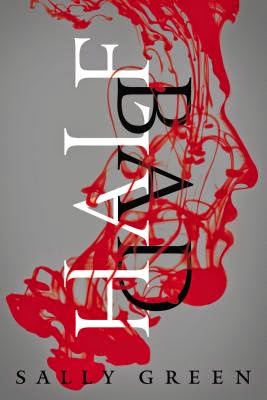
Half Bad

by Sally Green
First sentence: “There’s these two kids, boys, sitting close together, squished in by the big arms of an old chair.”
Support your local independent bookstore: buy it there!
Review copy pilfered from the ARC shelves at my place of employment
Content: There’s talk of imagined sex (none actual), and some (mostly mild) swearing. But the talk of the abuse Nathan takes is hard to get though, even for me as an adult. It’s in the teen section  (grades 9 and up) because of that. Be wary of giving this one to an overly-sensitive person.

I was talking this book up in January to a group of educators, saying to look for it, that Green turns the whole “white=good and black=bad” thing upside down. How little did I know.

It does do that: sure. But to say that’s all this first in a trilogy does is to woefully underestimate it.

Nathan is the illegitimate child of a White Witch — his mother — and the baddest of all Black witches. Marcus, Nathan’s father, has alluded the White Hunters for years. And so, to say that having his kid in their midst irks them is a gross understatement. So the council imposes Codes — restrictions — on all Half Bloods. They start mild, with yearly assessments, but get increasingly more restrictive as Nathan gets older. It ends with him being held in a cage for two years. This is partially because of a vision Marcus saw that Nathan would kill him. The White Hunters want to make that happen: he’s ostensibly being “trained” to murder his father. Not that he has any say in the matter.

So, yes, Greene is turning good and evil upside down; how can the “good” people treat someone who is different from them so atrociously. (And believe me, it’s worse than bad.) But, the black witches don’t fare so well, either. Marcus, from all reports (granted, they’re  untrustworthy) is a despicable person. And the one time we see him, he doesn’t entirely acquit himself either. And the only other black witches we see aren’t that much better. Perhaps it’s more a treatise on how power corrupts, and how differences become so ingrained that we can’t see those who aren’t the same as us.

And even though it was difficult at times to get through, emotionally, it did give me a lot to think about. I’m quite interested to see where she goes with this series, and if she can keep up the complex nature of the characters.

Dorothy Must Die

by Danielle Page
First sentence: “I first discovered I was trash three days before my ninth birthday — one year after my father lost his job and moved to Secaucus to live with a woman named Crystal and four years before my mother had the car accident, started taking pills, and begin exclusively wearing bedroom slippers instead of normal shoes.”
Support your local independent bookstore: buy it there!
Review copy handed to me by my manager who said “Get on this.”
Content: A pregnant teenager, a moderate amount of swearing including a few f-bombs, and some violence. The book belongs in the store’s teen section (grades 9+).

At first glance, the idea of this book is awesome: Dorothy from Wizard of Oz, didn’t want to be in Kansas after she went home, and found a way back to Oz, where she has taken over and is not only a tyrant, but she’s a bully. And she’s draining Oz of its magic. It is going to take another girl from Kansas — Amy, of the trailer park — who finds her way to this new and drained Oz, to kill the tyrant and save Oz from certain ruin.

See? Sounds pretty cool, right?

Well, not so much.

It’s not that this one was Horrible, per se. There were a lot of things to like about it, starting from the cool idea. I liked the way that Page developed the magic in the world, and made the Wicked Witches if not the good guys, at least the better ones. I liked Amy, and her willingness to try even though the odds were against her.

But that was about it. I won’t delineate my entire complaints (which include having Amy say “I was used to cornfields back in Kansas..” UM, where??), but rather my main one, this: why is this book not a stand-alone? There really was nothing in this book that either 1) warranted that it be 460 pages or 2) meant for it to go longer than one book. I think with some better plotting and editing (and less of the pregnant bully in the beginning) this could have been a tight, fun, cool romp in a unique version of Oz.

I guess I’m a bit miffed that it’s not, and that’s effecting how I see the book. Others (who don’t mind the whole drawn-out-ed-ness of this one) may find it more enjoyable. Part of me hopes she finds success with this, because it’s a really cool idea.

I just wish the execution was better.

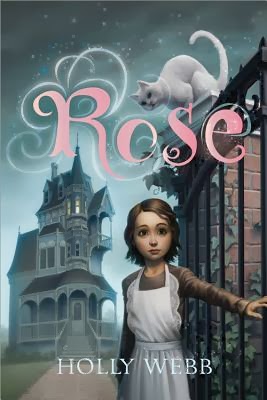
Rose

by Holly Webb
First sentence: “Rose peered out the corner of the window at the street below, watching interestedly as two little girls walked past with their nursemaid.”
Support your local independent bookstore: buy it there!
Review copy sent to me by the publisher for the Cybils.
Content: Aside from the creepy person kidnapping orphans (but it’s really not that scary), there isn’t anything untoward in this book. It would happily sit in the middle grade (3-5th grade) section of the bookstore.

Rose lives in St. Bridget’s Home for Abandoned Girls in London, with no idea, really, where she came from or who she is. (She’s named after the rose bush that was blooming the day she was found in a fish basket in the churchyard.) She really doesn’t have much hope of ever being adopted, so she trudges on, one day after another. Then one day, a housekeeper for a wealthy alchemist/magician arrives, and Rose ends up as a maid in the house. And she discovers that she has a talent for magic. It turns out, too, that orphan children are disappearing from the London streets. No one is really concerned — they’re orphans, after all — but when a friend of hers from St. Bridget’s goes missing, Rose knows she has to do something. And with the help of the magician’s apprentice, maybe she can.

This is, in many ways, a book that’s already been written. Orphan? Check. Plucky lower class girl outsmarting the gentry? Apprentice story? Check. Check. Evil magician stealing children? Check. It should have been by-the-numbers boring.

And yet, it wasn’t. Partially because of the writing — Webb does know how to keep the pages turning — but mostly because Rose is such an endearing character. She’s neither snarky nor plucky. She just does what Needs To Be Done. She’s hardworking, but doesn’t have any desire to be Great. She’s not terribly smart — she has no idea how she’s doing what she’s doing — but she is willing to learn. And she is, above all, loyal to those she calls her friends.

She is, for all purposes, a Hufflepuff.

And that is why I loved her. The story is good, as well. I think this is a first in a series, but it doesn’t need to be. I can see a lot of kids loving it — boys too, if they can get past the title and cover — because it’s quite accessible.

A true winner. (Go Hufflepuff!)

(Just for the record: because this is a Cybils nominee, I’ve been asked to make sure y’all know this is my opinion only, and not that of the panel.)

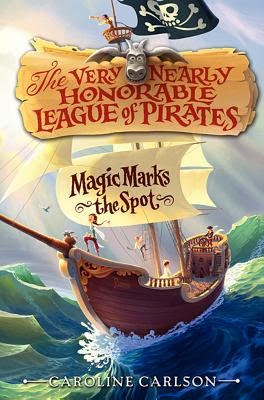
Magic Marks the Spot

The Very Nearly Honorable League of Pirates, Book 1

by Caroline Carlson
First sentence: “Ever since the letter had arrived from Miss Pimm’s, Hilary had spent more and more time talking to the gargoyle.”
Support your local independent bookstore: buy it there!
Review copy provided by the publisher for the Cybils
Content: There’s a couple of swordfights where no one gets injured. For a pirate book, it’s really quite tame. It’s shelved in the middle grade (3-5th grade) section of the bookstore.
Hilary Westfield has one dream: to become a pirate. Unfortunately the league of pirates in Augusta has one rule: no girls. Girls are sent to Miss Pimm’s finishing school, because that’s Where Girls Go. Thankfully, Hilary has Pluck and Determination and doesn’t let the Rules stop her. (This book insists you talk about Things in Capital Letters.) As soon as she gets a chance, she runs away from Miss Pimm’s and finds a pirate — Jasper, the Terror of the South Seas — who doesn’t care that she’s a girl. 
There’s more to this book — magic and treasure and an Enchantress and a Wicked Parent — but really, what I loved most about this book was that Hilary set out to be a pirate and succeeded ON HER OWN TERMS. No dressing up like a boy. No bowing to Tradition. No Resigning Oneself to her Fate and Making the Best of It. Nope. Not for Hilary. She (and her talking gargoyle, whom I really loved) decided that they wanted to be pirates, and Dang It, they became pirates. 
I liked this one an awful lot, mostly because of the above reason. But — aside from the unnecessary letters that were written in cursive, which is a real turn-off for kids These Days; the book got much better after I started skipping them — I really enjoyed all of it. There was humor (Miss Greyson, the governess/chaperone, was hilarious), sword fighting, a wee bit of romance (but not overstated; it was between the adults), and most of all Hilary being Awesome.
Yeah, it was a bit slow at the start, and I really don’t like that it’s yet another one in a series, but I thought the story wrapped up well enough, and I’d be willing to see where Hilary’s piratical adventures take her. 

(Just for the record: because this is a Cybils nominee, I’ve been asked to make sure y’all know this is my opinion only, and not that of the panel.)

The Real Boy

by Anne Ursu
First sentence: “The residents of the gleaming hilltop town of Asteri called their home, simply, the City.”
Support your local independent bookstore: buy it there!
Content: Some intense moments — both physically and psychologically — and the language and pacing are a bit slow, especially for a struggling reader. Still, it fits in the middle grade (3-5th grade) section of the bookstore.
Review copy snagged from the ARC shelves at my place of employment.

After I finished reading this, A took a look at it and said,”Huh.’The Real Boy’? Is that like Pinocchio?”

Well, yes. Yes it is.

The island of Aletheia is full of magic, even though there are no wizards anymore. There are magic smiths, and Oscar is the hand to one. Which means, he collects and chops the herbs and basically stays out of the way. That is, until the apprentice turns up dead and the magic smith go missing. That’s when Oscar’s world starts unraveling: everything he thought Aletheia was built on, everything he thought his master was turns out to be built upon a lie. And it’s up to Oscar and Callie, the healer’s apprentice, to figure out what the truth is, and how to set everything right. And, because I alluded to it, yes, the Pinocchio story does play a small role.

This was a lovely, lyrical book; Ursu is a magnificent, quiet writer. She knows how to evoke a feeling and a place — the forest is dark and magical and calming. And even though it’s never explicitly said, Ursu makes it obvious through little words and phrases that Oscar has some form of autism. That simple fact upped the tension when it was up to Oscar become the Hero of this story. How — if he doesn’t know how to interact with people — is he supposed to figure everything out? Enter Callie, who was a remarkable character. (In fact, all the characters, from the magic smiths to the bullies, to the people in the city who were Indulged and Coddled, were remarkably written.) She is the healer’s apprentice, magicless in a world where magic is everything, and yet she’s smart and plucky and brave, but most of all caring.

In addition to all that, and refreshingly, it’s not a start of a series! Hooray for stand-alone books! My only detriment is that I’m not sure this will appeal to many kids. But for the ones who are daring enough (or quiet enough) to pick it up, they’re in for a real treat.

(Just for the record: because this is a Cybils nominee, I’ve been asked to make sure y’all know this is my opinion only, and not that of the panel.)

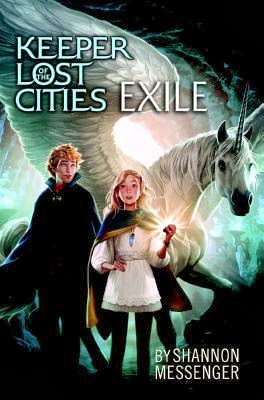
Exile

by Shannon Messenger
ages: 9+
First sentence: “Sophie’s hands shook as she lifted the tiny green bottle.”
Support your local independent bookstore: buy it there!
Others in the series: Keeper of the Lost Cities
Review copy snagged off the review shelves at my place of employment.

First off: kids like this series. So, take everything I say about it with a HUGE grain of (adult) salt. Also: spoilers for the first one. Obviously.

Sophie is still living with the elves. She’s still multitalented, which many of her age-mates find annoying. She’s still trying to get used to living with her adopted family. And she’s still trying to figure out who the Black Swan are, and why they created her.

It’s a lot for a 12-year-old to handle.

Especially since she found a rare alicorn — part unicorn, part Pegasus — in the woods and brought it home. It could “reset the timeline” (no, I have no idea what that means), and so Sophie’s been given charge (reluctantly) by the Council to tame and train the alicorn. Which, of course, she forms a bond with.

Much like the first one, this one was TOO long. Sure, there was a lot of white space and the text is big, but at 570 pages, I was exhausted before I was halfway through. And, much like the last one, I feel like Messenger has a good story in here. This time, though, she needed an EDITOR to hack her stuff down to 250 pages. (Especially all of Sophie’s anxiety moments. ENOUGH ALREADY.) I did like some of the characters — Keefe, especially– and I thought Messenger tied up the story nicely while leaving some threads for the next book.

(Can I hope for that one to be shorter??)

But, as I said at the first, kids do seem to like this series. It’s good for those who aren’t old enough for Harry Potter or want more like that. But it’s just not doing it for me.

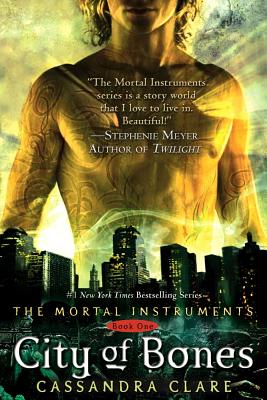
City of Bones

by Cassandra Clare
ages: 14+
First sentence: “‘You’ve got to be kidding me,’ the bouncer said, folding his arms across his massive chest.”
Support your local independent bookstore: buy it there!

For YEARS, I have told myself that I ought to read the Mortal Instruments series. For YEARS, I have looked at these books and said, “I’ll get too them… sometime.”

Well, sometime is now. Yes, I was prompted to pick these up because of the movie  coming out in August (I tell my kids to read the book before seeing the movie. I do practice what I preach, sometimes). But, honestly people: I was unprepared for how awesome it is.

Short version for the other rock-dwellers: Clary Fray is an ordinary NYC teenager until she witnesses what she thinks is a murder in a nightclub. Suddenly, she’s seeing things — and people — that shouldn’t exist. Then, her mother disappears and Clary’s drawn into this world of Shadowhunters: half human/half angels who fight demons. (An aside here: I don’t watch the show, but from what M has told me, this sounds a LOT like Supernatural. I mentioned that to a co-worker today and she said, “Yeah, I can see that. Without the angst and with more humor, though.”) And Clary has to figure out not only how to get her mother back, but how to keep herself alive.

Things I loved: the humor. It was so much fun to read; the witticisms, the sarcasm, the witty retorts. The world building: Clare put all sorts of effort into creating this alternate reality, and the effort comes through. Sure, in parts it was vaguely Harry Potter-esque, but I can forgive that. The fact that the love triangle fizzled. Yay for no love triangles. Jace. I don’t go for blondes or tough guys, but he was pretty swoon-worthy and awesome. Clary herself: considering she had no idea what she was doing half the time, she held her own and was all sorts of headstrong. The climax, but you will have to read it yourself.

And yes, I already put City of Ashes on hold. I can’t wait.

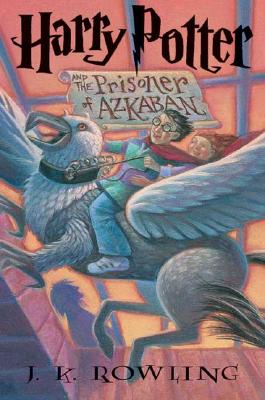
Audiobook: Harry Potter and the Prisoner of Azkaban

by J. K. Rowling
read by Jim Dale
ages: 9+ (Listening 6+)
Support your local independent bookstore: buy it there!

I could have sworn I had a review of Prisoner of Azkaban on here, but I only found a smallish blurb about the whole series here. But, I guess, I read this before the blog, and I haven’t gotten around to a reread until now.

The reason for picking this particular Harry Potter? Well, we went to the Wizarding World of Harry Potter for our family vacation a couple of weeks ago, and figured since we were going there, we needed to read a Harry Potter book. And since this is the next one in the series for K to read (her dad’s read her one and two), that’s where we started.

My thoughts, since everyone knows the plot already:

Out of all the books, this one is one of the tightest, I think. As they go on, they become more meandering and Rowling tries to pack so much in.

That said, at the end, when Sirius and Lupin confront Peter Pettigrew, there is an awful lot of monologuing. I know that Rowling needs to give us a whole bunch of information that existed before the story even started, but still. It slows the story down.

I really, really dislike the way Jim Dale reads Hermione. She’s a capable, smart girl, and every time she opens her mouth, Dale makes her sound like a whiny brat.

I adore Lupin as a character. That is all.

Hubby and I got into a discussion about adult figures in middle grade books. It was started because we realized that Dumbledore is a Really Bad Headmaster. He’s terrible at his job. Don’t get me wrong: I adore the character, but think about it: he’s neglectful, he’s bad at enforcing rules, and he plays favorites like no other. But then, if  Dumbledore were good at his job, there wouldn’t have been a story.

I think the lack of Voldemort in the story actually helps the book. It’s not as Dark and Foreboding as some of the others. 

It’s still one of my favorites of the Harry Potter series.

And I’d really like — for comparison’s sake — to hear the Stephen Fry audio versions. I wonder if he can do Hermione any better.

Jinx

by Sage Blackwood
ages: 9+
First sentence: “In the Urwald you grow up fast or not at all.”
Support your local independent bookstore: buy it there!

The setting: the Urwald, a forest of no uncertain danger. There are trolls, werewolves, witches, and wizards out there and no one — NO ONE — left the Path unless they were asking for trouble. Needless to say, there is magic here. The Urwald has no king, and belongs to no country, in spite of what the two neighboring kingdoms seem to think.

The main character: Jinx, a boy who lives in one of the clearings, being raised by his stepparents (mother died; dad remarried; dad died; stepmother remarried), who don’t particularly want him. So, his stepfather takes him off the path, presumably to leave him there. Except they run into Simon, a wizard of some power. He’s not as Powerful (or Evil) as the Bonemaster (whom, everyone knows, sucks your soul out with a straw), but he’s powerful enough to stop Jinx’s stepdad and take Jinx as a sort of serving boy/apprentice.

The other characters: One of the most delightful things about this enchanting novel were the characters. There is the mysterious, yet somehow comforting, Simon and his spitfire wife, Sophie. There’s the cackling witch (I swear I could hear her) Dame Glammer, who traveled by butter churn. There were the friends (of sorts) that Jinx met when he finally (not that I minded the set up; it was so cleverly imagined) got around to Questing, Reven (whose curse was that he could not say who he was) and Elfwyn (whose curse is that she always has to tell the Truth). And then there was the Urwald itself, written in such a way to be a character in itself.

It’s not an action-packed page-turner of a middle grade fantasy, and I appreciated that. It was a slow reveal, a world to revel in, characters to enjoy a journey with. And if there’s a sequel, I will happily follow Jinx through whatever adventure he has next.

Keeper of the Lost Cities

by Shannon Messenger
ages: 10+
First sentence: “Blurry, fractured memories swam through Sophie’s mind, but she couldn’t piece them together.”
Support your local independent bookstore: buy it there!

A young boy girl is raised among humans, never knowing that he’s she’s not one of them. He She manifests some special abilities, but mostly what he she does is lay low, living with his her family, knowing somehow that he’s she’s different than they are. Then on his eleventh birthday a school field trip soon after she turns twelve, he she is found by an emissary of the different world, gaining a glimpse into his her real future: that of the wizards elves. As he’s she’s introduced to this world by a soon-to-become good friend, he she learns that his place in the world is a unique one: that of the Chosen One Keeper. (Possibly; it’s not really clear.) He She is sent off to Hogwarts Foxfire, the wizard boarding school elf nobility school, where he she makes friends, endears himself herself to some teacher and offends others, shows incredible abilities in certain areas, gains a mentor, and ends up breaking a lot of rules. He She succeeds in thwarting the evil that he she faces in the end, but it’s only a temporary fix. How can he she, a mere boy girl, save this world?

If you haven’t figured it out by now, my main problem with this one — that I started with high hopes: a separate world with elves! Cool! (And, no, that’s not a train on the cover. I thought it was) — was, that by about halfway through, I realized it was Too Much Harry Potter Knockoff, and not enough cool elves doing cool, unique, elvy things. I thought that Messenger had a cool idea for the world, but in the end, just wasn’t able to pull it off as well as I’d hoped.

That, and  I realized that halfway through, at 488 pages, this was Much Too Long. All of which makes me kind of sad.

(Just for the record: because this is a Cybils nominee, I’ve been asked to make sure y’all know this is my opinion only, and not that of the panel.)