Pitch Dark

by Courtney Alameda
First sentence: “The wake up shock hits like a sledgehammer to the chest.”
Support your local independent bookstore: buy it there!
Review copy provided by the publisher for the Cybils.
Content: There is a lot of violence and gore, and some mild swearing. It’s in the YA section (grades 6-8) of the bookstore.

I’m going to be up-front with this: I really liked this book. A lot. But I have NO idea how to describe it succinctly. See, it’s kind of Ready Player One meets Indiana Jones meets Battlestar Galactica plus Aliens with a tad bit of Firefly thrown in. It really doesn’t quite know what it wants to be — a space adventure? A horror story? An archaeological adventure? Stopping a terrorist plot? Yes, to all of those — but HEY, it’s an incredible amount of fun while it’s trying to figure it out.

Let’s try with the plot. In the late 21st century, Earth sent people out into space in stasis, with samples of earth, in the hopes that they’d find another habitable planet and be able to terraform it into something livable. They were sent off, and never heard from again.

Fast forward 400 (!) years, and one ship, the USS John Muir, has just woken up out of stasis, and realized that Things Didn’t Go Quite To Plan. Like, most of the crew is dead, and while there were some survivors, many have turned into mutant beings who terrorize the rest of the survivors. Thankfully, Tuck, the son of one of the premier scientists, was a survivor, and has Things Figured Out.

Enter the ship Conquistador, captained by the Cruz family, who are archaeologists in search of the lost ships from the Exodus. Their daughter, Laura (lao-ra, please, not law-ra) is passionate about history and is excited to see what there is when they discover the Muir. But then a hacker gets into the ship’s systems (and frames Laura) and crashes the Conquistador into the Muir. And suddenly everyone is fighting for their lives.

So, yeah. Hot mess of a plot — things just kept happening and happening and happening and while it kind of made a weird sort of sense but not really — but it was all just so much dang fun that I couldn’t put it down. So, I liked it, in spite of the fact that I can’t figure out a really simple way to make it sound appealing aside from it’s just a fun read!

Bruja Born

by Zoraida Cordova
First sentence: “This is a love story.”
Support your local independent bookstore: buy it there!
Review copy provided by the publisher for the Cybils.
Content: There is some mild swearing and a few f-bombs. There is also a lot of violence. It would be in the Teen section (grades 9+) if the bookstore had it, but I think a 6-8th grader who was interested could read it. 

I’ll be forthright: this is a second in a series. And no, I haven’t read the first one (yet). But this one worked as a stand alone; Cordova gives enough information that it kept me in the loop with the backstory (though I do wonder if it was too much, if you’ve already read the first one?) but didn’t really get in the way of this story. 

Lula has been growing distant from her boyfriend, Maks, for many reasons (most of which have to do with book 1, but also because she’s a bruja – a witch) and he decided that he was done trying to make this work. So, on the way to a soccer game — he’s a player, she’s part of the cheer/dance team — he did. And then the bus got into a fatal accident. Lula’s family — who are all brujas — was able to save her through magic, but Maks, well, died. Except Lula, when she recovered, wasn’t able to accept that. So, she and her two sisters — Alex and Rose — performed a canto (a spell) to save him. Which… worked. Sort of. What it actually did was trap Death (the Lady de la Muerte) in between realms and created a whole hoard of casimuertos — zombies who eat hearts instead of brains — that quickly took over Brooklyn. 

What Lula (and Alex and Rose by extension) need to do is figure out how to get the Lady back to her realm and figure out a way to stop the casimuertos before they kill everyone. 

I’ve already addressed how nice it was that this was its own story rather than a continuation of a story that began in the first book, but it’s also a lot of fun. I enjoyed the Latinx flair that Cordova brought to witches (and zombies) and I thought the story was just a lot of fun. There was romance gone wrong, consequences to choices, some fun sidekicks, and a great family relationship. 

I’m going to try and go back and get my hands on the first book in the series. It’s really a LOT of fun. 

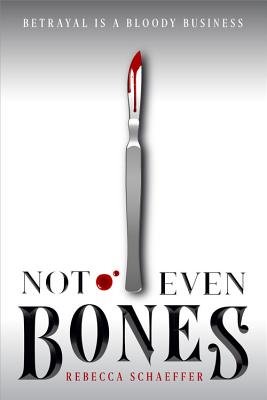
Not Even Bones

by Rebecca Schaeffer
First Sentence: “Nita stared at the dead body lying on the kitchen table.”
Support your local independent bookstore: buy it there!
Content: There is a LOT of violence, and some of it is gory. There is also swearing, including a couple of f-bombs. It’s in the teen section (grades 9+) of the bookstore. 

First off: this is being billed as a horror novel, and in some ways, I guess, it is. I was wary about starting this one, mostly because I really don’t do horror, but it’s more surgical gross/violent. And I do better with that in print than I do on the screen. So, if there is ever a movie made of this one (and it’d be a cool movie), I probably wouldn’t see it. 

Nita’s parents — her mother, mostly — deal in the black market. Body parts of supernatural beings, specifically. And for as a long as she can remember, Nita has been doing the dissecting. Until one day, Nita’s mother brings home a live “specimen” and Nita decides that she has some ethics, and refuses to dissect a non-dead body. However, that ends up badly: Nita is kidnapped and finds herself on the wrong side of a cage, in a parts market along the Amazon river. Which means, since she really doesn’t want to die, she needs to find a way out. 

It was one part moral dilemma — all of Schaeffer’s characters are “bad”, ranging from despicable to just morally questionable — and one part suspense novel (will Nita make it out alive and in one piece? How did she end up kidnapped? Who sold her out?). But it was immensely readable, and highly unputdownable. I thought Schaeffer had a very clever take on mythical creatures; unicorns, for example, were men who preyed on virgins, but whose bones, once ground up, were more addictive than crack. It was a unique and interesting world, one I definitely would like to learn more about. I also liked that this book is compact: Nita has one goal, to get out, and while questions are raised, Schaeffer doesn’t spend a lot of time chasing them down. 

It’s a first in a series (at least two), which means Nita will have more adventures as she tries to figure out the answers to her questions, and I think I might be willing to follow her there.

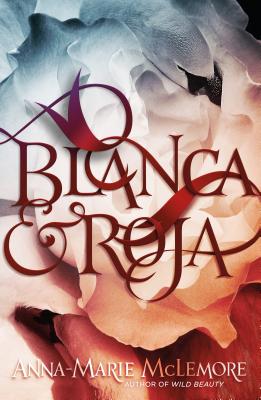
Blanca & Roja

by Anna-Marie McLemore
First sentence: “Everyone has their own way of telling our story.”
Support your local independent bookstore: buy it there!
Content:  There are some references to sex and some swearing (including a few f-bombs). It’s in the teen section (grades 9+) of the library.

For their whole lives, the del Cisne sisters — Blanca and Roja — have known that one of them would live and one of them would be turned to a swan.

All their lives, Blanca and Roja — named so because Blanca was blond and fair, and Roja had red hair and darker skin — tried to thwart the swans. They weren’t going to be divided, one of them was not going to be left behind. Then, the swans came. And behind them, two boys: Page and Barclay. 

One part fairy tale retelling (Snow White and Rose Red) and one part love story, Blanca & Roja is incredibly lyrical. I love the way McLemore writes, with spare chapters and magical language. I loved the way she used the fairy tales, and the way she was exploring the consequences of racism and white preference. It was a fascinating story, incredibly well-told, and thoroughly enjoyable!

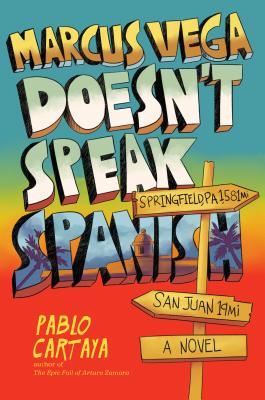
Marcus Vega Doesn’t Speak Spanish

by Pablo Cartaya
First sentence: “Most kids clear out of the way when I walk down the hall.”
Support your local independent bookstore: buy it there!
Review copy provided by the publisher.
Content: There’s nothing “objectionable” language or other-wise, but the main character is 14 years old, and the themes seemed a bit more mature than the usual middle grade fare. So, it’s in the YA (grades 6-8) section of the bookstore.

Marcus Vega is a very large 14 year old. He’s one of those kids that went through puberty early, and he’s the giant in the hallway. He uses this to his advantage: he charges kids for his “protection” services, walking them to school and home again and otherwise being the heavy, enforcing the principal’s rules (for a fee). The money goes home to help out his struggling single mom, and he’s also super protective of his younger brother, Charlie, who has Down Syndrome. So, it’s not out of character for Marcus to punch a kid — the school bully, Stephen — for making fun of his brother. However, it’s his word against Stephen’s, and Stephen’s parents are the super involved, high donors type, and so it’s Marcus who ends up being threatened with expulsion. Thankfully, it’s right before spring break, and Marcus’s mom decides that it’s about time for them to head to Puerto Rico to meet Marcus’s father’s (who left when Marcus was four) family.

Marcus then becomes obsessed with finding and confronting his father, if only for closure. This takes him, his mother, and his brother, all over the island, meeting different members of the extended Vega clan. But, mostly what this book becomes at this point is an extended love letter to Puerto Rico. The book starts with a blurb about the hurricanes that hit the island last year, and how many of these places in the book are no longer like Cartaya describes them. But, as a reader, you can tell the affection that Cartaya has for the island. It’s a charming, sweet, Spanish- and Puerto Rican-infused book. Sure, Marcus has a happy ending but that’s not the point of the book, I think. It’s more to raise awareness: there is a culture and a history in Puerto Rico that’s rich and rewarding and even though they’re different from us, they’re also Americans too.

And while it’s not as good as visiting Puerto Rico, it’s a good second choice.

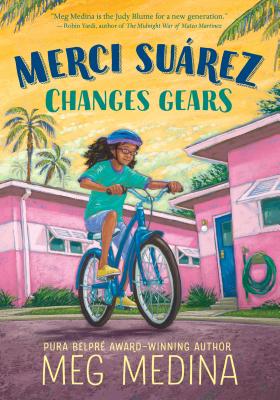
Merci Suarez Changes Gears

by Meg Medina
First sentence: “To think, only yesterday I was in chanletas, sipping lemonade, and watching my twin cousins run through the sprinkler in the yard.”
Support your local independent bookstore: buy it there!
Review copy provided by the publisher.
Content: There are some difficult situations with Merci’s grandfather and some intense moments and older themes. It’s in the middle grade section (grades 3-5), but it would probably be better for the older end of the spectrum.

Merci Suarez likes her life: she lives with her parents and her older brother next door to her aunt and her twin sons on one side and her grandparents on the other. They’re happy as a family, with their traditions and squabbles, and she doesn’t want things to change. But, she’s started 6th grade, with all the pressure that brings, and her brother is a senior in high school and is going to be leaving for college. And, then her beloved grandpa starts forgetting things and acting strangely. And then there’s that girl (THAT girl) at school who Merci thought she was friends with, but turns out to be nothing but a thorn in Merci’s side.

The question is: how is Merci going to deal with everything being different?

This is a perfect little book about friendship and family and figuring out how to manage change. Merci isn’t perfect, which I appreciated, and I enjoyed the fact that the conflict came from something other than bad parents. Merci’s parents are supportive of her, and encourage her in her education. I felt for her at times, especially because she had to make sacrifices with friends and school because of her family. It’s a very realistic portrait, and one I appreciated. I liked how Medina captured the Latinx family experience; it’s a good example why Own Voices is so important. I liked Merci’s story, and felt for her experiences, and I loved how Media wove in culture and heritage as well.

It’s an excellent book.

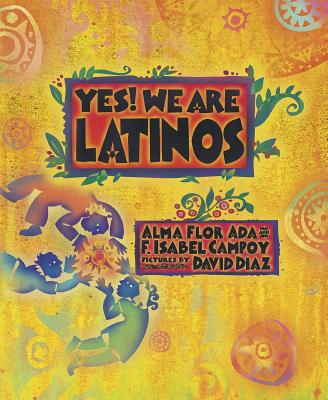
Module 14: Yes! We are Latinos!

Ada, A. F. and Campoy, F. I. (2013). Yes! We are Latinos. Watertown, MA: Charlesbridge.

Genre: Poetry with non-fiction mini-essays.

Book Summary: A series of narrative poems, followed by a brief narrative non-fiction essays about different aspects of Latinx history and culture. These are not based on any one person, but are a composite of the different variety within the Latinx world.

Impressions: I loved this one! I don’t often read poetry collections (and when I do, they are usually the humorous ones. My current favorite is I’m Just No Good at Rhyming) and I didn’t quite know what to expect. What I got were some narrative poems, each telling a story about a different child’s Latinx identity. It served as a reminder that even though we (white people, the media, etc.) lump all Latinx people together, there’s a lot of diversity and richness of heritage within the culture. (And, I was reminded, that they don’t all get along!) I really enjoyed the historical information that came after each poem, which told a bit about the history and culture of the person in the poem preceding. I knew quite a bit of the information already, but it was good to be reminded of the history (and some of it recent history) and how much of the United States was originally Spanish. (And that the Brits weren’t the only oppressive colonizers in the world.) Definitely a highly recommended collection.

Review: While the review was short and more oriented to the plot than any opinions about the book, Leon-Barrera did remark that the book was “refreshing” especially because of the vast representation from the Latinx world. She also wrote, “The vignettes also help to illustrate the meaning of being mestizo–the blending of indigenous, African, and Spanish lineage-mentioned in the introduction and explored throughout.” This was something I noticed but didn’t realize was as important as it is. She also commented on the inclusion of Asians in Latin America, which, she wrote, “is often overlooked in children’s literature”.

Leon-Barrera, M. (2013). Yes! We are Latinos.  School Library Journal. 59 (8), 94.

Uses: This was used as part of our city’s Big Read a few years back. It could also be used in a poetry writing workshop for middle or high schoolers, since these are all accessible, free-verse, narrative poems.

Readalikes:

  • Enchanted Air by Margarita Engle – This is the most obvious read-alike, as it is a non-fiction memoir in verse about Engle’s childhood and her family in Cuba.
  • The Epic Fail of Arturo Zamora by Pablo Cartaya – Another Cubano novel, this one focusing on the struggle to keep history and culture and family together in America. It’s also a David vs. Goliath book, in that a big developer wants to take out Arturo’s family’s restaurant in order to put in a huge multiplex.
  • Gabi a Girl in Pieces by Isabel Quintero – A young adult book about Mexican-American culture and the struggles between older generations and their traditions and younger generations.

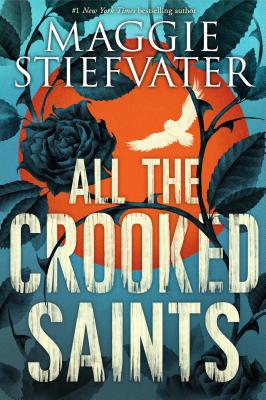
All the Crooked Saints

by Maggie Stiefvater
First sentence: “You can hear a miracle a long way after dark.”
Support your local independent bookstore: buy it there!
Release date: October 10, 2017
Review copy provided by the publisher.
Content: There’s some swearing, including a couple of f-bombs. It will be in the Teen section (grades 9+) of the bookstore, but younger kids might be interested in it.

The problem with this book is that the plot is really hard to describe. There’s a family in the southern Colorado desert, the Sorias, that have basically made a living performing miracles for pilgrims who come to their homestead looking for help. But, it’s much more than about the miracles. There’s a boy who comes looking for help (but not a miracle) and a few pairs of lovers, some who are new and some who have lost their way. In fact, a lot of the plot is about how to find one’s way back from being, well, lost.

It’s historical, set sometime in the 1960s (I had it initially pegged for contemporary, then set in the 1970s… so I was close), but it feels, well, set out of time.

Mostly, though, the best thing about this is, like many Stiefvater novels, the words. She just has a way of telling a story that sucks you in and won’t let you go. And this was no exception. The magic here was less “magic” and more magical realism; it felt like it really could happen, that it was a natural outgrowth of the story, and it made perfect sense.

I’m sure Stiefvater will get some push back for writing a story with Latin@ main characters, but honestly, I don’t think she used stereotypes at all. (Or at least, that’s the way I felt; I’m not a great judge of this.)  I loved all the characters, from the Soria family to the pilgrims, and I loved the way Stiefvater told the story. Everything just seemed to fit.

It’s really a wonderful story.

The First Rule of Punk

by Celia C. Pérez
First sentence: “Dad says punk rock only comes in one volume: loud.”
Support your local independent bookstore: buy it there!
Review copy provided by the publisher.
Content: There’s some lying (by omission) and some middle school drama. It’s in the Middle Grade section (grades 3-5) of the bookstore, though 6th-7th graders might like it too.

Mariá Luisa (call her Malú please) is NOT happy about moving to Chicago. She wants to stay where she is, in her own school, splitting her time between her house and her father’s record store. But, her mom got a job in Chicago teaching Mexican literature, so they’re moving. And so she has to start over. Which is additionally hard because she’s in a school with a large Mexican American population, and Malú is struggling to find her own identity, especially with her mother always harping on Malú’s love of punk music.

But, she slowly finds her crowd in this new school, and maybe even some friends, although she makes some enemies as well (inevitable). Maybe she can find a balance in this new place.

I loved this one! Malú is a seriously great character, and I loved how Pérez wove in Mexican culture and history through the work. I loved the inclusion of punk music (and lifestyle) and actually really liked the conflict between Malú and her mom (it’s SO hard to let kids be themselves and not what we want them to be). I loved the zines in the book, and Malú’s slow acceptance of her new school and neighborhood. It was just an excellent story all around.

The Epic Fail of Arturo Zamora

by Pablo Cartaya
First sentence: “I’m officially resigning from love.”
Support your local independent bookstore: buy it there!
Content: It’s a bit more, well, mushy than your usual middle grade fare, but it doesn’t smack of YA quite yet. While it’s in that nice spot for 10-12-year-olds, it’s in the Middle Grade section (grades 3-5) of the bookstore. I may change that and put it in the YA. We’ll see.

It’s the summer after 7th grade, and Arturo Zamora is ready to have a good one. He’s working at his family’s restaurant, hanging out with friends in his Miami neighborhood. That all changes, however, when a big developer decides to make a bid for the lot next door to the restaurant, the one which the Zamora’s were hoping to purchase from the city for their expansion, and has plans to put in a fancy new “exclusive” building. All of a sudden Arutro’s summer has turned into fighting this developer, and figuring out his place in the family. Not to mention his burgeoning feelings for his mother’s goddaughter, Carmen. It’s going to be quite the summer.

This was a really fun book. I enjoyed Arturo’s attempts to figure himself out. I loved the Cubano culture that threaded itself through the book. I loved Arturo’s relationship with his grandmother and mother. Even the slight romance wasn’t overdone. I loved that the Spanish was woven seamlessly in the book, often without English translation. It felt more authentic that way. And I also thoroughly enjoyed getting to know the Zamora’s and cheering the little guy in the fight against Big Man. Definitely one to check out.