Rose

by Holly Webb
First sentence: “Rose peered out the corner of the window at the street below, watching interestedly as two little girls walked past with their nursemaid.”
Support your local independent bookstore: buy it there!
Review copy sent to me by the publisher for the Cybils.
Content: Aside from the creepy person kidnapping orphans (but it’s really not that scary), there isn’t anything untoward in this book. It would happily sit in the middle grade (3-5th grade) section of the bookstore.

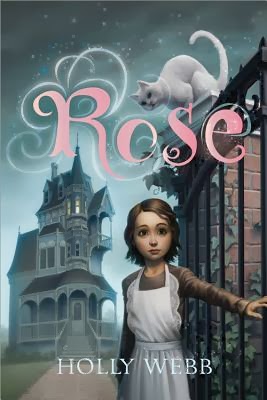
Rose lives in St. Bridget’s Home for Abandoned Girls in London, with no idea, really, where she came from or who she is. (She’s named after the rose bush that was blooming the day she was found in a fish basket in the churchyard.) She really doesn’t have much hope of ever being adopted, so she trudges on, one day after another. Then one day, a housekeeper for a wealthy alchemist/magician arrives, and Rose ends up as a maid in the house. And she discovers that she has a talent for magic. It turns out, too, that orphan children are disappearing from the London streets. No one is really concerned — they’re orphans, after all — but when a friend of hers from St. Bridget’s goes missing, Rose knows she has to do something. And with the help of the magician’s apprentice, maybe she can.

This is, in many ways, a book that’s already been written. Orphan? Check. Plucky lower class girl outsmarting the gentry? Apprentice story? Check. Check. Evil magician stealing children? Check. It should have been by-the-numbers boring.

And yet, it wasn’t. Partially because of the writing — Webb does know how to keep the pages turning — but mostly because Rose is such an endearing character. She’s neither snarky nor plucky. She just does what Needs To Be Done. She’s hardworking, but doesn’t have any desire to be Great. She’s not terribly smart — she has no idea how she’s doing what she’s doing — but she is willing to learn. And she is, above all, loyal to those she calls her friends.

She is, for all purposes, a Hufflepuff.

And that is why I loved her. The story is good, as well. I think this is a first in a series, but it doesn’t need to be. I can see a lot of kids loving it — boys too, if they can get past the title and cover — because it’s quite accessible.

A true winner. (Go Hufflepuff!)

(Just for the record: because this is a Cybils nominee, I’ve been asked to make sure y’all know this is my opinion only, and not that of the panel.)

Audiobook: Longbourn

by Jo Baker
read by Emma Fielding
Support your local independent bookstore: buy it there!
Content: There is some talk of sex, but it’s vague and not at all explicit. And some mild swear words. It’s in the general fiction section at the bookstore, mostly because that’s the way it’s marketed. If a 15 year old were interested, I’d give it to them.

This is, to be frank, Pride and Prejudice fanfiction. All the familiar settings — Longbourn, Pemberly, London — are there, as are the familiar characters — Lizzie, Jane, Mr. and Mrs. Bennett, Bingley and Wickham (Darcy not so much).The difference is that it’s really only the bare bones of the P&P and the story is told from the points of view of three servants: Mrs. Hill, the housekeeper; Sarah, a maid; and James, a footman.

It basically follows the plot arc of P&P, though the concerns are not the concerns of Lizzie and Jane. And, honestly, I was expecting to love visiting that story from the perspective of the downstairs help. However, I was in for a surprise: unlike Austen’s witty observations on human character, Longbourn is a very pedantic book: every day is get up, do the work, collapse in bed. It’s also a dirty book — literally, there’s dirt, blood, pig slop, mud, you name it; Baker doesn’t whitewash the 19th-century.

There’s a slight love triangle between Sarah, James and Mr. Bingley’s footman, and while it goes somewhere, it feels kind of superfluous. I never really connected with the help; Baker didn’t make me care about all the work they were doing, or how annoying Mrs. Bennett was, or what a creeper Wickham was. And so, when at the beginning of volume 4 (I think; listening to it kind of throws off those things), I got backstory on Mrs. Hill and James, I was more than annoyed. First, at the timing — why wait until most of the way through the book? — but secondly because Mrs. Hill and James were not who I cared about or was interested in.

And then it just kind of petered out at the end. Baker kept the story going past the end of P&P, through the marriage of Lizzie and Darcy and even later until everyone is Old. I didn’t care. I wanted to care, but I was just Tired of the story.

I finished it. But I’m thinking that I shouldn’t have. Which is too bad.

(A note on the reader: she was fine. She was interesting. But it wasn’t enough to make me really like the book.)

The Wells Bequest

by Polly Shulman
First sentence: “The Wednesday when the whole time-travel adventure began, I was fiddling with my game controller, trying to make the shoot button more sensitive.”
Support your local independent bookstore: buy it there!
Content: The main character is a bit obsessed with the girl (too much for my taste in a time-traveling, science fiction adventure book) and there’s a terrorist threatening to destroy NYC. It’s in the middle grade (3-5 grade) section of the bookstore, though I personally would hesitate before giving it to just any third grader, though I’m not sure I could pinpoint why.

Leo is the son of Russian immigrants who really only expect two things from him: excellence and to be scientifically minded. Leo — for better or for worse — is neither of those. At least not in the traditional sense. Leo is a Tinkerer. He loves taking things apart and putting them back together. He loves building new and better things. Which makes him perfect for the page program of the New York Circulating Material Repository. He gets there in a weird, round-about way, though: a time-traveling version of himself and an unknown girl (Jaya Rao, who was in the first book of this series The Grimm Legacy. Thankfully this one stands on its own, however.) stops in his room to tell him to read H. G. Wells’ The Time Machine.

I’d like to say that an adventure starts there, and there is a bit of an adventure that involves NikolaTesla, Mark Twain, and a crazed British page that has a raging crush on Jaya. I while I did enjoy reading this book, mostly I felt like it was a set-piece for Shulman to show off all the Really Cool Things that could come from reading science fiction books. There are many references to classic science fiction (which I got, but I wonder how an elementary school student would handle) and the inventions that come out of them are really neat. But I felt like that was the entire point of the plot. And I kind of wanted more action and less cool inventions.

(There’s also the side issue of Leo being Obsessed — though not in a crazy way — with kissing Jaya. I know he’s a hormonal pre-teen boy, but get on with it already. It’s a science fiction time travel book. I felt like it was a distraction.)

Even with my qualms, it was a fun story. And I’m curious about the first one as well.

(Just for the record: because this is a Cybils nominee, I’ve been asked to make sure y’all know this is my opinion only, and not that of the panel.)

Beholding Bee

by Kimberly Newton Fusco
First sentence: “The way I got the diamond on my face happened like this.”
Support your local independent bookstore: buy it there!
Content: There’s some bullying, both by (insensitive and stupid) adults and mean girls. But there’s no language, and the language isn’t difficult at all. It sits quite happily in the middle grade (3-5th grade) section of the bookstore.

It’s in the middle of World War II, and things are tough for those who work at the carnival. Especially for Bee, who works the hot dog stand with her makeshift guardian, Pauline. It’s difficult for Bee not only because she’s an orphan and the carnival owner, Ellis, is a world-class creep, but because she’s got a birthmark in the shape of a diamond on her face that everyone (EVERYONE!) stares at and/or makes fun of.

So, when Ellis takes Pauline away from her and threatens to put her on display as a sideshow attraction, Bee decides to run away. She makes it to a town with a perfect house, and finds a couple of women whom she ends up calling “aunts” there. The catch? Only Bee can see her aunts.

Of course life in her new town isn’t easy: there are busybodies who want to know who Bee’s caregivers are. There are mean girls who are dealing with Issues themselves. But there’s also good people who reach out to Bee and make her feel at home.

In so many ways, this was just a plain, regular middle grade fiction book. And it’s a good one at that. Fusco writes lyrical, short chapters; ones that make you want to keep turning pages. There’s the backdrop of hardship with the war, there’s bullying, there’s Bee’s “disfigurement” and shyness that places her in the special-needs class. It really is quite a lovely little novel about Overcoming, finding family, and creating a home.

The question I had, though, while reading this book is this: why the ghosts? It was a great novel without them, and I didn’t feel that the ghosts added anything to the story. They felt, well, contrived. And I wished that Fusco had found another way to get Bee into the town and the house that didn’t involve the supernatural. That way the book would have had a broader appeal, more power, and been absolutely perfect.

But, I guess, you can’t win them all.

(Just for the record: because this is a Cybils nominee, I’ve been asked to make sure y’all know this is my opinion only, and not that of the panel.)

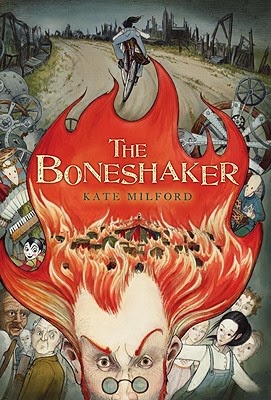
Audiobook: The Boneshaker

by Kate Milford
Read by: Erin Moon
Content: some intense moments (the Devil’s pretty scary), some violence, some disturbing images (if it were a movie). Language is probably suitable for someone reading on a 5th grade level. Has the feel of an older Middle Grade book, so I’d probably put it in the YA section (grades 6-8) at the bookstore.
Support your local independent bookstore: buy it there!

It’s 1914, and 13-year-old Natalie Minks has a pretty good life. Her father is the local mechanic — bicycle, mostly, but he’ll tinker with cars — and her mother tells the most amazing stories about their town, Arcane. Natalie herself has a predisposition for both: she loves tinkering with her father as well as listening to her mother’s stories.

Then one day Dr. Jake Limberleg’s Nostrum Fair and Technological Medicine Show comes to town. It was a fluke — their front wheel came off at the crossroads, and they decided to set up shop while they waited for Mr. Minks to fix their wagon. And that’s when the Trouble starts. Natalie, for better or for worse, is tuned into it and with her frienemy Miranda (I think that’s what her name was; I can’t look it up in the book!) and her trusty Chesterlane Eidolon bicycle (a bone shaker of an old thing that would be the fastest in the world, if Natalie could ever ride it), she decides to take on Limberleg and solve the mystery, saving her town. If she can.

I don’t know how I can write about the way this captured my attention. Sure, I was on a long drive to Austin, and it had my full attention anyway, but I didn’t want to stop listening. Milford has taken the idea of a Faustian Bargain — you know: those stories where a character meets the Devil and then outsmarts Old Scratch? — and elevated it. Not only is there two elements to this bargain, but we get historical elements thrown in as well. The traveling medicine show (I loved the Paragons of Science, even though they were Evil), the bicycles, the references to the “war” (which took me a minute to realize they meant the Civil War): it all added Atmosphere, which made the fantasy element, the bargains with the Devil at the Crossroads, that much creepier.

(It also helped that I kept thinking about this song:)

In short: a winner of a book.

Rose Under Fire

by Elizabeth Wein
First sentence: “I just got back from Celia Forester’s funeral.”
Support your local independent bookstore: buy it there!
Content: there were a lot of f-bombs (I didn’t count them) that came up once at the concentration camp (understandable) and other mild swearing throughout. Also a number of disturbing images and content (Nazi concentration camps don’t make for Light Reading). It is most definitely one I wouldn’t hand to a kid under the age of 13 or 14 (depending on their maturity handling Difficult Situation), whether or not they were on the reading level, so it’s shelved in my Teen section (grades 9-12) at the bookstore.

I don’t quite know where to start with this one. Once I discovered it was a Holocaust novel (as opposed to just a WWII novel), I put off reading it. I don’t like Holocaust novels, mostly because I don’t like being confronted with the evil things the Nazis did. But, because it was Elizabeth Wein, and because it’s a companion to Code Name Verity, I bravely gave it a shot.

And I found myself sucked into the world of women pilots, of strong, resilient women who know how to survive. It’s odd to say this about a Holocaust book, but I loved it.

Rose Justice is an American who has pulled strings to get enlisted as a transport pilot for the RAF. She’s doing her duty, blissfully unaware of the evils of the Nazis. Sure, they’re the Enemy, but the can’t be as horrible as they all say, right? Then, on a mission, she chases after a flying bomb (German pilotless planes loaded with bombs), gets lost over enemy territory, and ends up in Ravensbrück.

Even I, who actively avoids anything Holocaust, know about the horrors of Ravensbrück.

And yet, even though Wein captures the horrors, and the crimes, and the terribleness (I can’t seem to find a word strong enough) of Ravensbrück, it isn’t a hopeless, dark book. Even though Rose is changed permanently by her six months (only six measly months! How did people survive years there?), she retains her will to survive. And Wein has created a cohort of strong, amazing, wonderful (again, there is no word strong enough) women who do just that: survive. It’s amazing — and inspiring — to read.

I’m so glad I did.

All the Truth That’s in Me

by Julie Berry
ages: 13+
First sentence: “We came here by ship, you and I.”
Support your local independent bookstore: buy it there!
Review copy pilfered off the ARC shelves at work.

Two girls go missing. One turns up dead, floating in the stream. Two years later, the other one returns to the small town, intact, but with her tongue cut out. The villagers — from the preacher to her own mother — call her cursed, and shun her.

I’ve tried to sum up what goes on in the rest of the book, but I’ve found that I don’t really want to give too much away. Because much of the pleasure I got from reading this (in one sitting!) was not knowing that much about it. I will tell you this: at first, I thought it was a fantasy setting, because I think that’s what I was expecting. It’s not. Even though it’s not explicitly stated, it’s a Puritan setting, somewhere on the east coast. And the religion and mores that those communities set out play a major role in the book. And, even though it’s a story about kidnapping and murder, and you fear the worst for Judith, I will tell you that, as the story unfolds, it’s not the worst. It’s bad, but it’s not as bad as it gets.

The meat of the story is Judith — she’s the girl that returns — and her road to healing. For, in spite of everything that the village (and her mother) heaps on her, she does need to heal. It’s this process that is the true story. How Judith salvages her life from her trauma and reclaims her own sense of self. How she finds friends in the face of all the opposition in the town. How she even finds love. It’s a testament to the power of truth, to the power of the human spirit.

Remarkable.

Code Name Verity

by Elizabeth Wein
ages: 14+
First sentence: “I am a coward.”
Support your local independent bookstore: buy it there!

Things this book is:
A World War II book.
A book about friendship, between two young women, specficially.  Funny.
A book about torture.
A book about the Resistance.
A book about women pilots.
A book about things a person will do to save their skin.
An amazing example of voice. Seriously, the characters leap off the page.
Unputdownable. (Yeah, I know. Still, it fits.)
Freaking awesome.

Things this book is not:
Trite.
Another Holocaust book.
Boring.

In other words: if you haven’t yet read this story about Maddie and Verity, and been captivated by their story, you are missing out.

And yes, it really is just as good as “they” all say.

The Street of a Thousand Blossoms

by Gail Tsukiyama
ages: adult
First sentence: “A white light seeped through the shoji windows and into the room, along with the morning chill.”
Support your local independent bookstore: buy it there!

The thing that kept coming to mind as I was reading this sweeping novel, was that this book is much like a picture album. The pictures go together because they’re of the same family, and because they tell a story of the passing years. But, each individual picture has a story. Sometimes those stories are interesting, sometimes they’re a little boring. Much like this book.

Tsukiyama tells the story of two brothers — Hiroshi and Kenji — over the course of nearly 30 years. When we first meet them, it’s 1939, and they are orphans living with their grandparents (their parents died in a freak boating accident). The book follows them as they grow up: through the horrors of the war years; Hiroshi’s rise as a sumotori and Kenji’s discovery and mastery of the art of theater mask making; as both brothers find (and lose) love. It’s more than a slice of life, it’s history.

But, even though it’s quite lyrical and beautifully written and incorporates Japanese incredibly seamlessly, I found myself going back and forth on this one. Some of the snapshots were fascinating. Some of the people I cared immensely about. But, sometimes I found myself unable to get into the language, or drifting off because the plot, such as it was, wasn’t grabbing me.

That said, one of the things that Tsukiyama does beautifully is give us a slice of Japan. More than the people, it was the way Tsukiyama described the land, the culture, and the people, as well as the push and pull between tradition and modernity. For that alone, the book is worth reading.

The Heretic’s Daughter

by Kathleen Kent
ages: adult
First sentence: “The distance by wagon from Billerica to neighboring Andover is but nine miles.”
Support your local independent bookstore, buy it there!

This is a fascinating, harrowing tale about a time in American history that I know very little about: the Salem witch trials.

Our main character, Sarah Carrier, is growing up in Billerica (and later Andover), Massachusetts. She’s often at odds with her hard, logical, unsentimental mother, Martha. Then, the summer of 1691, Martha is arrested on suspicion of being a witch, and asks Sarah to do the unspeakable: to cry out against her own mother in order to save her life. That’s the basic plot in a nutshell, but the book is so much more than that. Rambling and long, it’s a look at how Puritan communities and families functioned and interacted. It’s an attempt to understand why the Salem witch trials happened — whether it was just misunderstanding, fear, or jealousy; though in that case, I’m not sure it succeeded. I was left with almost more questions, especially after the descriptions of Martha’s trial. It’s almost incomprehensible to the modern mind how exactly everyone could let these abuses of human rights could go on. It was a different time and place, and that feeling is something Kent captured quite well.

The ending, for me, was a bit off, though. After Martha’s trial (and eventual execution), the book goes on telling us the fate of Sarah. Sure, it’s called the heretic’s daughter, but I’m not sure I really cared that much about Sarah’s fate. Perhaps it was because I was more emotionally invested in the story of her mother, and their relationship. Or maybe it was because Kent leaps over years and years in the final 7 pages. At any rate, the final revelation, the final secret her mother was keeping came as a “Huh, what?!” moment, which lessened the impact of the rest of the book.

Which, to be sure, was fascinating.