The Riverman

by Aaron Starmer
First sentence: “Every town has a lost child.”
Support your local independent bookstore: buy it there!
Content: There’s some alcohol usage and talk of murdered children. Also, it feels really adult in its sensibilities. It’s in the middle grade (grades 3-5) section of the bookstore, but I’m not happy with that. On the other hand, it’ll languish in the YA (grades 6-8) section too, so I might just leave it where it is.

Alistair Cleary  is the kind of kid who blends in. He’s not popular at his middle school, but he’s not reviled, either. His best friend is a gamer — which is quite unusual, since it’s the fall of 1989 — but Alistair has managed to escape certain geek doom. He’s content to slide through life. Until Fiona decides that it’s Alistair who needs to write her sad tale down.

And what a tale: Fiona insists that she’s been going to this imaginary land, Aquavania, which is absolutely real. She’s added months to her life in her trips (which become years later in the book). And that her friends in Aquavania — who also happen to be real people in the Solid World — are disappearing because someone called the Riverman is sucking their souls away.

I had Issues with this book. It compelled me enough to finish it, sure, but it was one of those books that I threw across the room when I was done. I’ve been trying for days to figure out how to write about my issues, and to boil my problems with the book down into a neat, concise package, but I don’t think I can. There will be spoilers.

My initial problems come from the incongruity between the cover and the book itself. The cover screams middle grade, but the content is very… adult. On some level, I feel like Starmer should have gone all the way, made this incredibly dark and sinister, used the metaphor that he was building — that Aquavania is a crutch for Fiona, who uses it to escape horrible things in her life — and made it an adult book.

But, even though that is the set up for most of the book, Starmer doesn’t follow through. He pulls what I have come to think of as a bait-and-switch, a “HA! It’s Really REAL” moment. For which he has given us no basis in the rest of the book. Our narrator, Alistair, believes Fiona is making it up. He believes in the dark understory, so I do too. And so it’s incredibly unsatisfying (for me as an adult; would an older kid?) to have the rug pulled out from underneath you.

I’m sure there I have other complaints (did it really need to be set in 1989? REALLY?), but that’s the main one. Going in, I didn’t know what to expect, but by the end I hoped for a lot more than what I got.

The Road Home

by Ellen Emerson White
First sentence: “On Christmas morning, Rebecca lost her moral virginity, her sense of humor – and her two best friends.”
Content: This is a book about war, and doesn’t pull any punches. There’s language (with a couple of f-bombs), talk of sex (none actual) and lots and lots of violence. It’s also more emotionally mature. It’d be in the teen section (grades 9 and up) of the bookstore, if it were in print.

This was thrown at me by my wonderful friend Laura, without me knowing much else besides she thought it was really great.

This is the last book of a series about a family (I gathered, not having read any of the others), focusing on the daughter, Rebecca. Her long-time boyfriend was killed in Vietnam and her brother fled to Canada to avoid the draft. So she did the only logical thing: she signed up for a tour. Because it was the 1960s, and because women weren’t allowed to be on the front lines, and because Rebecca has an interest in medicine, she signed up to be a nurse. To say she didn’t know what she was getting into was an understatement. The book follows the second half of her tour in Vietnam, after a horrific event she was involved in, through to her coming home.

It’s taken me quite a while to get through this book, not because it was bad or I was disinterested — neither were true –but rather because it was so emotionally taxing. White knows how to write war. The mundane elements of being out in the field, the stress of the ER when helicopters full of wounded and dying soldiers come in. And then the PTSD of coming home. Especially in the 1960s, when there was so much anti-war sentiment at home. She captured Rebecca’s increasing despair, the difficulty she had in making it through so well, that I was drained each time I picked it up.

That’s not to say there wasn’t hopeful elements to the story: there were. Rebecca makes friends and even has a bit of a relationship But it’s not some miraculous recovery or some “ah-ha” moment. It’s very real, almost brutally so, and very honest.

I found it worth reading (once at least), and while I didn’t love it, I appreciated it. I appreciated the depiction of the soldiers and of Rebecca, and especially of her coming home. It’s not an easy read, but it’s definitely worth the time.

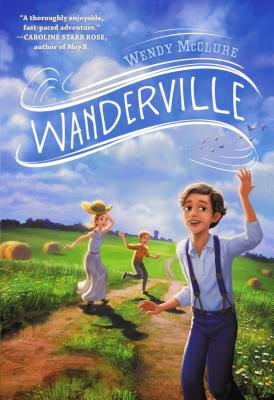
Wanderville

by Wendy McClure
First sentence: “Jack didn’t notice the smoke until there was far too much of it.”
Support your local independent bookstore: buy it there!
Content: There’s a some bullying and a fire that kills a family member of a main character, but that’s about it. It’s short enough to be a beginning chapter book, but it might be too challenging for most 1st and 2nd graders. Definitely belongs in the middle grade (3-5th grade) section of the bookstore.

Jack lives in a walk up in New York City in 1904. Their family is poor, but making it. That is, until a fire takes both their building and the life of Jack’s older brother. Frances and her younger brother Harold are orphans and living off the charity of one of the many orphanages in the city. Both find themselves on a train headed west, as part of the efforts of the Society for Children’s Aid and Relief Office. But, as all three find out, the best intentions of adults don’t always translate into good things for kids.

Faced with being separated from her brother, and looking forced labor in the eye, Frances, Harold and Jack decide to jump off the train before they reach their final destination. They’re wandering the Kansas prairie when they find Alexander, another orphan train escapee. He’s decided to start his own town, called Wanderville, and while it doesn’t look like much (or anything, really) it’s not his own. Unfortunately they way they get supplies is by “liberating” them from the nearby town. Which, obviously, is going to lead to trouble.

I wanted to like this one. It’s got a good idea — exploring the world of the orphans from the orphan train — and it’s set here in Kansas. I was hoping that it’d be a good contribution to historical/Kansas middle grade fiction. But it’s not. Perhaps it was me, but I didn’t like the characters, and felt the text itself was too condescending and predictable. I felt that if I had a checklist I would have ticked every single cliche off.  Bully on the train? Check. Evil man exploiting the system for his own gain? Check. Rugged and slow cop? Check. Sisterly figure who always knows better than the boys? Check. Adorable 7-year-old who is Wiser Than His Years? Check.) That’s not to say that kids won’t like it. I’m sure many will.

I just didn’t.

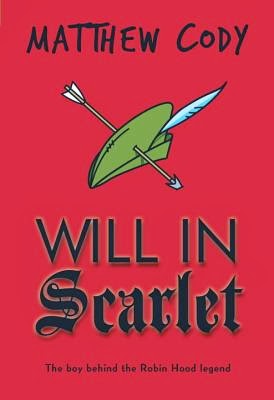
Will in Scarlet

by Matthew Cody
First sentence: “In the year 1192, while King Richard the Lionheart was on his way home from fighting in far-off Jerusalem, the lords of Shackley Castle were out hunting wolves by moonlight.”
Support your local independent bookstore: buy it there!
Review copy provided by the publisher because this was a book group pick.
Content: There is some violence, and the word count/comprehension is pretty high. My 4th grader wasn’t interested in taking the time to read it, though it’s probably within her reading/comprehension level. Even though it’s in the middle grade (3-5th grade) section of the bookstore, it may be more suitable for older readers.

William Shackely is the only son of the lord of the manor. And, at 13, he’s ready to become a Man. Under his uncle’s guidance he’s pretty sure he can take over running the lands. That is, until Sir Guy, a toadie of Prince John and a despicable human being, comes in and takes over the Shackley Castle. All of a sudden, Will finds himself landless, and on the run.

He ends up stranded in Sherwood Forest, taken captive by the Merry Men, who are led by none other than… Gilbert. (There is this guy named Rob, though, drunk in the corner.) Will’s pretty sure they just want him for ransom, so (against the better judgement of a girl named Much — though the readers only know she’s a girl; the characters, being boys/men, are clueless) he convinces them to go back and raid Shackley Castle. It’s on that raid that he finds out that drunken Rob is actually a charismatic leader, a good planner, and someone worth fighting with (and for).

I’ll spoil it for you: Rob turns out, by the end, to be Robin Hood. But, getting there was a less than enjoyable experience. I have to admit that I’m shallow: my biggest problem with the book was the font. I didn’t think I was so affected by something that simple, but from the get-go, the layout (it’s crowded, the typeface smallish) bothered me. But it was also not what I had expected. I wanted Robin Hood. The whole myth and legend. And while elements of it were there (Sir Guy, the Sheriff of  Nottingham, Sherwood Forest, Little John) too much of it — including Robin himself — was missing. And while there was action (the first chapter starts out with a pretty intense wolf hunt), it wasn’t paced well. It’d be exciting for a bit, and then pages and pages of Will’s inner struggle with his desire for revenge.

There were some bright spots. I enjoyed Much as a character; she did hold her own with all the guys. And I liked that there really wasn’t a romance. But, mostly, it just feel flat for me.

Which was disappointing.

Cloud Atlas

by David Mitchell
First sentence: “Beyond the Indian hamlet, upon a forlorn strand, I happened on a trail of recent footprints.”
Support your local independent bookstore: buy it there!
Content: There is some language, including strong language in some of the chapters, and some implied sex. It’s in the adult fiction section at the bookstore, and I think, while there are some kids who might like this, it’s a good place for it.

I won’t say that I had high expectations going into this. Or that I really wanted to read it. Actually, after S., I kind of didn’t want to have anything to do with adult fiction for a good long while. But, this was our book group pick, and I’m a good book group member, so I picked it up.

I’m not even going to try a plot summary; mostly because I’m not sure there is a plot. There are multiple plots. And, even though I kind of liked some of them, they’re not worth recounting. It’s because this book isn’t about plot. It’s about Style and Meaning. And it doesn’t even really pretend (unlike S.) to be anything else.

But that’s what infuriated me. Aside from the stories stopping halfway through (very annoying, that), I wanted there to be some real connection between the individual stories. (Mostly because it’s a “novel” rather than a collection of stories.) But there wasn’t. Sure, the previous story is referenced in the next as a book or a movie (Symbolizing The Interconnectedness Of Our Existence or something Deep like that), but I wanted a character to travel through time. Or it to be someone’s descendant. Or something like that. And so, I spent too much of my time trying to figure out how the stories interconnected.

Plus, I’m not a careful reader. I miss details. And if you miss details in this, you loose Meaning and Substance.

I was game to finish the book, reading it as it’s “supposed” to be read (I did, briefly, contemplate jumping and finishing each individual story before moving on.), but I bailed when I got to the “middle” story, not just because I was increasingly frustrated with the book, but because of this: “I watched the clock’s tickers that mornin’ too tll Abbess came back from her augurin’ an’ sat ‘cross from me. She telled me Old Georgie was hungerin’ for my soul, so he’d put a cuss on my dreamin’s to fog their meanin’.” I. Don’t. Like. Dialect. I find it hard enough to read in the most normal of circumstances, but to throw dialect on me, in addition to all the other frustrations, was the straw that broke the camel’s back.

I bailed. I did go and check on Wikipedia to see what I missed, and I found that (at least according to them) I didn’t miss much.

THIS is why I read kids’ books.

Bluffton

My Summers With Buster
by Matt Phelan
First sentence: “Life in Muskegon, Michigan was quiet.”
Support your local independent bookstore: buy it there!
Content: Nothing. Nada. Not a bit. Perfectly fine for graphic novel/history buffs of all ages. Resides in the middle grade (3-5th grade) section of the bookstore.

The thing I like best about Matt Phelan — aside from his gorgeous art; it’s so very unlike anything else being drawn out there — is the way he takes historical events (like traveling around the world, or the Dust Bowl) and turns them into something… intriguing.

This time out is probably the most successful — for me, at least — of his books. It’s about the summers Buster Keaton and his family spent on Lake Michigan outside Muskegon. Now, in spite of being a Michigander (of sorts; I claim it mostly because my parents are still there), I’ve never been to that side of the state, and had no idea that Buster Keaton (!) summered on the lake.

And that discovery was part of the overall charm of the book. It’s nominally about a local boy, Henry, and his dislike of being “stuck” in Muskegon (even in 1908) and how dull, ordinary, everyday it all was until the day when the vaudeville performers showed up. Henry goes out to their compound by the lake, affectionately name “Cobwebs and Rafters”, and becomes intrigued by the antics of Buster. They become friends, of a sort, pulling pranks, playing baseball, but Buster refuses to teach Henry any of his “tricks”. That doesn’t stop Henry… determined, he tries out things on his own. (And doesn’t succeed terribly well. I think this was done to emphasize just how talented Buster was.)

My only complaint is that I don’t think Phelan quite knew how to end it. Instead of being the story of one summer, it’s the story of many summers over the course of many years. Henry grows up, stays put, and opens a movie theater. I’m not quite sure what the purpose of this was. Maybe to show that Buster grew into someone famous? Perhaps. It did take away from the fun of the first summer, the joy of meeting someone new, someone unique.

It’s worth taking a look at for the art, though. And for the joy of that first summer.

The Strange and Beautiful Sorrows of Ava Lavender

by Leslye Walton
First sentence: “To many, I was myth incarnate, the embodiment of a most superb legend, a fairy tale.”
Support your local independent bookstore: buy it there!
Release date: March 25, 2014
Review copy sent to me by the publisher in exchange for an IndieNext blurb.
Content: There are a few mild swear words, but lots of sex (none of it graphic), including a rape scene. It also reads more like an “adult” book than a “teen” one. I’ll probably shelve it in the Teen (grades 9 and up) section, though it might do better in the general fiction section at the bookstore.

While the title of the book suggests this book is about a girl named Ava Lavender, there is more to this story. In fact, it’s about Ava Lavender only because she’s the granddaughter of Emmaline Roux and daughter of Viviane Lavender. It’s equally their story. And it’s (to be honest) a difficult story to tell.

There’s foolish love, unrequited love, passion, and most of all a magic running through it all. It’s the magic of Like Water for Chocolate: Things happen because of the passion. Not the least of which is that Ava Lavender was born with wings. Not just little wings, either. Full-fledged, huge speckled wings. Her mother, being the person she is, doesn’t allow Ava to leave their hilltop Seattle home. But. Ava longs to be a “normal” teenager. Unfortunately, normality comes at a price.

The magic runs in other places as well: Ava’s twin, Henry, only talks when he needs to, and that’s not very often. Her grandmother sees ghosts. Her mother sense of smell is beyond extraordinary. The man down the road inspires people to confess their sins. Things like that.

The writing is… lyrical. The book… magical. And me? Well, I read it. See, magical realism and I don’t really get along terribly well. I wanted… something more to happen.  It’s not that it was a bad book; it wasn’t. It just wasn’t, well, my cup of tea.

How I Became a Ghost

by Tim Tingle
First line: “Maybe you have never read a book written by a ghost before.”
Support your local independent bookstore: buy it there!
Content: This is not a happy story. This is a sad and painful story. And even though the language is suitable for ages 8 and up, the content is, well, hard. And sad. And painful. (It was difficult even for me to get through because of the subject matter.) It’s in the middle grade (3-5th grade) section of the bookstore, but I’d be careful which child to give it to.

There was a time in my life, when I was junior or senior in high school, when I would have loved this story.

Isaac is a Choctaw boy, happy growing up in the swamps of the south. That is until the Nahullos — the white people — come along, and begin forcing his people out of their homes. And that’s when Isaac begins seeing ghosts. He sees shades of how his family and friends will die (horrible, horrible deaths). He foretells his own death and becomes a ghost. (No surprise: it’s in the first sentence!)

It’s when they’re on the Trail of Tears, however, that things get intense. The soldiers kidnap a girl, and it’s up to Isaac — as a ghost — and his friend — who can morph into a panther — to rescue her. They do, and it’s quite interesting how it happens.

I mentioned that I would have loved this story when I was younger. It’s because I was fascinated by — that seems the wrong word — the Native Americans, and their genocide. I would have eaten this book up, and passed it along to everyone I could. Now, though? Now, I just felt impossibly sad. I know it’s a tale that Needs to be told, a story that so many people need to be reminded of. But call it liberal guilt, call it having children: I couldn’t stomach it. It wasn’t violent, necessarily, but it was heart-wrenching. And even though Isaac turned out to be a hero, I never could find it in my heart to be proud of him (even though I wanted to).

It’s a well-written story, and a book that needs to be out there. I’m just not sure that I’m the right reader for it.

(Just for the record: because this is a Cybils nominee, I’ve been asked to make sure y’all know this is my opinion only, and not that of the panel.)

Absolution by Murder

by Peter Tremayne
First sentence: “The man had not been dead long.”
Support your local independent bookstore: buy it there!
Content: Murders, all off screen, and a lot (a LOT) of historical information to wade through. A novel for people with patience and time and a passing interest in Seventh Century Ireland/England/Catholicism. Nothing untoward (aside from the dead people) though.

This book is about a lot of things:
1. The mid-seventh century.
2. Early Catholicism in medieval England and Ireland.
3. The history of convents/monasteries in that time period.
4. The Saxon-Irish animosity of the time.
5. Saxon traditions that someone Irish would find despicable.
6. A woman court advocate in Ireland.
7. Solving a murder.

This book (I know I skipped the plot. It goes like this: there was a murder. They solve it. There’s 200 pages of incidental historical information.) has the same problem that many of the fantasy books I read have: there’s too much world-building (in this case, it’s medieval Great Britain) and not enough, well, plot.

I had the same problem I had with Deborah Harkness’s Shadow of Night: I felt like Tremayne (who is a professor of Celtic history) thought: “I’ve got ALL this historical information I NEED TO SHARE. Let’s see HOW MUCH I can put in this book!!” and then he proceeded to cram it ALL in. There was a plot — the abbess is murdered and Sister Fidelma (she’s the Irish woman court advocate) and a Saxon male (for the sake of balance) solve it. But I felt like the murder — which is really supposed to be the PLOT of the whole book — was incidental to the history. And I realized (even though I finished this one) that if I really wanted to read a book about medieval Great Britain, I’d find a non-fiction one.

How to Catch a Bogle

by Catherine Jinks
First line: “The front door was painted black, with a shiny brass knocker that made a satisfying noise when Alfred used it.”
Support your local independent bookstore: buy it there!
Review copy off the ARC shelves at my place of employment.
Content: There’s a few mild swear words and some very intense moments. I’d put it in the middle grade (3-5th grade) section of the bookstore, but I’d be wary about giving it to a sensitive younger kid.

Imagine a Dickensian London, complete with orphans, pickpockets, unsavory doctors, toshers, and blackmailing landladies. And then add… bogles.

What are bogles, you might ask?

Well, it’s what our fair heroine, Birdie, and her master, Arthur, call the paranormal creatures that they get rid of for the people of  London town. Not everyone believes in them, but Arthur and Birdie know one thing: if there’s children disappearing, it’s most likely a bogle.

(I’ll let you read the book to find out how to catch them, though.)

There isn’t much plot to this one in terms of plot; Birdie and Arthur catch bogles until they meet a woman of Society who decides that bogle catching is an unsuitable occupation for a girl. (Birdie objects.) They catch more bogles until things become Sufficiently Dangerous (that’s when the unsavory doctor comes in). There’s a bit of excitement, a kidnapping, and some hauntings before it’s all over. No, this one’s mostly about atmosphere. It’s a dark book — bogles are not nice creatures — and very  much the dirty London of Dickens’ time.

I loved it.

I know: I don’t usually like atmospheric books, or Dickens for that matter. But the combination of a clever take on the paranormal and the plucky character of Birdie was enough of a combination for me to fall head over heels for this one. It’s a perfect stand alone story (though it — like many this Cybils season — says it’s a “Book one”), one that is perfect for those who love historical fiction as well as the paranormal.

(Just for the record: because this is a Cybils nominee, I’ve been asked to make sure y’all know this is my opinion only, and not that of the panel.)