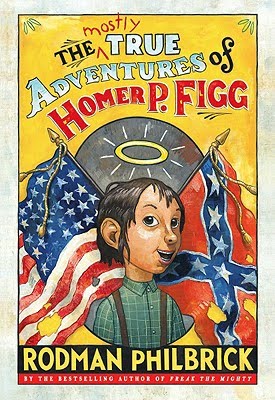
The Mostly True Adventures of Homer P. Figg

by Rodman Philbrick
ages: 9+
First sentence: “My name is Homer P. Figg, and these are my true adventures.”
Review copy provided by the publisher.
Support your local independent bookstore: buy it there!

Life is not good for Homer P. Figg. His father was felled by a tree. His Dear Mother passed away, leaving Homer and his other brother, Harold, in the care of their uncle, Squint, who — to write an enormous understatement — doesn’t treat them well. Now Squint has illegally sold Harold to the Union Army, and it’s up to Homer to find him and bring him home.

These are his adventures. (Mostly true, anyway.)

And, boy are they adventures.

From getting caught by a couple of slave hunters (in Maine, of all places), and rescued by a Quaker to becoming a part of a traveling circus, this is one a rip-roaring adventure. Sure, it’s a Civil War book; there’s the same old Civil War themes of slavery, fighting, traitors, and death. But it didn’t feel like a Civil War book; instead, it’s more of an adventure story with a Civil War backdrop. (Bonus plus: Joshua Chamberlin, my absolute favorite Civil War character, made an appearance!) But, more than the unusual take on the war, the best part of the book was Homer. He’s is not only a winning character, he’s a wonderful narrator, even if he is (admittedly) a bit of a liar. It’s not a lying book like, say, Justine Larbalestier’s Liar is: the lying is more for comic effect, something which adds to the unique charm of Homer’s character. But, it was that dash of comedy (and, yes, lying) that made the pages just fly by.

And it was Homer’s charm that completely won me over. The cadence of the sentences, the word choices all lend itself to the whole charming tale. I’m not often a visual reader, but while reading this I had a definite picture of Homer. And I could totally wrap him up — spite, spit, dirt and all — and stick him in my pocket.

Which means that this one is a keeper.

(Just for the record: because this is a Cybils nominee, I’ve been asked to make sure y’all know this is my opinion only, and not that of the panel.)

Year of the Bomb

by Ronald Kidd
ages: 10+
First sentence: “There were Martians in the backyard.”
Review copy provided by the publisher.
Support your local independent bookstore, buy it there!

It’s 1955. It’s the middle of the Cold War. There are frightening things all around, from the threat of nuclear war, to McCarthy’s Communist hunting, to the monsters in the movies.

And in Sierra Madre, California, Paul and his friends — Arnie, Crank and Oz — are in the thick of it all. Especially when the filming of the greatest B movie of them all — Invasion of the Body Snatchers — comes to their hometown. Being movie buffs, they are drawn to the set, which, in turn, opens up a whole can of worms: espionage, scientists, blacklisting, movie magic. You name it, it’s probably in there.

This book is wild and fun. It feels like a B movie: a bit cheezy, a bit over-the-top, but in the end, quite lovable. Kidd’s writing style flows — even if sometimes the narrative time line gets a little bit fuzzy, flipping between movies, real time and flashbacks — and Paul is a winner of a character. He’s concerned about his friends, he wants everyone to get along, and yet he’s not willing to give in to all the conspiracy theories and fear that are all around him.

There’s nothing really deep or life-changing about the book. It’s mostly just fun times and monster movies. Which is really just fine.

(Just for the record: because this is a Cybils nominee, I’ve been asked to make sure y’all know this is my opinion only, and not that of the panel.)

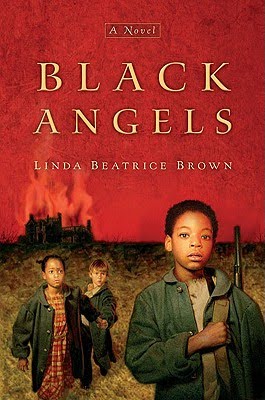
Black Angels

by Linda Beatrice Brown
ages: 10+
First sentence: “Luke took the key out of the sideboard drawer in the dining room, took a rifle and put the key back very carefully.”
Review copy provided by the publisher.
Support your local independent bookstore, buy it there!

Fiction about children during wartime is pretty overdone, in my humble opinion. Do we really need another book that illustrates the horrors of war, the trials that the children go through, the pain of separation? Probably not. But in this case, I’ll make an exception: Brown’s book takes the generic child-in-war story and moves it beyond the cliche to something else. Something more gripping, more lyrical, more — dare I say it? — poignant.

Luke is twelve years old. He hates his master, he hats the South, and he is running away to join the Union and fight to end slavery and free his people. Daylily is ten. She’s been freed by her master, but in the journey north with her Gramma and Buttercup (whom we never really find out much about), the two are brutally murdered. We’re never quite sure if they’re murdered by Union or Confederate soldiers, but the fact of their murder renders Daylily silent and bruised. She’s lucky to be left with her life, and she knows it. Caswell is seven, and he’s the son of a wealthy landowner who’s off fighting for the Confederacy. He’s lost in the woods, trying to find a neighbor’s house and his Mamadear who was carted away in the night because she was in labor.

The three manage to meet in the woods, going north, and make an unlikely trio. Yet dire circumstances make strange bedfellows. And when they meet Betty Strong Feet, things get even more unusual. The three children learn about survival, and working together, but most of all about love and friendship in the face of adversity.

The plot arc is huge: not only do we follow the children through the few months during their time in the woods and with Betty, but we follow their paths for the ten years after they got separated. This didn’t quite work for me: I felt that the book got preachy and too altruistic near the end; on the one hand, it was important to see how the children had changed because of their experiences together, but — on the other hand — perhaps it would have been nice to leave that to the imagination.

Minor quibble with the ending aside, the book was lyrical, descriptive and quite powerful. A fresh look at a overdone subject.

(Just for the record: because this is a Cybils nominee, I’ve been asked to make sure y’all know this is my opinion only, and not that of the panel.)

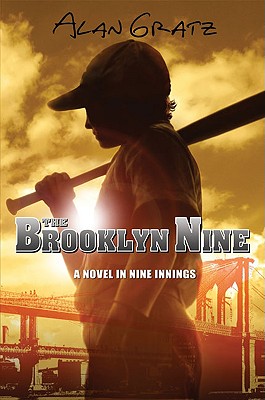
The Brooklyn Nine

by Alan Gratz
ages: 10+
First sentence: “Nine months ago, Felix Schneider was the fastest boy in Bremen, Germany.”
Support your local independent bookstore: buy it there!

This book is one of the more unique ones I’ve read recently. It’s not that it’s tackling something different or controversial. Rather, it’s quite the opposite: it’s a sweeping portrait of a family, a game, a nation. Quiet in its execution, yet grand in its ambition, Gratz pulls off something I didn’t think was possible: this book is a slice of Americana through and through.

The format is clever, too: it’s a series of short stories, told in nine “innings”, that travel through the years. Beginning in 1845, with a German immigrant, Felix Schneider, and going until present, the stories offer up a picture of how baseball — and America — has evolved over the last 160 years. Gratz touches on all the major highlights of Americana: there’s a Civil War soldier, Vaudeville, gangsters, racism and the Negro League, the All-American Girls Baseball league, and the Cold War. As in the case of all short story collections, some of the stories work better than others: in my case, the further back in time, the better the story; the final two more modern stories felt a bit cliched to me. But, even with its unevenness, it’s a fabulous undertaking. This is probably sounding like a sports book, and in some ways it is — I think there are many baseball-minded boys out there who would love the book — but, it’s so grounded in history and in family that baseball becomes more a character in the story than just a game that people played. That, and the stories — and especially the authors notes in the back, which I flipped to and read after every chapter — make the game itself sound quite fascinating.

At one point, I thought that it would have been nice to read these stories backward, beginning with the present day, and working back to 1840s. But, that’s just me being particular. This book really is a wonderful little story.

(Just for the record: because this is a Cybils nominee, I’ve been asked to make sure y’all know this is my opinion only, and not that of the panel.)

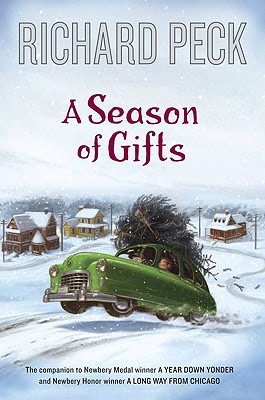
A Season of Gifts

by Richard Peck
ages: 9-12
First sentence: “You could see from here the house was haunted.”
Support your local independent bookstore: buy it there!

I’m not a big Richard Peck fan. Sure, I’ve read his other Grandma Dowdel books, but while I think I found them charming, I think that’s about all I found them to be. Not exactly thrilling or touching or even memorable.

That said, I really wanted to love this one. Perhaps it’s because it’s that time of year, and it’s vaguely a Christmas book. Perhaps it’s because I’ve heard so much good about Peck over the years that I wanted to see if I could figure out what I was missing.

It was a good book: charming, like I remember the others being; funny at times, poignant at others. It’s full of fun and interesting and mildly skanky characters; historical details from the 1950s, from Elvis going into the Army to the Russian scare. There’s a lovely, hilarious Christmas program and an overall moral to the story. There’s bullies and new friends, there’s adjusting to small town life by our narrator, Bobby, one of the new Methodist parson’s kids. Yet — like so often when you have expectations from a book — there was something missing. Something to make the book soar. Becky has more thoughts on that — and she hit upon much of what I was feeling.

Perhaps some of Peck’s other books are better?

(Just for the record: because this is a Cybils nominee, I’ve been asked to make sure y’all know this is my opinion only, and not that of the panel.)

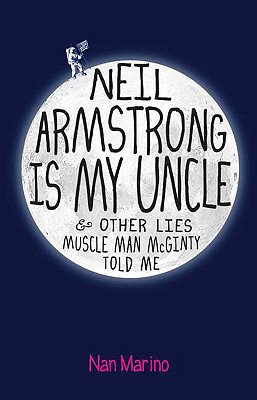
Neil Armstrong is My Uncle

and Other Lies Muscle Man McGinty Told Me
by Nan Marino
ages: 9-12
First sentence: “Muscle Man McGinty is a squirrelly runt, a lying snake, and a pitiful excuse for a ten-year-old.”
Support your local independent bookstore: buy it there!

Not quite sure where to start on this one.

On the one hand: it was an interesting story of loss and tension and dealing with differences. Tamara’s best friend, Kebsie, has just moved out of her foster house and back in with her mother. Without saying goodbye to Tamara. In her place, Tamara has Muscle Man McGinty, who loves (loves!) to tell stories.

On the other hand: in a book that is so thoroughly driven by the main character, it helps if that character is sympathetic. I understand that she was hurting. I understand that she was resentful. I understand that she had annoying, stupid, bad parents. But. I. Hated. Tamara. Wanted to smack her upside the head and tell her to get a better attitude.

On the one hand: it captures the essence of a 1960s summer, from endless games of kickball, to the anticipation of the first moonwalk, to the tension about the Vietnam War, to the joys of sitting on a roof and howling at the moon.

On the other hand: I thought Marino could have been better with the middle one — it was a small undercurrent that swelled in the last few pages. It was unevenly paced: I wanted more oomph, more tension, more — oh, more like Shooting the Moon, which I thought captured much of these same themes but did it better.

On the one hand: It’s a quick read. And some kids will really like both Tamara and Muscle Man’s stories.

On the other hand: that kid is not me.

(Just for the record: because this is a Cybils nominee, I’ve been asked to make sure y’all know this is my opinion only, and not that of the panel.)

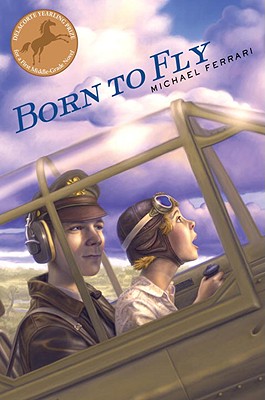
Born To Fly

by Michael Ferrari
ages: 9-12
First sentence: “Just ’cause I was a girl in 1941, don’t think I was some sissy.”
Support your local independent bookstore: buy it there!

Eleven-year-old Bird McGill has always wanted to fly, particularly the P-40 fighter plane. It’s something she and her dad have worked towards ever since she was old enough to reach the pedals. The fact that she’s a girl — and girls in 1941 weren’t supposed to be interested in flying airplanes — never seemed to matter to either her, or her father.

Then, the Japanese bomb Pearl Harbor, and Bird’s life changes. Her father gets shipped away to fight in the war, and a new kid — Kenji — comes to town. He’s Japanese, in Rhode Island to live with an uncle because of the forced internment his family in California is facing. He’s resentful, and — interestingly, realistically — faces much of the same resentment and racism that he’d faced in California.

Both being outcasts, Bird and Kenji form a tentative friendship, which is strained and tested when they inadvertently witness both the murder of a local draft dodger and the sabotage of a engine factory. Kenji’s uncle is framed for both, and found guilty. And it’s up to Bird to set things right.

It’s partly a mystery, partly an adventure story, partly a tale of friendship and ignoring expectations. It tries to do a bit too much, and is a bit over-the-top, but Ferrari succeeded admirably on one account: it’s a story with not only a strong female character, but a middle grade one who makes things happen. Sure, it’s unbelievable that she would actually get to fly a P-40 plane, but by the end, who cares? Bird is awesome. Bird makes things happen. Bird — in spite of, or perhaps because of, her faults, and insecurities — rocks. She’s inspiring.

In addition to a strong heroine, Ferrari unflinchingly tackles things like class and race and patriotism and makes it work in the context of the plot. Kenji is not just a cardboard 1940s Japanese character; he’s got hopes and dreams and frustrations, all of which are quite palpable. Enough so that you cringe when people call him the “Jap” and tell him to go back where he came from. Enough so, that you want Bird to rescue him, to beat down the bad guys, to show up everyone in town.

Again, it’s probably a bit heavy-handed to put so much in one book (I, personally, would have liked it if there was a bit less, and it did come off as a bit moralistic by the end), but overall, it works, and works well.

(Just for the record: because this is a Cybils nominee, I’ve been asked to make sure y’all know this is my opinion only, and not that of the panel.)

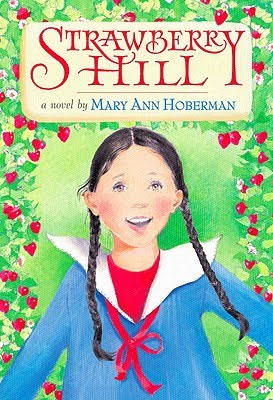
Strawberry Hill

by Mary Ann Hoberman
ages: 8-11
First sentence: “You would have thought it was the best news in the world.”
Support your local independent bookstore: buy it there!

It’s the Depression, and Allie’s father has lost his job in New Haven, Connecticut. He has, however, found another job in Stamford. However, that means the family — Allie, her brother Danny, and her parents — will be moving away from everything Allie has known.

However, when Allie finds out that they will be living on a street called Strawberry Hill, everything will be okay. Won’t it?

This is the story of how Allie came to accept the inevitable, learn to like her new home, and make friends. It’s a quiet story, somewhat predictable, that follows Allie’s ups and downs over the first year that she lives in Stamford. There’s new places to discover, there’s a new school class to get used to, there’s disappointments, there’s pretty mean girls (there’s ALWAYS pretty mean girls), there’s new best friends, there’s unexpected friends.

What really made this book stand out for me, though, was the undercurrent of Jewishness. Allie and her family are Jewish — something that, unlike in, say, All-of-a-Kind Family, isn’t readily noticeable or even prevalent, but nonetheless is still there. The only holiday we get is Hanukkah, and other than a few mentions of temple, that’s pretty much it. Except for an instance of Antisemitism. That, in particular, I found intriguing, especially when Allie’s mom lays into the kid. It was the most obvious sign of the times — aside from a few mentions of lost jobs and hobos, the book could have been contemporary — and one that I thought was done quite well.

Overall, though, the book could have been better. According to the author blurb, Hoberman is a poet of some renown, and I couldn’t help but thinking that the language of the book just fell flat for me. I expected more of a poet, I guess. Something more, well, poetical.

That said, it is an interesting look at the Depression-era, and a nice story of friendship.

(Just for the record: because this is a Cybils nominee, I’ve been asked to make sure y’all know this is my opinion only, and not that of the panel.)

Al Capone Does My Shirts

by Gennifer Choldenko
ages: 9-13
First sentence: “Today I moved to a twelve-acre rock covered with cement, topped with bird turd surrounded by water.”
Support your local independent bookstore: buy it there!

Moose Flannigan is NOT happy about his father’s new job. His father is a guard and an electrician on the most notorious prison in the country, especially in 1935: Alcatraz. And, because it’s 1935, that means the family gets to come along, too. Which means Moose has to leave his friends and start over.

All this is complicated by his sister Natalie’s condition. With today’s knowledge, she’d be diagnosed with autism. In the book — and I give Choldenko so much credit for making it seem as it probably really was, which was alternately quite revealing and very painful — she’s just got a “condition”, something that needs to be “cured”. Moose and Natalie’s mother was the hardest character to stomach: she couldn’t deal with Natalie, pretending she was ten for years, because younger children have more of a “chance” and because she just couldn’t deal with the fact that child was not “normal”. That I cringed every time she began to speak is a testament to how well Choldenko wrote her.

While autism, as well as Natalie’s acceptance to a special school in San Francisco, played a major role in the book, it wasn’t the whole plot. When Moose wasn’t struggling with his feelings about, or taking care of his sister, he was trying to figure out how to deal with the kids on the island — especially Piper (whom I wanted to smack!), the daughter of the warden, and who had it in her head that she could get away with just about everything — and trying to make friends at a new school, which is never easy. Choldenko got middle grade awkwardness down pat, from Moose’s reluctance to make waves to Piper’s bossiness. I also felt like she caught the time period; it felt like the 1930s, or at least what I imagine the 1930s to feel like.

Oh, and the ending: perfect.

Which makes me wonder what she’s done with Moose, Natalie and the island in the sequel. Something interesting, I hope.

The Guernsey Literary and Potato Peel Society

by Mary Ann Shaffer and Annie Barrows
ages: adult
First sentence: “Dear Sidney, Susan Scott is a wonder.”
Copy won in a contest sponsored by A High and Hidden Place
Support your local independent bookstore: buy it there!

Sometimes, when I read a book, one word keeps popping in my mind. For this book, the one word I constantly thought was charming. Utterly, unabashedly, and unreservedly charming.

The book reminded me in many ways of 84 Charing Cross Road, and it wasn’t just that it was an epistolary novel. Shaffer and Barrows got a feel for the time (post-war), the place (England), and the people. That, and it’s a book about readers and community and belonging, all of which I totally love. It’s got a bit of everything, too: romance, literary illusions, soaring descriptions, history. It’s a war book, an epistolary novel, a romance, a work of historical fiction.

It’s nearly perfect.

Perhaps the only thing holding it back was the hype. I’m always suspicious of NY Times best-sellers, and while I think this one proved my suspicions wrong, I do think that I wanted more out of it. I wanted it to be more soaring, to be more than it actually was. Perhaps that’s the nature of the book, though: to get so involved in it that you want more at the end. Whatever the reason, I did enjoy the journey: I just wanted something more out of it.

But what I did get was thoroughly captivating.