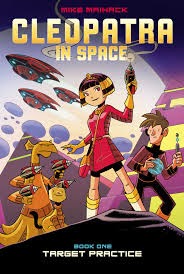
Cleopatra in Space

Book One: Target Practice
by Mike Maihack
Support your local independent bookstore: buy it there!
Content: There’s some violence, but nothing terribly graphic. What struck me is that there is a lot of exposition (with long words) in this one. I’m not sure if K understood everything that went on, but she got the gist of it. Which is what graphic novels are great at.

It’s her 15th birthday, Cleopatra (yes, that Cleopatra) doesn’t want to go through with her party. The ceremony, the pomp, the everything. So, she sneaks away from her tutor, and discovers a portal to a future time and place that is being besieged by a tyrannical dictator. The prophecies declare that she will be the Savior of the world, but first: she has to go to academy to figure things out.

It’s essentially a fish-out-of-water story; BCE girl meets futuristic technology. I liked how she found everything boring, until she got to combat training. She took to that immediately. She’s a girl of action, and she’s smart and tough — when it comes to combat. She’s not a scholar and that’s okay. The only thing that was a bit disconcerting was the whole talking cats. Cats in this world have evolved to the point where they kind of run things. And it’s a bit weird. But that just may be me.

In the end, it reminded me a lot of Zita the Spacegirl — both in the content as well as the artistic style — which is a good thing. And I’m curious to see where Maihack goes next.
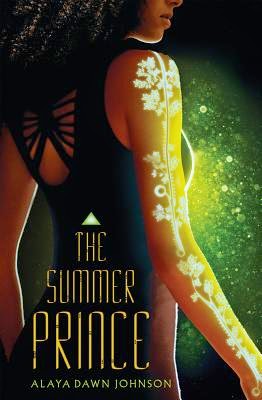
The Summer Prince

by Alaya Dawn Johnson
First sentence: “When I was eight, my papai took me to the park to watch a king die.”
Support your local independent bookstore: buy it there!
Content: I was initially thinking that this would be good for those who like Uglies; there’s about the same amount of swearing. But the reason it’s in the Teen section (grades 9+) is because there’s a lot of allusions to sex, including a couple (tasteful) sex scenes.

June Costa is the best artist in Palmeres Três. Or so she thinks; she just hasn’t had a chance to prove it yet. And in this, a moon year in which her futuristic, matriarchal society chooses a one-year Summer King to “rule”, she will have that chance. It starts innocently: her best friend, Gil, falls in love with the summer king, Enki. And she does, too, though she tells herself that it’s mostly about the art. And what art June and Enki create. Ever more elaborate, they end up sparking a revolution of sorts between the technophiles and the isolationists; the government, made up of women they call “Aunties”, has placed strict regulations on what kind of tech can be in the city.

It was this tech element that reminded me so much of Uglies. But, I think Johnson was pointing out the value of art and the power of love, even in a futuristic (and while not dystopian, certainly not perfect) society. It’s a very thought-provoking novel, one that winds and unfurls instead of proceeding in a linear fashion. And it was this winding that kept me most interested. Johnson chose to build her futuristic Brazilian society in bits and chunks throughout the entire book, dropping hints and clues about what happened to get the world to this point along the way. And the society she built was equally as fascinating, with all its machinations and political scheming.

But, ultimately, it was June and Enki and Gil (and June’s competition/friend, Bebel) that kept me reading in the end. I cared about what happened to them, how this year played out for the summer king and his newfound friends. I found myself moved by the ending, and thinking about the book long after I turned the last page.

Audiobook: Randi Rhodes Ninja Detective: The Case of the Time Capsule Bandit

by Octavia Spencer
Read by the author.
Support your local independent bookstore: buy it there!
Content: There wasn’t anything objectionable. I don’t know how it’d be reading it, but my 8-year-old followed the story pretty well while listening to it. We did have to stop the audio a few times to explain some things, however. It’s in the middle grade (grades 3-5) section of the bookstore.

I threw this in the audiobook pile mostly because I’ve seen it at the store and wondered if it was any good. (I know: celebrity authors. Ugh. But, sometimes they surprise me. Not often, though.)

Randi Rhodes is a die-hard city girl. She’s grown up in Brooklyn and loved every minute of it. Her family summers in Deer Creek, Tennessee, which is just about the right length of time for a city girl to spend in a boring, dull, small town. But the year after her mother dies (I called that pretty early on; I do get so tired of dead parents), her father, a mystery writer, packs the two of them up to live full-time in Deer Creek. Randi is not happy about this.

But, once there, she falls head-first into a mystery: the 200-year-old time capsule for the town’s Founder’s Day has been stolen. And they have 72 hours to get it back. Much against her over-protective father’s wishes, Randi (and her two new friends, D. C. and Pudge) decide that they are the only ones to solve the mystery.

It’s a pretty run-of-the-mill middle grade mystery book. Nothing too fantastic or brilliant; in fact, as an adult, I’ve seen all the tropes before. The banker is a Bad Guy, as is the power-grabbing Mayor. There’s a grumpy old man with a heart of gold, and a woman sheriff who’s a bit bumbling. (Though — spoiler — this isn’t a true middle grade novel, because by the end, you discover that the sheriff isn’t bumbling at all, but has instead figured out the mystery WAY before the kids ever did.) The best parts of the book are when Randi and her friends are out being detectives; the worst are the angsty tensions between her and her overprotective dad. I got extremely tired of the rants Randi went on about not being “understood.” (But that’s a parent speaking. I did appreciate that Randi was a non-girly girl; she was often ranting about how she wasn’t a princess and didn’t need protection. She’s a black belt in Tae Kwon Do, after all.)

In the end, it wasn’t anything special, though A and K enjoyed listening to it. But, it wasn’t absolutely horrible, either, and Spencer did an admirable job of narrating her book (which I would expect, with her being an actress and all).

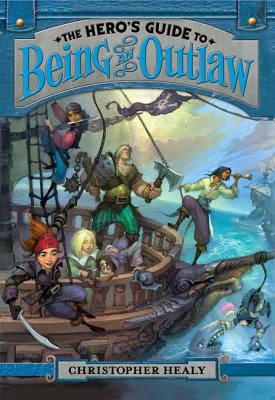
The Hero’s Guide to Being an Outlaw

by Christopher Healy
First sentence: “Outlaws have too many feathers in their hats.”
Support your local independent bookstore: buy it there!
Others in the series: The Hero’s Guide to Saving Your KingdomThe Hero’s Guide to Storming the Castle
Content: There’s some kissing, a bit of violence (and almost violence), and it’s long for a middle-grade novel. It’d be in the middle grade section (grades 3-5) of the bookstore; don’t let the length fool you; it goes fast.

I don’t even remember what our Fair Heroes were doing at the end of the second book. But, honestly: it doesn’t matter. I fell right back into the silly stupidity (and I say that with all loving kindness in my heart) of this book, snorting and giggling as The League of Princes (and the Ferocious Female Freedom Fighters — or FFFF) try to save the Thirteen Kingdoms from Lord Rauber’s (who they thought they killed in the last book) evil plan to take over the world.

The point to the book, I think, is not the plot. Sure, there is a plot: The whole gang is branded as outlaws because they were supposed to have murdered Briar Rose (sure, she’s annoying, but they wouldn’t literally kill her. Only figuratively) so everyone’s on the run and trying to prove their innocence. But the point is for the guys to be dorky (ah, Duncan), the girls to be awesome (bonus: pirate captain Jerica! Double bonus: Gustav trying to flirt), and for super-silly jokes and asides (like the prisoner Val Jeanval. Get it??). Yes, it was stupid. But, I love it.

Full of action (and stupid jokes), and perfect for just about anyone who doesn’t mind a bit of fairy tale adventure.

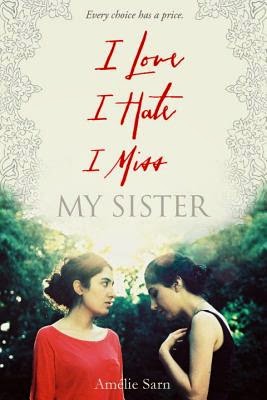
I Love I Hate I Miss My Sister

by Amélie Sarn, translated from French by Y. Maudet
First sentence: “The women walk slowly, heads down.”
Support your local independent bookstore: buy it there!
Release date: Augst 5, 2014
Review copy snagged from the ARC shelves at my place of employment.
Content: There is violence, some mild swearing, and some teen drinking and smoking. I’ll probably put this in the Teen (grades 9+) section of the bookstore, though I wouldn’t hesitate to give it to a 7th- or 8th-grader who is interested.

Sohane Chebli is many things: 18 years old, a daughter, a sister, a scholar, French, and a Muslim. She lives in an apartment complex full of others of  Algerian heritage, and mostly she and her younger sister (by 11 months), Djelila, get along with their neighbors, schoolmates, and each other just fine.

Then, during Sohane’s senior year, a few young Muslim men take it on themselves to start harassing Djelila because she dresses in jeans and tighter shirts. Because she wears makeup. Because she smokes with her friends. And Sohane, whose path has become more conservative — she wears the hijab — doesn’t step in to defend her sister. Partially because Sohane thinks her sister is wrong for following a path away from Islam. And partially because Sohane’s been expelled from school, due to a French law banning all religious symbols, for wearing the hijab.

I’m going to spoil a bit — it’s not too bad, because from the beginning,  you know this — but Djelila is killed by the Muslim boys for her refusal to conform to their expectations. And it’s that paired with the other side of the coin: Sohane’s constant discrimination for wearing the hijab. (Not that I mean to compare murder with discrimination.) But it got me thinking: why do we feel a need to tell others how to behave? Why did these boys feel compelled to not only shame, but eventually kill a girl for not following her/their religion to the letter? Why did people refuse to see Sohane’s hijab wearing as an expression of her religion, instead interpreting it as an act of repression? It’s a thought-provoking book.

And it’s written well, in tight, short chapters. It took a bit for me to catch the rhythm of the book because it’s translated, but once I did, I was hooked. And I wasn’t disappointed, in the end.

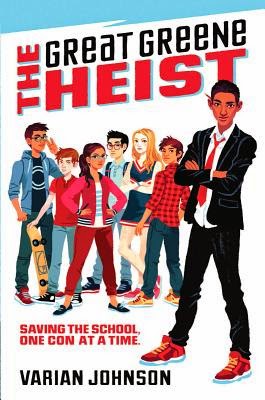
The Great Greene Heist

by Varian Johnson
First sentence:
Support your local independent bookstore (actually, just support mine!) and buy it there! (Before the end of June, PLEASE.)
Review copy sent to me by the author, upon my request. Also, I’ve met him a couple of times and I think he’s fantastic.
Content: There’s no swearing, and only hints at romance. It’s in the middle grade section (grades 3-5) at the bookstore, though older kids would like the con aspects of it, I think.

Jackson Greene is going clean. He got ratted out (and caught) four months ago, in what he calls the “Kelsey Job” but what the school has come to know as the “Mid-Day PDA”. It cost him a certain amount of freedom (he can no longer have a cell phone, and he has weekly meetings with the principal, Dr. Kelsey) and one of his best friends, Gaby de la Cruz. Fast-forward to the fall of 8th grade, and student elections. Gaby’s running for president, and Jackson’s not going to get involved. That is until her opponent suddenly drops out, and Jackson’s nemesis, Keith Sinclair, enters the race. Jackson knows something fishy is up, and sets out to prove it. Of course, that means a long con. Which means he needs a crew.

Jackson assembles a memorable one: reminiscent of great heist movies (Oceans 11 is referenced more than once) and books (Heist Society!), Johnson weaves in not only every stereotypical element (there’s the right-hand-man, the tech guy, the runner, the money) but also plays against stereotype. My favorite is with the beautiful cheerleader Megan Feldman, who is a tech and programming genius. But there’s also Hashemi who is a budding inventor (my favorite: the MAPE, a beta cellphone the size of a brick); Bradley, a sixth-grade artist who’s mostly in awe of being included; Victor, the money behind the operation; and Charlie, twin brother to Gaby, and Jackson’s right-hand-man. And the cool thing? Only two of the crew is white.

It was refreshing that race rarely comes into play; for the most part characters were just that, and not the “Asian kid” or the “Black kid” or the “White girl”. Yes, one of the older secretaries is subtly racist, mixing up the names of the Asian kids and saying “Boys like you are always up to something or other.” It’s probably over-the-top, but in the context, it works. And the principle is a certified jerk (he was the one I wondered about: how did he ever get to be in charge of a school and not challenged?). But then again, this is all an elaborate fantasy: how many 13-year-old boys are capable of running a long con?

It was a ton of fun, though.

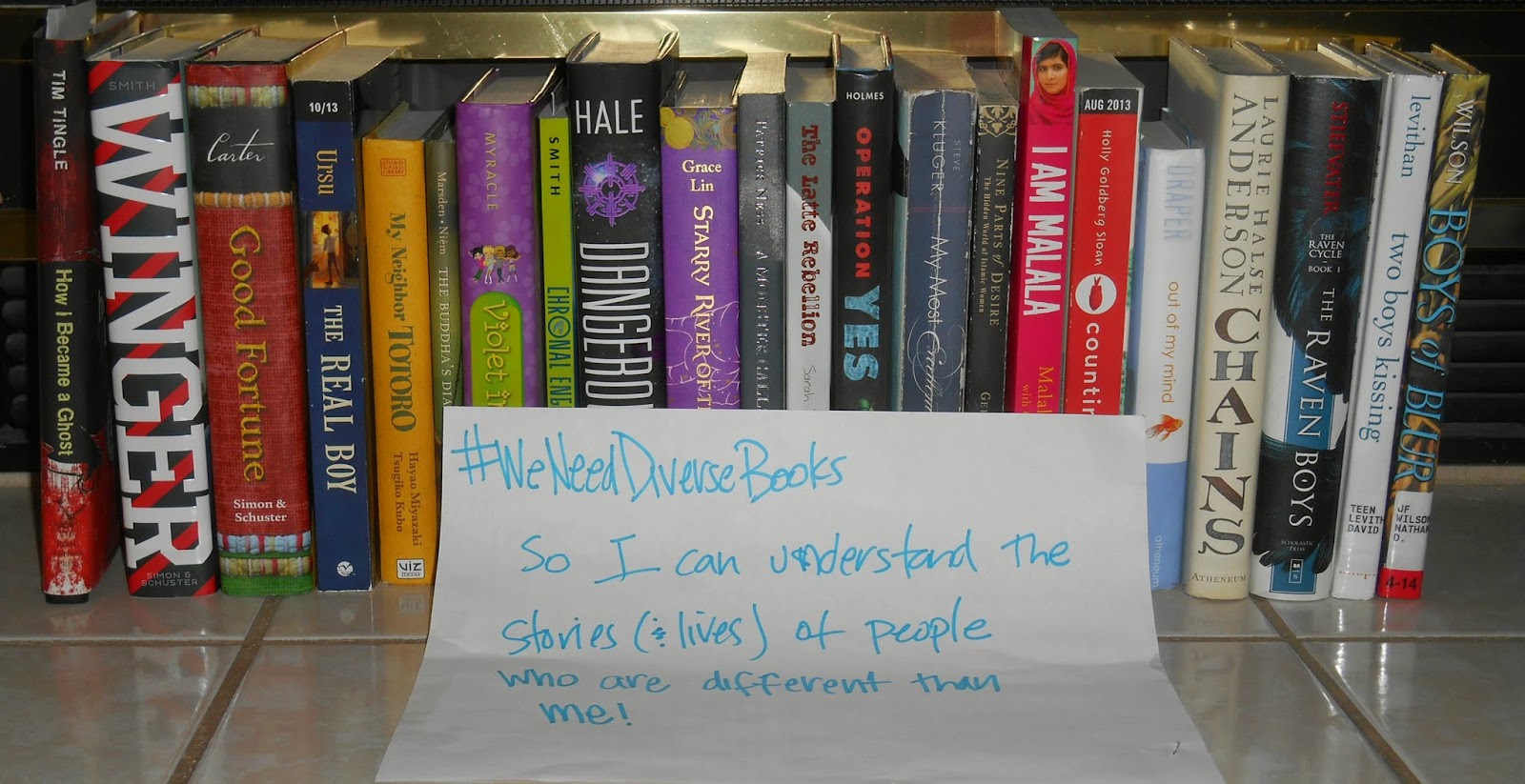
#WeNeedDiverseBooks

I’ve seen this slowly building over the course of the last week or so, and finally, Tuesday night, I sent out my tweet as part of it.

I honestly believe that. Even if 95% of what I actually read is about white females (because that’s what I relate to), I believe that there needs to be books for all the stories that can be told, not only so those readers can see themselves in the pages (like I see me), but so I can learn their stories. I firmly believe that books can change the world, can help people reach outside of their own experience in order to understand others. And that by doing so — by reading books about people of all stripes, orientations, colors, backgrounds, experiences — we will be able to have the empathy we need to make the world a better place.

Check out #WeNeedDiverseBooks (and the tumblr) for more reasons why all books are important and for good suggestions for books to read and support.

(As an aside, the store I work at, Watermark Books, has been challenged to the #greatgreenechallenge. I’m super excited about this. If you want to support me — us — you can pre-order the book from us here. I haven’t read it yet, but I’ll promise you it’ll be a good book, if only because Varian’s a terrific writer.)

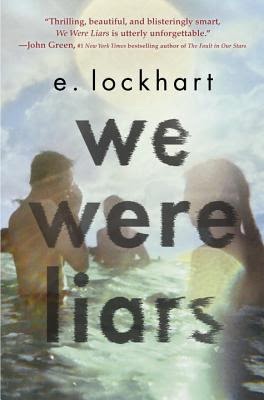
We Were Liars

by E. Lockhart
First sentence: “Welcome to the beautiful Sinclair family.”
Support your local independent bookstore: buy it there!
Release date: May 13, 2014
Review copy snagged from the ARC shelves at my place of employment.
Content: There were multiple f-bombs and some mild swearing. It’s also a very intense book, emotionally, so be prepared for that. It will be in the Teen section (grades 9 and up) of the bookstore, but I think a mature 13-year-old could handle it.

There is a problem with writing a review for this book. It’s best if you know absolutely nothing going in. Nothing. Nada.

In fact, the back of the ARC says “If anyone asks you how it ends, just LIE.”

I will tell you this. Cady is one of the Beautiful Sinclairs, an old-money family in Boston that vacations every summer on a small island near Martha’s Vineyard. Her grandfather is the patriarch of this family but her mother and her two sisters have not really lived up to the family name. Cady is also one of the four Liars: she, her cousins Johnny and Mirren, and Johnny’s mother’s boyfriend’s (Indian) nephew, Gat. Something happened two summers ago, and Cady lost her memory. No, the summer that she’s 17, she needs to figure out what happened.

I will also tell you this: read it. Just read it. Lockhart is amazing. This book is haunting and so gorgeous in its simplicity and so powerful.

I promise that’s not a lie.

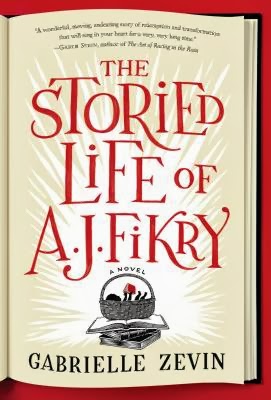
The Storied Life of A. J. Fikry

by Gabrielle Zevin
First sentence: “On the ferry from Hyannis to Alice Island, Amelia Loman paints her nails yellow and, while waiting for them to dry, skims her predecessor’s notes.”
Support your local independent bookstore: buy it there!
Review copy is the one that’s being passed around the bookstore staff.
Content: There’s a lot of language, including a handful of f-bombs. I would give it to a bookish teenager, if they expressed interest.

A.J. Fikry is the owner of Island Books on Alice Island (off the coast of Massachusetts), and it’s not something he’s terribly fond of. In the twenty-one months since his wife’s accidental death after an author event, he’s become increasingly more reclusive and cranky. Then two things happen: someone steals his first edition copy of Tamerlane, by Edgar Allen Poe and someone leaves a two-year-old girl on the doorstep of the bookstore. The first is significant because selling Tamerlane was A. J.’s retirement fund. Without it, he’s stuck on the island, running this bookstore, for the unforeseeable future.  The second is significant because it changes his life.

He is a reluctant father, mostly because his wife was pregnant when she died, and he hasn’t quite gotten over the loss. But his daughter, whom he names Maya Tamerand Fikry when he finally adopts her, gets under his skin and the skin of the community. It’s through concern for her (and for A. J. as her father) that the bookstore finds a second life. As does A. J. Through taking care of Maya and getting involved in the community, he finds that running a bookstore isn’t half bad. Even if you sometimes have to sell pulp fiction in order to carry the literary fiction.

It’s really a love song to community and to bookselling, and the connection between the two. And even though I didn’t find it to be deep or meaningful, I did (as a bookseller) relate to it, finding it charming. It was one of those books where you like everything, wanting to live next door to these quirky characters because they’re so interesting. However, it lacked the emotional punch at the end that I think Zevin was going for; I wasn’t even the tiniest bit sad. (Maybe that’s more me than Zevin. Even though I liked the characters, I didn’t feel emotionally connected enough to be moved.)

In the end, though, it was simply delightful.

The Diviners

by Libba Bray
First sentence: “In the town house at a fashionable address on Manhattan’s Upper East Side, every lamp blazes.”
Support your local independent bookstore: buy it there!
Content: There wasn’t any language (at least that I noticed), and there was only illusions to sex. What puts this in the Teen (grades 9 and up) section of the library is the violence. There are 5 gruesome murders, spouse abuse, and other assorted violence. And then there’s the whole occult/creep factor, not to mention the teenage drinking. However, I’d give it to a 12- or 13-year-old if they weren’t overly sensitive.

Evie hates her small-town Ohio life. She’s a modern ’20s woman, and hates being shackled, especially by her Prohibition-supporting mother. So, when Evie makes big blunder with her talent for “reading” objects — she accuses the town’s Golden Boy with knocking up a maid — and she’s shipped off to Manhattan to stay with her admittedly odd uncle, she’s more than happy. She’s thrilled: finally, her life can Begin!

But while Evie makes some good friends, and goes to a couple of thrilling events, things aren’t all coming up roses. There’s a serial killer out there, brutally murdering people and leaving occult signs on the bodies. Her uncle — who runs the Museum of American Folklore, Superstition, and the Occult — has gotten involved with the investigation into the murders, and Evie, being the Modern Woman that she is, weasels her way into that. Which brings a whole mess of problems.

One of the strengths and weaknesses of Bray’s book is that Evie’s isn’t the only story. Bray is weaving a huge tapestry here, with multiple story lines that weave in and out of each other. She’s setting up a huge confrontation, of which the murders only play a small part, but I didn’t mind because the characters themselves were so engaging. To the tortured Ziegfeld star Theta, to the daughter of union supporters Mable, to the charismatic thief Sam, to the tortured Jericho, to the African American bookie runner Memphis, they were all characters I wanted to spend time with and get to know. But in many ways, there was almost too much. The book comes in at nearly 600 pages, and it’s only a first in a series. That’s a lot of set-up going there. And while the overall plot line — the murders — gets resolved, the last 40 pages are spent setting up the next book, which dampened my enthusiasm for it.

But dampened isn’t a dislike. There really is so much to love about this one, from the creepy to the characters.