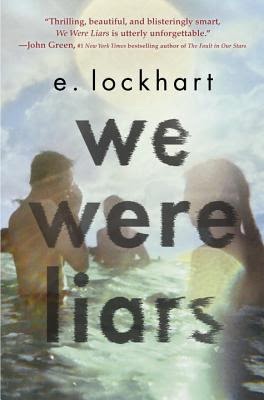
We Were Liars

by E. Lockhart
First sentence: “Welcome to the beautiful Sinclair family.”
Support your local independent bookstore: buy it there!
Release date: May 13, 2014
Review copy snagged from the ARC shelves at my place of employment.
Content: There were multiple f-bombs and some mild swearing. It’s also a very intense book, emotionally, so be prepared for that. It will be in the Teen section (grades 9 and up) of the bookstore, but I think a mature 13-year-old could handle it.

There is a problem with writing a review for this book. It’s best if you know absolutely nothing going in. Nothing. Nada.

In fact, the back of the ARC says “If anyone asks you how it ends, just LIE.”

I will tell you this. Cady is one of the Beautiful Sinclairs, an old-money family in Boston that vacations every summer on a small island near Martha’s Vineyard. Her grandfather is the patriarch of this family but her mother and her two sisters have not really lived up to the family name. Cady is also one of the four Liars: she, her cousins Johnny and Mirren, and Johnny’s mother’s boyfriend’s (Indian) nephew, Gat. Something happened two summers ago, and Cady lost her memory. No, the summer that she’s 17, she needs to figure out what happened.

I will also tell you this: read it. Just read it. Lockhart is amazing. This book is haunting and so gorgeous in its simplicity and so powerful.

I promise that’s not a lie.

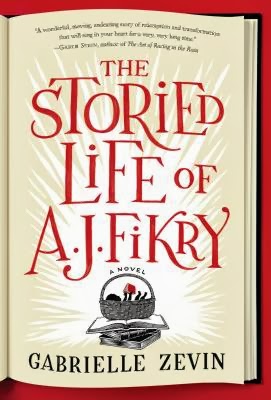
The Storied Life of A. J. Fikry

by Gabrielle Zevin
First sentence: “On the ferry from Hyannis to Alice Island, Amelia Loman paints her nails yellow and, while waiting for them to dry, skims her predecessor’s notes.”
Support your local independent bookstore: buy it there!
Review copy is the one that’s being passed around the bookstore staff.
Content: There’s a lot of language, including a handful of f-bombs. I would give it to a bookish teenager, if they expressed interest.

A.J. Fikry is the owner of Island Books on Alice Island (off the coast of Massachusetts), and it’s not something he’s terribly fond of. In the twenty-one months since his wife’s accidental death after an author event, he’s become increasingly more reclusive and cranky. Then two things happen: someone steals his first edition copy of Tamerlane, by Edgar Allen Poe and someone leaves a two-year-old girl on the doorstep of the bookstore. The first is significant because selling Tamerlane was A. J.’s retirement fund. Without it, he’s stuck on the island, running this bookstore, for the unforeseeable future.  The second is significant because it changes his life.

He is a reluctant father, mostly because his wife was pregnant when she died, and he hasn’t quite gotten over the loss. But his daughter, whom he names Maya Tamerand Fikry when he finally adopts her, gets under his skin and the skin of the community. It’s through concern for her (and for A. J. as her father) that the bookstore finds a second life. As does A. J. Through taking care of Maya and getting involved in the community, he finds that running a bookstore isn’t half bad. Even if you sometimes have to sell pulp fiction in order to carry the literary fiction.

It’s really a love song to community and to bookselling, and the connection between the two. And even though I didn’t find it to be deep or meaningful, I did (as a bookseller) relate to it, finding it charming. It was one of those books where you like everything, wanting to live next door to these quirky characters because they’re so interesting. However, it lacked the emotional punch at the end that I think Zevin was going for; I wasn’t even the tiniest bit sad. (Maybe that’s more me than Zevin. Even though I liked the characters, I didn’t feel emotionally connected enough to be moved.)

In the end, though, it was simply delightful.

The Diviners

by Libba Bray
First sentence: “In the town house at a fashionable address on Manhattan’s Upper East Side, every lamp blazes.”
Support your local independent bookstore: buy it there!
Content: There wasn’t any language (at least that I noticed), and there was only illusions to sex. What puts this in the Teen (grades 9 and up) section of the library is the violence. There are 5 gruesome murders, spouse abuse, and other assorted violence. And then there’s the whole occult/creep factor, not to mention the teenage drinking. However, I’d give it to a 12- or 13-year-old if they weren’t overly sensitive.

Evie hates her small-town Ohio life. She’s a modern ’20s woman, and hates being shackled, especially by her Prohibition-supporting mother. So, when Evie makes big blunder with her talent for “reading” objects — she accuses the town’s Golden Boy with knocking up a maid — and she’s shipped off to Manhattan to stay with her admittedly odd uncle, she’s more than happy. She’s thrilled: finally, her life can Begin!

But while Evie makes some good friends, and goes to a couple of thrilling events, things aren’t all coming up roses. There’s a serial killer out there, brutally murdering people and leaving occult signs on the bodies. Her uncle — who runs the Museum of American Folklore, Superstition, and the Occult — has gotten involved with the investigation into the murders, and Evie, being the Modern Woman that she is, weasels her way into that. Which brings a whole mess of problems.

One of the strengths and weaknesses of Bray’s book is that Evie’s isn’t the only story. Bray is weaving a huge tapestry here, with multiple story lines that weave in and out of each other. She’s setting up a huge confrontation, of which the murders only play a small part, but I didn’t mind because the characters themselves were so engaging. To the tortured Ziegfeld star Theta, to the daughter of union supporters Mable, to the charismatic thief Sam, to the tortured Jericho, to the African American bookie runner Memphis, they were all characters I wanted to spend time with and get to know. But in many ways, there was almost too much. The book comes in at nearly 600 pages, and it’s only a first in a series. That’s a lot of set-up going there. And while the overall plot line — the murders — gets resolved, the last 40 pages are spent setting up the next book, which dampened my enthusiasm for it.

But dampened isn’t a dislike. There really is so much to love about this one, from the creepy to the characters.

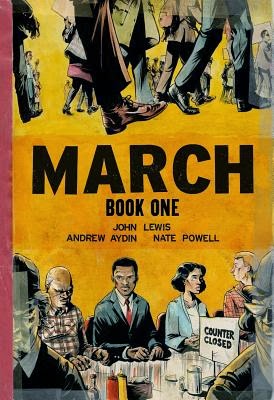
March (Book One)

by John Lewis, Andrew Aydin, and Nate Powell
First sentence: “John, can you swim?”
Support your local independent bookstore: buy it there!
Content: The only objectionable thing in the book is the use of the “n” word (which doesn’t make the white Southerners look good at all). The library has it filed under adult graphic novels, but I think I’d put it with the teen ones. I’m sure even a curious 10- or 11-year-old would get something out of this one as well.

I picked this up because it made the SLJ’s Battle of the (Kids) Books contenders list and I like to (try to) read as many as I can before the competition starts. Like every year, I found a wonderful book I’d have never picked up otherwise.

This is a slim graphic memoir, telling the first part of Congressman John Lewis’s story. (For the record, Hubby knew who Lewis was; I did not.) This volume starts with his childhood in Alabama, and goes through the Nashville sit-ins that he participated in. My favorite thing about this memoir was the framing: It opens with Lewis waking up the morning of Obama’s first inauguration, and the story unfolds as Lewis is remembering his path to D.C. as he tells it to a couple of constituents who have stopped by his office.

It’s your pretty typical Civil Rights story: sharecropper parents save money for their own farm. After an exposure to a different way of doing things (he visited his uncle and aunt in New York City for a summer), child wants an education, rather than be stuck at home doing what his parents do. (I loved the bits about raising chickens, though.) He feels a call to be a preacher, and ends up at American Baptist Theological Seminary in Nashville. There is an interesting aside here: Lewis wanted to go to college in Alabama, closer to home, and actually met with Dr. Martin Luther King, Jr. and his lawyers to talk about segregating Troy State. In the end, though, Lewis’s family didn’t want to chance the backlash, so he stayed in Nashville.

He was very influenced by the school of non-violent protests, and he got involved with a group that organized the sit-ins in Nashville in 1959. I think this was the most moving part of the book; the abuse and hurt that Lewis and his friends endured just so they could have the same services as the white people in Nashville was pretty brutal. This volume ends just after the Nashville mayor decrees that all businesses should be integrated. I’m quite interested to see where Lewis’s story goes from here.

I loved the format as well: there aren’t enough non-fiction graphic novels (at least that I’ve read), and the art — done in stark black and white — adds to the intensity of the story. I’m glad I picked this one up.

The Tyrant’s Daughter

by J. C. Carleson
First sentence: “My brother is the King of Nowhere.”
Support your local independent bookstore: buy it there!
Review copy downloaded from NetGalley
Content: Some mild language, and some indirect violence. It sits in the YA section (grades 6-8) of the bookstore. I don’t know if I’d give it to a 5th grader or not. I think it depends on how news-savvy the kid is.

Laila is the daughter of the ruler of an unnamed Middle Eastern country. She has a good life — trips to Paris with her mother, a private tutor, a resort by the sea. Then one day her world turns upside down when her father is assassinated right before her eyes.

Suddenly Laila, her mother, and her younger brother, Bastian (the “little king”) are exiled, taking refuge in the United States as Laila’s fundamentalist uncle takes over the country. Not only is Laila exiled from her country, she’s thrown into a world that — for all the riches and opulence she was used to — is vastly different from her own. And, on top of that, as she meets other refugees from her country, she discovers that her loving father was actually a brutal dictator.

I think the publishers are billing this as a thriller — J. C. Carleson is a former CIA operative, after all — but it’s not. It’s much more one girl’s story of awakening, and the harsh realities that brings, as well as of the plight of immigrants and how difficult it is to make a new home. Although she makes friends in her Washington D. C. school, Laila never quite belongs here, being uncomfortable with little things: from wearing short skirts to the dance to the seeming nonchalance that the students have to a bomb threat. Laila is constantly a fish out of water, and I think Carleson captures that perfectly.

There are some thriller-esque elements; Laila’s mom is a constant schemer, and there’s a CIA guy hanging around ominously. And I felt the ending was a bit too pat, not quite fitting in with the rest of Laila’s story. But, for the most part, it was a fascinating exploration of one girl’s attempt to come to terms with her family and the outside world.

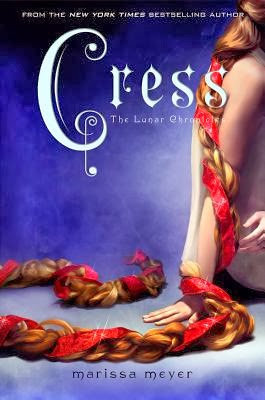
Cress

by Marissa Meyer
First sentence: “Her satellite made one full orbit around planet Earth every sixteen hours.”
Support your local independent bookstore: buy it there!
Content: Some violence, none of it gruesome. It’s shelved in the YA section (grades 6-8th), but I’d have no problems giving it to a capable younger reader.
Review copy given me by our MPS rep, who likes to enable my addictions.
Others in the series: Cinder, Scarlet

Obviously: If you haven’t read the other two, there will be spoilers.

So, our fearless (of sorts), rag-tag crew of a cyborg, a scruffy-looking nerfherder of a pilot, a disembodied android, a human girl, and a Lunar wolf-man operative are on the run from the Commonweath government. What are the most-wanted on Earth supposed to do? Especially when there’s an insanely evil queen who’s trying to take over the world by marrying the super-hot emperor? (“Tyrone, you know how much I love watching you work, but I’ve got my country’s 500th anniversary to plan, my wedding to arrange, my wife to murder and Guilder to frame for it; I’m swamped”) Well, hang out in space, of course. And then go rescue Rapunzel in her tower. Or Cress in her satellite, that is.

Except the rescue operation goes wrong, and our group of rag-tag outlaws are split up. Scarlet ends up on Lunar (and doesn’t figure much in the story), Cress and Captain Thorne end up in the satellite, crashing in the Sahara desert. And Cinder, Wolf, and the New Guy end up looking for the crazy Dr. Erland. As the plot thickens….

C’s biggest complaint with this one was that there were too many plot lines. Which is true, to an extent. Meyer is juggling a LOT of balls here. And there are at least 5 (if not more) story threads running through the book. BUT. I thought she managed all her threads well. With the exception of Scarlet, who really wasn’t interesting until nearly the end of the book (oh, but then her story line is tantalizingly interesting, setting up the last book in the series, Winter, well), I thought what all the characters were doing were fascinating. My favorites — probably goes without saying — are the two MAIN main characters in this one, Cress and Thorne. I adored Cress as a character: she’s a bit insecure around people, having been trapped in a satellite for 7 years. And she’s a total fangirl. But she’s also a smart hacker, and a resourceful and determined (if a bit naive) girl. And Thorne, well, let’s just say Thorne is that perfect mix between all the roguish bad good guys in all the books and movies I’ve ever loved. (It’s hard NOT to have a crush on him.)

And even though Cinder’s finally coming into her own, and there are some brilliant moments, it’s still a middle book in a series. It doesn’t stand as well on its own as Scarlet did, but I wasn’t disappointed with where the story is going. Meyer has created a terrifically interesting world, and is doing some fun things mixing the fairy tales in with the cyborg/futuristic elements. I can’t wait to see how it all ends.

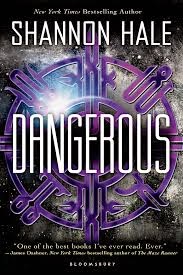
Dangerous

by Shannon Hale
First sentence: “The warehouse was coffin dark.”
Support your local independent bookstore: buy it there!
Release date: March 4, 2014
Review copy given to me by our publishing rep.
Content: There’s some intense action, and a few characters die. But there’s no language (its all “bleeped” out), and no sex. I think it belongs in the YA section at the store (grades 6-8) but I’d give it to curious younger kids.

Maisie Brown has lived a quiet life. She has scientist (read: introverted) parents and is happily homeschooled in her community just outside of Salt Lake City. But she has a secret dream: she wants to be an astronaut. She doesn’t think this will happen: she’s missing one of her arms, after all. But her middle name is Danger (literally) and when she gets an opportunity to enter a contest to win a week at a space camp in Houston, she goes for it.

And gets in.

She arrives at the camp — run by billionaire genius (not playboy) Bonnie Howell, who built the first elevator into space — not knowing that this week will change her life. That she’ll meet the Boy of her Dreams (who’s more than a bit of a jerk). That she’ll meet friends and watch them die. That she’ll become truly Dangerous.

In many ways, this was a breath of fresh air. One gets bogged down in the current trends in young adult/teen literature (read: paranormal or dystopian/post-apocalyptic) and to have something that is honestly science fiction with high tech gadgets, spaceships, and alien lifeforms. With honest-to-goodness average people doing techy, fun, science-based things. It was wonderful. And I really enjoyed Maisie as a character. She’s Latina (her mother’s from Paraguay), she’s smart, she’s confident, she’s disabled and she doesn’t let it get in her way. (In fact, at one point, she makes herself a pretty cool robotic arm.) And Hale does a good job incorporating most of the various elements she throws at us. The “fireteam” is a hodgepodge mix of races and cultures, but none of them seem like stereotypes (to me) and there ends up being a reason for it in the end. And although the love triangle was pretty silly (I think Hale makes it clear that it’s supposed to be silly), I did like that the love interest wasn’t love at first sight.

I did have some quibbles: mostly (and I understand why she did this) that she created a character who swears a lot, but then “bleeped” out all of the swear words. Literally. It pulled me out of the story, every single time. And while I loved that the parents were good people and good parents, they were a bit… corny. Which (again) pulled me out from enjoying story.

But, even with the quibbles, Hale does know how to spin a tale. And I was kept guessing with whom to trust and the ultimate motives. And a Latina superhero girl who kicks butt and is awesome and yet vulnerable without being irritating is, well, awesome.

How I Became a Ghost

by Tim Tingle
First line: “Maybe you have never read a book written by a ghost before.”
Support your local independent bookstore: buy it there!
Content: This is not a happy story. This is a sad and painful story. And even though the language is suitable for ages 8 and up, the content is, well, hard. And sad. And painful. (It was difficult even for me to get through because of the subject matter.) It’s in the middle grade (3-5th grade) section of the bookstore, but I’d be careful which child to give it to.

There was a time in my life, when I was junior or senior in high school, when I would have loved this story.

Isaac is a Choctaw boy, happy growing up in the swamps of the south. That is until the Nahullos — the white people — come along, and begin forcing his people out of their homes. And that’s when Isaac begins seeing ghosts. He sees shades of how his family and friends will die (horrible, horrible deaths). He foretells his own death and becomes a ghost. (No surprise: it’s in the first sentence!)

It’s when they’re on the Trail of Tears, however, that things get intense. The soldiers kidnap a girl, and it’s up to Isaac — as a ghost — and his friend — who can morph into a panther — to rescue her. They do, and it’s quite interesting how it happens.

I mentioned that I would have loved this story when I was younger. It’s because I was fascinated by — that seems the wrong word — the Native Americans, and their genocide. I would have eaten this book up, and passed it along to everyone I could. Now, though? Now, I just felt impossibly sad. I know it’s a tale that Needs to be told, a story that so many people need to be reminded of. But call it liberal guilt, call it having children: I couldn’t stomach it. It wasn’t violent, necessarily, but it was heart-wrenching. And even though Isaac turned out to be a hero, I never could find it in my heart to be proud of him (even though I wanted to).

It’s a well-written story, and a book that needs to be out there. I’m just not sure that I’m the right reader for it.

(Just for the record: because this is a Cybils nominee, I’ve been asked to make sure y’all know this is my opinion only, and not that of the panel.)

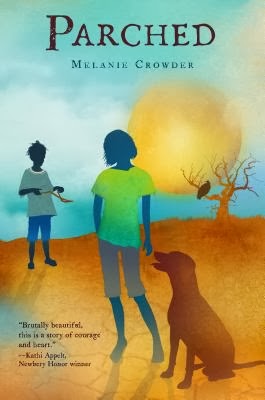
Parched

by Melanie Crowder
First line: “Sniff-sniff.”
Support your local independent bookstore: buy it there!
Content: There’s some harsh situations — a character was kidnapped and brutally treated, another character is shot and killed — but there’s no swearing at all. It’s not an action-packed book, so even though it’s on a 3-5th grade writing level, I’d be picky about which kid to give this to.

The world has turned to dust. Water is hard to find. And that makes anyone with water — or who can find water — valuable. Sarel’s family had water, until the gangs came through and killed Sarel’s parents and burned the compound to the ground. All that’s left is Sarel and the dog pack her father trained. It’s not a good thing; Sarel is running out of the little water she has left. Musa has a talent for dowsing, and has been kidnapped (or sold; I was never quite sure) to the gangs to find water. One night, Musa escapes, and finds his way to Sarel’s compound. It’s up to the two of them to work together to survive.

As you can tell, there isn’t much to this slim (seriously: it’s 152 pages.) novel. It’s highly introspective, more narrative than anything else. Even with the tension mounting to the end, it’s a quiet book about survival. I liked it, but I never really connected with it. Some of that was the quietness of it all. But it was also that I wanted more. I am not saying I needed a 300 page action-filled book, but I finished this one feeling like there was something missing. There wasn’t quite enough to it. I wanted more about how the world ended up parched. More about Sarel and her past. More about Musa and his talents. (Though I didn’t want more dog.) I wanted more connection between the characters. And the ending kind of came out of nowhere to me: I wanted answers as to how the book got to that point.

That said, the writing was gorgeous. And I have to give Crowder props for setting a dystopia book in an African-feeling setting. But it just wasn’t all I wanted it to be.

(Just for the record: because this is a Cybils nominee, I’ve been asked to make sure y’all know this is my opinion only, and not that of the panel.)

The Wells Bequest

by Polly Shulman
First sentence: “The Wednesday when the whole time-travel adventure began, I was fiddling with my game controller, trying to make the shoot button more sensitive.”
Support your local independent bookstore: buy it there!
Content: The main character is a bit obsessed with the girl (too much for my taste in a time-traveling, science fiction adventure book) and there’s a terrorist threatening to destroy NYC. It’s in the middle grade (3-5 grade) section of the bookstore, though I personally would hesitate before giving it to just any third grader, though I’m not sure I could pinpoint why.

Leo is the son of Russian immigrants who really only expect two things from him: excellence and to be scientifically minded. Leo — for better or for worse — is neither of those. At least not in the traditional sense. Leo is a Tinkerer. He loves taking things apart and putting them back together. He loves building new and better things. Which makes him perfect for the page program of the New York Circulating Material Repository. He gets there in a weird, round-about way, though: a time-traveling version of himself and an unknown girl (Jaya Rao, who was in the first book of this series The Grimm Legacy. Thankfully this one stands on its own, however.) stops in his room to tell him to read H. G. Wells’ The Time Machine.

I’d like to say that an adventure starts there, and there is a bit of an adventure that involves NikolaTesla, Mark Twain, and a crazed British page that has a raging crush on Jaya. I while I did enjoy reading this book, mostly I felt like it was a set-piece for Shulman to show off all the Really Cool Things that could come from reading science fiction books. There are many references to classic science fiction (which I got, but I wonder how an elementary school student would handle) and the inventions that come out of them are really neat. But I felt like that was the entire point of the plot. And I kind of wanted more action and less cool inventions.

(There’s also the side issue of Leo being Obsessed — though not in a crazy way — with kissing Jaya. I know he’s a hormonal pre-teen boy, but get on with it already. It’s a science fiction time travel book. I felt like it was a distraction.)

Even with my qualms, it was a fun story. And I’m curious about the first one as well.

(Just for the record: because this is a Cybils nominee, I’ve been asked to make sure y’all know this is my opinion only, and not that of the panel.)