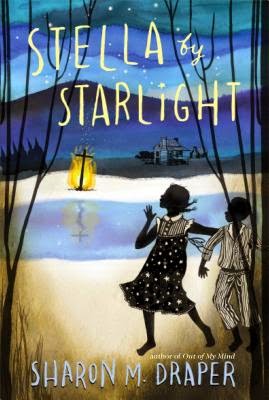
Stella By Starlight

by Sharon M. Draper
First sentence: “Nine robed figures dressed all in white.”
Support your local independent bookstore: buy it there!
Review copy snagged off the ARC shelves at my place of employment.
Content: There’s some pretty intense stuff going on in this book, by Draper never lets it get too dark. She knows her audience and (rightly) assumes they can handle anything that is thrown at them. Be prepared, however, for some discussion. It’s in the middle grade (grades 3-5) at the bookstore.

It’s 1932, North Carolina. The whole country is in the throes of the Great Depression, Franklin D. Roosevelt is running for office. For Stella and her family, this doesn’t really matter. They’re more concerned about making ends meet. And avoiding the local Klu Klux Klan.

And they’re doing a pretty good job until Stella’s dad, pastor, and a family friend decide to exercise their constitutional right and vote. Then, all hell breaks loose.

There’s actually a lot more going on than that: Draper knows her history, and paints a picture of what life was like for African Americans struggling to get ahead in the 1930s. The one-room school, with a teacher who handles all grades next to the white school where they get new books. The small houses and hand-me-over clothes. Having to enter in the back door of shops. Or, most tellingly, a white doctor who won’t come help Stella’s mother after she’d been bitten by a rattler.

And Stella is such an engaging character to go through all this with. She’s an observant, smart girl, but one who also struggles with writing in school. She’s trying to figure out her place in life, how to navigate the injustices of her situation, and still come out ahead. She’s got fantastic parents, and a supportive community. There’s so much that I found admirable about the way she deals with her situation. And so much to discuss (I know; I ended up talking to my family) when you’re done.

Absolutely Almost

by Lisa Graff
First sentence: “Not everybody can be the rock at the top of the rock pile.”
Support your local independent bookstore: buy it there!
Content: It’s pretty basic: short chapters, nothing too difficult plot or language-wise. It’d be good for reluctant readers as well as stronger ones. It’s in the middle grade (grades 3-5) section of the bookstore.

Albie has spent his life being almost. Almost smart enough. Almost good enough. Almost observant enough. But not quite. In fact, he’s been kicked out of his fancy prep school because he wasn’t smart enough, and his parents sent him to a public school. It’s never said what kind of learning disorder Albie has, but he definitely has one: math is hard, spelling is near impossible, and he just can’t live up to his busy parents’ expectations.

But things are going to change for Albie — not drastically, but some — because of a couple of teachers and a nanny who truly see potential in Albie. Not for just almost, but on his own terms.

It’s a simple story, following Albie over the course of most of a school year. He does learn and grow, and figures out things about friendship and how to stand up to his overbearing parents. It’s one of those affirming books: kids can be successful on their own terms and in their own way, and we need to appreciate that without making them measure up to some sort of standard. It’s all fine and good and sweet (and I did like Albie, quite a bit), but it lacked depth for me. Sure, it’s a middle grade novel, but that doesn’t mean that there can be some bite, some seriousness to it.

I don’t know if I was looking to shed tears, or to be Truly Moved, but I did feel like this one felt a little flat. Not bad, but not amazing, either.

Graphic Novel Round Up, December 2014

In Real Life
by Cory Doctorow and Jen Wang
Support your local independent bookstore: buy it there!
Content: There’s a couple instances mild swearing and because it’s about economics and gaming, it’s in the teen section of the bookstore. That said, A (who is in 5th grade) read it, understood most of it (at least the general idea), and really liked it. It’s in the teen graphic novel section of the bookstore.

I’ve never read anything by Cory Doctorow, but I was intrigued by this when it came into the store, and after reading a review of it for the Cybils blog I knew I needed to pick this one up.

Anda is a gamer. Which makes her a bit of an anomaly in her new school in Flagstaff, Arizona. So when a woman comes to their tech class, inviting them all to join this new online gaming community, Coarsegold, Anda jumps at the chance. Once inside the game, though, she soon finds out things are not all coming up roses. She hooks up with another player, Sarge, who introduces Anda to the world of gold farming. Actually, Anda and Sarge’s job is to kill off those who are gold farming — harvesting virtual gold for real money.

But then Anda befriends one of the gold farmers, a Chinese boy who goes by the English name, Raymond. She discovers that he’s being forced to work for hours on end without a break, for very little money and no health coverage. So, she gets Involved.

I enjoyed much about this foray into the gaming world. I enjoyed Anda as a character, and that Jen Wang drew her realistically. Even her avatar, which was slimmer and “whiter” than Anda was, wasn’t Barbie perfect. I enjoyed the fact that the introduction to the gamer world was a girl, as well. Especially with gamer-gate, acknowledging that girls are gamers, too (and good at it) is a good thing. Doctorow mentions in his introduction that this is not just about gamers, but it’s also about economics and making a difference. And I could see that as well; it’s a primer how electronic transactions take place and a reminder that in this world, no one is truly ever disconnected from anyone else.

Fascinating.

I Remember Beirut
by Zeina Abirached
Support your local independent bookstore: buy it there!
Others in the series (loosely speaking): A Game for Swallows
Content: Much like Hidden, this is about the effects of war on everyday people. It’s pretty matter-of-fact, but it feels like an older graphic novel. It’d be in the teen graphic novel section of the bookstore.

This is basically Abirached’s memories of growing up during the war in Lebanon. Her  house was in the middle of what she called “no man’s land”, which was a zone in between the worst of the fighting and the safer places in Beirut. Her memories are organized roughly chronologically, and range from the mundane — how they showered — to the macabre — her brother loved collecting bits of schrapnel — to the sad — when a neighbor had to move because their house got blown up.

Done in the same stark black and white drawings, it’s a reminder that no war is without casualties, and that sometimes those casualties are the everyday lives of people who aren’t even involved in the fighting. 

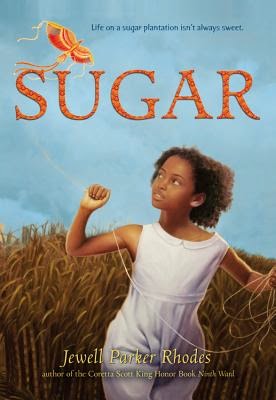
Sugar

by Jewell Parker Rhodes
First sentence: “Everybody likes sugar.”
Support your local independent bookstore: buy it there!
Bought and signed by the author at KidLitCon 2014
Content: This one would be appropriate (and probably okay, difficulty-wise) for kids third grade and up. It’s in the middle grade section (grades 3-5) of the bookstore.

It’s 1871, and slavery is supposed to be over. However, for ten-year-old Sugar, on a sugar plantation in Louisiana, it doesn’t feel like it. Sure, the former slaves are free to go if they can, but they’re paid so little that it’s almost impossible for them to leave. And then the plantation owner, Mr. Wills, decides that he needs more workers, so he hires some Chinese to come and supplement the former slaves.

For Sugar, her life revolves around sneaking out to play with Billy, the owner’s son, and trying not to get under Mrs. Beale’s feet. And planting and cutting sugar cane. Once the Chinese arrive, however, Sugar’s world is expanded: one of them speaks English and she befriends them. In fact, she is the bridge that gets the whole working community to work together rather in competition. There’s a passage about halfway through that pretty much sums up what I think Rhodes was getting at in this book:

“How come I ca’t decide who I can see? How come I can’t decide my friends?”
“We don’t trust these men, Sugar.”
“I like Chinamen. Reverend, don’t you preach ‘Treat folks like you want to be treated’?”
“Well, now,” says Reverend, not looking at me, twiddling his thumbs.
“Sugar,” says Mister Beale, “folks get along best with folks like them. Always been that way.”
“Seems cowardly.”

Of course, things aren’t easy for Sugar and her friends: it is 1871 in the South, and white people — especially the former Overseer — are reluctant to change and adapt. There is some tragedy in this book, but it is a middle grade book, after all, and the tragedy is kept simple and appropriate.

It’s the overall message of friendship and inclusion that made this slim historical fiction book worth reading.

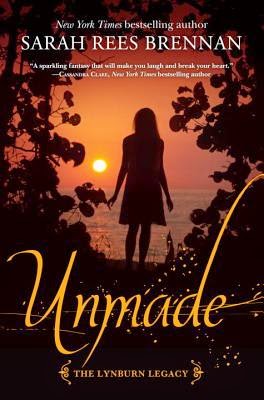
Unmade

by Sarah Rees Brennan
First sentence: “Kami Glass was standing to close to the fire.”
Support your local independent bookstore: buy it there!
Others in the series: Unspoken, Untold
Content: There’s a lot of violence, some of it brutal, plus some almost sexytimes. Not enough, however, to move it from the YA section (grades 6-8) of the bookstore.

Remember last time when I said the book was a bit of a middle book, and that the ending had me excited for the conclusion? (No? Well, neither did I?) Even so, I was able to fall back into Sorry-in-the-Vale with the Lynburns and Kami Glass with all her snarky confidence and contagious hope with ease.

Rob Lynburn has all the cards, all the power. And that has made Jared and Ash and Kami and their “side” quite desperate. Desperate enough to do desperate and dangerous things. This is an epic battle, a long, slow buildup to an intense climax. And interspersed in all that is heartache and love, loss and life, and a lot of heart.

This is a series, I think, that demands to be binge-read. And, thankfully, now you can. Sit down over a long weekend (like… Thanksgiving!) and immerse yourself in this deep, complex, wonderful world Brennan has created. Enjoy the characters, the good vs evil, the humor, the mystery, all at once without the wait.

I wish I could have. I enjoyed this book, but I think I would have enjoyed it SO much more had I read them all at once.

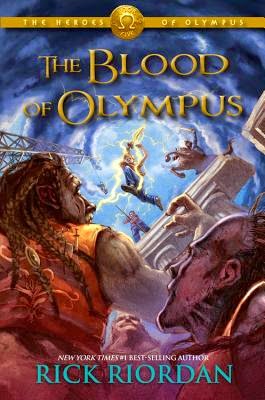
The Blood of Olympus

by Rick Riordan
First sentence: “Jason hated being old.”
Support your local independent bookstore: buy it there!
Others in the series:  The Lost Hero, The Son of Neptune, Mark of Athena, The House of Hades
Content: There’s some mild kissing and lots of fantasy violence. It’s in the YA section (grades 6-8) of the bookstore, but it’s more than appropriate for Percy Jackson fans of all ages.

The doors of Hades have been sealed, but Gaea is awakening anyway. Our heroes have split up: seven on the Argo II trying to go get to Athens to stop Gaea, the other two (plus Coach Hedge) are shadow-traveling the Athena Parthenon to Camp Half-Blood as a goodwill gesture from the Roman camp to the Greek camp. Both sets are facing Great Odds: monsters and minor gods that have switched sides as well as Octavian and the Roman camp’s impending invasion of Camp Half-Blood. Will they be able to stop everyone in time?

It’s a good ending. Not a great ending, not a fantastic book, but a good, solid one. It was a nice send-off to characters I’ve come to know and love for 10 years. And I was more than happy to take this ride with them. I was glad that the unsung characters — Piper, Reyna, and especially Nico — got a chance to shine. I enjoyed the whole book well enough, but I REALLY enjoyed the Reyna/Nico chapters. I just felt like that was where the more interesting story was, with saving Camp Half-Blood and fighting Orion and Octavian, and they were just awesome. Period. Everything else paled in comparison.

I do have some theories about the end (which ticked off A, by the way) but I’m not going to go into my theories here. I have some complaints about the sort of writer Riordan’s become; he’s become much too much of a formula writer for my taste. But I understand the demands of publisher’s and fans and the constraints of storytelling and I’m still more than happy to give everything he writes a read.

I will be sad to see this series end; it’s been a good ride.

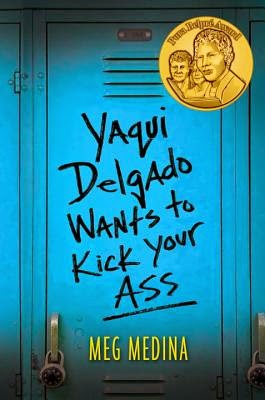
Yaqui Delgado Wants to Kick Your Ass

by Meg Medina
First sentence: “Yaqui Delgado wants to kick your ass.”
Support your local independent bookstore: buy it there!
Content: There’s some mild swearing. The real reason it ended up in the Teen (grads 9+) section is for the bullying and the violence. It’s pretty graphic and the fallout is pretty severe.

Piddy Sanchez is starting a new school. It’s one of those inner city schools in a Hispanic neighborhood in Queens, the kind that justifies every bad stereotype there is. Just a few weeks in, and someone informs Piddy that Yaqui Delgado — whom Piddy has neither seen nor spoken with — is going to kick her ass. Why? Because she thinks Piddy is flirting with her boyfriend. (She’s not.)

It’s this threat, among other things, that begins defining Piddy’s life. She doesn’t feel like she can talk to her mother, who is working extra shifts to try and provide for the both of them. She does turn to her aunt Lila, but even then she keeps the awful details to herself.

It’s a harsh journey, one that I wouldn’t wish on any kid. I did like that there was a range of diverse people in this one; not all white characters were “good” and not all Latin@ ones were “bad”. There was a wide range of personalities, and the color of the skin just happens to be incidental. I also enjoyed how Piddy embraced her culture and loved her neighborhood.

I was glad for the solution to this one, as well. No one really “learned their lesson” and the bully wasn’t reformed and they didn’t become friends and live happily ever after. No, it was much more realistic and messy and showed that sometimes the best option isn’t always the most noble one.

It was a tough read, emotionally raw especially for me (because of the whole daughter thing), but I’m glad I did.

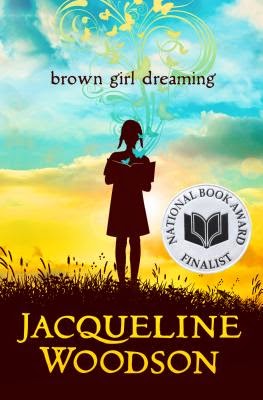
Brown Girl Dreaming

by Jacqueline Woodson
First sentence: “I am born on a Tuesday at University Hospital Columbus, Ohio, USA — a country caught between Black and White.”
Support your local independent bookstore: buy it there!
Content: There’s nothing objectionable. And it’s even an easy-ish read. Sure, it’s poetry, but it’s not difficult. Hand it to anyone with an interest in writing, kids, and history. It’s in our middle grade biography section at the bookstore.

I’m not quite sure where to start on this one. It seems We’ve (the collective we, here) been inundated by memoirs and biographies of celebrities, People of Note, and at first glance Jacqueline Woodson’s new book just falls into that pit of “celebrity” (of a sort) biographies.

Except, it’s not so much a biography or memoir as it is a reflection upon a childhood. Woodson makes her childhood an Everyperson experience, something that the reader can readily identify with, even if they didn’t have her exact same experiences.

Her childhood begins in Ohio, but mostly it’s spent in South Carolina, with her grandparents, and in Brooklyn, where her mother finally settled with Jacqueline and her brothers and sister. I kept trying to figure out the timeline (if she was born in 1963, then it must be…) but eventually, I just gave up and let myself get absorbed in the story.

And absorbed I was. Woodson wove historical elements into her story — sit-ins in the South; the way her grandmother felt about the way she was treated in stores by white people; music that was playing on the radio — all of which helped put her personal story in a larger framework. I could easily forget I was reading a memoir; it felt so much like a novel.

Part of that, too, was the form. Written in free verse, the memoir took on a lyrical quality. There were moments, especially toward the end, where I was moved by her insights not only in her life, but for Life in general.

One more thing: I appreciated her portrayal of religion. I get the sense she’s not a practicing Jehovah’s Witness anymore, but she portrayed the religion of her grandmother and her own childhood with respect. It was neither good nor bad; it was just a part of her life. And I found that refreshing.

Highly recommended.

I’ll Give You the Sun

by Jandy Nelson
First sentence: “This is how it all begins.”
Support your local independent bookstore: buy it there!
Content: There is some teen drinking, a (non-graphic) rape scene, and several f-bombs. That, and because of the subject matter, puts it in the Teen section (grades 9+) of the bookstore.

Noah and Jude are twins, separate people but connected in thought and purpose (generally). So much so that they’ve become NoahandJude, pratically inseparable. That is, until the summer they turn 14. Then everything starts to fall apart. Jude becomes “wild”; Noah retreats into his own world until a new boy shows up next door. They end up “dividing” their parents, each vying for the other parent’s attention and love. On top of that, they are fiercely competing to get into the local prestigious art high school. It’s a mess.

Two years later, things aren’t much better. Jude made it into the school; Noah (who was arguably the better artist) did not. They’re still dealing with the aftermath of their mother’s fatal accident. They harbor secrets. And they’re no longer NoahandJude. They’re not even Noah and Jude. They’re two separate planets, who never talk to each other. It’s different from what it was before, but no better.

Did I mention that Jude sees the ghost of her dead grandmother, and senses the presence of her dead mom?

It’s thanks to the two ghosts that Jude searches out Guillermo, sculptor extraordinaire and Latino Mystical Guide, and finds not only salvation but True Love.

Yeah, the book derailed just about there.

For the record: everyone in this book is a Tortured Soul Needing Redemption. And they all find it together. I did enjoy Guillermo — in fact, he was the most interesting character — but that doesn’t change the fact that his role in the book was to cause a change in the white people around him. He was Passionate Lover, he was Father Figure, he was Spiritual Guide. And sometimes he was a living-breathing person, but those times were rare.

And don’t even get me started on the whole Soul Mate thing. Ugh.

What saved this book from being Truly Horrible was the writing — Nelson paints the world vividly, and I do have to admit that there was some good chemistry between Jude and her Soul Mate, even if that’s a trite trope and needs to be done away with. But what I really loved was the art. I loved Guillermo’s giant sculptures and the way Nelson depicted the process of art. I loved Noah’s chapters and the way he’d come up with paintings for everything. I loved how she considered fashion an art.

In the end, I did respect what Nelson was trying to do. But it’s not a perfect book by any means.

Graphic Novel Roundup – Raina Telgemeir Edition

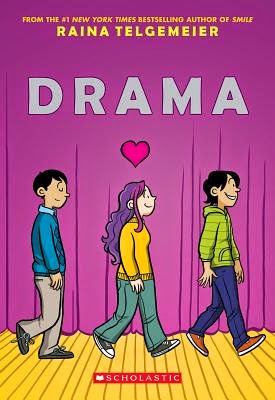
Drama
Support your local independent bookstore: buy it there!
Content: There’s middle school drama, but other than that, it’s pretty tame. It’s in the teen graphic novel section of the bookstore, but only because it feels a bit mature for the middle grade section.

Callie is a theater nerd. She’s not one to be on stage — she can’t sing, and her acting needs some work — but she LOVES being backstage, helping create the sets. And so, for the middle school production (middle school!) of Moon over Mississippi, she’s been assigned to be in charge of the sets. That’s overwhelming enough, but Callie’s personal life has taken a turn for the confusing. She thought she was getting somewhere with her long-time crush, but he went back to his girlfriend (who’s not terribly nice). And then a set of twin brothers show up in her life to just confuse things more.

I really liked Telgemeir’s depiction of middle school (spot on!) and the theater program (again, spot on!). I loved Callie’s spunk and drive and her longing to feel accepted and belong. And even though it was Callie’s story, I thought that all her friends — from the twins to her best friend, Liz — were fully developed. (Though there were some stereotypes, the mean girl girlfriend being one.) My only real complaint was the inclusion that all guys who do theater (at least on-stage) are gay. It’s a stereotype, and although there are gay boys who do theater, not all theater boys (even on-stage) are gay. I know I’m nitpicking, but here in Kansas, that’s the kind of stereotype that really takes hold and so parents discourage boys from participating in the arts because of it. I would have appreciated one character, at least, who wasn’t part of that.

Even so, it was a lot of fun to read.

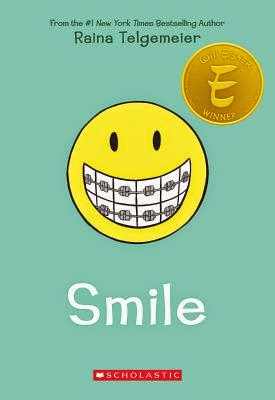
Smile
Support your local independent bookstore: buy it there!
Content: much the same as Drama; it’s got some themes that are a bit old for the younger elementary crowd, but there’s not much “objectionable”. It’s in the Teen Graphic Novel section, mostly because it seems to do better there.

Every once in a while, there’s an author (or in this case an author/artist) who gets the middle grade years so absolutely perfectly. The awkwardness, the challenges with friends, the wanting to be liked and not feeling liked.

Telgemeier is one of those people. It’s loosely based on her early teen years, and tells the story of how she lost her two front teeth in an accident and the dental work it took to make her smile what it is today. But it’s also the story of acceptance (inner and outer) and the things we’ll do and put up with so we don’t feel alone.

One thing I liked (well, I liked lots of things) was that the middle and high school Telgemeier drew was a diverse one. From her friends to the boys she liked, there were all shades of skin. And it wasn’t  this one’s the “black friend” or the “Asian friend”. They were all just friends — well, sort of; some of her friends, as A pointed out when she read it, were not very nice — and it wasn’t like Telgemeier was forcing a diverse world on things. It felt natural.

And, on top of that, she set it in 1989, which was a lot of fun to revisit.

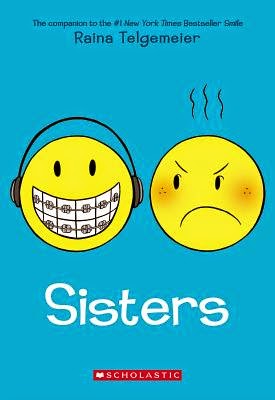
Sisters
Support your local independent bookstore: buy it there!
Content: This one is “tamer” (not that the other two are wild) than the previous two books, and has a more universal appeal, being about sibling rivalry. It’s in the middle grade graphic novel section of the store.

This is another memoir(ish) graphic novel, that takes place during Smile (though you don’t need to read that one to enjoy this one). It’s centered on Raina’s relationship with her younger sister, Amara. It has their backstory, their relationship as siblings as well as a road trip (yay road trip!) to visit cousins in Colorado for a family reunion.

It’s not an easy relationship, the one between Raina and Amara. There’s jealousy, age difference, interest differences, and (of course) just plain sibling rivalry. It’s the usual stuff: hitting, yelling, punching, name-calling. But an event on the road trip (I knew they were useful!), helps the sisters see that maybe it’s okay if they’re different. They can still get along.

I think, out of the three, this one was the least angsty, the least middle-school drama-y, and my personal favorite. Not only because I still remember fighting with my siblings, but because I’ve got all these girls around here who fight and squabble and don’t get along. Maybe, someday, they’ll figure it out. So, this one hit home in a way the other two didn’t.

A word on her art: it’s a bit cartoon-y (that’s the techincal term), but I thought it fit her story-telling style. It’s not terribly detailed, but it served it’s purpose, and the bright colors drew the eye in.

I handed all three of these off to the girls and they enjoyed them as much as I did. I’m glad we finally got around to reading her work!