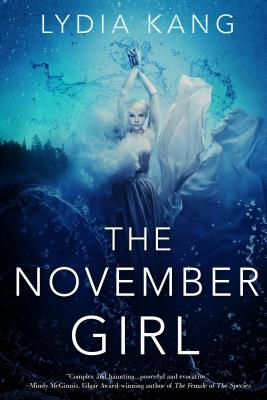
The November Girl

by Lydia Kang
First sentence: “There’s a foolproof method to running away.”
Support your local independent bookstore: buy it there!
Content: There is some swearing, including multiple f-bombs. It’s in the teen section (grades 9+) of the bookstore.

Every November on Lake Superior, the weather is unpredictable and ships go down. It’s been that way forever. They call it the November witch. And little do they know that they’re right: her name is Anda, and she’s the half-mortal, half-nature witch who feeds on death and destruction, living with her father on Isle Royale most of the year, and feeding on shipwrecks in November to satiate her appetite.

Hector is a half-Korean, half-Black kid who’s on the run from his abusive uncle. His plan: hide out on Isle Royale until he turns 18 in May, and can be a legal adult, and get out the grips of his uncle. Except, things don’t quite go according to plan. First reason? He can see Anda (no one else can). And second reason? They get involved.

I feel like, as a Michigander, I should have liked this one more. It was super atmospheric, and Kang’s love for the Lake (though not the one I’m most familiar with; I know Erie better) shines through. But, honestly? I just found I couldn’t care for the characters. I didn’t buy Hector and Anda’s romance (and I got tired of it, especially since she played the manic pixie dream girl role to Hector’s cutter outsider persona) and I thought the ending was a bit on the tidy side.

Maybe it’s just a wrong person, wrong time, wrong book problem.

Beasts Made of Night

by Tochi Onyebuchi
First sentence: “I make sure to sit where they can’t see me.”
Support your local independent bookstore: buy it there!
Content: There are a couple of mild swear words, some violence, and a bit of kissing. It’s in the YA section (grades 6-8) of the bookstore.

The world that Onyebuchi created is fantastic: purity means everything to the people of this city, and so to remain pure from sin and wrongdoing, the rich and powerful hire Magi to call the sin from them, in the form of shadow beasts. Then sin-eaters, called aki, destroy the beasts, and swallow the sin, which appears in the form of a tattoo on their bodies. The aki are considered the lowest of the low, because their impurity is visible on their bodies, and so they are shunned and cheated and die early.

But, unfortunately, that’s as far as the book got. There isn’t much of a plot — first our main character, Taj, is in the slums, and then he’s in the palace, and then he’s sent to train new aki — and it never really seemed to go anywhere. There’s a rebellion and a resistance and who is really the “bad guy” (was it the head Magi? Or the royals?) and the princess Taj was kissing HAD to be at least old enough to be his mother, which just creeped me out.

So, while I adored the world that Onyebuchi created, the book just didn’t do it for me.

Bruja Born

by Zoraida Cordova
First sentence: “This is a love story.”
Support your local independent bookstore: buy it there!
Review copy provided by the publisher for the Cybils.
Content: There is some mild swearing and a few f-bombs. There is also a lot of violence. It would be in the Teen section (grades 9+) if the bookstore had it, but I think a 6-8th grader who was interested could read it. 

I’ll be forthright: this is a second in a series. And no, I haven’t read the first one (yet). But this one worked as a stand alone; Cordova gives enough information that it kept me in the loop with the backstory (though I do wonder if it was too much, if you’ve already read the first one?) but didn’t really get in the way of this story. 

Lula has been growing distant from her boyfriend, Maks, for many reasons (most of which have to do with book 1, but also because she’s a bruja – a witch) and he decided that he was done trying to make this work. So, on the way to a soccer game — he’s a player, she’s part of the cheer/dance team — he did. And then the bus got into a fatal accident. Lula’s family — who are all brujas — was able to save her through magic, but Maks, well, died. Except Lula, when she recovered, wasn’t able to accept that. So, she and her two sisters — Alex and Rose — performed a canto (a spell) to save him. Which… worked. Sort of. What it actually did was trap Death (the Lady de la Muerte) in between realms and created a whole hoard of casimuertos — zombies who eat hearts instead of brains — that quickly took over Brooklyn. 

What Lula (and Alex and Rose by extension) need to do is figure out how to get the Lady back to her realm and figure out a way to stop the casimuertos before they kill everyone. 

I’ve already addressed how nice it was that this was its own story rather than a continuation of a story that began in the first book, but it’s also a lot of fun. I enjoyed the Latinx flair that Cordova brought to witches (and zombies) and I thought the story was just a lot of fun. There was romance gone wrong, consequences to choices, some fun sidekicks, and a great family relationship. 

I’m going to try and go back and get my hands on the first book in the series. It’s really a LOT of fun. 

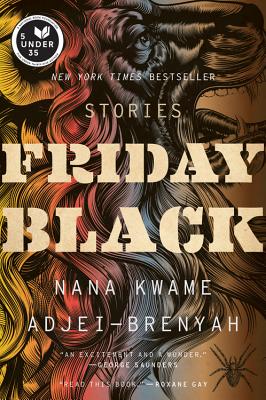
Friday Black

by Nana Kwame Adjei-Brenyah
First sentence: “Fela, the headless girl, walked toward Emmanuel.”
Support your local independent bookstore: buy it there!
Content: It’s violent and there is some strong language, including a lot of f-bombs. It’s in the adult fiction section of the bookstore. 

I picked this one up after hearing the author on the New York Times Book Review Podcast. I’m not usually a short story sort of person — and this one took me a while to get through — but it sounded fascinating enough that I felt compelled to pick it up. 

It’s a set of mostly unconnected short stories (though there are three about working in retail that take place in the same store) about what it’s like to be black in America. It’s nominally speculative fiction: the shoppers in the title story are forms of zombies, made that way by consumer greed, literally killing each other on the way to get the Product They Need. Or, in the final story, “Through the Flash”, Adjei-Brenyah imagines a future where technology and climate change has stuck us all in this terrible time loop, doomed forever to repeat the same day and the effects that would have on people, for good and ill. 

But my favorite story — “favorite” meaning “the one that suck with me the most” is “Zimmer Land”, an “amusement” park where white people get to pay for the opportunity to extract “justice”: stop a terrorist, solve a bomb threat, or stop a “thug” from invading their streets. If, by the end, you haven’t realized that it’s a pretty damning telling of the way white people deal with crises, whether real or perceived, then I think you read it wrong. 

I didn’t get all the stories — part of my problem with short stories, usually — but that could be because I’m a white person, and I just don’t understand black life or experience. Even so, I found this to be incredibly powerful. He’s definitely a voice in fiction I’ll be watching out for more from. 

Mirage

by Somaiya Daud
First sentence: “He is the only one of his family without the daan.”
Support your local independent bookstore: buy it there!
Content: There is some violence, and a few mild swear words. It was in the teen section (grades 9+) but I moved it to the YA, partially because there was nothing really “offensive” in it, and partially because I think 6-8th graders might be a better target audience. 

I’ve been thinking of this one as Star Wars with a Persian flair. Let me explain: in this universe, there is a cruel imperial overlord, the Vath, who conquer lesser systems, including the home world of our main character, Amani. The cruel overlords (and their droids) have wiped out the native language and customs, though they do keep some. 

The daughter of the emperor is about to come of age, and it turns out that she is very disliked on Andala, the world she is set to rule. So, Amani is kidnapped — because she looks exactly like the princess — and made to serve as a body double, something she resents, until she discovers (you guessed it: the resistance). See? Star Wars. 

The Persian flair is what made this book stand out to me: Daud infuses the world with a rich mythology, religion, and history, sewn together with poetry and family. I liked the developing relationship between Amani and the princess’s fiance, Idris. And I even really liked where the story went, though it took a long time to get to the climax. My only complaint is the usual one: I do wish it had been a stand-alone. 

Even so, it was a unique and interesting tale. 

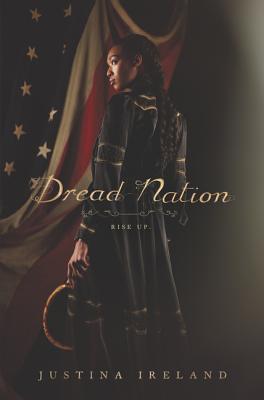
Dread Nation

by Justina Ireland
First sentence: ” The day I came squealing and squalling into the world was the first time someone tried to kill me.”
Support your local independent bookstore: buy it there!
Content: There’s a lot of violence and some swearing and some references to the sex trade. It’s in the Teen section (grades 9+) but I think it’d be good for a younger reader, if they were interested. 

It’s the 1880s, and America is still trying to overcome the zombie — they call them shamblers — infestation that began during the Civil War. Sure, the war kind of petered out, but the south is pretty much wiped out, given over to shamblers. And the east coast is partially fortified, but mostly because the government ships blacks and native peoples into schools where they get training to be, well, shambler killers. 

Our main character is Jane McKeene, a half-black girl from a plantation in Kentucky, who has attended Miss Preston’s School of Combat in Baltimore. She’s set to graduate and become an Attendant, protecting some rich white woman, when she discovers the seedy underbelly of the city. Which puts her into some definite hot water. And lands her in the West, where there are no rules. Especially for someone like her. 

I loved this one. Seriously. It’s a lot of fun, first of all (and I don’t really read zombie books), and I really liked the alternative history that Ireland created. It felt like it could have been a real history, just with zombies. But, I also really liked that it wasn’t all fluff and nonsense, that there were some real issues of racism and sexism and even zealotry in there. Things that would make for a good book discussion. 

And while there will most likely be a sequel, the story did come to a satisfactory conclusion. Which is always nice. 

A really really good book. 

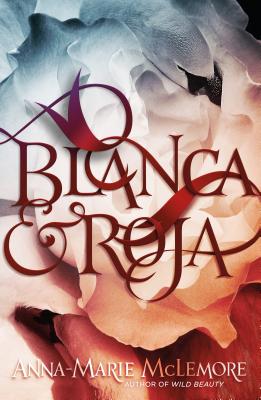
Blanca & Roja

by Anna-Marie McLemore
First sentence: “Everyone has their own way of telling our story.”
Support your local independent bookstore: buy it there!
Content:  There are some references to sex and some swearing (including a few f-bombs). It’s in the teen section (grades 9+) of the library.

For their whole lives, the del Cisne sisters — Blanca and Roja — have known that one of them would live and one of them would be turned to a swan.

All their lives, Blanca and Roja — named so because Blanca was blond and fair, and Roja had red hair and darker skin — tried to thwart the swans. They weren’t going to be divided, one of them was not going to be left behind. Then, the swans came. And behind them, two boys: Page and Barclay. 

One part fairy tale retelling (Snow White and Rose Red) and one part love story, Blanca & Roja is incredibly lyrical. I love the way McLemore writes, with spare chapters and magical language. I loved the way she used the fairy tales, and the way she was exploring the consequences of racism and white preference. It was a fascinating story, incredibly well-told, and thoroughly enjoyable!

Beneath the Citadel

by Destiny Soria
First sentence: “Four people were supposed to die at sunrise.”
Support your local independent bookstore: buy it there!
Content: There’s multiple instances of one swear word, and some violence. It’s in the YA section (grades 6-8) of the bookstore.

Things I really liked about this book:

  1. The time frame was super condensed: most of the action took place (shock) beneath the citadel, where the council of Eldra has been hiding, listening to prophecies, and determining the Fate of the citizens of their country.  Likewise, the entire book took place over four days. 
  2. Even though there was shifting perspectives (I really am kind of over that) between the five characters, Soria kept the action propelling forward, and I never found myself losing interest in the story. 
  3. Which is to say: Soria really knows how to write. No, the sentences weren’t lyrical and lovely all the time, but the characters and dialogue popped, and she kept me guessing throughout the whole book. And she doesn’t hold back any punches. 
  4. I really liked the world Soria built, and the conflict between prophecy and free will. It was a nice tension, and the fact that who the “bad guy” was kept shifting was pretty impressive as well. 

In short? I really enjoyed this one. 

Isle of Blood and Stone

islefobloodandstoneby Makiia Lucier
First sentence: “The outing had been planned on a whim; an afternoon lesson up in the ills, away from the smoke and stink of the city.”
Support your local independent bookstore: buy it there!
Content: There is some mild swearing and violence. It’s in the YA section (grades 6-8) of the bookstore, even though the characters are 18/19 years old.

Eighteen years ago, the two princes of Island of St. John del Mar were kidnapped with the chief navigator and their nurse, never to be seen again. The king (and everyone, really) presumed them to be dead and went to war with a nearby island, Mondrago, ravishing it. Fast forward, and the king’s remaining son, Ulises, has become king, and his two friends, Mercedes — half Mondragan and Ulises’ cousin — and Elias, the son of the former chief navigator, have discovered some maps with a riddle about that fateful event 18 years ago. And, at the king’s command, Elias begins to look into it.

What he finds is a complex and tangled riddle, full of lies and information that will shake not only Elias’s beliefs, but perhaps the entire kingdom.

On the one hand: this was a compelling book, and a fantastic idea. I liked both Elias and Mercedes (who were roughly our narrators; it was written in third person, but we never followed Ulises around), and I loved the twists and turns as Elias uncovered information about the princes’ disappearance.

What held me back from really loving the book, however, was that I felt that Lucier told me what was going on rather than showing me. There was a LOT of exposition, and a lot of narrative, which isn’t necessarily bad, but what it did was keep me at an arm’s length. Like, Elias and Mercedes ended up falling in love (mild spoiler), but I had absolutely no connection to that. At all. There were strains of racism and sexism, but I felt like it was all at a distance, and never really connected with any of it.

Which is too bad. I really wanted to love this one.

Dear Martin

dearmartin.jpgby Nic Stone
First sentence: “From where he’s standing across the street, Justyce can see her: Melo Taylor, ex-girlfriend, slumped over beside her Benz on the damp concrete of the FarmFresh parking lot.”
Support your local independent bookstore: buy it there!
Content: There is some teenage drinking, talk of sex, swearing, and violence. It’s in the Teen section (grades 9+) of the bookstore.

Justytce is a scholarship student at one of the most prestigious prep schools in Atlanta. He’s smart, he’s observant, he definitely deserves to be there.

Except. He’s one of only three black students in the school. And when he was arrested for trying to help his drunk ex-girlfriend (so she wouldn’t drive drunk!) right before his senior year, he starts to notice things he’s let slide before. Like how his best friend’s (who’s also black) friends are, well, racist. Like how cops seem to get a pass when dealing with black people (especially men). And he tries, through writing letters to Martin Luther King, Jr, to understand they way black people are treated, and tries to understand how to do the, well, “right” thing.

It’s not easy. Justyce says at one point in the book that it’s tough being in his position: he’s got white people at his school questioning whether he deserves to be there (or to get into Yale) and then black people in his mother’s neighborhood trying to pull him back and making fun of him and his aspirations. It’s unfair, to say the least.

And then, in one fateful afternoon, his whole life changes: his best friend is shot and killed in a traffic altercation with an off-duty cop. And Justyce — who was also in the car – – is caught in the cross hairs, and blamed for everything.

It’s a short novel — just over 200 pages — but it packs a punch. The takeaway? White people are awful. We have to work really hard at not being awful, because we take so much for granted. It was definitely eye-opening.

Pair it with The Hate U Give and Ghost Boys, and if you’re white, remind yourself of the privilege you have every day of your life.