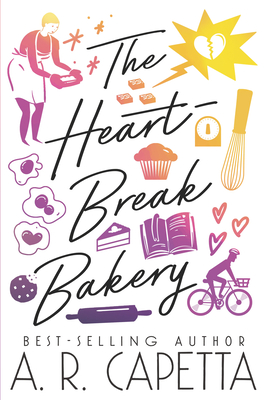
The Heartbreak Bakery

by A. R. Capetta
First sentence: “The splintered crack of my egg of the counter sounds like an ending.”
Support your local independent bookstore: buy it there!
Content: There is talk of sex, and a couple of f-bombs with some mild swearing It’s in the YA section (grades 6-8) of the bookstore.

This book hits all my buttons: it’s a book about food and baking — Syd our main character, loves to bake as self-expression; it’s a book about Austin (which I really do love to visit); it’s a book about friendships and finding love; it’s a book that truly embraces the entire rainbow of LGBTQIAP+ life and culture.

The plot is simple: Syd goes through a bad breakup, and bakes heartbreak into brownies, which get sold at the bakery, and which cause everyone who eats them to break up. Syd, feeling guilty and miserable — the owners of the Proud Muffin bakery where Syd works are one of the couples — sets about with Harley, the delivery person at the bakery, setting things right. There are lessons Learned and Love along the way, along with a smattering of magical baked goods.

Syd doesn’t have pronouns, and identifies as agender, which to be honest, has made writing this really difficult. One doesn’t consider how much pronouns are a part of life until one tries to write a review not using them.

But the book is still cute and light and frothy, following the paces of a foody romance, with an LGBT+ spin. I did like that this one felt Queer in incredibly inclusive ways (I think the only cis/het characters were Syd’s parents); I felt like (as an outsider) that the whole rainbow was represented. As a baker, I love the idea of magical baking, and some of the recipes Capetta includes sound amazing.

I don’t think tis is going to be my favorite book this year, but I am so happy that a book like this exists in the world.

Cinderella is Dead

by Kalynn Bayron
First sentence: “Cinderella has been dead for two hundred years.”
Support your local independent bookstore: buy it there!
Content: There are illusions to domestic abuse. It’s in the YA section (grades 6-8) of the bookstore.

In the kingdom of Lille, the story of Cinderella is not just a fairy tale, it’s fact. It’s the book by which every young woman is to live their life. Serve their family. Prepare for the ball, which happens every fall, where they are to be Chosen by one of the eligible men in the kingdom, and then live out their lives happily ever after. There are problems with this, of course: there are rules — curfews, limits on autonomy — that work to keep women and girls in line. Our main character, Sophia, isn’t interested in being chosen — she’s in love with another girl, which is strictly forbidden — and doesn’t want any part of the ball. Unfortunately, that’s not allowed. But, at the ball, she can’t take any more, so she runs off — which is a crime. She hides out in the woods, finds Cinderella’s mausoleum, and meets one of Cinderella’s only living descendants, and discovers the story that everyone in Lille is told is actually built upon a lie.

On the one hand, I’m always down for a new telling of a fairy tale. I adore retellings, and this one does have a unique spin. I liked that Sophia, in the end, was able to begin to fix the country — with help of course — and find her own version of happiness. What didn’t sit right with me was the way she got there. I didn’t like that all the men (except for the gay one) were complete assholes on one level or another. I get that you’re drilling down the misogynistic rules, but “not all men”? It sounds bad saying that, but that’s what I felt reading it. I also felt like Bayron felt she needed to have Sophia be gay because to have her in a hetero relationship would be Bad for the Message. (I just didn’t feel like this book was Queer in the way books written by LGBTQ+ authors are.) It’s not a bad book, but in the end, I didn’t love it.

When I Was the Greatest

by Jason Reynolds
First sentence: “‘Okay, I got one.'”
Support your local independent bookstore: Buy it there!
Content: There is swearing, including multiple f-bombs, and talk of teenage drinking. It’s in the Teen section (grades 9+) of the bookstore.

Allen — call him Ali — lives in Bed Stuy in Brooklyn, and while it’s not the best place to grow up, it’s not the worst, either. He has a mom who works hard and cares a lot about Ali and his sister Jaz. And even though his dad is a bit of a loser, he also cares. The next-door neighbor kids — Needles and Noodles; Jazz game them the nicknames — not so much. They’re brothers, and Needles as Tourettes Syndrome, which makes Noodles simultaneously super protective and incredibly dismissive of his brother.

It’s basically a slice of life story; this is Ali and Noodles and Needles and their lives and interactions. The only conflict that happens is when they invite themselves to a party they are not suposed to be at, and then Needles’ has a spasm and inadvertantly starts a fight.

It’s not my favorite of Reynolds’ books, to say the least. I disliked his portaryal of Tourettes, and while i think he was trying to deal with acceptance of disabilites in the Black community, I think he fell short of the mark. It was good enough to finish, but not good enough to really like.

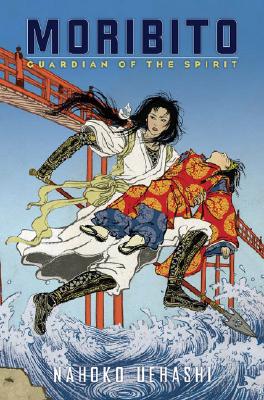
Moribito: Guardian of the Spirit

by Nahoko Uehashi
translated by Cathy Hirano
First sentence: “At the moment the royal procession reached the Yamakage Bridge, Balsa’s destiny took an unexpected turn.”
Sadly, it’s out of print.
Content: There’s some fighting and the main character is 30. It’s in the teen section of the library.

Balsa is a warrior woman, who is a bodyguard for hire. She saved the life of the Second Crown Prince — he had fallen into a river — which lead her to her most recent job: guarding his life because the prince — Chagun — is carrying the water demon egg inside of him. His life is in danger, partly because his father, the Mikado, is supposed to have descended from the gods, and having a son with a demon egg inside of him isn’t the best thing for public morale. And there’s also the Rarunga — the egg eater — who will do everything it can to stop the egg from hatching.

Okay, that sounds really weird, doesn’t it?

Honestly, though, it worked. It’s a good little fantasy, ripe with adventure and fighting, mysticism, a bit of friendship-turned-romance (but just a small bit), and a crazy old lady. It was kind of like reading a novelization of a manga; not terribly linear with the storytelling, but entertaining nonetheless. Not sure I would have ever picked this up without the class I’m taking (and because this was one of a very few on the reading list; not many works in translation for kids are in my local library) but I’m not sorry that I read it. It was fun, in the end.

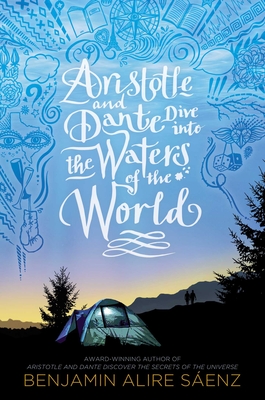
Aristotle and Dante Dive Into the Waters of the World

by Benjamin Alire Saenz
First sentence: “And here he was, Dante, with his head resting on my chest.”
Support your local independent bookstore: buy it there!
Others in the series: Aristotle and Dante Discover the Secrets of the Universe
Review copy pilfered off the ARC shelves at work.
Content: There is much swearing, including many f-bombs, teenage drinking, and some tasteful sex. It’s in the Teen section (grades 9+) of the bookstore.

Ah, Aristotle and Dante. I remember liking the first book when it came out, but not loving it. I’ve read Saenz’s stuff since then (like one other book?) And I have respect for his observations on life and living. This is no different.

Picking up where the first book left off, Aristotle and Dante are together, but because it’s 1987, they are not telling many people. Their parents, of course, but really that’s it. See, it’s dangerous to be gay in El Paso in 187. Dante got beat up, as do other characters for being too flamboyant, not “manly” enough. But Ari and Dante learn how to be together, Ari learns how to have friends and be a part of the group, they grw up and graduate, suffer loss, and basically Live.

It’s a beautiful book, full of Love of all kinds, full of Life and Heart. It’s gorgeously written; Saenz knows how to put words that Mean Something on a page. It’s probably a bit long, and the Tragic Event the back cover copy alludes to takes place nearly 2/3 of the way through. But, those re minor complaints. Saenz is a gorgeous writer and this is a gorgeous book.

When Dimple Met Rishi

by Sandhya Menon
First sentence: “Dimple couldn’t stop smiling.”
Support your local independent bookstore: buy it there!
Content: There is talk of sex, and a tasteful on-screen sex scene. It’s in the YA section (grades 6-8) of the bookstore, but it should probably be in the Teen section (grades 9+).

Dimple has one goal: go the the Insomnia Con, win, get her app idea out in the world, and go to college and be a successful developer. Her parents (her mother, really) has one goal: to get Dimple married to an Ideal Indian Husband. Rishi has one goal: to be a Good Son, and uphold the traditions of his family and culture. Therefore, he’s asked his parents to arrange a marriage for him (yes, he’s 18). The person they’ve picked? Dimple.

Rishi goes to Insomnia Con with the sole purpose of meeting Dimple and getting their relationship going. The problem? Dimple has no idea that her parents set this up. Needless to say: Dimple and Rishi don’t get started on the best foot. But, then, over the course of the six weeks of the con, they get to know each other, bring out the best in each other, and yes, fall in love.

It’s a silly Bollywood movie as a book: light, refreshing, fun (with musical numbers!), but with a serious underside that makes you think a little. I like how Menon is exploring and subverting Indian-American culture, all the the guise of a romcom. Both Rishi and Dimple are delightful characters, and their descent into love is a quick, but believable one. I’ve enjoyed Menon’s other books, and this one is no exception.

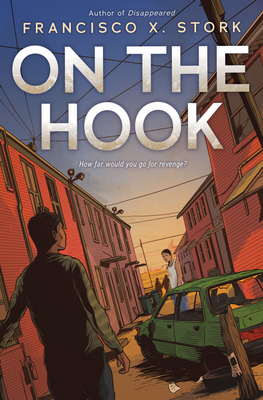
On the Hook

by Francisco X. Stork
First sentence: “Hector could tell that Ai wanted to discuss something.”
Support your local independent bookstore: buy it there!
Content: There was a lot of violence, and some talk of drug use and addiction. There is swearing, but in Spanish. It’s in the Teen section (grades 9+) of the bookstore, but I think it’d be good for younger kids as well.

Hector lives a very small life. His father passed away a few years ago, and he and his mother, brother, and sister are all trying to scrape by. They had to move from their home and into the projects, wher ethey live next to drug dealers, one of whom, Chavo, has a beef with Hector’s brother, Fili. Hector just wants to stay out of the way. But Chavo’s brother, Joey, seeks him out to intimidate and assault Hector, and gets into Hector’s brain. Suddenly, Hector is convinced he’s not a “real man”, and when Chavo and Fili get into an altercation (over a girl), both Hector and Joey do rash things and end up in the same juvenile rehabilitation center. Hector has to deal with feelings of hate and revenge, and learn to live with them.

I struggled with this one. Stork played into all sorts of Mexican stereotypes: drug dealers, macho men who can’t deal with feelings except by drinking or through violence, women who really don’t have a say and men who fight over them. Hector has embraced this toxic masculinity and struggles against it, but fails: he has determined that the only way to “balance” things is to kill Joey. I found myself loathing Hector as the book went on; he wasn’t a fun character to live with.

And I know there are always truth to stereotypes, and books need to be written about people who struggle with toxic masculinity and come through on the other side, which Hector did. (The one thing I did like: Hector and Joey never became friends. That would have been much too maudlin.) But that doesn’t mean it was fun to read.

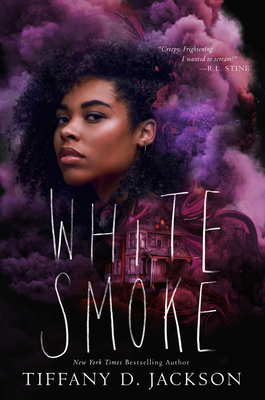
White Smoke

by Tiffany D. Jackson
First sentence: “Ah. There you are.”
Support your local independent bookstore: buy it there!
Content: There is a lot of swearing, including multiple f-bombs and some teenage marijuana usage. It’s in the Teen section (grades 9+) of the bookstore.

Marigold is looking for a fresh start. Or, at least that’s what she tells herself. She, her brother, her mother, and her stepdad and step-sister are headed away from California, away from Mari’s mistakes and moving to Cedarville for a fresh start. It doesn’t hurt that her mom got a residency there, with free housing. Except: Cedarville isn’t that great of a place. There’s something… off about it. Mari’s hearing sounds in the house. There are smells, and things go missing. Not to mention that every. single. other. house in the neighborhood is boarded up and decrepit looking. It’s all… very, very weird.

I think the mileage on this one depends on how horror-savvy you are. I’m not, so I found it spooky and intimidating and atmospheric. And I had to put it down often just to drop my anxiety levels. But, I suppose if you are the sort of person who likes horror and reads/watches it often, this one might not have the same effect. I did like that Jackson was exploring the idea of gentrification ad the impact it has on the (mostly black and poor) community. I also liked that she talked about unfair incarceration because of drug laws, and how those laws fall differently for black and white people. This horror story has some meat to it.

And then there’s the ending. Without spoilers, I’ll just say it’s kind of abrupt and weird. I wonder if there’s a sequel, because so much is unresolved. Or if Jackson meant it to be that way. At any rate, I found it a fun enough ride.

Audio book: Once upon a Quinceañera

by Monica Gomez-Hira
Read by Frankie Corzo
Support your local independent bookstore: buy it there!
Or listen at Libro.fm
Content: There are a number of swear words, including multiple f-bombs, teenage drinking, and one off-screen sex scene. It’s in the Teen section (grades 9+ of the bookstore)

Carmen Aguliar has one goal this summer: finish an internship so she can graduate high school. Except her internship is being an assistant for a woman who runs a knock-off Disney princess-for-hire outfit. And, she just hired Carmen’s ex-boyfriend from when she was 15. Who just happens to be behind the reason Carmen’s quinceañera got canceled and she and her mami fell out with her mami’s family. What was going to already be an unbearable summer gets even worse when the “Dreams” get hired to perform at Carme’s cousin’s quince. The same cousin that Carmen and her mami haven’t talked to in three years.

It’s a silly , light romance, one you can see coming from a mile off (lovers to enemies to lovers, gotta love tropes!) but it’s got some heart and soul to it. I liked the portrayal of Cuban-Americans in Miami. Spanish was effortlessly woven through, as was an exploration of stereotypes and expectations (or lack thereof) of Latine women. I adored the narrator; she made Carmen and her friends and family come alive in a way that made me want to keep listening.

Definitely a fun late-summer read.

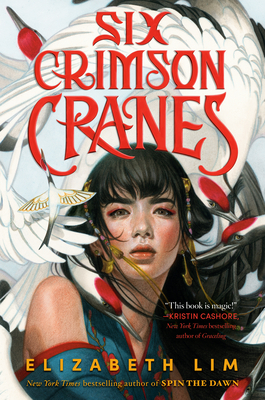
Six Crimson Cranes

by Elizabeth Lim
First sentence: “The bottom of the lake tasted like mud, salt, and regret.”
Support your local independent bookstore: buy it there!
Content: There is some violence. It’s in the YA section (grades 6-8) of the bookstore.

Shiori is the only Princess of the Kiata kingdom, the youngest of seven children of the Emperor. She’s basically a good kid, except she has a secret: she is magic. Which is a big deal in a world where magic has been banned. Oh, and she does NOT want to marry the person she is betrothed to. But when she discovers a secret about her stepmother, her six brothers are turned into cranes and Shiori is cursed: for every sound she utters, one of her brothers will die. She is then sent to the farthest reaches of the kingdom, and she has to find her brothers as well as her way back home. Along the way, help comes from the unlikeliest of sources: the same betrothed she was trying so hard to avoid marrying.

I’ve seen Lim’s work around; one of the teens in the teen review group at the store really liked her Spin the Dawn. And I have to admit: Lim has a way with fairy tales. It’s a grand fantasy, with dragons and magic and villains and double crossing, but it’s also, at its heart, a fairy tale, where the main character has growth and learns her lessons and all ends up happily ever after (mostly). Lim was able to keep me turning pages, pulling me in with her storytelling. It wasn’t heavy-handed, and I was genuinely surprised at the twists and turns it took (though I did suspect a few things, but I think we were supposed to). It was a really good story, and one where I am curious to see where it goes from here.

Maybe I’ll even go back and read her other duology, too.