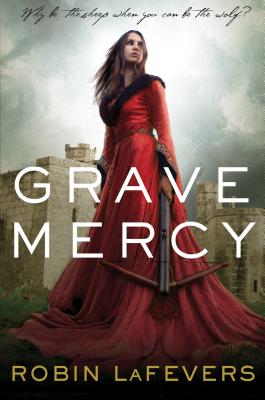
Grave Mercy

by Robin LaFevers
ages: 15+
First sentence: “I bear a deep red stain that runs from my left shoulder down to my right hip, a trail left by the herbwitch’s poison that my mother used to try to expel me from her womb.”
Support your local independent bookstore: buy it there!
Review copy provided by my place of employment.

I feel like I’m the last on the bandwagon with this; everyone seems to have read it already, and everyone seems to have loved it (including M who, 17 pages in, came to me and said, “This book is awesome.”). Thankfully, it was one that quite lived up to the hype.

It doesn’t hurt that it has a pretty cover (or a catchy tagline), either.

It’s Brittany, 1485, and Ismae, our fair heroine, has been married off (at the paltry age of 14!) by her abusive father to a hulking brute of a man. Consigned to her fate, she is surprised when a series of herbwitches and priests save her, sneaking her off in the night. She ends up at the convent of St. Mortain, one of the old gods, where they worship Death.

And train the girls who are brought to them to be assassins.

Three years pass, and Ismae is ready to be sent off on assignments. She performs well, and so is thrown into something more grand and complex: court politics. She is sent off to keep an eye on Gavriel Duval, adviser to Anne, duchess of Brittany. Ismae is supposed to pose as his “cousin” (*coughcough*), and keep an eye on him; if he turns out to be a traitor, as the abbess and Count Crunard, a patron of the convent, suspect, then she is to kill him.

However, once there, Ismae discovers that court politics — as well as her heart — are much more complex than that.

I realized about 30 pages in that if Marion Zimmer Bradley’s Mists of Avalon and any Phillipa Gregory book had a love child, this one would be it. There is court intrigue, romance, fights, horse chases, desperate situations, historical trappings, sweeping European settings, all covered in a sheen of mysticism that makes everything sparkly.

In other words, quite awesome.

Stupid Fast

by Geoff Herbach
ages: 14+
First sentence: “This could be a dark tale!”
Support your local independent bookstore: buy it there!

I will say this up front: in spite of what you might think judging from the title and the cover, this is not a football book. Sure, the main character, Felton Reinstein, gets drafted to play football (which he hasn’t the first clue about), football actually plays a real minor role.

It is, however, a guy book. In fact, that’s the best thing about this book. Herbach knows guys, and gets the voice down: his sweatyness, awkwardness, quirks, confusion, lusts, and cluelessness scream 15-year-old Guy. Additionally, it works because Felton is so dang likeable. Even in his guyness, you want to know this kid.

It’s the summer before Felton’s junior year. He’s about to turn 16, and his growth spurt (starting around Thanksgiving) has finally hit him: he can’t keep up with his body. That said, he’s, well, stupid fast. Which means he can actually do things in the sports arena, something which he never could do before. He almost beat the track star before nerves got to him. And so, he gets recruited to play for the football team. He has no idea what he’s doing, but it feels good to get out and work his body out. Especially since his home life has been falling apart at the seems.

See, his dad killed himself when Felton was five (Felton had the unfortunate experience of finding him), and his mother, Jerri, has been holding it together. Until this summer: now she’s slowly falling apart. Well, maybe not so slowly. She went from loving mom to calling Felton a jerk and a f-bomb-er, and spending her days in a dark room watching TV and sleeping. Felton has a way out, but his younger brother Andrew is suffering.

It sounds dark, but trust the first sentence: while it’s tackling some tough issues, it never becomes an issue book. It’s really just about Felton and his ability (or lack thereof) to deal with all the changes in his life. The ending does wrap things up a bit nicely, but instead of being happy, it’s more hopeful: that maybe Felton, in spite of all the crap around him — because, after all, he’s a nice guy — will will make everything work out for the best.

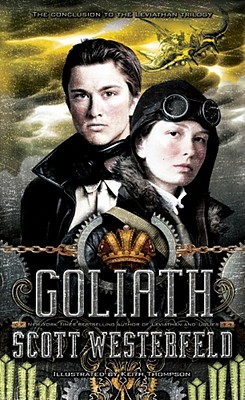
Goliath

by Scott Westerfeld
ages: 12+
First sentence: “‘Siberia,’ Alek said.”
Support your local independent bookstore: buy it there!
Others in the series: Levithan, Behemoth

When we last left our fair heroes, Deryn and Alek, they had helped the revolution against the Ottoman Empire succeed, and prevented them from entering the Great War. Now the crew of the Leviathan is headed for Siberia, to pick up some unusual cargo — inventor Nikola Tesla, who claims that his invention, Goliath, can bring the Great War to an end, once and for all.

Of course, there’s still the problem of Deryn being a girl and Alek thinking she’s a boy, and plus she’s in love with him and he’s a prince and she’s a commoner. So, of course, there will be stickiness when he finds out.

Like the previous two books, Goliath is many things all at once: action-packed, filled with battle scenes and daring escapes and cool contraptions; gorgeous, with Keith Thompson’s art elegantly complimenting Westerfeld’s words. I have to admit flipping through the book to look at the pictures, just so I can see them before reading the words so I can figure out what the heck is going on. It’s a bit of a love story this time around as well, and even though Westerfeld doesn’t have the swoon-worthy prose of, say, Maureen Johnson, he does fairly well keeping a balance between Deryn and Alek’s friendship and their budding love. (Though I have to admit here that one of my favorite characters was Alek’s perspicacious loris, Bovril. He was awesome.)

It has a wider scope than the previous two books, as the Leviathan basically circumscribes the world, going from Siberia to Japan to California through Mexico to New York. It’s almost as if Westerfeld felt like he couldn’t leave any part of his new steampunk world untouched. It kind of felt forced, though I do get the historical implications; he was, after all, just following the path that the actual World War I took.

Even with that criticism, it was wonderful to follow Deryn — who is really one of those awesome, cool, capable heroines you just have to cheer for! — and Alek’s — who has really grown on me over the trilogy — story come to a good end.

And you can’t ask for more than that.

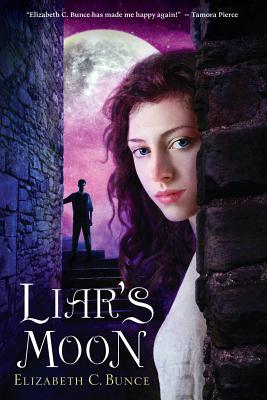
Liar’s Moon

by Elizabeth C. Bunce
ages: 14+
First sentence: “I’d have gotten away if that little guard hadn’t cracked me in the eye.”
Support your local independent bookstore: buy it there!

When we last left our fair Digger/Celyn (if you really don’t want spoilers for Starcrossed, you ought to read that one first and then come back), she had survived the winter snowed in at a remote mountain castle, and helped rescue a prince and incite a rebellion against the ever-increasing militant state of her country and town. Now she’s back in Gerse, doing what she does best: thieving. She never expected to get caught, let alone thrown in jail with Lord Durrell, who’s in there as the main suspect in his wife’s murder. Digger gets enlisted to do the other thing she does best — digging — in order to prove Durrell’s innocence. Along the way, she finds herself in possession of more than one secret she wishes she didn’t have. Ones that people may do everything in their power to keep hidden.

Much like the first book in this series, it’s easy to get lost in Digger’s world. For starters, she’s a fascinating, complex character, full of both flaws and virtues. She’s smart, clever, and strong, as well as loyal enough to go out on a limb for her friends. It’s amazing to sit back and watch her do her stuff.

In addition, this one reads like a historical fantasy mystery novel: if Durrell is innocent (and is he really?), who did kill his wife? And what about all the mysterious goings on with both Durrell’s family as well as his wife’s family? Not to mention the rebellion… The book has a different feel than Starcrossed — grittier is the first word I can think of — and yet is just as rich and engaging and thrilling (and full of swoon-worthy heroes, though I missed Prince Wierolf) as the first book. (Though you do need to read Starcrossed before you read this one. Then again, why wouldn’t you?)

And then there’s the twist at the end: some you saw coming, but the very end… completely out of left field in a most delicious way. I can’t wait to see what Bunce does next with Digger and this world.

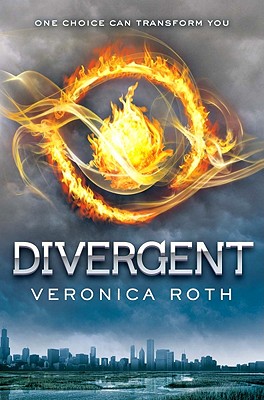
Divergent

by Veronica Roth
ages: 14+
First sentence: “There is one mirror in my house.”
Support your local independent bookstore: buy it there!

In what used to be known as Chicago in this post-apocalyptic world, humanity is divided into four factions, each devoted to developing a particular virtue: Candor, the honest; Erudite, the intelligent; Amity, the peaceful; Dauntless, the brave; and Abnegation, the selfless.

Beatrice has grown up in Abnegation, but doesn’t quite feel she fits. She’s not as selfless as her parents and brother, she’s always questioning her own inner motives. She sees kids from the other factions and wonders if she wouldn’t fit in better there. Then, at age 16, she is given a test and the opportunity to stay with her faction or choose another one. And she discovers that she’s Divergent.

We spend most of the book wondering, along with Beatrice — who christens herself Tris after she joins Dauntless — what the heck Divergent is. On one level, this is annoying; but by the end, when it all makes sense and you realize that the timing was perfectly right for it, all is forgiven. It’s an intense book and a violent one, as we follow Tris through her brutal training to join the Dauntless faction. As she goes through the training, Tris discovers two things: that the people in the factions — including her birth faction — aren’t nearly as altruistic as they proposed to be. And that romance can blossom in the oddest places.

There will be inevitable comparisons to The Hunger Games (it’s really a good book for those who love Hunger Games and are wondering what to read next): there’s a society that’s become corrupt, and a girl who doesn’t fit the norm who has the potential (yes, there is a sequel, at least) to change that society for the better. Though Tris is a more active and less selfish heroine than Katsa was, which makes her more interesting in my book. It’s less black-and-white, and more complex; Roth does an excellent job balancing the good and bad in every faction, providing us with not only the worst, but also both the best and the human in human beings.

It’s compelling and engrossing storytelling as well, with a little bit of everything — romance, politics, action, tension — for everyone. An excellent start to a good new series.

Lola and the Boy Next Door

by Stephanie Perkins
ages: 14+
First sentence: “I have three simple wishes.”
Support your local independent bookstore: buy it there!
Review copy provided by an ARC sent me from the amazing A Jane of All Reads

I need to say, first off: I completely and totally regret what I wore to my senior prom. It was white, it was totally late-80s, and it was completely forgettable. What I should have done was be daring (like Lola, who wants to attend her mid-winter formal as Marie Antoinette) and completely memorable.

So, one of my favorite things about this book was all the costume changes that Lola went through. I never knew what she was going to wear, and somehow, that made the book that much more enjoyable for me.

The plot is pretty simple: Lola and Cricket used to be neighbors. Then they were more than neighbors. And then he moved away because his family is pretty invested in following his sister Calliope’s dream of being an Olympic figure skater. But before that happened, he hurt Lola, so she’s spent the last two years trying to forget that Cricket ever existed. It’s worked so well, that she’s happily in love with Max, who’s a punk rocker and (gasp) five years older than she is (she’s barely 17). Then, one day, Cricket (and his family) move back in. Lola figured she was over him, but she didn’t count on him not being over her.

Second thing I adored about this book: Cricket. Seriously. He’s nice. No: he’s wonderful. Swoon-worthy, geeky, genius, awkward, and much, much too good for Lola. It was an interesting twist having the guy be the “good” one, the one that Lola has to aspire to “deserving”. (I find it’s often the guys who are the cads, but in many ways Lola is in this book.) At first she pushes Cricket away, but eventually realizes that she still has *feelings* for the boy next door.

I found, in this book, that it was the little things that made it enjoyable. Anna and St. Clair are back, and even though they only play a small role, they light up the pages they’re on. Lola’s two dads are also a delight: it’s nice to have a gay couple shown as stable and loving without making a big deal about it. (Additionally: they’re great characters in their own right.) That said, I still have issues with True Love (always have, always will) and this one is all about finding and recognizing True Love, but it wasn’t enough to get in the way of me thoroughly enjoying this book.

Perhaps it comes down to the awesome Marie Antoinette dress after all.

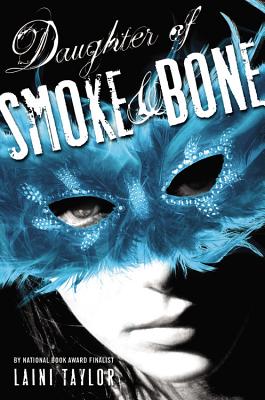
Daughter of Smoke and Bone

by Laini Taylor

ages: 14+

First sentence: “Walking to school over the snow-muffled cobbles, Karou had no sinister premonitions about the day.”

Support your local independent bookstore: buy it there!

Review copy provided by a friend of a friend who got it from the publisher.

Release date: September 27, 2011

As an art student in Prague, 16-year-old Karou tries to keep up the appearance of a normal life. Except her life (not to mention her azure hair and myriad of tattoos, including the hamsa eyes on her hands) is anything but normal. She lives with a group of monsters called chimera, who have been her family for as long as she can remember. She runs errands for her father-figure, Brimstone, collecting teeth. It’s a lonely life, but she finds comfort in knowing that while she has many unanswered questions about who she is, she has a family (of sorts).

And then things take a turn for the, well, interesting. The seraphim — other beings from the same world as the chimera — attack Brimstone, closing all the magic portals in our world. As they are doing this, one of them, Akiva spots Karou and is inexplicably drawn to her.

There is more to the story, obviously, but it’s best left for you to discover on your own. I will say this: I adore Taylor’s storytelling. It’s dark and sinister and yet so very lovely all at the same time. It’s a twisting, meandering sort of story, and yet nothing superfluous or out of place. Her characters are captivating, drawing you in with humor and affection; you can’t help but love Karou and all the people she loves in her life. (As M said when she finished: “I want to be an art student in Prague and have blue hair.”) Added to that, Taylor plays with fantasy and religion and myth in wild, fascinating ways. Yes, there are angels and monsters in this book, but in playing around with themes of tolerance and prejudice — there’s a war going on between the chimera and the seraphim, and Karou is, for many reasons, caught in the middle — Taylor takes the simple myths, and mythological creatures, to a new, higher level.

The only quibble I have — and it’s not really much considering this is the sort of haunting, beautiful story that will stay with you for a long time — is that while the story comes to a natural stopping point, it doesn’t fully resolve (infuriatingly!). Which means, we’ll need to wait until Taylor’s imagination works its wonders again, and she comes out with a sequel. Which is sure to be as wonderful as everything else Taylor writes is.

Anna and the French Kiss

by Stephanie Perkins
ages: 14+
First sentence: “Here is everything I know about France: Madeline and Amélie and Moulin Rouge.”
Support your local independent bookstore: buy it there!
Copy given to me by the lovely Vasilly

So, this one has been getting a lot of hype, all of it saying how wonderful, how great, how supremely perfect this was.

M, when she finished it said, “Well, that was cheesetastic. Good cheese, but so cheesy.”

The basic story: Anna Oliphant is the daughter of a Nicholas Sparks-type author, who, not wanting to be outdone by all his Posh Hollywood Friends, ships Anna off to a Posh boarding school in Paris. (Oh noes.) She doesn’t know a lick of French, doesn’t want to leave her comfortable life in Atlanta, doesn’t want to leave her blossoming almost-relationship with Toph. But, to Paris she goes.

Where she bumps into — literally — Étienne St. Clair.

(cue dreamboat music)

What ensues is a lot of romantic push-and-pull. Anna obviously St. Clair, but she has a double problem to deal with: he’s got a girlfriend though she’s kind of out of the picture, and Anna’s friend Mer likes him as well. Then there’s the question of whether or not St. Clair likes her? Sure, they’re friends, and they hang out all the time. But does he like her?

(Because, you know, we ALL want to know that.)

That’s not to say this is a bad book: it’s predictable, sure. But I did enjoy the relationship between Anna and St. Clair, it’s heights and valleys, and it’s inevitable, swoon-worthy resolution. It’s not a simple book, and much like Maureen Johnson’s work, Perkins knows how to write a romance that deals with more even while putting the relationship front-and-center.

Update, 2018: I can see how I thought it was cheesy, but for whatever reason (time, place, etc.), I found it to have a lot more depth this time. There were themes about communication and assumptions that touched me, and a reminder that while my children are my responsibility, they are also their own people with their own dreams, and it’s not up to me to control their lives. Also: I missed the subtext that Americans really can be awful (en masse) the first time around. Still a very good book.

Not perfect, b I ut delightful.

Audiobook: The Wee Free Men

by Terry Pratchett
read by Stephen Briggs
ages: 9+
Support your local independent bookstore: buy it there!

I first read The Wee Free Men two years ago, and thoroughly enjoyed every bit of the time I spent with the book. It’s hilarious, adventuresome, cool, and Tiffany Aching, even when she’s just 11 years old, is a force to be reckoned with. There’s a power in her, a determination. I love that in this world, all it takes to be a witch is powers of observation and the knowledge that you’re the only one who can do anything about the situation.

There’s magic, of course, but it’s not flashy magic. It’s quite, subtle, and still there, even after you know how it’s done.

That said, I loved hearing this book read aloud. Even more so than when I read it. It’s fine reading it and all, but nothing — nothing! — is funnier than someone doing a spot-on Scottish accent for the Nac Mac Feegle. And the voice for Toad? So deadpan, so hilarious. I laughed. So hard. Often. And I actually got the section near the end when Tiffany goes up against the Queen; something which I remember eluding me when I read it. Perhaps because listening to it means I go through things more carefully than when I read them? Whatever it is, listening to the audiobook made this books so much more loveable and enjoyable than it already was.

Which means, of course, that I’m going to have to listen to the rest of the Tiffany Aching books.

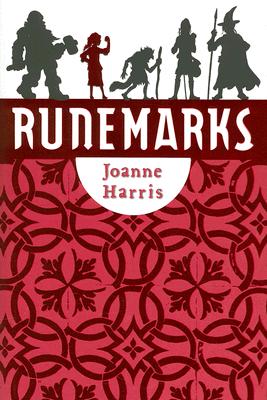
Runemarks

by Joanne Harris
ages: 14+
First sentence: “Seven o’clock on a Monday morning, five hundred years after the End of the World, and goblins had been at the cellar again.”
Support your local independent bookstore: buy it there!

Maddy Smith is basically a nondescript resident of the small village of Malbry in the Middle Worlds. Except for the runemark on her hand, which brands her a bit of an outcast, but she doesn’t pay that much attention. She has no friends, except for a wandering traveler that goes by the name of One-Eye whom she only sees once a year at Harvest time.

Then, one day when she’s fourteen, her world shifts: all the things she’s been taught to believe about the Order and the Word — the religious organization that rules the Middle World — are put into question. The End of the World was just a new beginning, and there are powers she has that she never knew. One-Eye sends Maddy on an adventure that will lead to a new end and a new beginning for everyone.

If that sounds really confusing, don’t worry: it is really confusing to summarize this huge, 521 page, fantasy. It’s based on Norse mythology, something which I found fascinating, and is quite impossible to summarize. It’s a sprawling fantasy, in the Grand High Fantasy style: adventure, twists, turns, multi-perspectives, and even a somewhat confusing ending. It’s got it all. Maddy is an interesting main character to follow through the world; she ends up being a very powerful character, but because of her age and innocence, she’s not quite in tune with all the subtleties of the world. It helps guide the reader through some complex mythology and relationships between the old gods which helps with the flow of the book. It takes a while to sink into the rhythm of the world, and the pacing of the novel, but once the adventure truly gets underway it’s enough to keep you involved and interested.

It also felt very Neil Gaiman-esque. I can’t quite pinpoint why: perhaps it’s because it’s so sprawling, or perhaps because it’s just got that dark, gritty undertone that Gaiman is known far. Whatever the reason, it reminded me of Gaiman’s work, which is never a bad thing.

That said, I don’t think I truly loved it. It was interesting, and I’m glad I read it, but it was lacking that spark to make it truly great.