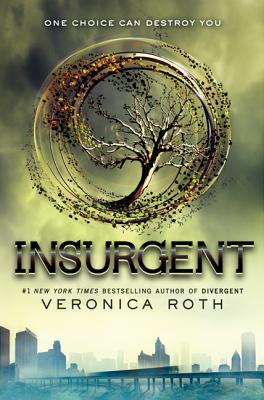
Insurgent

by Veronica Roth
ages: 14+
First sentence: “I wake with his name in my mouth.”
Support your local independent bookstore: buy it there!
Others in the series: Divergent

(Warning: if you haven’t read Divergent, go do that now. There will, obviously, be spoilers for Divergent in this review.)

Tris, Tobias and their friends are on the run. After successfully — sort of — stopping the Eurdite faction and their plan to exterminate the Abnegation faction, and the city government, they’re hiding out, regrouping. Their faction, Dauntless, has all but dissolved: half have defected to Eurdite, basically becoming their thugs, the other half is hiding out in the Candor faction. Then there’s the “factionless”: those without a place to belong. In this fight which pits Knowledge and Brawn against Truth and Selflessness, it seems those whom everyone has been ignoring are suddenly quite important.  But the important thing is this: Tris and Tobias (and their friends) make their way through most of the factions, assessing and trying desperately to figure out what Jeanine (the leader of Eurdiate) wants so badly with the Divergent, so badly that she will kill for.

The action picks up immediately where Divergent leaves off which is both a strength and a weakness. A strength because for this story, there isn’t a need for months in between plot lines. The action is too intense, too immediate for that. And Roth finds a way to build on the ideas of Divergent, taking the plot lines in intriguing directions. The weakness comes if you, like me, haven’t read Divergent immediately proceeding. Roth wastes no time on exposition, no time on explanations: if you don’t know what’s going on, tough luck.

That said, she does weave bits of information into the chapters, enough so that I was able to remember the basic story of Divergent by the time I was half way through. (It’s just getting to that point!) But, eventually, this story kicked in, and I no longer needed past information — admittedly, I did get tired of Tris and Tobias’s clandestine smooching, which lacked both intensity and passion — to carry my interest. The story is very much a middle-of-a-trilogy: things need to happen, pieces need to move, revelations need to come out (though, honestly: I felt the Big Reveal was a bit forced), in order for the story to move forward. There’s a lot of running around from faction to faction (on the plus side: you get to see the insides of all the factions), recruiting people, trying to understand what the Ultimate Purpose is here. Much like Katniss, Tris spends the book trying to recover from Bad Deeds She Did, though she’s a much more pro-active character than Katniss is. However, everything seems too cut-and-dried, too much like jumping through hoops. I wanted there to be more surprises. (There were a few; Roth, I think, revels in making characters who will do both “good” and “bad” things, within the space of a few chapters.)

I’m not sure it’s as good as Divergent was, but since it left us on a bit of a cliff-hanger (Roth does know how to write an ending!), I’ll have to leave my ultimate judgement until the next book comes out.

The Girl of Fire and Thorns

by Rae Carson
ages: 13+
First sentence: “Prayer candles flicker in my bedroom.”
Support your local independent bookstore: buy it there!

Elisa is the younger sister in the royal family of a smallish country. The only thing that marks her as different is that she’s the bearer (the first in a century) of the Godstone, a jewel in her navel. She has no idea what her “service” is supposed to be, but she does know that it will require something of her.

So, when she’s married off to a king of an adjoining country on her sixteenth birthday, she figures it’s the first step in her destiny.

Little did she know what that would mean.

There really is so much to like about this book. It does start slowly; Elisa with her eating issues and insecurities are quite hard to like. But, as the book goes on, she warms on you: it’s truly a book about growth, about Elisa figuring out how to come into her own. And it’s a pretty amazing journey. I enjoyed that the book was religious in its own right. Elisa sees herself as a servant of God, and there’s some interesting implications and conflicts that arise from that belief. It’s a richly detailed world, Spanish-influenced, but one in which the world doesn’t overpower the characterization, a remarkable feat in itself.

I also have to admit (slight spoiler here) that I’m happy that while there is a bit of romance (she does get married in the opening chapter, after all), Elisa manages to find a way to be strong and self-assured without having to be on the arm (or in the arms) of some boy. Sure, she’d like to be desired, but in the end, a boy is not necessary. Good message, that.

All of which means I’m quite interested to see what Carson comes up with next.

Reread: The Hunger Games

by Suzanne Collins
ages: 12+
First line: “When I wake up, the other side of the bed is cold.”
Support your local independent bookstore: buy it there!
Others in the series: Catching Fire, Mockingjay

I caught the Hunger Games hype early (not as early as some, but earlier than others), reading it a few months after it came out. And because I did, I mostly just linked to others’ reviews, and gave you my thoughts. I haven’t picked the book up since then (though I did read the other two), though I did go see the movie the weekend it came out with C and M.

Then, it was our choice for our mother-daughter book group, and we decided to go with this one. I couldn’t pass up the chance to read it again.

First off: it lives up to a second reading. (I was actually worried about this.)

So, if you have been living under a rock, the basic plot is this: it’s sometime in the distant future, and the US has dissolved into a country with a capitol and 13 districts. Then, at some point, the districts rebelled against the domineering capitol. Except that they were defeated — the 13th obliterated — and the other 12 were made to give one girl and one boy as “tributes” to the Hunger Games: a contest of survival, where the winner is the last one left alive.

Katniss lives in the poorest of the districts, 12, and she’s making it by. Her father was killed in a mine accident, and she’s been single-handedly keeping her family — her mother, and her younger sister, Primrose — alive. So, when at the Reaping (when they choose the tributes), Primrose’s name is called, Katniss does the only thing she can do: volunteer to go in Primrose’s place. She’s off to the 74th annual Hunger Games.

I’ve heard Katniss called a strong heroine, and after this reading, I’m not sure I agree. Don’t mistake me: she’s a survivor. She will do anything to make sure she keeps herself, and those she loves, alive. It’s her sole purpose in life. But I’m not sure she’s a strong character, someone who takes charge, who’s proactive about herself and her future. No, she’s more a reactive type, someone who deals with situations thrown at her. Which isn’t bad, but that doesn’t mean she’s strong, in the typical sense.

The second thing I thought of is that all the hype about Team Peeta and Team Gale is really quite misguided. Sure, there’s romance, but really: Katniss is too busy surviving to really pay much attention to the boy, and while we think Peeta likes her, we’re getting everything warped from Katniss’s point of view. I like those who say they’re Team Katniss, because honestly: there’s just too much going on in her world for her to spend time on a luxury as romance.

But, overall: worth the reread. It’s still a book I’d recommend to people, as a commentary on reality television, on the hoplessness of war. It’s tight, action-packed, and still unputdownable. And you can’t beat that.

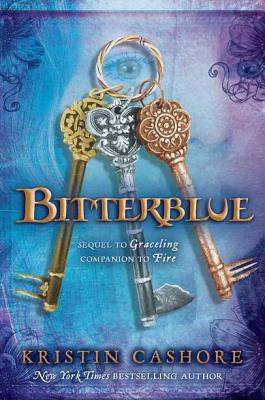
Bitterblue

by Kristin Cashore
ages: 13+
First sentence: “When he grabs Mama’s wrist and yanks her toward the wall-hanging like that, it must hurt.”
Support your local independent bookstore: buy it there!
Others in the series: Graceling, Fire

First: If you haven’t read Cashore’s previous two books, you should. Seriously. Like, right now.

I’ve been waiting three years for this book. Three years of following Kristin Cashore on her blog, waiting patiently, hoping that Bitterblue will be as wonderful as Graceling and Fire are. So, obviously, my expectations were high.

It’s eight years after the death of Bitterblue’s (completely insane, cruel, wicked, evil, horrible, terrible, there-isn’t-a-word-strong-enough-to-describe-his-atrocities) father’s (justifiable) murder. She’s been queen since she was 10, surrounded by advisers that her uncle (the king of Lienid and Po’s father) picked. She’s been moving paperwork, treading water. And now, she’s beginning to wake up, for lack of a better word. She wonders what goes on outside of her castle, and starts sneaking out at nights. There she learns that she’s not the only one who is having trouble putting Leck’s atrocities behind her. It’s all over the kingdom: her people are not well people, and those who are searching for truth are being harassed and murdered. However, realizing this is not the end of the story: it’s only the beginning. This book is very much one of healing, of getting past a tyrant (a mild way to put it) and his terrible past, and finding a new path of Truth and Justice, while acknowledging that the abusers were in so many ways victims, too.

When I logged that I read this one on Goodreads, I started scrolling through the reactions of people there, and I discovered two things. One: you’ll either love or hate this book. Two: It seems to me that the complaints boil down to just a couple things.

First: there isn’t enough Katsa and Po, and they’re different. True, Katsa and Po aren’t the main characters of this book, but they do play a role. (Also: of COURSE they’ve changed. It’s been eight years people!) In fact, sometimes I felt that Po was too much of a fallback for Bitterblue, and I was actually glad the times in which he wasn’t around, and Bitterblue was forced to do things on her own. That said, there are really two storylines going on here, and our heroes from Graceling do play a major part in the second one. Also: Bitterblue’s romance isn’t full of chemistry, but is rather a slow one, in which they are friends first. However, it’s also not one that can go anywhere. That said, my favorite character was Giddon. I don’t remember him well from Graceling, but I adored him in this book. He was such a rock, such a kind, good-hearted individual, that I couldn’t help like him.

Which brings me to point number two: Cashore is so heavy on women that she doesn’t cut men a break. (Though one person said they didn’t like the way Cashore treated women, and to that I have no answer… REALLY?) I don’t understand this. There are strong women in this book, strong men and weak men and traitorous women. It’s all there. One of the things I think Cashore does best is portray the spectrum of human possibility: it’s possible for people to lie for good reasons. It’s possible for people to be in love and fight. It’s possible to trust people and then be betrayed. It’s possible for healing. It’s possible to find good women and men to surround oneself with.

Complaint three: it’s long, boring, complex, confusing. Well, yes. I think that’s done on purpose: Bitterblue is confused — warped by her father’s actions, which still have a hold on her, her advisers, and the country — trying slowly to work things out, and we see events through her eyes and memory. It’s not an easy process, and therefore to have a straightforward book would not do Bitterblue and her story justice. It’s very much like Chime in this: Bitterblue is not always the most reliable narrator, because she doesn’t have all the pieces, but to tell the story any other way would lessen the impact of the revelations at the end.

I’ve blathered on too long. The short version of all this: Bitterblue is excellent. One can only hope that Cashore doesn’t take three years writing the next book. I need her stories.

Spell Bound

by Rachel Hawkins
age: 12+
First sentence: “There are times when magic really sucks.”
Support your local independent bookstore: buy it there!
Others in the  series: Hex Hall, Demonglass

I suppose it’s typical, but honestly: Sophie Mercer just can’t catch a break. Then again, when you’re 17, a demon (though not currently in possession of her powers), and facing down some of the most evil people on earth (the problem is that they always think they’re right), then there’s not many breaks to be had.

Then — after she discovers that her mother isn’t really who she thought she was (sounds creepy, but it’s not) — she mysteriously gets transported back to Hex Hall (thankfully, with BFF, boyfriend, fiance, and ghost-friend) to face down the evil demons once and for all.

There really isn’t much to be said about this one that I already haven’t said about the other two.

Swoon-worthing kissing? Check.
Snark? Check.
Awesome magic fighting? Check.
Cool vampire BFFs? Check.
Creepy ghosts? Check.
Kick-butt heroine? Check.

And a great way to end the series, as well. Hawkins wrapped everything up nicely, put a bow on it, managed the love-triangle thing without getting all weird on us, and gave us some fun, magical nonsense in the process.

What more can you ask for? Nothing.

Demonglass

by Rachel Hawkins
ages: 12+
First sentence: “At a normal high school, having class outside on a gorgeous May day is usually pretty awesome.”
Support your local independent bookstore: buy it there!
Others in the series: Hex Hall


When we last left Sophie, she had figured out who was killing off the witches, but not in time to save Elodie, one of those popular girls/dark witches. (She wasn’t exactly the nicest person around, but she didn’t really deserve to die…) Oh, and she discovered that Archer Cross, love of her life, was actually a member of L’Occhio di Dio (aka, The Eye, an organization that’s out to eradicate the world of Prodigium), and they can never see each other again. In other words: life sucks.

So, how about summer vacation in England? (That makes everything better, right?)

She finally gets to meet her demon/warlock/powerful dude dad, who comes to Hex Hall to take Sophie away from the frying pan and into the fire. Sure, they place they’re staying (Thorne Abbey) is huge and gorgeous and English, but there’s trouble brewing. There are two demons staying at the abbey, which means someone is “breeding” them. Then, there’s an attempt on Sophie’s life. And, to make matters worse, Archer saunters back into her life. Just when she thought she was getting over him, and learning to like the guy she’s betrothed to (don’t ask), Cal.

This book is just as full of smart, magical nonsense as Hex Hall was. And I’ll have to add Hawkins to my list of people who know how to write a kiss, because there were some seriously swoon-worthy parts of this one. They are snarky fun, books that are meant to be read in one sitting, engrossing and hilarious, with pretty wicked twists and turns.

Awesome.

Blood Red Road

by Moira Young
ages: 15+
First sentence: “Lugh got born first.”
Support your local independent bookstore: buy it there!

This one took a while for me to get into. In fact, I read the first quarter, then put it down for a good week before picking it up again (and then, only because I didn’t want to return it to the library unread — since I had already started it — and I couldn’t renew it). But, once I got halfway through, I was in, hook, line and sinker.

It’s the future, and because of some undetermined event, the world as we know it has dissolved into chaos. Saba and her family, twin brother Lugh and little sister Emmi along with their father, live out in the middle of nowhere, going nowhere, basically existing. That is, until four men come and forcibly take Lugh away. Well, that doesn’t sit well with Saba, so after her father dies (which is pretty much right away), she takes Emmi and heads off to get Lugh back. Actually, she tries on several occasions to ditch Emmi, but the little girl is tough and won’t be left behind.

The world they discover is not a happy place. They spend a month in Hopetown where Saba is a cage fighter (which is as grim as it sounds), before they manage to escape. From there they have to make it to the hidden valley in the mountains where the king (who is certifiably insane) has Lugh hostage, preparing to kill him as a human sacrifice on midsummer day. Which, by this point, is right around the corner.

It’s a tough book to get into — there are no quotations marks, and it’s written in dialect, which always throws me for a loop — but I have to admit that Young knows how to write action (there are many intense moments) as well as romance (seriously). She’s given us a strong reluctant heroine, someone who leads without knowing it, inspiring greatness in both herself and those around her.

All of which makes me curious to see where Young is going to go in the next book.

Hex Hall

by Rachel Hawkins
ages: 12+
First sentence: “Felicia Miller was crying in the bathroom.”
Support your local independent bookstore: buy it there!

Back in the fall, I was invited by the lovely Laura at A Jane of All Reads to participate in a book group. We read YA books, snark quite a bit, and then post about it on our blogs (so you all can be jealous?).

This month was mine to be Keeper of the Book, and the one out of my nominations that was chosen was the “smart magical nonsense” of Hex Hall.

So: the basic plot for those of you with your heads under rocks…. Sophie Mercer is a witch. She’s been raised for the past 16 years by her human mom, but after a prom night gone bad (don’t ask), she’s shipped off to juvie for Prodigium (that is: fairies, witches and shapeshifters): boarding school Hex Hall. There, she makes a best friend in Jenna, her pink-loving vampire roommate; develops a wild crush on the hottest warlock on campus, Archer Cross; makes enemies of the only other dark witches (read: the popular girls); and eventually crosses paths with a demon. Part boarding school story, part teen crush, part mystery, and all sorts of awesomeness, Hex Hall is quite the fun read.

This is what the three of us who read it (and Demonglass and Spell Bound) had to say about it (spoilers, obviously, ahead):

Me: So… I’ve finished both Hex Hall and Demon Glass, and I’m trying to figure out a way to get Spell Bound without having to buy it (if I can find one of the two copies we’re supposed to have it at work, I’m going to check it out there). So, if y’all want to start discussing any (or all?) of the trilogy, be my guests. 🙂

Sya: I have it on my kindle and plan on reading it before the hex hall discussion.

Donna: I’m almost done with mine. I’m ambivalent. I’m entertained but I’m not blown away by it or anything…. Just finished and read the teaser for the next book. If there’s more Cal, I may read on. He’s awesome. Overall the whole book reminded me a bit of Mari Mancusi’s titles in tone and voice but not as satirical. Entertaining but still not blown away. Did like the ending though.

Sya: I think that that’s kind of the point – it’s solidly entertaining without being even remotely challenging. And yes, there’s quite a lot more Cal in book two and he’s particularly swoonsome on a regular basis.

Me: I agree with Sya: it’s good, fluffy, magical chick-lit. I don’t think it’s supposed to blow you away. And I agree, too, Donna: the ending was quite good. Did you see any of it coming? Also: what think ye about the love triangle nonsense (it develops more in book 2)?

Sya: I think the love triangle is a bit of a non starter… It’s not been played up as that much of a plot point as far as I can see (I’ve just started the third book) so far.

Melissa: Oh, good. Actually, I was worried about that (in the third book); I didn’t want it to become your typical YA-we-can’t-just-have-one-love-interest thing.

Sya: I really am right at the beginning of the third one so out could come into play. Will keep you posted.

Me: Thanks! (I really do need to get my hands on that one…) I have higher hopes than mediocre YA tropes for it.

Donna: I saw the big baddie ending up being someone close to Sophie. I just didn’t have it pinned down as who. As for Alice, she didn’t sit right although I didn’t see the entire thing coming. It’s not too often I see something coming full force. When I do then it’s really bad! I didn’t even realize there was a love triangle, unless you count Elodie-Sophie-Archer. And I found it slightly hypocritical of Archer to rank on Sophie’s name for the ‘ie’ when he’s dating the Cliff Notes version of Melodie.

Sya: I kind of figured that Alice didn’t have the best of intentions but I was still taken aback by the ending and liked the way it set things up for book two. On the love triangle front, it’s a bit more prevalent in the third book but still in a sort of background way and doesn’t detract from the rather exciting and sinister story.

Me: Donna: “And I found it slightly hypocritical of Archer to rank on Sophie’s name for the ‘ie’ when he’s dating the Cliff Notes version of Melodie.” HA! I totally agree. Sya: Rather exciting and sinister??? I need to find that one.

Sya: I just finished it. I thought it was completely awesome – such a lot of fun and actually even a wee bit moving in places. Great way to end the series.

We kind of got off-topic there. Back to Hex Hall…

Sya: I’m not quite sure what thread I should be posting my Hex Hall thoughts so I’m jumping in here. I thought the book was great. I read it for the second time for this discussion and followed it up with the second and third in the series. And I really enjoyed the whole lot. Sophie is a fun and believable protagonist, pleasingly flawed and endlessly entertaining. The mean girls are particularly fun to read and Archer is a bonafide hottie – played by Ethan Peck in my head (also, Sophie’s dad? Totally Richard Armitage. Obvs). Cal is also rather scrummy and I actually really liked his character arc as the trilogy continued. In fact, I was pleased that in a trilogy that is essentially light reading the characters really did display some depth. The plot itself kept me reading and while I could see that Alice wasn’t all she seemed, I didn’t really see the whole demon-family thing coming. The writing was fluid and pleasingly visual – I had a really good sense of what Hex Hall looked like – and all in all I’d recommend these books. Will be interested to see what Rachel Hawkins comes up with next.

Me: I agree about the depth of the characters. In my mind, these are a lot like Ally Carter’s books: a lot of fun, but smart, engaging fun. Entertaining, without making you feel guilty. And proof that brain-candy doesn’t have to be written badly, or just hit the same note over and over and over again. I also like that it’s basically clean, geared toward the age group, without pandering and talking down.

Donna: I grew a little tired of Carter’s Gallagher girls books but that quirk kind of wore off. I’d have to keep reading the HEX HALL series to see if I’d feel the same way but since I’m more amenable to this Mancusi-ish quirk it might have more staying power for me. The GG series kind if got away from me and went a little too quirky.

Me: Mancusi-ish quirk”??? And I wasn’t thinking so much Gallagher girls as Heist Society, which I like better, anyway. (*sigh* Hale. *swoon*)

Donna: Mancusi is really over the top but in a way it’s really palatable for me. It’s probably totally personal as she and I share a Lost Boys love and she satirizes current camps to no end so the joke ran longer for me. Haven’t read Heist Society and I think I got to book 2 in GG before I didn’t feel much of a need to keep reading. I may have read three.

And that ends our discussion… we get a little scatterbrained when talking, no? Have you read Hex Hall (or any of the sequels — my reviews coming next week)? What did you think?

(Participants in this discussion: Sya @ The Mountains of Instead and Donna @ Bites)

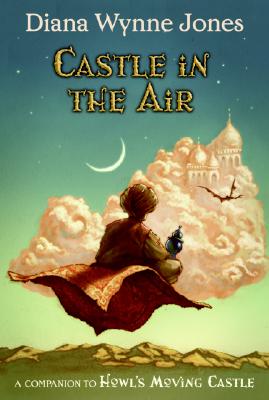
Audiobook: Castle in the Air

by Diana Wynne Jones
Read by Jenny Sterlin
ages: 12+

Support your local independent bookstore: buy it there!
Others in the series: Howl’s Moving Castle

Abdullah is a mediocre carpet merchant in Zanzib, living a terribly boring life. Sure, his daydreams are exciting, full of princesses and beautiful gardens, but his life? It’s just selling carpets and dealing with his father’s first wife’s relations. That is, until a stranger comes by and sells Abdullah a magic carpet.

The first night he has it, he goes to sleep on it and wakes up in the garden of Flower-in-the-Night, a smart, yet naive (and very sequestered) princess. Abdullah, of course, falls instantly in love. Everything was supposed to be happily ever after, but a powerful djinn kidnaps Flower-in-the-Night, and Abdullah’s life suddenly gets more complicated. There’s a cranky genie, a trip to Ingary, falling in with a bitter Strangian soldier, and finally, a castle in the air where Abdullah has to save 30 princesses from their fate of being brides of an evil djinn.

It’s the perfect kind of fairy tale (which is, of course, what DWJ is known for): romance, adventure, humor, magic; sweeping grand panoramas that captivate you fully. No, Howl and Sophie aren’t in this one (well, hardly at all), but that’s really just fine: Abdullah, the pompous flatterer and coward that he is, made up for that. I was constantly rolling my eyes at him — the way that Sterlin made him sound was quite grating at first — but that didn’t mean I didn’t like him. On the contrary, he was quite enjoyable to go on an adventure with, even if he was lovesick and heartily silly.

Sterlin (aside from the grating-at-first Abdullah) was a stellar reader, doing voices for all the different characters and keeping me entertained throughout the story. I’m glad I picked this one as an audiobook; it was definitely an enjoyable way to spend a commute.

The Floating Islands

by Rachel Neumeier
ages: 12+
First sentence: “Trei was fourteen the first time he saw the Floating Islands.”
Support your local independent bookstore: buy it there!

The world: a large country, Tolounn, whose only art is war. A small country, The Floating Islands, which are technically part of the Tolounn empire, but have been nominally independent for 200 years. There’s magic —  mages and dragons and flying men (called kajuraihi) — and the books goes for an ancient feel, with boats and horses, though it has steam-powered engines.

The characters: There’s Trei, half Tolunnese and half Islander, which makes him an outcast, at least in Tolounn. He relocates to the Islands after his family’s death, mostly because his father’s family won’t take him and his mother’s will. There he meets his cousin Araene, who is a brilliant chef and chafes against the really strict rules for girls: she wants to be able to follow her passions. (Who wouldn’t?) It turns out that she has an affinity for magic, and the mage school pulls her in; however, since she’s a girl it means she needs to go out as a boy. While she follows her passion, Trei follows his: to be a kajuraihi. Both of them will have roles to play in the conflict between the Islands and ; both will help determine not only their fates, but the fate of their country.

There are other minor characters, boys from the mage school and boys from the kajuraihi school, including Prince Ceirfei, a nephew to the Island king.

While it wasn’t a bad story, or even poorly written (it’s pretty good on both accounts), I really wanted this book to be more than it was. I had a hard time keeping all the characters and places and terms (*sigh* Why is it when some fantasy writers create a whole new world, they feel a need to create a new language along with it?) straight, and eventually stopped trying for pronunciations. I also expected it to be more about Trei and Araene, and their determination to make their way against all odds. Instead, it turned out to be more about the conflict between the two countries, and everything else was swept aside. So, by the end — when there were still 60 more pages to the book — it felt really anti-climatic. I wanted everything to be stronger, more forceful, more gripping. It was nice, but that’s about it. (I feel bad for saying this because it really was a nice read. Not terrific, but nice.)

So, maybe this one was just a victim of my expectations. That does happen sometimes.