The Impossible Knife of Memory

by Laurie Halse Anderson
First sentence: “It started in detention.”
Support your local independent bookstore: buy it there!
Review copy snagged off the ARC shelves at my place of employment.
Content: There’s a fair amount of swearing, but no f-bombs (I’m pretty sure, anyway), and some violence (some of domestic) and drinking and drug use, some of which involve teens. For that reason, it’s in the teen (grades 9-12) section of the bookstore.

Part of me wants to get off doing the easy thing here and say, “It’s Laurie Halse Anderson’s newest book. OF COURSE YOU SHOULD READ IT.”

Because, really? That’s all you NEED to know.

But, I suppose, you would like to know the plot?  Okay…. Hayley, 17, returns to school after being on the road with her rig-driving, veteran father for the past five years. The reason they move back to his home town is that he can’t seem to keep a job anymore. And that seems to be the case, now. Her father (who had several tours in both Iraq and Afghanistan) spends his days and nights drinking and smoking pot. How could she WANT to go to school and “assimilate” when the life of someone she loves is going to hell?

Or perhaps the reason you should read this (other than it’s Laurie Halse Anderson)? Because even though Anderson writes about PTSD, she doesn’t just write about the disease. She writes about the people.  The people you come to know and love. And she doesn’t just write about the disease, she writes about the issues surrounding it, like how hard war is on both the vets and the families; and how the community, however well meaning they may be, doesn’t always understand how hard war is; and like how no matter how much you love a person, they’re not going to be able to get help until they want to get help.

And then there’s Finn. Oh, man, I fell for him. But I don’t want to make it seem like this is a love story (it’s not, even though there is kissing! In a pool!) or that he saves the day (he doesn’t, though he is a catalyst and a support).

No, you should read this because it’s the story of a father and a daughter who have lost their way, and how they find it again.

Or you could just read it because it’s Laurie Halse Anderson.
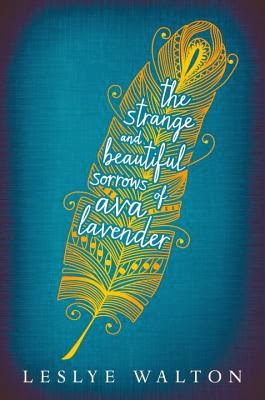
The Strange and Beautiful Sorrows of Ava Lavender

by Leslye Walton
First sentence: “To many, I was myth incarnate, the embodiment of a most superb legend, a fairy tale.”
Support your local independent bookstore: buy it there!
Release date: March 25, 2014
Review copy sent to me by the publisher in exchange for an IndieNext blurb.
Content: There are a few mild swear words, but lots of sex (none of it graphic), including a rape scene. It also reads more like an “adult” book than a “teen” one. I’ll probably shelve it in the Teen (grades 9 and up) section, though it might do better in the general fiction section at the bookstore.

While the title of the book suggests this book is about a girl named Ava Lavender, there is more to this story. In fact, it’s about Ava Lavender only because she’s the granddaughter of Emmaline Roux and daughter of Viviane Lavender. It’s equally their story. And it’s (to be honest) a difficult story to tell.

There’s foolish love, unrequited love, passion, and most of all a magic running through it all. It’s the magic of Like Water for Chocolate: Things happen because of the passion. Not the least of which is that Ava Lavender was born with wings. Not just little wings, either. Full-fledged, huge speckled wings. Her mother, being the person she is, doesn’t allow Ava to leave their hilltop Seattle home. But. Ava longs to be a “normal” teenager. Unfortunately, normality comes at a price.

The magic runs in other places as well: Ava’s twin, Henry, only talks when he needs to, and that’s not very often. Her grandmother sees ghosts. Her mother sense of smell is beyond extraordinary. The man down the road inspires people to confess their sins. Things like that.

The writing is… lyrical. The book… magical. And me? Well, I read it. See, magical realism and I don’t really get along terribly well. I wanted… something more to happen.  It’s not that it was a bad book; it wasn’t. It just wasn’t, well, my cup of tea.

Just One Year

by Gayle Forman
First sentence: “It’s the dream I always have: I’m on a plane, high above the clouds.”
Support your local independent bookstore: buy it there!
Content: There are a half-dozen f-bombs in addition to a handful of other milder swear words. Also there’s off-screen sex and some drug use. For these reasons, the book is in the Teen (ages 14+) section of the bookstore.
Others in the series: Just One Day

The book opens with Willem de Reuter, Dutch actor and playboy, waking from a coma. For those who have read Just One Day, you know exactly what point in the overarching story of Willem and Allyson that this picks up. The question is: where does Willem go from here?

While I’ve known that this book was coming out since reading Just One Day, I have to admit that I’m not sure it needed a companion book, or that Willem’s side of  the story needed to be told. That said, I was curious about Willem as a character, and the path that he took over the year that Allyson was trying to figure herself out. It turns out that while Willem’s path was more adventurous than Allyson’s, it essentially was the same: he needed to figure himself out.

However, it was Willem’s adventurous lifestyle that made the book for me. He couldn’t shake the memory of Allyson — or Lulu as he called her — and the searching for her (and, inadvertently, the healing from the grief of his father’s death three years before) took him to Mexico and India as well as through rural Netherlands and Amsterdam. I’m a sucker for books like these, ones where the main character gets to travel the world, giving himself over to the experience of seeing things.

And even though Willem is uncertain about his direction and, admittedly, a bit angsty (or in a funk a we’d call it around our house), he’s a pretty amiable character to be traveling the world with. I love how he picks up friends as he wanders from place to place. And how he just falls into experiences. It seems so… effortless.

I do understand that in many ways this is a fantasy. Not only the love-at-first-sight thing, but also the Fate/Kismet/Karma thing. No one’s life is that effortless, that charmed, that fate-driven. But, it was a nice fantasy to immerse oneself in for a while to get away from the drugery of “real” life.

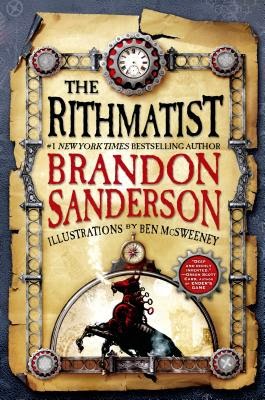
The Rithmatist

by Brandon Sanderson
First sentence: “Lilly’s lamp blew out as she bolted down the hallway.”
Support your local independent bookstore: buy it there!
Content: It’s pretty mild; there is some talk of murders, and some intense situations by the end and a mild romance. It’s only upper middle grade because of the length. I’d give it to my 10 year old, if she showed interest. It’s shelved in the YA section (grades 6-8) at the bookstore because of the length. That, and the publisher’s recommendation was 15+, which I disagree with.

Imagine a future where some unforseen disaster splits the US into several island country/states. Imagine a future where there are people — Rithmatists — who can draw with chalk and make it come… alive. Imagine a future where wild chalkings — two-dimensional chalk drawings that are sentient, somehow — can attack and kill a person. It’s in this world that Joel, a chalkmaker’s son, exists. His father used to be the chalkmaker for a prestigious Rithmatist training school, before he died. Now, Joel and his mom are scraping by. Joel would love to be a Rithmatist, but they’re chosen at age 8, in a mystical/religious ceremony, and Joel wasn’t Chosen. That hasn’t stopped his passion for Rithmacy and the history. He’s pretty much shunned until one of the top professors, Fitch, is toppled from tenure by a young upstart. And then, top students start disappearing. With another not-so-great student, Melody, Joel works at figuring out just what is threatening the students.

This was slow-going at first. I didn’t quite grasp the idea of the world, or the importance of the illustrations. Which, in many ways, is a drawback: if you can’t grab a kid in the first chapter or two, then in many ways you’ve failed as a book. But this one is worth the slog in the first couple of chapters. It takes a while, but as the mystery develops, and things become more intense, and more about the Rithmastist world is explained, Joel — and especially Melody — come into their own. The final couple of battles are quite intense and very much worth the while. And even though I kind of called the mystery, there is a bit of a twist that I didn’t see coming, which was very satisfying. And as I came to understand the illustrations — which admittedly were off-putting at first — I found them at least as fascinating as the story. If Sanderson wants to write a guidebook for the Rithmatist world, I’m sure there’d be a market for it.

I do wish — and I know that I’ve said this before — that people would stop writing series books. This one worked quite well as a stand-alone, even with a few threads hanging. I do appreciate that (even though the last three words are “To Be Continued.” ARGH). But overall, it was a fascinating world to immerse myself in.

(Just for the record: because this is a Cybils nominee, I’ve been asked to make sure y’all know this is my opinion only, and not that of the panel.)

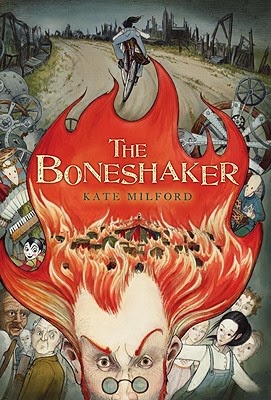
Audiobook: The Boneshaker

by Kate Milford
Read by: Erin Moon
Content: some intense moments (the Devil’s pretty scary), some violence, some disturbing images (if it were a movie). Language is probably suitable for someone reading on a 5th grade level. Has the feel of an older Middle Grade book, so I’d probably put it in the YA section (grades 6-8) at the bookstore.
Support your local independent bookstore: buy it there!

It’s 1914, and 13-year-old Natalie Minks has a pretty good life. Her father is the local mechanic — bicycle, mostly, but he’ll tinker with cars — and her mother tells the most amazing stories about their town, Arcane. Natalie herself has a predisposition for both: she loves tinkering with her father as well as listening to her mother’s stories.

Then one day Dr. Jake Limberleg’s Nostrum Fair and Technological Medicine Show comes to town. It was a fluke — their front wheel came off at the crossroads, and they decided to set up shop while they waited for Mr. Minks to fix their wagon. And that’s when the Trouble starts. Natalie, for better or for worse, is tuned into it and with her frienemy Miranda (I think that’s what her name was; I can’t look it up in the book!) and her trusty Chesterlane Eidolon bicycle (a bone shaker of an old thing that would be the fastest in the world, if Natalie could ever ride it), she decides to take on Limberleg and solve the mystery, saving her town. If she can.

I don’t know how I can write about the way this captured my attention. Sure, I was on a long drive to Austin, and it had my full attention anyway, but I didn’t want to stop listening. Milford has taken the idea of a Faustian Bargain — you know: those stories where a character meets the Devil and then outsmarts Old Scratch? — and elevated it. Not only is there two elements to this bargain, but we get historical elements thrown in as well. The traveling medicine show (I loved the Paragons of Science, even though they were Evil), the bicycles, the references to the “war” (which took me a minute to realize they meant the Civil War): it all added Atmosphere, which made the fantasy element, the bargains with the Devil at the Crossroads, that much creepier.

(It also helped that I kept thinking about this song:)

In short: a winner of a book.

Rose Under Fire

by Elizabeth Wein
First sentence: “I just got back from Celia Forester’s funeral.”
Support your local independent bookstore: buy it there!
Content: there were a lot of f-bombs (I didn’t count them) that came up once at the concentration camp (understandable) and other mild swearing throughout. Also a number of disturbing images and content (Nazi concentration camps don’t make for Light Reading). It is most definitely one I wouldn’t hand to a kid under the age of 13 or 14 (depending on their maturity handling Difficult Situation), whether or not they were on the reading level, so it’s shelved in my Teen section (grades 9-12) at the bookstore.

I don’t quite know where to start with this one. Once I discovered it was a Holocaust novel (as opposed to just a WWII novel), I put off reading it. I don’t like Holocaust novels, mostly because I don’t like being confronted with the evil things the Nazis did. But, because it was Elizabeth Wein, and because it’s a companion to Code Name Verity, I bravely gave it a shot.

And I found myself sucked into the world of women pilots, of strong, resilient women who know how to survive. It’s odd to say this about a Holocaust book, but I loved it.

Rose Justice is an American who has pulled strings to get enlisted as a transport pilot for the RAF. She’s doing her duty, blissfully unaware of the evils of the Nazis. Sure, they’re the Enemy, but the can’t be as horrible as they all say, right? Then, on a mission, she chases after a flying bomb (German pilotless planes loaded with bombs), gets lost over enemy territory, and ends up in Ravensbrück.

Even I, who actively avoids anything Holocaust, know about the horrors of Ravensbrück.

And yet, even though Wein captures the horrors, and the crimes, and the terribleness (I can’t seem to find a word strong enough) of Ravensbrück, it isn’t a hopeless, dark book. Even though Rose is changed permanently by her six months (only six measly months! How did people survive years there?), she retains her will to survive. And Wein has created a cohort of strong, amazing, wonderful (again, there is no word strong enough) women who do just that: survive. It’s amazing — and inspiring — to read.

I’m so glad I did.

All the Truth That’s in Me

by Julie Berry
ages: 13+
First sentence: “We came here by ship, you and I.”
Support your local independent bookstore: buy it there!
Review copy pilfered off the ARC shelves at work.

Two girls go missing. One turns up dead, floating in the stream. Two years later, the other one returns to the small town, intact, but with her tongue cut out. The villagers — from the preacher to her own mother — call her cursed, and shun her.

I’ve tried to sum up what goes on in the rest of the book, but I’ve found that I don’t really want to give too much away. Because much of the pleasure I got from reading this (in one sitting!) was not knowing that much about it. I will tell you this: at first, I thought it was a fantasy setting, because I think that’s what I was expecting. It’s not. Even though it’s not explicitly stated, it’s a Puritan setting, somewhere on the east coast. And the religion and mores that those communities set out play a major role in the book. And, even though it’s a story about kidnapping and murder, and you fear the worst for Judith, I will tell you that, as the story unfolds, it’s not the worst. It’s bad, but it’s not as bad as it gets.

The meat of the story is Judith — she’s the girl that returns — and her road to healing. For, in spite of everything that the village (and her mother) heaps on her, she does need to heal. It’s this process that is the true story. How Judith salvages her life from her trauma and reclaims her own sense of self. How she finds friends in the face of all the opposition in the town. How she even finds love. It’s a testament to the power of truth, to the power of the human spirit.

Remarkable.

The House of Hades

Heroes of Olympus, book 4
by Rick Riordan
ages: 12+
First sentence: “During the third attack, Hazel almost ate a boulder.”
Support your local independent bookstore: buy it there!
Others in the series: The Lost Hero, The Son of Neptune, Mark of Athena

First off: I liked this one SO much better than Mark of Athena. I am glad for that.

The plot picks up right after MoA left off (actually, one of my favorite things about the book is the dedication. I love how Rick knows his fans.), with Percy and Annabeth in Tartarus and the rest of the seven (Leo, Hazel, Frank, Jason, Piper) plus Nico are on the Argo II. Both sets have one goal: make it to the House of Hades and shut the Doors of Death before Gaea raises the giant army.

From the start, you know that the heroes have to fail. If they succeeded, there wouldn’t be a need for a fifth book. And yet, I like how Rick (we’re on a first-name basis  now, you know) plots this one. They do fail, but not completely. And, along the way, they learn some valuable lessons about themselves and each other.

To be fair, this was an incredibly crowded book. While I’ve enjoyed this series, I do have to admit that, in many ways, making it so huge with so many view points and so many main characters is a drawback rather than a plus. I enjoyed the book as a whole, sure, but I also felt like there were things missing. There is so much going on — not just Percy and Annabeth sludging through the monster hell, but also the impending battle back at Camp Half Blood, or the rest of the heroes’ adventures — that bits are bound to be left out. And part of me wants those stories, as well. Granted, those aren’t the stories that Rick chooses to tell, but I still feel like there’s something missing.

Even with the crowded feeling, I did enjoy the book. Rick has a gift with creating characters you just love (Bob! Nico! Frank! Leo! Hazel! Even Piper had a chance to be awesome!) and — I know I’ve said this before — he still has a gift for making you want to turn pages, to find out what’s next. And just when you start to think it’s slogging (at least this time), he switches the action somewhere else. (On the other hand, that’s probably a contributing factor to the busy-ness of the book.)

No, this isn’t my favorite series Rick has written (give me the original Percy Jackson and the Olympians!), but it’s a good one. And I’m more than happy to go on a journey one more time with Percy and crew. And I do think I’ll be sad when it’s over next year. Which means, in spite of my quibbling, it really was a good book.

(Just for the record: because this is a Cybils nominee, I’ve been asked to make sure y’all know this is my opinion only, and not that of the panel.)

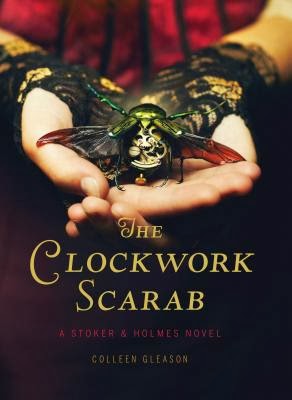
The Clockwork Scarab

by Colleen Gleason
ages: 12+
First sentence: “There are a limited number of excuses for a young, intelligent woman of seventeen to be traversing the fog-shrouded streets of London at midnight.”
Review copy pilfered off the ARC shelves at my place of employment.

Years ago, I remember when Colleen Gleason came out with the Gardella vampire books. I won the first one, if I remember right, and I remember liking it quite a bit. And so, when I got wind that she was writing a YA books, starring the “niece” of Sherlock Holmes and the half-sister of Braham Stoker, I was excited. And the cover is sooo pretty. I had high hopes.

The basic story is this: There have been a series of disappearances and apparent suicides in late-19th century socialite London. Miss Holmes and Miss Stoker are invited by Miss Irene Adler (I had to remind myself who she was), to help assist in this investigation. There are suspicious circumstances surrounding the deaths/disappearances of the girls, and there’s a mechanical scarab left at every scene. There are, of course, several love interests, including a Lieutenant, a mysterious gentleman who goes by the name of Pix, and (most interesting), a time traveler from the future.

That’s all the plot I got from the handful of pages I read. See, in spite of my high expectations (or perhaps because of them?), I couldn’t make it very far in this one. It just wasn’t clicking for me. Miss Holmes was interesting, but Miss Stoker was… off. And I was put off by the talk of clothes and hair, and the swooning over the boys. Much like Etiquette & Espionage, I felt like Gleason was dumbing herself down, and that wasn’t sitting right with me.

True, it has all the markings of a good YA mystery, but in the end, I bailed.

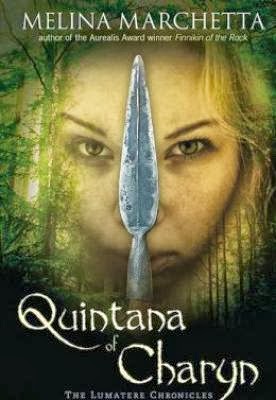
Quintana of Charyn

by Melina Marchetta
ages: 14+
First sentence: “
Support your local independent bookstore: buy it there!
Others in the series: Finnikin of the Rock, Froi of the Exiles

(Spoilers, obviously, for the other two.)

It’s been a few months since the Charyn king was killed, and Charyn is in upheaval. Froi is recovering from his wounds (to put it mildly), Quintana is pregnant and in  hiding, in the valley bordering Charyn and Lumatere. Isaboe and Finnikin are fighting, mostly because Isaboe, who is expecting their second child, is obsessing over Froi (he hasn’t returned from his assignment to assassinate the Charyn king). It’s all very complicated and political. As the book progresses, it doesn’t get any less so: the setting up of a country (or re-setting, I guess) is a messy affair. There are fits and starts, miscommunications and offenses, second guesses and traitors. It’s not a pretty story, laid out in nice, neat rows, but rather a realistic one: in this political game, where the futures of several countries are at stake, the question is how many lives is it going to cost?

(I’m glad I didn’t have to write the jacket blurb on this one.)

I wish I had had the opportunity to read this series like M did, one right after another. Well, actually: she read Finnikin, started Froi, didn’t like the book because it wasn’t Finnikin, put it down for a while, picked it back up, finished it, demanded Quintana, and then RAVED about it.

It took me a bit longer, and I think the book suffered for the wait. because it took me a while to get into the characters and the world again. But, thankfully, Marchetta remembered that it’d been a while since Froi came out, and helped me remember the important bits as we went along. While it’s not as dark as the previous two books, it’s still an intense ride. Marchetta keeps us on the edge of our seat the whole way through (which is a considerable feat, seeing as the book is 500+ pages long) , wondering if the outcome will be what we want, and wondering how she is going to get there. I loved this book for many reasons, but two stand out. First, that it was a messy book, which made it more real. This isn’t a fairy tale. This is a political drama, and I appreciated the mess. It kept me interested. The second thing was that the relationships were so complex. All of them. Marchetta has a gift when it comes to writing relationships. And not just romantic ones. Friendships were complex. Parent-child relationships were complex. And loves were complex, deliciously so. And because of that, everyone (EVERYONE!) had a growth arc. There were no simplistic characters. I can’t tell you how happy that made me.

And the end, oh the end. (Endings have been meaning a lot more to me lately, for some reason.) I should have seen it coming (M did!), but I didn’t, and it was perfect in so many ways.

Which means the only thing wrong with this book was that it was over, and there are no more stories to tell about these characters. And that makes me impossibly sad.