Untold

by Sarah Rees Brennan
ages: 12+
First sentence: “Welcome to Sorry-in-the-Vale.”
Support your local independent bookstore: buy it there!
Others in the series: Unspoken
Review copy greedily stolen from the package the publisher sent to the bookstore, then hoarded on my shelves until I finally devoured it.

To catch up (spoilers for Unspoken, obviously.):
1. Kami’s imaginary friend, Jared, is real.
2. He’s part of an old sorcerer family.
3. Who used to rule Sorry-in-the-Vale
4. His uncle, Rob, is more than slightly batty, and is killing people because blood gives him power.
5. Kami wants to stop him.

In many ways, this is very much a second book in a trilogy. The first was a brilliant set up. This one, while still interesting and laugh-out-loud funny at times,  had the feel that everything is building toward some grand conclusion. Though we never quite get to it in this book.

That’s not to say that it’s a bad book. On the contrary, it’s actually quite good. Even though I felt like I was spinning my wheels — will Kami and Jared get together? Will Lillian ever stop being a Royal Snob?  Will Angela and Holly work out their differences? Will Ash ever grow a backbone? — it was done in a way that I didn’t mind the spinning. At all. It was also because I adore Kami. I hate to call her plucky, but she really is. She’s smart, and determined, and bossy, and willing to do ANYTHING for her family, friends, and town. I love her.

And the ending? Oh. My. Gosh.  If I wasn’t already convinced that endings can make or break a book, I would be now. The ending is brilliant. And painful. Because now I have to WAIT for the next book.

It was worth it, though.
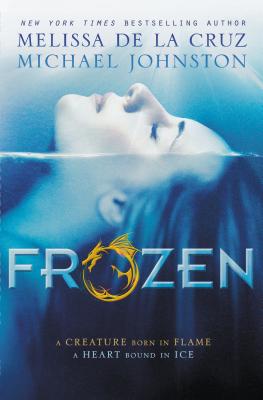
Frozen

by Melissa de la Cruz and Michael Johnston
ages: 12+
First sentence: “They were coming for her.”
Support your local independent bookstore: buy it there!
Review copy snagged off the ARC shelves at my place of employment.

I’ve come up with a tagline for this: It’s what’d you get if you smashed an environmental dystopian novel with Firefly. And I’m not just saying that because of my Nathan Filion crush. Promise.

It’s a future where due to environmental changes, the world flooded and then froze, and those who survived did so by either stubbornness or by selling their soul to the military that controls the government of the RSA — the Remaining States of America. It’s a tough world, one where you get by on luck and with a quick wit and a faster gun.

Nat is one of the survivors in this world, and she’s found herself in New Vegas, working as a blackjack dealer. Except she’s one of the Marked: a race of people with special powers, who have been marked on their body some way. That makes them ripe for persecution; the military, especially seems hell-bent on exterminating them. Nat was caught, once, but managed to escape. And now her powers — voices in her head, really — have her set on finding the Blue: a place where the sun shines and the grass grows.

For that, she enlists Wes, a captain of a crew and a ship, a mercenary with a heart of gold. Why, yes: he is Captain Mal and Han Solo rolled into one. He’s charming and captivating, saucy and sly; everything you’d expect a 19-year-old mercenary in a dystopian world to be. And yeah, there is a romance. But I didn’t mind that.

Oh, one more thing and it’s a little bit of a spoiler: that dragon in the O? It means something. And it makes the book that much better.

Considering my last outing with Melissa de la Cruz ended in a Did Not Finish, I consider this a win. It’s not a amazing book, but it is a lot of fun.

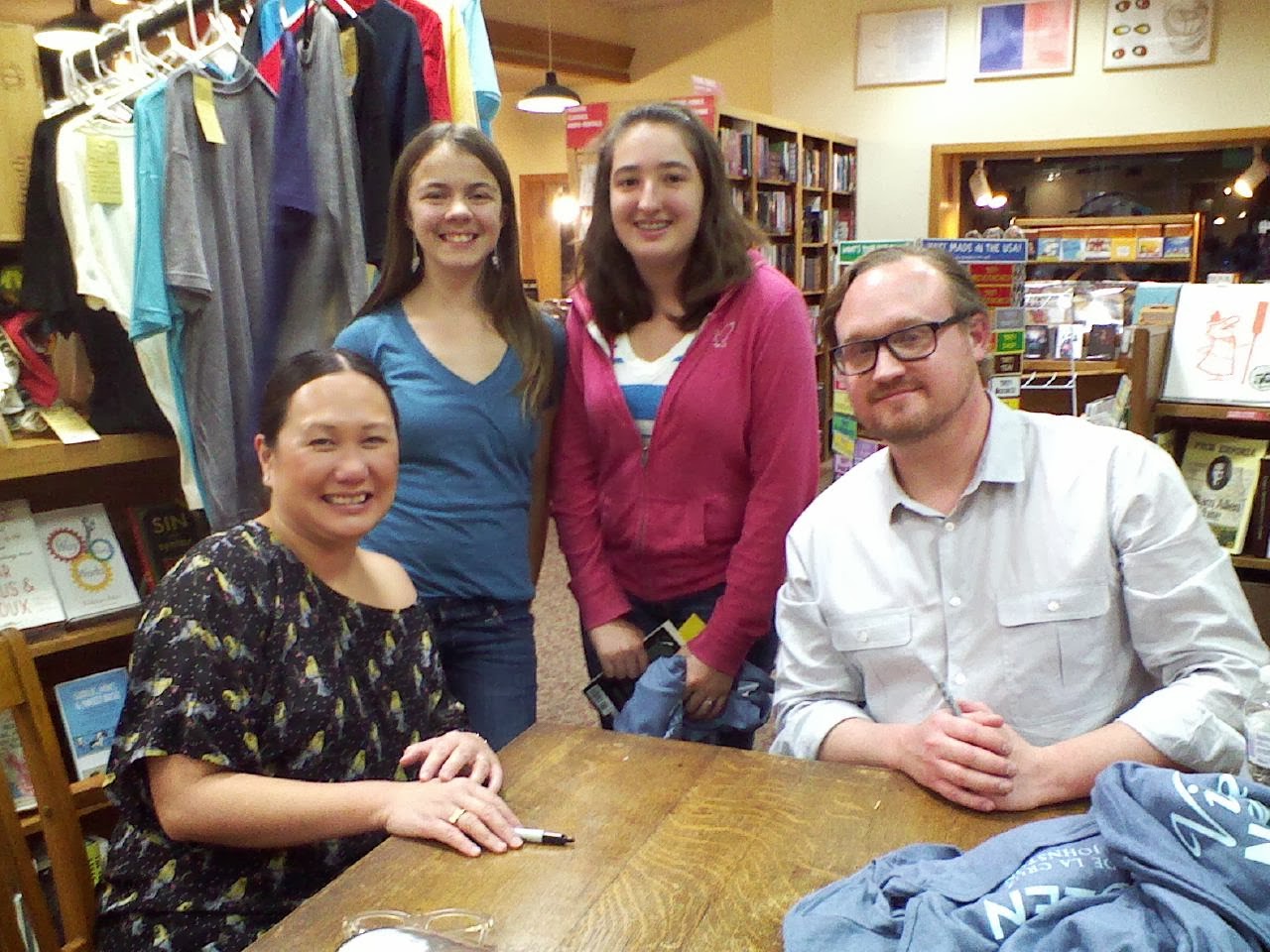
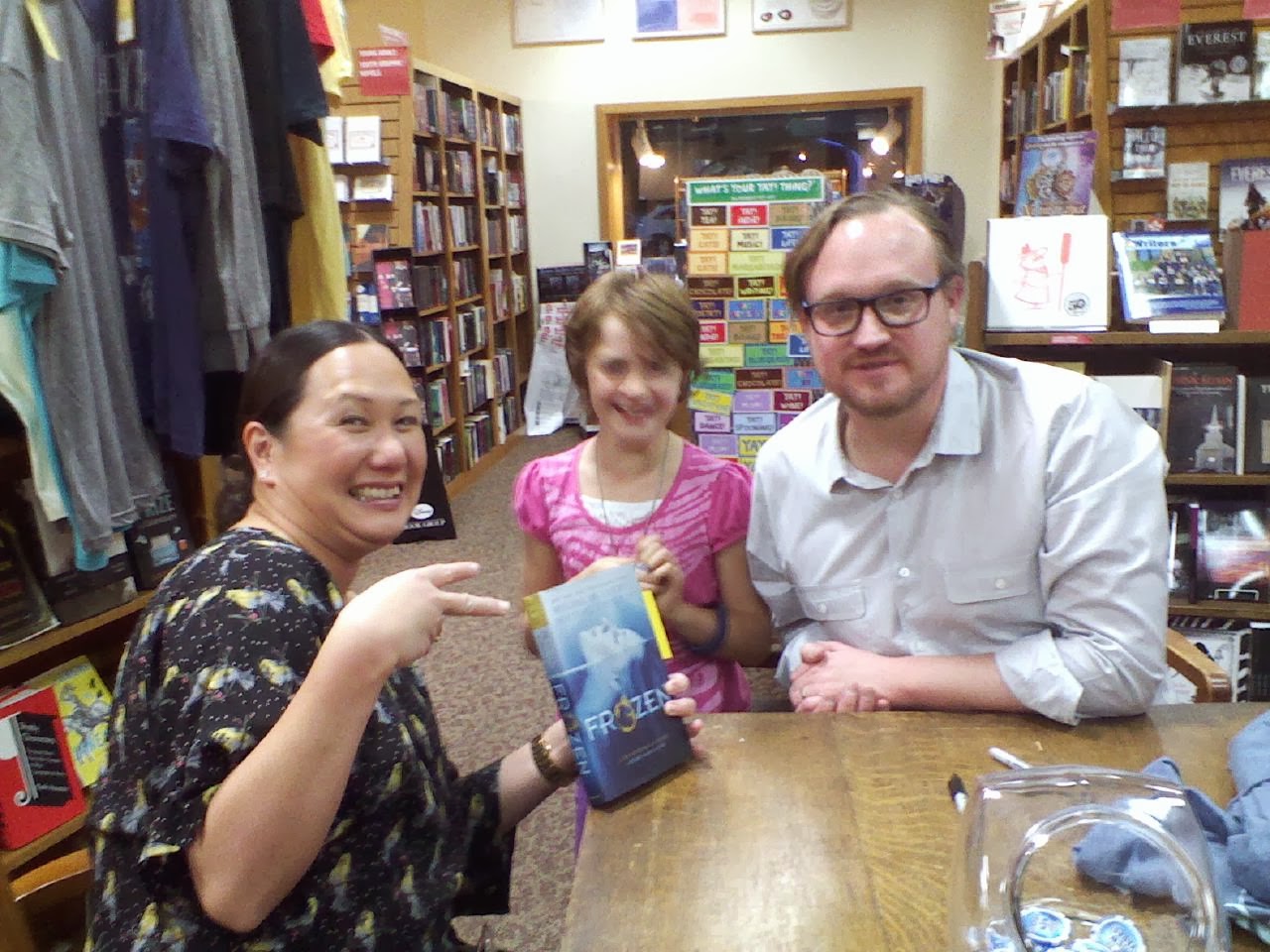
As a bonus: pictures from the event last night. They were really fun, and talked a lot about collaborating and selling the rights to their stuff. The girls had a good time.

I think out of all of them, Alison was the most interested in the book. We picked it up, she got it signed to her, and started reading it. Pretty cool.

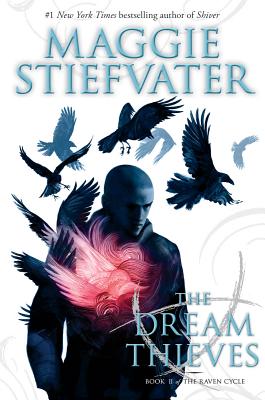
Dream Thieves

by Maggie Stiefvater
ages: 14+
First sentence: “Theoretically, Blue Sargent was probably going to kill one of these boys.”
Support your local independent bookstore: buy it there!
Review copy snagged from the ARC shelves at work.
Others in the series: The Raven Boys
Release date: September 17, 2013

I’m not quite sure where to start off on this one. Sure, I could always start with the plot, but in some ways, that’s mostly immaterial in this book. Yes, yes, Things Do Happen — it’s mostly Ronan Lynch’s story: about who and what he is, about his family, about how he got to be who he is — but that’s really a side effect to everything else that is going on in the book.

First off: because it’s about Ronan, it’s not a happy, or a light book. No, this is threaded throughout with all sorts of Darkness and Violence. Ronan is not a nice person. No, that’s not true: there are people in this book that are truly Not Nice, and Ronan isn’t one of them. But he’s not a carefree, happy-go-lucky person (well, none of them are), or at least an immediately likable and charismatic one (like Gansey, whom I decided I really liked by the end). No: you have to work to understand Ronan (I won’t say like, because I’m not sure I did), and spending so much time in his head isn’t easy.

But, it is worth it.

This time it’s worth it for the words. For the “furiously red tie” or the “sanguine, pleasant air of either a nun or a pothead” or the “all food eaten in anticipation of a kiss is delicious.” This book is full of gems like this. Stiefvater’s descriptions, casual throw-away lines littering the book, left me literally in awe and aching for more. I couldn’t read this one fast enough (and considering I had to put it down for days while I read a couple others, that was only magnified): it was mesmerizing in its terribleness, in its rawness.

And the end? How it wrapped things up, but gave us a new mystery to solve, while weaving everything that happened in both of these books together? Perfect.

Seriously.

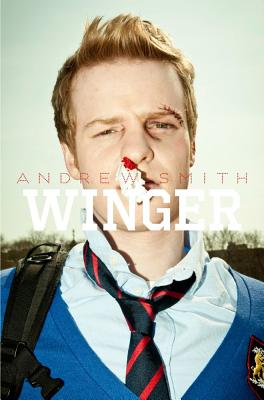
Winger

by Andrew Smith
ages: 14+
First sentence: “I said a silent prayer.”
Support your local independent bookstore: buy it there!
Review copy picked up at ABA Winter institute for me. Yes, I have taken that long to get to it.

Ryan Dean (yes, that’s his whole first name) West has a lot going for him: he’s a junior at Pine Mountain, a boarding school for troubled rich kids (his dad’s a high-powered Boston lawyer) in the Pacific Northwest. He is first string winger (think running back in football, but more intense) for the rugby team. He’s pretty smart.

But there are some downsides: he got transferred into O-Hall this year because he was caught hacking into a cell phone account at the end of last year. And, to top it all off: hes only 14.

And when you’re in O-Hall with all the delinquent football and rugby players? It’s not going to be a stellar year.

Add to that some major girl drama (he’s in love with his best friend, Annie, but snogging his roomate’s girlfriend), late night poker games (let’s just say that Ryan Dean is not a good drunk), and lots and lots of testosterone-induced fights. Let’s just say, I was impressed that Ryan Dean — who was decent human being underneath all the 14-year-old boy nonsense — survived until Thanksgiving.

I’m of two minds about this book. On the one hand, I can sum it up in two words: sex and rugby. Actually, the sex is all in Ryan Dean’s mind: he’s incredibly immature, and objectifies EVERY girl, and EVERY situation becomes about sex. In other words: he’s a normal 14-year-old boy. But unlike Carter’s Unfocused One-Track Mind which I couldn’t get through (and which is the best comparison to this one), I found myself endeared to Ryan Dean. Maybe it was the underdog element. Maybe it was because although he was annoying, he was almost mostly harmless. Maybe it was because he really did mean well, in the end.

Because, I found myself compelled by this. I was invested in Ryan Dean’s drama. I loved the camaraderie of the rugby team. I enjoyed Ryan Dean, dork that he was.

My only real problem was with the ending. See: Ryan Dean becomes good friends with the rugby captain, Joey, who also happens to be gay. Joey’s sexuality isn’t a big deal for Ryan Dean (though he feels the need to comment that he isn’t a lot), but it is for other guys in O-Hall. And in the last 20 pages of the book, it takes a sharp left turn and stops being a fun boarding school drama, and becomes Something More. Not that I minded something more, it was the sharp left turn that threw me. It didn’t work. I didn’t feel pain, or anguish, or anything at all at the end, because I was flabbergasted that a fun and entertaining book so suddenly became Serious. It came off as bad pacing and lack of focus rather than anything more substantial.

It didn’t ruin the book for me, but it did take some of the shine off. Which is too bad, because I was having fun with it before then.

The Madman’s Daughter

by Megan Shepherd
ages: 13+
First sentence: “The basement hallways in King’s College of Medical Research were dark, even in daytime.”
Support your local independent bookstore: buy it there!

Juliet Moreau is 16 and in desperate straights. Her father — yes, that is the Dr. Moreau of H. G. Wells’ classic The Island of Dr. Moreau — has been exiled from London in a scandal and her mother has died of consumption, leaving Juliet penniless. Thankfully, someone found her work cleaning in the medical labs, but that — while keeping her off the streets — is not ideal.

So when she runs into her father’s old servant (now assistant), Montgomery, she bullies him into taking him with her back to the island, back to her father.

Which is where the madness is.

I have never read the H. G. Wells classic, so I can’t compare the two. (As a side note: I kind of want to read it now.) But this one was… interesting. Victorian in setting, Gothic in feel, the novel propelled me a long its story of love, betrayal, and, well, science. I liked Juliet as a character, even if she did feel a bit modern to my tastes; I don’t think in this kind of book it could be helped. She needed to be a strong, independent-minded young woman, and Shepherd gave us that. She also convincingly portrayed Juliet not as a naive girl, one who is all too willing to believe in her father’s innocence, but rather as someone who believes and hopes for the best in her father, until evidence beyond a shadow of a doubt proves otherwise.

In addition, the island setting, with its creatures and monsters, was sufficiently creepy. Not enough to keep me up at night, but close.

What didn’t work for me was the romance. I think it was partially because I felt it was unnecessary: Juliet had enough on her plate with her insane father, and trying to figure out all the ins and outs of his experimentation (all the way down to figuring out if she’s real or a creation), that it seemed a bit much to throw in a love triangle as well. I did like the way it turned out: there’s a spectacular twist (which I probably should have seen coming but didn’t), and while I thought the ending was somewhat unsatisfying, in retrospect, I have to admit it fit the characters and the story.

It was a good, solid debut, and since I hear the next one is based on Dr. Jekyll and Mr. Hyde, I’m sold.

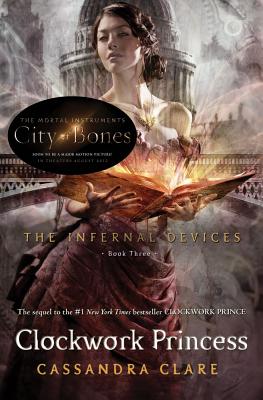
Clockwork Princess

by Cassandra Clare
ages: 14+
First sentence: “‘I’m afraid,’ said the little girl sitting on the bed.”
Support your independent bookstore: buy it there!
Others in the series: Clockwork Angel, Clockwork Prince

(Obviously, spoilers. You’ve been warned.)

Over the past two months, things have been quiet in London. Jem and Tessa are preparing for their wedding, Will’s sister Cecily is at the Institute training (Will’s not terribly happy for either of these events), Gideon Lightwood is crushing on Sopie (the maid), when their peace is shattered by Gabriel Lightwood announcing that his father has arrived at the final stages of Demon Pox (gotta love that), and transformed into a giant, man-eating worm. This sets in motion a chain of events that will end with the London Shadowhunters facing down Mortmain and his Insane, Evil plan.

It sounds simplistic, but in reality it’s more complex. Charlotte is facing down Counsul Josiah Wayland and his sexist ploy to oust her. In fact, one of the things that bugged me most about the book was Wayland’s character. I didn’t think, in the first two books, that Wayland was a sexist jerk, and so his attempts to oust Charlotte (going as far as trying to bribe the Lightwood brothers) felt off to me. I wanted there to be an ulterior motive. There wasn’t: he really was a sexist jerk. (He was also a 19th-century man, so there’s that.) However, he got his comeuppance in the end, which made me (unreasonably) happy.

In addition, we FINALLY get to know how Tessa came to be. It took most of this book, but in the end, it was worth it. As was the ending: Tessa thoroughly rocks as a character. She is both feminine and strong, a remarkable combination. (Additionally: Clare’s resolution to the love triangle was brilliant. Seriously.)

I thoroughly enjoyed this conclusion to the series. In fact, I thoroughly enjoyed the whole series. I’m not sure if I would have enjoyed it without reading The Mortal Instruments first, because much of what I liked was seeing how the two fit together (like when Magnus and Henry perfect the Portal!). But the characters were great, the storyline fantastic, and they were a lot of fun.

I’m so glad I made the time to read these this summer. Now to go see the movie. (Tonight, hopefully.)

Clockwork Prince

by Cassandra Clare
ages: 14+
First sentence: ” The fog was thick, muffling sound and sight.”
Support your local independent bookstore: buy it there!
Others in the series: Clockwork Angel

Picking up pretty much exactly where the first book left off (spoilers for that, of course): Mortmain is still at large, Will is still cursed and angsty about it, Jem is still dying, and Tessa still doesn’t know what she is. Mortmain, for this book at least, stays well in the background as other interests take precedence: the head of the London Institute, Charlotte, is being challenged for her position by Benedict Lightwood,  and has been given an ultimatum: find Mortmain in two weeks, or lose your position.

So, the Enclave at the Institute sets out to do just that, and gets bogged down in some interesting messes. Jessamine is stepping out with Tessa’s (evil) brother Nate; Benedict is messing around with some less-than-nice elements;  and Mortmain is a whole lot older than he looks and has been planning his revenge for a long, long time. And that’s not even mentioning the whole Jem-Tessa-Will love triangle. Or Will’s search with Magnus (yay!) to end his curse.

(As a side note: M has said she needs a t-shirt that says: “Magnus Bane is more fabulous than you.” She found this one, which is close enough.)

It’s very much a middle book in the trilogy, except I think Clare handles it better than most people. Mortmain is gone, but she gives us a very real villain in Nate, and Jessamine’s deception and treachery is quite delightful. Perhaps one of the things I liked best was seeing how all the names fit in with the first series (which, I suppose, is one reason to read those first, but I think it would work the other way, too). And seeing how much the Shadowhunters have changed. It frustrated me that I still had no answers about Tessa, or why Mortmain wants her, but I was able to roll with it. Speaking of Tessa: she’s a fabulous character. They all are. (Even angsty Will.) I don’t know why it is that I like these characters better than the ones in the Mortal Instruments. Perhaps it’s because the world seems more complex. Or maybe it’s just because I’m comparing them to Clary and Jace and so on, and finding these characters more interesting. (Or maybe just because I like Victorian London better than contemporary NYC. It could be that.) What ever it is, I’m happily moving on to the last book, just to see how it all ends.

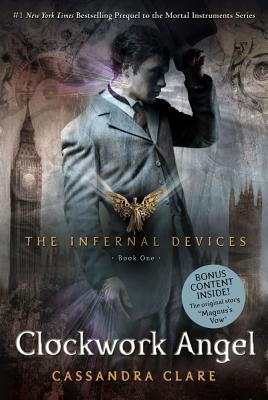
Clockwork Angel

by Cassandra Clare

ages: 14+
First sentence: “The demon exploded in a shower of ichor and guts.”
Support your local independent bookstore: buy it there!
You don’t have to read The Mortal Instruments series first, but I think it helps.
Tessa Gray is an orphan on her way to London to be with her older brother when she’s kidnapped by a couple of women calling themselves Dark Sisters. They force her to wake up a latent power she has, called Changing, saying they’re prepping her for the Magister. She manages to escape with the help of a couple of Shadowhunters — Will Herondale and Jem Carstairs — who take her back to the Institute in London. Where Tess learns about the whole Shadowhunter world, and the fact that no one knows quite who she is. Oh, and that the Magister isn’t going to give up looking for her. 
There’s more to this — of course there is — including a wicked cool twist I didn’t see coming. I enjoyed seeing the Shadowhunter world from the perspective of Victorian London. And the smattering of steampunk with the automatons was a nice touch.  In fact, in many ways, I liked this one better than the Mortal Instruments. It’s funnier, it’s more intense, and it’s got a more interesting plot. Oh, and Tessa is a WAY better heroine than Clary. Sure, it’s kind of confusing: you never find out what Tessa is, or why the Magister wants her. And the beginning leaves your head spinning. But the end is completely worth it.
On to the next one.

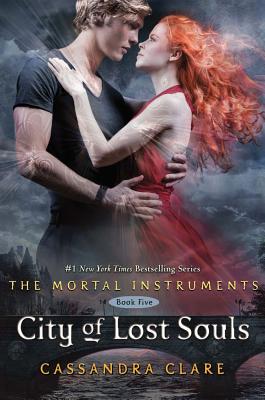
City of Lost Souls

by Cassandra Clare
ages: 14+
First sentence: “Simon stood and stared numbly at the front door of his house.”
Support your local independent bookstore: buy it there!
Others in the series: City of Bones, City of Ashes, City of Glass, City of Fallen Angels

This series — now five books in — is becoming increasingly complex and somewhat convoluted (not necessarily in a bad way). I’m not sure I can even begin to summarize what went on in this one. Let me try (spoilers for all. You’ve been warned.)

Jace and Sebastian are connected, linked in such a way that to harm one is to hurt the other. And Jace isn’t himself, but rather an extension of Sebastian. Clary knows this, but goes over to Team Evil anyway with the express idea that she’ll figure out what their plan is and report back to Simon using these fairy rings.

Meanwhile, Simon, Alec, Isabelle, and Magnus (I loved that Magnus played an active role in this book) are off searching for a way to split Jace and Sebastian apart that doesn’t involve killing Jace. (It’s okay if Sebastian dies. In fact, they wish he would.) This involves raising a prince of Hell as well as an angel. It’s more complex than that, but those are the basic bones of the story.

This one was a lot harder to get a grip on. It’s bigger than the others (or it feels bigger, anyway), weighing in at 534 pages. And it was a lot slower to get started as well. But the end? It was totally worth the slog to get there. I really liked the role Simon had to play, as well as Isabelle — while she’s not quite the same Isabelle I liked in City of Bones, I think she’s settling into herself, and there was some of the spunk I liked. In fact, there was a lot of the sass and spunk from the first books back. I know Jace wasn’t himself in this one, but I liked him a whole lot better than I have for a couple of books. He was funny. And even Clary wasn’t simpering; she finally puts up a fight for what she believes, and makes an impact. And her decisions at the end? Courageous.

And I’m committed: I need the next one to come out so I can see how this all ends.

The Blue Sword

by Robin McKinley

ages: 12+
First sentence: “She scowled at her glass of orange juice.”
Support your local independent bookstore: buy it there!

I first read The Blue Sword ages and eons ago. No, not when I was a kid, though I could have. It was soon after I first read Beauty by Robin McKinley (the book a friend gave me that I credit with my current love of YA). While I liked Beauty well enough, it was Harry Crewe and the country of Damar that I fell hard for.

Since I read this pre-blog, when I started it up, I wrote a couple sentences about my favorites. This one went like this: “The Blue Sword is full of adventure, magic, romance, swordplay… it would probably make a pretty good movie if anyone ever thought of it. It was an engaging book, well-written and the heroes were believable and interesting (there’s a lot of believable tension and chemistry between the two lead characters, which makes it fun).”

That doesn’t even begin to sum up the awesomeness that is The Blue Sword.

Harry Crewe is an orphan who has been shunted out to Damar, which lies on the outer reaches of the empire. She’s a ward of the regional head there, and is not happy about that. At all. Partially, it’s because she misses her parents, but mostly it’s because she’s unsettled. Unsatisfied. She never was the type of girl to sit still; she preferred riding and climbing to sitting and sewing. But, she’s supposed to be “proper” now, which means she looks wistfully out at the mountains, and wishes she could just do something.

Then Corlath, the king of the Hillfolk, shows up at the settlement. Nominally to try and make some sort of agreement with what they call the Outlanders, but that fails. Instead, he sees Harry, and his kelar — which is a kind of magic — demands that she come with him. So, he kidnaps her. Yes, it’s unsettling at first, but eventually she learns that the Hillfolk is where she belongs. She has the kelar, too, as strong as Corlath’s. And it becomes her Fate to be Harimand-sol, the lady Hero, and the first one since Lady Aerin to wield the Blue Sword in battle.

That’s the basic gist of it, but not the whole thing. McKinley, when she’s at her best, knows how to weave a good story. She pulls in amazing characters — my favorites are Jack Dedham, the career military guy with a soft spot for Hillfolk; and Narknon, the hunting cat that adopts Harry — and creates a vivid and detailed world but without all the exposition. She’s such a tight writer, such a gifted writer, that she’s able to do all this with a minimum of words, or without making it seem inaccessible or difficult.

In short: it’s brilliant. (And it’s more than 30 years old, without being dated in any way. That counts for a lot.)