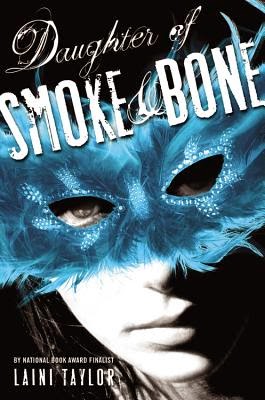
Audio Book: Daughter of Smoke & Bone

by Laini Taylor
read by Khristine Hvam
Support your local independent bookstore: buy it there!
Content: There is some talk about sex (though all the actual sex is off screen), a lot of violence, and some mild swearing. Is in the teen (grades 9 and up) section of the bookstore, though I didn’t have any problems with C (now 14) reading it.

I’ve been wanting to reread this (and Days of Blood & Starlight) in anticipation of Dreams of Gods & Monsters coming out. And so, when I saw that this one is out in audio, I snatched it up. (You should have seen me; I was fangirling all over the place. Kind of like when a customer came in to preorder Gods & Monsters. We were just gushing.) Anyway. I don’t have much to add about the story that I didn’t already say when I first read this.  But the audio was glorious. Hvam captured all the voices perfectly. To a spunky Zuzanna (love her best still) to Akiva and Karou, to the various chimera and seraphim that run throughout the book. (Brimstone is EXACTLY like I heard him in my head.) It was a joy to listen to. And one of those books that made you want to sit in the car, listening for hours on end.

If you haven’t had a chance to experience Taylor in all her awesomeness, you need to. And with the third coming out, take a weekend and splurge and read all three. You won’t regret it.

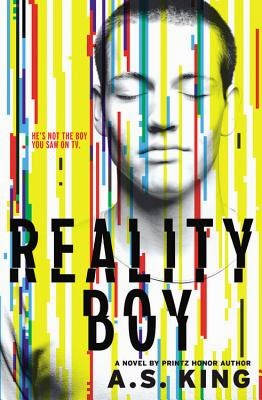
Reality Boy

by A. S. King
First sentence: “I’m the kid you saw on TV.”
Support your local independent bookstore: buy it there!
Content: A lot — a LOT — of language, and to say Tasha isn’t nice is to grossly misunderstand her. There’s also sex, but none of it is graphic. Or even titillating. It’s in the teen section (grades 9 and up) of the bookstore.

I’ve been doing a lot of thinking about this one since I finished it. Like other books I’ve read recently, I’m not sure this one boils down to a “like” or “dislike”. There was just so much going on that was SO horrific that when I was finished I didn’t want to run around saying to everyone that you HAVE to read this book. That said, I finished it basically in one sitting, because I couldn’t tear myself away.

When Gerald was five, his parents (his mother, mostly) decided that he was a Problem Child and wrote to the Network Nanny show to get them to come help Solve the Problem that was Gerald. And so the Network Nanny came, and he was shown crapping on national TV on the table, in his mother’s shoes, in all sorts of places. And, 12 years later, he still hasn’t lived it down. His nickname is “Crapper”. He’s in Special Ed (because someone who craps on the table MUST be developmentally delayed). He’s in therapy for anger management. And he given up all hope of having a future; his only goal is to stay out of jail.

As the book progresses, though, you come to realize that Gerald isn’t a problem child, that he’s just been labeled that way. And that the situation — from his parents who DON’T DO ANYTHING to his teachers who DON’T DO ANYTHING — has rendered Gerald completely helpless. The book is basically his awakening: the realization that it’s HIS life and if he wants to change it, he CAN. That he doesn’t have to be a victim, doesn’t have to conform to his mother’s expectations of him (which are low, to say the least). And that’s empowering.

Its not an easy read.  Gerald’s family is beyond messed up. But King’s writing is not without compassion towards Gerald and his eventual girlfriend, Hannah. There are moments of hope, breaks between the bleakness that make it easier to get through the moments — with his sister Tasha, especially, who is the driving negative force in Gerald’s life — that are hardest to get through. There is hope, in the end, as well. It’s not a happy book, by any means. But it is a powerful one.

And for that reason, it should be read.

Audiobook: The Killer’s Cousin

by Nancy Werlin
Read by: Nick Podehl
Support your local independent bookstore: buy it there!
Content: There’s talk about a murder and a suicide, a lot of mild language, and one f-bomb. Plus a lot of intense situations. It’s in the teen section, (grades 9 and up) of the bookstore, but I’d give it to an 8th grader if they showed interest.

David Yaffe is a killer. Sure, he was acquitted at trial for murdering his girlfriend, but he knows in his heart that he. is. a. killer. So, even though he’s off to Boston to live with his Uncle Vic and Aunt Julia (and their daughter, Lily) and to start over at a new school, he knows — knows — that things will never, ever be the same again.

It doesn’t help that Vic and Julia have waged a cold war with David’s parents for years, and that Julia (at least) is not happy to have David there. It also doesn’t help that their daughter, Kathy, committed suicide in the attic apartment where David’s currently living. And it really doesn’t help that Lily resents David’s presence. Not because he’s a killer — which is the reason most people can’t be around David — but because he’s an intrusion in her perfect little (albeit warped) world.

I don’t know how this is in print form, but listening to Podehl narrate the book, I was completely creeped out. Especially by Lily. It was one of those books where I was yelling at the CD in the car “NO. SHE NEEDS HELP!!” pages (discs) before the characters realized it. And Vic and Julia? I don’t care if it was the mid-1990s (I realized, at one point, that Kathy was my age, which means Vic and Julia were my parents age), they were horrible, horrible, horrible parents. (So were David’s, for that matter.) The epitome of controlling and judgmental. And there was very little growth arc, for them, at least. (Though I’m pretty sure that wasn’t the point of the book.) However, David and Lily, were fascinating characters, and the book is more about their relationship than anything else.

And that had me compelled — even if I thought Podehl’s voice for Lily was a bit on the whiny side — from the first disc to the last.

The Diviners

by Libba Bray
First sentence: “In the town house at a fashionable address on Manhattan’s Upper East Side, every lamp blazes.”
Support your local independent bookstore: buy it there!
Content: There wasn’t any language (at least that I noticed), and there was only illusions to sex. What puts this in the Teen (grades 9 and up) section of the library is the violence. There are 5 gruesome murders, spouse abuse, and other assorted violence. And then there’s the whole occult/creep factor, not to mention the teenage drinking. However, I’d give it to a 12- or 13-year-old if they weren’t overly sensitive.

Evie hates her small-town Ohio life. She’s a modern ’20s woman, and hates being shackled, especially by her Prohibition-supporting mother. So, when Evie makes big blunder with her talent for “reading” objects — she accuses the town’s Golden Boy with knocking up a maid — and she’s shipped off to Manhattan to stay with her admittedly odd uncle, she’s more than happy. She’s thrilled: finally, her life can Begin!

But while Evie makes some good friends, and goes to a couple of thrilling events, things aren’t all coming up roses. There’s a serial killer out there, brutally murdering people and leaving occult signs on the bodies. Her uncle — who runs the Museum of American Folklore, Superstition, and the Occult — has gotten involved with the investigation into the murders, and Evie, being the Modern Woman that she is, weasels her way into that. Which brings a whole mess of problems.

One of the strengths and weaknesses of Bray’s book is that Evie’s isn’t the only story. Bray is weaving a huge tapestry here, with multiple story lines that weave in and out of each other. She’s setting up a huge confrontation, of which the murders only play a small part, but I didn’t mind because the characters themselves were so engaging. To the tortured Ziegfeld star Theta, to the daughter of union supporters Mable, to the charismatic thief Sam, to the tortured Jericho, to the African American bookie runner Memphis, they were all characters I wanted to spend time with and get to know. But in many ways, there was almost too much. The book comes in at nearly 600 pages, and it’s only a first in a series. That’s a lot of set-up going there. And while the overall plot line — the murders — gets resolved, the last 40 pages are spent setting up the next book, which dampened my enthusiasm for it.

But dampened isn’t a dislike. There really is so much to love about this one, from the creepy to the characters.

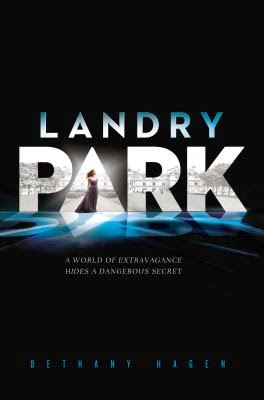
Landry Park

by Bethany Hagen
First sentence: “Two hundred years ago, America found itself at a crossroads.”
Support your local independent bookstore: buy it there!
Review copy snagged from the ARC shelves at work.
Content: There’s some talk of violence, though it’s all offscreen; a few mild swear word; and an illusion to an affair. It’s in the YA section (6-8th grade) of the bookstore, but I’d have no problems giving it to a younger child if they were interested.

Madeline Landry has grown up in a luxurious world: she’s the only child of an elite family and surrounded with opulence. She’s not particularly happy: she has struggles with her father over her education. She wants to got to university; he (and his will, not to mention the law) wants her to stay home, get married, run the estate, and pop out an heir. But she’s not entirely unhappy either: she loves her family and her home and the life. That is, until David Dana — the un-landed son of a gentry — comes into her life. Then, the things that have been skirting around her life — the class issues, the environmental concerns, especially with the lowest class, the Rootless — come front and center. Not to mention that David’s pretty dreamy.

In many ways, Hagen is treading the same ground as every dystopian book before her. America falls to the Eastern Empire, only managing to hang on by a thread. In the aftermath, a class system is formed — not based on race, as Hagen is so careful to point out — based on money and influence. And at the bottom are the Rootless, who handle the nuclear charges the gentry’s energy — and much of the wealth, especially the Landry wealth — comes from. And they’re getting restless. Where Hagen’s dystopian diverges from the pack is in the focus: Madeline is one of the elite, not the underclass. And when she has her eyes opened, she stands to lose everything. And I respected that.

I also really loved the world Hagen built, even though she never really gave us an explanation why the women were corseted and shoved into ball gowns and paraded around like it was Victorian England. I’m sure I could come up with some hypotheses — fancy dresses are synonymous with wealth? the women are as shackled as the Rootless? — but they are just that. No matter: Hagen is tackling issues that aren’t (readily, I think) usually seen in dystopia. Also, she doesn’t have a Romeo & Juliet love story going on here: both Madeline and David are from the gentry, and have to come to terms with their increasingly dissenting opinions.

It’s not a perfect beginning, but it is an intriguing one. I’m going to be curious to see where the rest of this series goes.

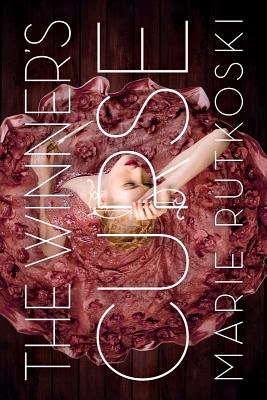
The Winner’s Curse

by Marie Rutkoski
First sentence: “She shouldn’t have been tempted.”
Support your local independent bookstore: buy it there!
Review copy pilfered from the ARC shelves at the bookstore.
Content: There is some violence, an attempted rape scene, some mild swearing, and a lot of politics. It’s in the YA section (grades 6-8th) of the bookstore.

Ever since I finished this book, I’ve been trying to think up a book talk about it. Some 30-second summary that I can give to entice people to want to read it. But I can’t. It’s partially because I’m enthralled with the book and once I start talking about it I just want to keep going and tell everyone ALL the good bits. And it’s partially because this one is REALLY hard to sum up.

I’m going to try, though.

It’s set in the fantasy world of Valoria, an empire of warriors loosely based on ancient Rome. Ten years ago they conquered Haran and enslaved all the people (they didn’t kill, of course). This is the world that Kestrel has grown up in. Her mother died when she was a young girl and her father — the general who led the invasion of Haran — has mostly raised her. He wants her to join the army — one of the two choices a Valorian girl has; it’s either that or get married — but Kestrel has resisted. Partially because she’s devoted to her music (taboo in Valorian society; music is for the slaves) and partially because she’s no good at it. What she is good at, however, is gambling.

I’m going to stop here and say that Kestrel is one of the more interesting characters I’ve read about, and one of the reasons I really liked this book. She wasn’t a “kick butt” heroine in the “traditional” fantasy sense of the word; she sucks at swordplay, is more interested in protecting her hands than learning how to slit a throat. But she is cunning. And observant. And willing to take risks and use what she knows (or deduces) to win a hand, whether that be in her game of choice, or in her life.

In fact, watching her strategize and manipulate the people around her was one of the most enjoyable aspects of this book. She’s not cruel — she’s actually sympathetic to the Haran rebellion that comes up — but she has her priorities, and she will do anything (anything!) to fill them. And even though it’s the first in a trilogy, this story line wraps up quite nicely.

The only weak leak is the Haran slave, Arin, that Kestrel falls in love with. He’s pretty much a one-dimensional character, and the love story felt, well, weak. Thankfully, there’s some nice twists near the end that fill it out much nicer. And maybe Arin will become more complex and fleshed out in later books.

Even with that minor quibble, I more than thoroughly enjoyed reading this one. I’m hooked.

The Tyrant’s Daughter

by J. C. Carleson
First sentence: “My brother is the King of Nowhere.”
Support your local independent bookstore: buy it there!
Review copy downloaded from NetGalley
Content: Some mild language, and some indirect violence. It sits in the YA section (grades 6-8) of the bookstore. I don’t know if I’d give it to a 5th grader or not. I think it depends on how news-savvy the kid is.

Laila is the daughter of the ruler of an unnamed Middle Eastern country. She has a good life — trips to Paris with her mother, a private tutor, a resort by the sea. Then one day her world turns upside down when her father is assassinated right before her eyes.

Suddenly Laila, her mother, and her younger brother, Bastian (the “little king”) are exiled, taking refuge in the United States as Laila’s fundamentalist uncle takes over the country. Not only is Laila exiled from her country, she’s thrown into a world that — for all the riches and opulence she was used to — is vastly different from her own. And, on top of that, as she meets other refugees from her country, she discovers that her loving father was actually a brutal dictator.

I think the publishers are billing this as a thriller — J. C. Carleson is a former CIA operative, after all — but it’s not. It’s much more one girl’s story of awakening, and the harsh realities that brings, as well as of the plight of immigrants and how difficult it is to make a new home. Although she makes friends in her Washington D. C. school, Laila never quite belongs here, being uncomfortable with little things: from wearing short skirts to the dance to the seeming nonchalance that the students have to a bomb threat. Laila is constantly a fish out of water, and I think Carleson captures that perfectly.

There are some thriller-esque elements; Laila’s mom is a constant schemer, and there’s a CIA guy hanging around ominously. And I felt the ending was a bit too pat, not quite fitting in with the rest of Laila’s story. But, for the most part, it was a fascinating exploration of one girl’s attempt to come to terms with her family and the outside world.

Grasshopper Jungle

by Andrew Smith
First sentence: “I read somewhere that human beings are genetically predisposed to record history.”
Support your local independent bookstore: buy it there!
Review copy highly recommended by our publisher rep.
Content: Weeelll….. sh*t is Austin’s favorite word, and all grasshoppers do is “f**k and eat”. Which gives you a pretty good idea of the language. And Austin and Robby smoke. There is some drinking and one very unsexy sex scene (and talk of masturbating and erections and sex). It’s in the teen section of the bookstore, but I know I’m going to find it difficult to find a parent willing to buy this one for their kid. (That’s not to say the kids won’t like it. They might.)

The short version, the one I’ve been pitching at work (after I realized it was more than “grasshoppers and sex” — though it is that), is that it’s what would happen if Holden Caulfield found himself in a Stephen King novel. Austin — he’s the 16-year-old, sex-obsessed boy whose head we’re living in — is confused and lonely (even though he has a best friend and a girlfriend) and angsty and more than a little self-absorbed, much like Holden. And yet, the setting is so utterly antithetical to our character: a strain of mutant bacteria gets out and starts changing people into six-foot-tall praying mantises whose sole purpose in life is to eat — everything, including each other — and procreate.

Who dreams up these sorts of things? (Well, Stephen King and Andrew Smith, obviously.)

At any rate, it’s nothing like what I expected. I think with all the advance buzz — not just from our rep, but also Publisher’s Weekly, and just the reviews on Goodreads — I expected something, well, amazing. And I got… well, a sex-obsessed, selfish, confused 16-year-old boy. I can deal with that, for the most part (I did make it through Winger after all), and I appreciated Smith for giving us a confused sex-obsessed boy; Austin’s not only confused about life, but also about his own sexuality: how can a person be in love with — and desire — both of his best friends at once?

But, reading through the Goodreads reviews, I stumbled upon one from Kellie at Stacked that made points that I think had been at the back of my mind while reading this book. Nominally, it boils down to this: a woman couldn’t have written a book like this about a girl talking so frankly about sex or her vagina and have it receive the same amount of buzz and acclaim that this one is getting. And secondly: Austin treats girls and women as objects.

The first point, I can see and understand and am a little bit miffed about. It really does go back to this “boy books” and “girl books” thing we (publishers/sellers/parents) have gotten into. We “need” this book because boys “need” this book (because they’re not reading anything else). But that least me to point number two, which is what was bothering me while I read the book. I had chalked it up to being inside a 16-year-old boy’s mind, which is not a comfortable place. But, looking back, it’s really because, to Austin, all women (well, perhaps all people) are a means to an end: sex. He says he “loves” his girlfriend, but honestly, he just wants to jump her. And this — at my very core — bothered me. (In fact, when Robby finally confronts Austin and tells him he’s selfish, I cheered. More of that, please.)

I was talking to a friend at work about this and she pointed out that maybe, just maybe, it was meant to be satirical or ironic. That perhaps we, as readers, were meant to see that Austin is a complete jerk, and find humor in that. Or at the very least, self-reflection.  Perhaps. All I found was discomfort.

There were other things I was disappointed in: Austin’s circular telling of his own personal history, his constant repeating of people’s names (yes, I know Shann’s name is Shann Collins and her stepfather is Johnny McKeon, can you PLEASE stop already?), and just the general uneven pace of the narrative. That said, there were things to admire: actual sentences that made me laugh aloud. Or the fact that Austin’s (and Robby’s for that matter) sexuality was just a thing, and not an “issue”. Or six-foot-tall unstoppable praying mantises.

But I don’t think the positives outweigh the negatives on this one.

Cress

by Marissa Meyer
First sentence: “Her satellite made one full orbit around planet Earth every sixteen hours.”
Support your local independent bookstore: buy it there!
Content: Some violence, none of it gruesome. It’s shelved in the YA section (grades 6-8th), but I’d have no problems giving it to a capable younger reader.
Review copy given me by our MPS rep, who likes to enable my addictions.
Others in the series: Cinder, Scarlet

Obviously: If you haven’t read the other two, there will be spoilers.

So, our fearless (of sorts), rag-tag crew of a cyborg, a scruffy-looking nerfherder of a pilot, a disembodied android, a human girl, and a Lunar wolf-man operative are on the run from the Commonweath government. What are the most-wanted on Earth supposed to do? Especially when there’s an insanely evil queen who’s trying to take over the world by marrying the super-hot emperor? (“Tyrone, you know how much I love watching you work, but I’ve got my country’s 500th anniversary to plan, my wedding to arrange, my wife to murder and Guilder to frame for it; I’m swamped”) Well, hang out in space, of course. And then go rescue Rapunzel in her tower. Or Cress in her satellite, that is.

Except the rescue operation goes wrong, and our group of rag-tag outlaws are split up. Scarlet ends up on Lunar (and doesn’t figure much in the story), Cress and Captain Thorne end up in the satellite, crashing in the Sahara desert. And Cinder, Wolf, and the New Guy end up looking for the crazy Dr. Erland. As the plot thickens….

C’s biggest complaint with this one was that there were too many plot lines. Which is true, to an extent. Meyer is juggling a LOT of balls here. And there are at least 5 (if not more) story threads running through the book. BUT. I thought she managed all her threads well. With the exception of Scarlet, who really wasn’t interesting until nearly the end of the book (oh, but then her story line is tantalizingly interesting, setting up the last book in the series, Winter, well), I thought what all the characters were doing were fascinating. My favorites — probably goes without saying — are the two MAIN main characters in this one, Cress and Thorne. I adored Cress as a character: she’s a bit insecure around people, having been trapped in a satellite for 7 years. And she’s a total fangirl. But she’s also a smart hacker, and a resourceful and determined (if a bit naive) girl. And Thorne, well, let’s just say Thorne is that perfect mix between all the roguish bad good guys in all the books and movies I’ve ever loved. (It’s hard NOT to have a crush on him.)

And even though Cinder’s finally coming into her own, and there are some brilliant moments, it’s still a middle book in a series. It doesn’t stand as well on its own as Scarlet did, but I wasn’t disappointed with where the story is going. Meyer has created a terrifically interesting world, and is doing some fun things mixing the fairy tales in with the cyborg/futuristic elements. I can’t wait to see how it all ends.

Dangerous

by Shannon Hale
First sentence: “The warehouse was coffin dark.”
Support your local independent bookstore: buy it there!
Release date: March 4, 2014
Review copy given to me by our publishing rep.
Content: There’s some intense action, and a few characters die. But there’s no language (its all “bleeped” out), and no sex. I think it belongs in the YA section at the store (grades 6-8) but I’d give it to curious younger kids.

Maisie Brown has lived a quiet life. She has scientist (read: introverted) parents and is happily homeschooled in her community just outside of Salt Lake City. But she has a secret dream: she wants to be an astronaut. She doesn’t think this will happen: she’s missing one of her arms, after all. But her middle name is Danger (literally) and when she gets an opportunity to enter a contest to win a week at a space camp in Houston, she goes for it.

And gets in.

She arrives at the camp — run by billionaire genius (not playboy) Bonnie Howell, who built the first elevator into space — not knowing that this week will change her life. That she’ll meet the Boy of her Dreams (who’s more than a bit of a jerk). That she’ll meet friends and watch them die. That she’ll become truly Dangerous.

In many ways, this was a breath of fresh air. One gets bogged down in the current trends in young adult/teen literature (read: paranormal or dystopian/post-apocalyptic) and to have something that is honestly science fiction with high tech gadgets, spaceships, and alien lifeforms. With honest-to-goodness average people doing techy, fun, science-based things. It was wonderful. And I really enjoyed Maisie as a character. She’s Latina (her mother’s from Paraguay), she’s smart, she’s confident, she’s disabled and she doesn’t let it get in her way. (In fact, at one point, she makes herself a pretty cool robotic arm.) And Hale does a good job incorporating most of the various elements she throws at us. The “fireteam” is a hodgepodge mix of races and cultures, but none of them seem like stereotypes (to me) and there ends up being a reason for it in the end. And although the love triangle was pretty silly (I think Hale makes it clear that it’s supposed to be silly), I did like that the love interest wasn’t love at first sight.

I did have some quibbles: mostly (and I understand why she did this) that she created a character who swears a lot, but then “bleeped” out all of the swear words. Literally. It pulled me out of the story, every single time. And while I loved that the parents were good people and good parents, they were a bit… corny. Which (again) pulled me out from enjoying story.

But, even with the quibbles, Hale does know how to spin a tale. And I was kept guessing with whom to trust and the ultimate motives. And a Latina superhero girl who kicks butt and is awesome and yet vulnerable without being irritating is, well, awesome.