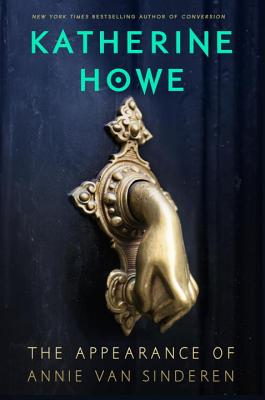
The Appearance of Annie Van Sinderen

by Katherine Howe
First sentence: “The cafe in the basement of Tisch, the art and film school at New York University, was redecorated this year.”
Support your local independent bookstore: buy it there!
Review copy snagged from the ARC shelves at work.
Content: There’s talk of teenage drinking (and some actual), plus drug use. There’s also one almost-sex scene. It’s in the Teen (grades 9+) section at the bookstore.

There is no way to write this, I think, without spoiling the premise. If you choose to go into this without knowing what it is, then you should probably stop reading now.

Wes is at NYU for the summer film workshop for a reason: he wants to transfer from the University of Wisconsin-Madison to NYU because Madison is, well, small. Constricting. The Same. He needs something different, and he Knows he can find it in New York City. (Well, can’t we all?) He’s out helping one of his friends, Tyler, film an art film at a seance when his life really changes: he meets Annie and Maddie. They’re edgy, they’re different, they are most definitely not from Wisconsin. And as Annie pulls Wes into her story (and he gets more tangled up with Maddie), he discovers that maybe the life-changing event he thought New York would offer him isn’t going to be in film school.

I’m going to say it, even though Howe danced around it: this is a ghost story. And, as such, it’s quite good. I liked not knowing that Annie was a ghost for a while — it took the whole first section for me to figure it out, though there’s a pretty big clue at the end of the prologue. I liked Wes’s discovering of her story, and how Annie flitted back and forth in time. I liked Howe’s historical detail; it’s most definitely something she excels at. And I thought the love triangle-ish thing between Wes, Annie, and Maddie was unique as well.

The only thing that really bothered me was that Howe refused to call a spade a spade. She never, once, admitted, in words, that Annie was a Ghost. She was a Rip Van Winkle. Every time it came up, they dodged the bullet. It got old. Just say she’s a ghost, please.

But, other than that, it was an intriguing weaving between past and present, and a unique way to look at ghost stories.

Zeroes

by Scott Westerfeld, Margo Lanagan, Deborah Biancotti
First sentence: “More coffee?”
Support your local independent bookstore: buy it there!
Review copy pilfered from the ARC piles at my place of employment.
Content: There’s some talk of drug use (none of it by teens), a smattering of mild swearing, and one (unnecessary, misplaced, and kind of glaring) f-bomb.

Who are the Zeroes?

They are six teenagers, all born in the year 2000, who have discovered, over the years that they have extra-ordinary powers. Bellwether can charm a crowd of people into believing whatever he wants them to. Crash is bothered by electronics, and she can make entire systems, well, crash. Flicker is blind, and yet she can see through every one else’s eyes. Anon isn’t invisible, but he is easily forgettable; his parents once forgot that he was deathly ill and left him (to die) in the hospital. Scam has this voice inside him that can talk anyone into anything he wants, which is what gets all the Zeroes into trouble.

With Mob, who can control a crowd’s mood, and her father, who is in deep with the Russian mob.

The question is: will the Zeroes be able to help them? Or are they just going to make things… worse?

It’s kind of hard to juggle multiple points of view in a book, and in this one they tackle six of them. Some of them — Anon, Flicker, Scam, and Mob come out with the best story arcs in the book — are really well developed. Others — Bellwether and Crash — aren’t so much. But, for the most part, the flipping between people helped push the story forward, and I found that I didn’t mind seeing the action from different perspectives.

And the story was pretty seamless, considering there were three authors writing. I was worried that it would be choppy, but whatever they did — editing, lots and lots of rewriting — worked.

It’s definitely a ton of fun.

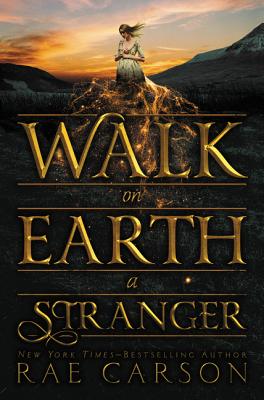
Walk on Earth a Stranger

by Rae Carson
First sentence: “I hear the deer before I see him, though he makes less noise than a squirrel — the gentle crunch of snow, a snapping twig, the soft whuff as he roots around for dead grass.”
Support your local independent bookstore: buy it there!
Review copy picked up at Children’s Institute and signed by the author (who I fangirled over).
Content: There’s some violence, including a few deaths, and some talk about sex (but none actual). It’s in the YA section (grades 6-8) of the bookstore.

Leah Westfall has a talent for finding gold. Well, maybe more than a talent: she can magically sense gold out in the wilderness. But, in northern Georgia in 1849, gold is getting pretty scarce. Even so, she and her parents get by. She’s fairly content. Then, her parents are brutally murdered by a man wants to control her “talent”, so she disguises herself as a man, runs away and head for the place where gold is most plentiful: California.

That’s basically the premise, as this book is primarily concerned with Leah’s — Lee’s — journey getting to California. It’s full of action and suspense, but it’s ordinary action and suspense. Robbers, rough rivers, threats from the known and unknown. It doesn’t seem like much, but it kept me turning pages.

This book deviates from Carson’s other works in that it’s more of a historical fiction piece and less of a magical one. Sure, Lee has magical abilities. But (so far), that’s the only magic. The rest of it, from the inherent sexism and racism to the trials they face while crossing the plains is historical. Even though I like Carson’s magic, I think I enjoyed this one more because the magic was so understated. It did help Lee out, on occasion. But for the most part, she was making her own way on her own terms. Which was awesome.

The other thing is that this is the first of a projected trilogy, but I have no idea where Carson is heading. Sure, the Big Bad isn’t taken care of, but he wasn’t a real threat in this novel either. I was actually content with the way this one ended: Lee survived the journey, she got to California, she can live happily ever after. However, I will follow Carson down whatever road she wants to take, and I wouldn’t mind reading more of Lee’s story at all.

Husky

by Justin Sayre
First sentence: “Ducks, now would you look at this!”
Support your local independent bookstore: buy it there!
Release date: September 22, 2015
Review copy provided by the publisher rep.
Content: There’s really nothing objectionable, though the subject matter is a bit on the more mature side. It will be in the YA section of the bookstore, though it’s probably good for 5th graders as well.

Davis is an only child, living with his mother — who is gone all the time, working at the bakery she owns — and his grandmother. His father’s out of the picture (dead? I think?) and his grandpa died a few years ago. And his grandmother is one of those Irish Grandmothers: overprotective, nosy, loud. The only real escape Davis has is his opera music (yes, he likes opera. No, it doesn’t come off as weird) and his friends, Sophie and Ellen. Except that Ellen is a sarcastic mean and likes Charlie (whom Davis isn’t really quite sure of), and Sophie has been hanging out with Allegra who is one of those stereotypical Mean Girls. So, where does that leave Davis?

During this summer before high school, Davis tries to figure all of it out.

I wanted to like it. Partially because I like our rep, and she really liked this one. But. I just didn’t get it. Davis was bothered by his weight, but it’s not a fat book. Which is a good thing. It’s not one of those books where he has to Overcome Being Fat in order to be happy. But, it’s also not a Accept Yourself and Be Happy book, either. On the one hand, it’s a process, and it doesn’t have a tidy happily-ever-after, which I respect. But I didn’t like the underlying assumption — especially at the end — that Davis was gay. A boy who listens to opera and whose best friends are girls isn’t necessarily gay. (Way to play into stereotypes.) That really bothered me, in the end.

Davis was a decent enough character; a bit lethargic for my tastes, and prone to being a reactor instead of someone who actually participates in his own life. But, it wasn’t a bad thing.

Aside from the stereotypes, I really can’t pinpoint why I didn’t love this book. It just wasn’t my thing.

Everything Everything

by Nicola Yoon
First sentence: “
Support your local independent bookstore: buy it there!
Release date: September 1, 2015
Review copy picked up at CI3 and signed by the author.
Content: There is a few mild swear words, and one sort-of on-screen, sort-of-off-screen sex scene. The publisher has it listed for grades 7 and up, which puts it in the YA section, but I might move it to the Teen (grades 9+).

Madeline has spent her entire life inside. White furniture, white walls, filtered air, the whole deal. It’s because she has Severe Combined Immunodefiency (SCID), which basically means she’s allergic to the world. Any little disease, any little microorganism will kill her. So, she stays inside, reading, doing her online school.

And then Olly moves in next door.

Okay: yes, the plot is predictable. Boy moves in next door, they meet and have instalike, and suddenly the girl is questioning her Life Choices and Taking Risks.

But I ate this up. I don’t know if it was the short chapters, snippets of Madeline’s thoughts and observations, interspersed by some charming line drawings. Or the parallel worlds between her being trapped inside her house because she’s sick and Olly being trapped because of his abusive father. Or just the chemistry between Madeline and Olly, which was fantastic. Or the fact that Madeline was Afro-Asian, and yet it wasn’t really an issue. She just was. Her mother is suffenciently controlling (for good reason), and I adored Carla the Latina nurse, who was really more of a mother figure to Madeline.

And all of this added up to overcome the predictable plot and make me fall for this book. Another absolutely amazing debut.

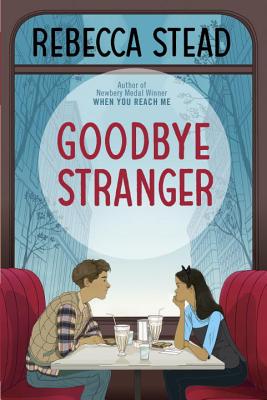
Goodbye Stranger

by Rebecca Stead
First sentence: “When she was eight years old, Bridget Barsamian woke up in a hospital, where a doctor told her she shouldn’t be alive.”
Support your local independent bookstore: buy it there!
Review copy picked up at Children’s Institute
Content: There’s one swear word. And several situations that are more middle school than elementary school. It’s in the YA section (grades 6-8) of the bookstore, but I’d give it to a fifth grader, especially as they’re approaching middle school.

I’ve been thinking about how to start this. It’s not an easy book to categorize: is it a book about friendship? Yes. About growing up? Also yes. About bullying and the shame girls feel about their developing bodies?Again: yes. About first love and that line between friendship and something more? Yep.

But it’s also more: it’s about doing the wrong thing and making it right. About figuring out who you are in the wake of change. And it’s all done with Rebecca Stead’s beautiful writing.

The story is nominally about three friends — Bridge, Em, and Tab — who have been friends since the third grade. They made a pact to always stick together and never to fight, which is easy until seventh grade. Then Em begins attracting the notice of older kids and boys, and, well, likes it. Tab becomes enamored of a feminist teacher and dives headfirst into the world of equality and civil disobedience. And Bridge is kind of stuck in between. She doesn’t really want to grow up (I can relate), and yet she’s kind of interested in it as well. She picks up a pair of cat ears on a headband and wears those through the fall and winter because they felt “right”. She’s not quite sure who she is, or where she fits.

There are plot points, and chapters written in second person by a “mystery” high school freshman narrator (I figured out who it was fairly quickly. Yay me!), but mostly the book is about every day little things as Bridge is trying to figure out where she fits in this weird middle school world.

I loved it, and I think I did for one reason: I saw both myself and my daughters in this book. I saw the awkward 7th grader I was, and realized that Bridge was okay in her journey, because I survived. I saw M and C in the friends, and the ups and downs of their middle school experiences. And I saw A, as she starts middle school next year, and was reminded (again) of all the changes that will come her way. And for that, I loved this. I loved the smallness of it (and the diverseness: Bridge is Armenian and Tab is Indian) and the hopefulness of it. And I loved that the friends did, in fact, make it work out.

I thought it was marvelous. I just hope it finds the kids who will think that too.

Trouble is a Friend of Mine

by Stephanie Tromly
First sentence: “Of course I didn’t like Digby when I first met him.”
Support your local independent bookstore: buy it there!
Release date: August 4, 2015
Review copy provided by the publisher rep.
Content: There’s some mild swearing. And inferences about drug use by teens. I think it’ll be in the YA section (grades 6-8) though. (It’s not too bad.)

Zoe is the product of a bad divorce: her Wall Street broker dad cheating on her mom. She generally sided with her dad, but ended up in her mom’s custody, moving to a small podunky college town in upstate New York after the divorce. Zoe doesn’t want to be there at all and when Digby — kind of the high school pariah, of sorts — decides that she needs to be his side-kick (she really doesn’t have much say in it; he really just inserts himself into her life and she doesn’t kick him out) in discovering what has happened to a local kidnapped teenager, she goes along with it. For kicks and giggles.

When the ARC came into the store, it had this sticker on it:

I won’t say it gave me high hopes, but I was expecting some laughs. And there were: Digby has a talent for getting into some very bad situations, and there was some pretty amusing antics trying to get out of them. And Zoe’s mom with her bumbling cluelessness was pretty amusing too. (Though: not as amusing as the mom in Finding Audrey.) But while I didn’t find it funny, I did find it endearingly charming. Incredibly charming. And fascinating. There’s a mystery running throughout — and not just the finding the kidnapped teenager one — that kept my interest, and kept me guessing, which added to my general enjoyment. And I just adored Zoe and Digby and their friend Henry. And all the other people they came into contact with. It was just… delightful.

So, maybe it’s not the hilarious read our rep promised. But it’s still definitely worth the time to read it.

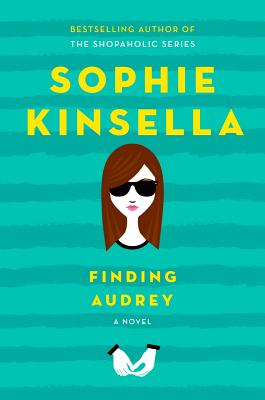
Finding Audrey

by Sophie Kinsella
First sentence: “OMG, Mum’s gone insane.”
Support your local independent bookstore: buy it there
Content: It has six f-bombs, all near the end of the book, and nothing else. So, I’m torn: do I leave it on the YA shelves (grades 6-8), where it thematically belongs? Or do I move it to Teen (grades 9+) where it’s not quite edgy enough, but it fits language-wise? Tough call.

Audrey doesn’t leave the house. Doesn’t talk on the phone. Doesn’t talk to people (outside of her therapist and her family). Doesn’t look people in the eye (in fact, she prefers to wear dark sunglasses all the time). She hasn’t done any of these things since the “incident”. And she prefers to keep it that way.

Before I go much further I have to interject: this is a hilarious book. Perhaps it’s because I love All Things British, but I was thoroughly charmed by Audrey and her family. It is possible to take something serious (like bullying — though you never really find out what happened, and that’s okay) and severe anxiety and to be, well, warm about it.

Maybe I should make a second diversion: I adored Audrey’s family. From her gamer older brother (with his mile-wide sarcastic streak) to her absolutely adorable four-year-old younger brother (adorable!) to her completely clueless dad (probably stereotypical, but it worked), to her over-protective mom (I will stand by my statement that the best way to be a good parent is to read YA books), they were all entertaining. Kinsella definitely wrote this with love.

(It reminded me, in some ways, of the Casson family books. That makes me happy.)

The arc of the novel is Audrey’s “recovery”. It’s aided by Linus, one of her brother’s friends who takes an interest in her. He supports her and pushes her to try new things, to somehow get a grip on her anxiety. I really liked that Audrey was never “cured”: she learned how to handle her fears and her body’s reaction to them, but they were always still around, which was not only realistic but somewhat of a relief.

Yes, things were kind of tied up in a nice bow at the end, but that’s kind of expected and I didn’t mind. In fact, I really quite enjoyed this.

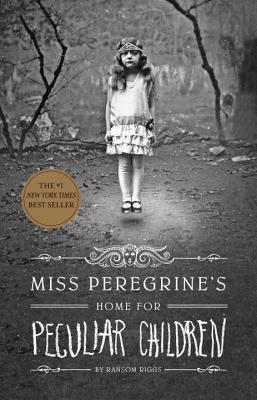
Miss Peregrine’s Home for Peculiar Children

by Ransom Riggs
First sentence: “I had just come to accept that my life would be ordinary when extraordinary things began to happen.”
Support your local independent bookstore: buy it there!
Content: There’s a few swear words and general creepiness. It’s in the Teen section (grades 9+) because that’s where adults want to find it, but I wouldn’t be adverse to giving it to a 7th or 8th grader.

I read this one by request of one of my fellow booksellers; she’d picked it for her summer teen book group and couldn’t make a session. So, I’m filling in.

I know the rest of the world has read this already, so I’ll spare much of the plot. I’ll just say that Jacob has grown up on his grandfather’s stories of the boarding school he stayed at in England during World War II. They weren’t normal stories, and the other children weren’t normal children. But Jacob thought that’s all they were: stories. That is, until his grandfather ends up dead in his garden, Jacob feels like he’s slowly going insane. So, he heads off to this island off the coast of Wales (or some place sufficiently secluded and broody and English-y) to find out the truth for himself.

Yes, the format was clever. Riggs intersperses (real) creepy, weird, old photographs and it’s quite unique how he incorporates the pictures. But, that’s all it was: clever. I never got past the whole “I’m supposed to be loving this?” feeling. Maybe it’s too much hype. Or maybe it was his writing. Or maybe it was just the mood I’ve been in, but this one fell flat.

On the other hand, that might make for more interesting discussion at the book group….

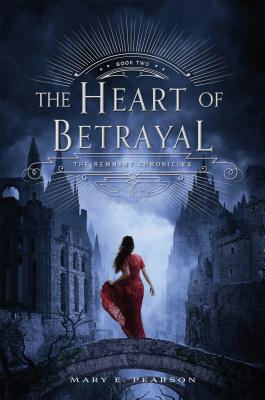
The Heart of Betrayal

by Mary E. Pearson
First sentence: “
Support your local independent bookstore: buy it there!
Review copy snagged off the ARC shelves at my place of employment.
Release date: July 7, 2015
Others in the series: The Kiss of Deception
Content: There’s violence, and a hint at sex (but none actual). It’s kind of slow moving, and complex, but it should be find for the younger end of the age range. It’s in the YA section (grades 6-8) of the bookstore.

Spoilers for The Kiss of Deception. You’ve been warned.

Lia is a prisoner in the “barbaric” country of Venda, having been kidnapped by Kaden, the assassin, and dragged there as a prize for the Komizar, Vendan’s ruler. Venda doesn’t take prisoners; their reputation for violence is well-deserved. But because Kaden has a thing for Lia, so he made an exception.

Lia regrets that now.

It doesn’t help that Rafe — the prince Lia was initially supposed to marry and whom she fell in love with when they were both pretending to be commoners — is also a prisoner in Venda, masquerading as an inept emissary. They have to keep it under wraps that they know each other (let alone that they care for each other), or they are both dead.

And that’s just the beginning.

It’s a twisty, turn-y maze of lies, double crossing, manipulation, maneuvering, and deception, and I loved every minute. Even the love triangle, which could have been trite, worked to Pearson’s advantage. Kaden and Rafe play off each other, and I truly didn’t care, really, which one Lia “ended” up with. (Honestly: the woman is her own woman, and doesn’t need either of them. You go girl!) There was complexities to the relationships that Lia had with both of them, and even though Pearson wrote that Rafe was Lia’s True Love, I never felt that that relationship defined her.

But what intrigued me most was Lia’s role in Venda, how she plays against the Komizar, trying to outsmart him, using his weaknesses (of which there are few) to her advantage. The Komizar is the primary villain, but Pearson gives him layers; he’s not simply an Evil Dictator Overlord (though there is some of that). Additionally, there was an element of prophecy to the book that could have been oppressive and lame, but I felt Pearson even worked that to her advantage. And Pearson is still ruthless: killing people right and left.

Of course, this ended on a cliff-hanger, and I have to WAIT until the next one comes out. Which is always the most difficult part.

Excellent.