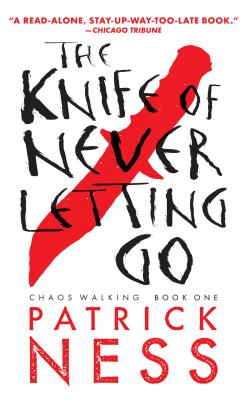
The Knife of Never Letting Go

knifeofneverby Patrick Ness
First sentence: “The first thing you find out when yer dog learns to talk is that dogs don’t got nothing much to say.”
Support your local independent bookstore: buy it there!
Content: There’s the anxiety factor plus a lot of violence plus the f-bomb a couple of times (though the main character says “eff” a lot). It’s in the Teen (grades 9+) section of the bookstore.

Todd is the last boy in Prentisstown in the New World. He’s waiting for his thirteenth birthday, which will come soon, and then he will become a man and join the other men in the town (and there’s only men). It’s an interesting place, this New World — there’s a virus that makes men’s thoughts (and only men, not women) audible, so not only is there no secrets, it’s chaotic hearing everyone else’s thoughts. But, as Todd is out gathering apples in the swamp, he encounters something he’s never experienced before: silence. Quiet. A gap in the Noise which turns out to be a girl.

Viola is part of a new wave of settlers to the New World, on the initial scouting ship. Her parents died in a crash, and when she finds Todd, she’s on the run from Aaron, who is Prentisstown’s fanatic religious leader. Then Todd is sent into exile and he and Viola are on the run, one step ahead of not only the insane Aaron, but the controlling mayor of Prentisstown and his army of fanatics.

There’s way too much to unpack in this novel in a blog post. Seriously. I’m glad I’m reading this as part of a book group, because I don’t think I could even begin to process it on my own. It’s a weird sort of mix between old-timey (the book is in a sort of dialect) Western and science fiction-y futuristic. It’s a survival story with a hint of dystopian. It’s weird and wild and gave me anxiety over and over again (!) and I practically read the whole 480 page book in two sittings. It’s engrossing and there’s so much to discuss. And even though it was written eight years ago, it’s still so very relevant.

My only complaint? The cliffhanger ending. ARGH. I’m just glad I can pick the next book up and read it right away, and I don’t have to wait for it to come out.

If I Was Your Girl

ifiwasyourgirlby Meredith Russo
First sentence: “The bus smelled of mildew, machine oil, and sweat.”
Support your local independent bookstore: buy it there!
Review copy pilfered off the ARC shelves at my place of employment.
Content: There’s some almost sexytimes, teen pot smoking and drinking, and a few instances of the f-bomb. It’s in the Teen (grades 9+) section of the bookstore.

I’m going to get this out of the way, first. Whether or not this book is Good, it’s Important. It’s a book about a trans teenage girl written by a trans woman, and that perspective is invaluable. Period.

It’s an interesting plot, though, focusing not on the act of transitioning, or the reasons of transitioning (those come through flashbacks throughout the story), but the after-effects of the transition. Andrew grew up knowing he was a girl, and that he was just in the wrong body. And after a suicide attempt, his mother approved his transitioning — not just in name, Amanda now, but fully, with hormones and surgery. So, when she’s beaten up by a man for using the “wrong” restroom (because she was known in the their town; also, how very timely…) she heads to rural Tennessee to live with her father, who bailed on the family when Andrew began his transition to Amanda.

The goal is to pass: she is beautiful, and no one really can “tell” she wasn’t always biologically a young woman. And, at first, it all goes well. Sure, she’s hiding her past, but she’s living as her truest self, so it all seems like it will be okay. She has friends for the first time in a long time. She has a boyfriend. The problem is that even though she’s living as her truest self, keeping her past a secret isn’t always a comfortable thing.

(I hope I’m writing about this right.)

What this gave me, as a cisgender straight woman, was perspective. I did enjoy the romance; Amanda and Grant were super cute together and Russo does know how to write some good almost sexytimes. But what I found I enjoyed more was the understanding, the humanizing of Amanda. I’ve said that books are an excellent way to gain empathy for those who are different from you, and this was no exception. I feel like, through Amanda, I got to know one trans person’s story. And while that’s not to be taken as Everyperson’s story — as Russo points out in the note at the beginning of the book  — it’s a start. It made Amanda’s hopes, dreams, and feelings real to me, and that’s important.

So, even if this book wasn’t any Good (and it was very well written; Russo does know her South!), it’s Important. And that counts for a lot.

Outrun the Moon

outrunthemoonby Stacy Lee
First sentence: “In my fifteen years, I have stuck my arm in a vat of slithering eels, climbed all the major hills of San Francisco, and tiptoed over the graves of a hundred souls.”
Support your local independent bookstore: buy it there!
Review copy provided by the publisher.
Content: There’s some violence (done my Mother Nature) and some horrible people saying horrible things. Also, an illusion to sex (by minor adult characters). It’s in the YA section (grades 6-8) of the bookstore.

Mercy Wong has Aspirations and Goals. She wants out of Chinatown, where the whole of San Francisco in 1906 wants to keep her and her family. She wants more than marriage (though she does like Tom, the son of a respected apothecary). She wants to Be Somebody. And, she’s decided that St. Clair’s School for Girls is the way to get it. She bargains her way in, and discovers that things aren’t always as simple as they seem. Then the earthquake hits, and when everything comes crashing down around Mercy, she discovers that perhaps the best things in life are friends and a bit of determination.

This really was a nice combination of historical — the dresses and rules of etiquette and restrictions on women — and modern, with Mercy’s progressive ideas and determination to do things without the permission of authority figures. Lee did a great job balancing the two, so it never felt too modern, nor too old-fashioned. I appreciated seeing San Francisco through a Chinese girl’s point of view, and Mercy really is one of those characters you just want to root for. I liked that while there was a romance, it didn’t dominate the story, and that Mercy was enough of her own person to make the romance believable rather than sappy.

I should go back and read Lee’s first book; I’ve heard good things about it. And if it’s anything like this one, it’s sure to be good.

Summer Days and Summer Nights

summerdaysedited by Stephanie Perkins
First sentence: “There were a lot of stories about Annalee Saperstein an d why she came to Little Spindle, but Gracie’s favorite was the heat wave.”
Support your local independent bookstore: buy it there!
Content: Some stories are sweary (including f-bombs), some have drinking. I don’t think there’s any sex (maybe some references to it, but none actual.) It’s in the teen section (grades 9+) of the bookstore.

Short story collections are hard books to talk about. Do you talk about the theme as a whole — ah, swoony summer romance, how wonderful it is? Or do you talk about individual stories, and how they resonate with you? (And how hard it is to actually read short stories? You get going and settled in the story and then it ends. *sigh*)

I did love that the stories by authors I knew absolutely fit them: Libba Bray of course would write a story about a haunted classic movie. Stephanie Perkins’, Nina LaCour’s, and Jennifer Smith’s stories felt like their books. Cassandra Clare’s was kind of lame (it was supernatural, sure, but underdeveloped). Some were definitely better than others: I really like Brandy Colbert’s story as well as Lev Grossman’s.  And surprisingly, Veronica Roth’s story made me tear up.

Is it something I’m going to come back to over and over again? No. But that’s the nature of short stories: they’re there, and they disappear as quickly as they come. But, I did enjoy the time I spent with it.

When Friendship Followed Me Home

whenfriendshipby Paul Griffin
First sentence: “You’d have to be nuts to trust a magician.”
Support your local independent bookstore: buy it there!
Review copy provided by the publisher.
Content: It’s not a difficult read, and there’s nothing objectionable, but the subject matter is probably more serious than your average 8- or 9-year-old will want. That said, if they’re interested, I’d give it to them. It’s in the YA section (grades 6-8) of the bookstore.

Ben has had a rough life. He was dropped off at a group home when he was a baby, abandoned by his mother. He made friends, but one of them died after an accident. That lead to him meeting a social worker, an older woman whose partner had died, and him being adopted by her. Everything was looking up, especially after he found a stray dog (who ended up being the dog of a woman who had recently become homeless) and met a new friend, Halley, who is in remission from a rare cancer.

If you’ve read ANY middle grade/YA books, you know where this one is headed.

On some level, I wanted to be annoyed with this book. I felt like Griffin employed every single cliche out there: Manic Pixie Dream Girl, Dead Parents, Bad Parents, Cancer Book, it’s all in there. I wanted to be annoyed at it. I was a little frustrated when I realized the direction it was taken. But… I didn’t hate it. I didn’t.

Partially, it’s because it’s self-aware. There’s one quote, early on when Ben and Halley are talking about a story they’re writing, where Halley says, “Well, you have to get rid of [parents] somehow, and that is the most merciful yet expeditious way. Otherwise how do you turn her into an orphan? This is a middle grade story, for like ages ten to fourteen, and the rule is you need an orphan.”

I laughed, and as the book went on, I realized that Griffin knew what he was doing. He was Making Points, but subtly, and I didn’t hate him for his messages. I liked Ben and Halley and Flip the dog, among other characters, so I could get past the messages. And even though I wasn’t Moved by the book, I did enjoy reading the stories. And it was, in fact, written well.

So, I’m torn. I didn’t Love it like I wanted, but I didn’t loathe it either.

The Museum of Heartbreak

museumofheartbreakby Meg Leder
First sentence: “In her junior year of high school, Penelope Madeira Marx, age sixteen going on seventeen, experienced for the first time in her young life the devastating, lonely-making, ass-kicking phenomenon known as heartbreak.”
Support your local independent bookstore: buy it there!
Review copy provided by the publisher.
Content: Lots and lots of swearing. So much that it landed itself in the teen (grades 9+) section of the bookstore.

Penelope has been friends with Audrey and Eph for forever. They’ve been a trio, with traditions and in-jokes, and Penelope loves it that way. She loves the consistency, the predictability, the comfort of it all. Except, in their junior year, things aren’t right. Audrey has been going off with another girl, one who is mean to Penelope, and Eph is, well , increasingly distant. Things just aren’t the same.

The best thing about this book (well, aside from Pen and Eph; they’re both fantastic characters) is the format. Every chapter starts with an “artifact” from Pen’s friendship history. A sweatshirt, a piece of paper, a toy. A memory, a connection. It’s very much a book about things falling apart, about changes that are spiraling out of control. The format fit the theme of the book, which I found wonderfully delightful.  (Even the douchebag characters who totally deserved everything.)

In fact, I found the whole thing delightful. A perfect summer read.

The Shepherd’s Crown

shepherdscrownby Terry Pratchett
First sentence: “It was born in the darkness of the Circle Sea; at first just a soft floating thing, washed back and forth by tide after tide.”
Support your local independent bookstore: buy it there!
Others in the series: Wee Free Men, A Hat Full of Sky, WintersmithI Shall Wear Midnight
Content: It’s perfectly appropriate for all ages; no swearing, some drinking by hard working adults, though it might be a bit complex, plot-wise for the younger set. It’s in the YA section (grades 6-8) of the bookstore.

I didn’t think the Tiffany Aching series needed another book to end the series, but since Sir Terry has passed away, and this came out, this one must be read. I did put it off, mostly because if I didn’t read it, the whole thing can’t end. Right?

It’s spare-er than the other Tiffany Aching books, mostly because Pratchett didn’t have as much time to fiddle with it. Still, it has a story with a decent plot, even if it feels somehow less full. Granny Weatherwax has passed on, making Tiffany  her successor, and so Tiffany is trying to balance being the witch of two steads. And her death created in the elf world: the queen is overthrown and the elves are back in the human world making mischief again. It’s a lot for one young woman to handle.

Thankfully, solutions come her way: Geoffry, the son of some lord or another, is much maligned at home, but he leaves and Tiffany takes him on as a helper. It turns out that he’s a great witch. And Tiffany takes in the elf queen once she gets thrown out, and discovers that sometimes the person you’ve always thought of as awful, may not be.

I loved it. I love Tiffany Aching so much anyway, with her practical witchiness (yes, there is magic, but being a witch in this world is such a practical affair). I loved the gender-bendiness with Geoffrey wanting to be a witch (not a wizard, which is what men Traditionally Do), and how the witches just accepted that. I appreciated that Geoffrey got a bunch of elder men, who were generally considered Useless, to help out with the Final Battle. And I loved the end. So much that I cried.

And while I am sad that there really won’t ever be any more Tiffany Aching books, I’m so very happy that Sir Terry thought up this one for us.

The Last Star

laststarby Rick Yancey
First sentence: “Many years ago, when he was ten, her father had ridden a big yellow bus to the planetarium.”
Support your local independent bookstore: buy it there!
Review copy sent to me by our publisher rep.
Others in the series: The Fifth Wave, The Infinite Sea
Content: It’s violent and intense; Yancey pulls no punches. There’s also a lot of (understandable) swearing, including f-bombs. It’s in the Teen section (grades 9+) of the bookstore.

If you can, read them all one right after the other; the impact of this one will be that much greater. Like the past two, I’m not going to go that much into plot; it’s really better if you just hit these as blind as possible.

I re-read my review for Infinite Sea, and my thoughts are mostly the same here. It’s intense. bordering on hopeless. Cassie and Zombie and Evan and Ringer and Sam are trying, against the odds, to prevent the end of the world. In many ways, it’s too late: the aliens have pitted us against ourselves:  if there’s no trust, there can be no civilization. But maybe, just maybe, they can prevent the world from completely imploding — Evan’s assured them that the aliens will start bombing the cities any day now — and keep millions more people from dying.

It was the hoping against hope that got me in this one. I read it slower; in small doses over several days this time because I couldn’t take the building hopelessness: will it work? There’s no glorious Independence Day or Men in Black climax here. Sure, it’s a small plucky (though increasingly small and increasingly desperate) team against incredible odds, but Yancey never shies away from the cost of those odds. I found that I appreciated it very much. It’s an incredibly intense series (I’m actually kind of sad the movie didn’t catch on the way Hunger Games did), and an powerfully written one.

I’m sad to see it end.

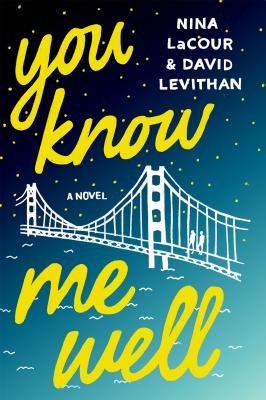
You Know Me Well

youknowmewellby Nina LaCour and David Levithan
First sentence: “Right now, my parents think I’m sleeping on the couch at my best friend Ryan’s house, safely tucked into a suburban silence.”
Support your local independent bookstore: buy it there!
Release date: June 7, 2016
Review copy provided by the publisher.
Content: There’s illusions to sex (but none actual), some underage drinking, and lots of f-bombs. It’ll be in the Teen section (grades 9+) of the bookstore.

Mark and Kate have sat next to each other in Calculus all year, but it isn’t until a June night at the beginning of Pride week in downtown San Francisco that they actually see each other. Mark is suffering from heartbreak: he’s been in love with his best friend for years, but his best friend isn’t really comfortable coming out as gay. Kate is supposed to be meeting this girl, the cousin of her best friend, but her anxiety takes over and she’s bolted. Between the two of them, maybe they can figure out their lives, their future, and which direction to go from here.

The thing that impressed me most about this was that it was less about the romance — although there was romance — and more about how Kate and Mark developed their friendship. It was about them needing a change from their lives and finding something new in a new person, something that allowed them to become More than they already were. It was about them being there for each other, not romantically, but as a good friend. And it was about jealousy that we all feel when our friends do something new or something different without us, about how sometimes that’s the hardest part of growing.

I liked how it felt seamless between Kate and Mark’s parts; that characters who showed up in one part felt authentic in the other, how LaCour and Levithan balanced their character’s stories. And, as a cis-gender straight person, I was able to find things to relate to. Life really is universal.

Quite good.

Written in the Stars

writteninthestarsby Aisha Saeed
First sentence: “‘Naila, I wish you didn’t have to miss the game,’ Carla tells me.”
Support your local independent bookstore: buy it there!
Review copy provided by the publisher ages and ages ago.
Content: There’s a (non-graphic) rape and some REALLY bad parenting. It’s in the Teen (grades 9+) Section of the bookstore, but if a 12- or 13-year-old were interested, I’d recommend it.

This was one I’ve been meaning to read for a long, long time. I have no excuse for not getting to it, except that I have a LOT of books to read (so much so that I’m actually starting to panic about my piles. There’s just not enough time!) and many things competing for my attention.

But, recently, I picked this one up and gave it a try. And finished it nearly in one sitting. It’s just THAT compelling.

Naila is the daughter of Pakistani immigrants, ones who are fairly traditional. While she can go to public school and is not required to wear a hijab, she’s not allowed over at friends’ houses, to date, to drive, and college is still up for grabs. (An interesting side-note: Saeed never spells it out, but the discrepancy in treatment between Naila and her younger brother is both unsurprising and frustrating.) She happens to have a boyfriend, though, one she keeps secret from her parents. And when her secret gets out, her parents react by whisking her away to Pakistan where they go about arranging a marriage for her. Behind her back.

It’s awful.  Seriously: I know that arranged marriages like this happen, and that they’re not always bad, but Saeed makes no bones about it: the way Naila’s parents go about this, in order to “save” her honor from the boy she picked, is just awful. And that’s being mild.

It’s an interesting thing to think about though: the balance between choice and tradition, between religious principles and progressive thought (I’ve been trying to think of a better way to say that, and I just couldn’t), between The Way Things Have Always Been and what individuals want. It was especially interesting reading it as a parent because I could see that while her parents thought they were doing right, they were so, so very wrong. And that’s a tough thing to see.

It’s excellently written, highly diverse (hardly any white people at all!), and an intriguing story. One that I hope many, many others will read.