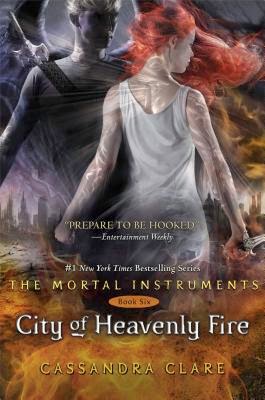
City of Heavenly Fire

by Cassandra Clare
First sentence: “On the day Emma Carstairs’s parents were killed, the weather was perfect.”
Support your local independent bookstore: buy it there!
Others in the series: City of Bones, City of Ashes, City of Glass, City of Fallen Angels, City of Lost Souls
Also helpful to read before picking up this one: Clockwork Angel, Clockwork Prince, Clockwork Princess
Content: There’s violence, some mild swearing, and some sexytimes. The sex is tasteful and protected (yay!), but it is depicted, to an extent. This entire series is in the Teen section (grades 9+).

I’m not even going to try and sum up what has happened up to this point, or even what happens in this book. Coming in at over 700 pages, to say a lot of stuff happens is a major understatement. But, everyone is here: Jace and Clary, Simon and Isabelle, Alec and Magnus, Jocelyn and Luke, as well as hangers on: Brother Zachariah (yay!) and Tessa each play a role, as do Maya and Raphael. And, of course, the big baddie, Sebastian.

It also introduces new characters in 12-year- old Emma Carstairs and her best friend Julian Blackthorn. They don’t really play a huge role in the story; mostly they just play small roles. But they — and their family — are involved enough that we get to know them. And — and this is a complaint I have — they serve as a linchpin for a start of a new series. At some point, one does have to wonder, I think, if Clare can write any stories in a different world. But then, why should she, when this one is so rich?

It was nice to hang out with Clary and crew again, to see how relationships have developed, and follow them as they try to thwart Sebastian’s evil plan. Like always, Magnus was the most interesting character, and I was thrilled to see the way he and Alec’s relationship went. There’s some heartbreaking moments, and Simon even gets to shine with his Dungeons & Dragons references.

It’s a good conclusion (of sorts) and a fun story, even for all its length.
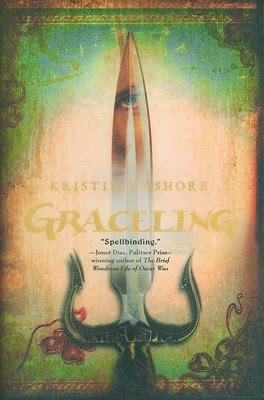
Re-read: Graceling

by Kristin Cashore
First sentence: “In these dungeons the darkness was complete, but Katsa had a map in her mind.”
Support your local independent bookstore: buy it there!
Content: There’s some tasteful sex, a lot of violence, and you need to be somewhat more mature to understand what Leck is capable of in order for it to have its full impact. It’s in the Teen section (grades 9+) of the bookstore, but I wouldn’t hesitate to give it to an 8th grader who was interested.

For June’s YAcker book, we picked Bitterblue, but one thing led to another, and we ended up making a summer project of reading Cashore’s trilogy. I’m not one for re-reading books, but since I hadn’t picked this one up in 5 years, I thought, in order to be an intelligent participant, I needed to reread it.

And, oh, it was just as wonderful as it was the first time.

I don’t have much more to say (the above link takes you to my initial review) that won’t be said when the YAckers post our discussion. But let me say this: I love Kasta. Her fierceness, her depth of emotion, her contrariness. And I love her with Po. I love their team, I love their relationship. I love how Cashore describes them together.

And I love Bitterblue. I’d forgotten that, not having reread this when Bitterblue came out. But, she’s so small and so fierce, and I love her.

The Inventor’s Secret

by Andrea Cremer
First sentence: “Every heartbeat brought the boy closer.”
Support your local independent bookstore: buy it there!
Content: There’s a couple of intense romantic moments, and the characters talk of “wanting” each other, but no actual physical contact takes place other than kissing. There is talk of an affair a character’s dad had, and there is quite a bit of violence. It’s in the YA section (grades 6-8th) but I wouldn’t blink at giving it to a savvy 5th grader.

It was the cover that caught my eye. The steampunk dragonfly with the explosion in the background promised really cool things. And since I hadn’t read any Cremer before (she of the Wolf series), I wasn’t really expecting anything.

So, I was more than blown away when I was pulled into an alternate history where the American Revolution failed, Boston converted to a maximum security prison, and the “traitors” were hanged for their crimes against the crown. And they were the lucky ones. In the years since the failed revolution, the Empire has just become stronger and more stratified. The elite live in the Floating City, New York City, in levels rising up into the sky. The lower you are, the worse off. There’s still a rebellion, out in the woods outside of the city, where the adults are trying to topple the Empire. And the children? They’re in the Catacombs, underground, safe from harm until they turn 18 and go to join the rebellion.

The Catacombs is all Charlotte remembers. She and her older brother, Ash, have been there since they were 5 and 7, respectively. And now, at nearly 18, Ash is in charge. This is where the plot gets a bit tricky to describe. Too much, and it sounds silly. And maybe it is.  I do know there was more romance than I was expecting, and it was a bit hackneyed and overwrought as well. But I loved the world. I loved the combination of history and mythology and technology. I loved how the class issues were at the forefront. I loved the imagination that Cremer put into the book, the cool little things — like mice bombs, or Pocky the gun — she littered everywhere.

No, it’s not perfect. Far from it. But it IS fun. And that’s exactly what I needed right now.

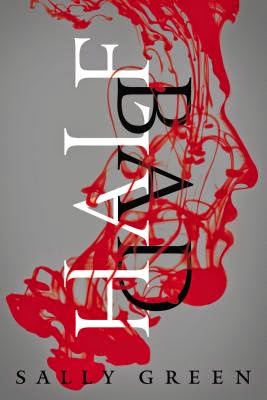
Half Bad

by Sally Green
First sentence: “There’s these two kids, boys, sitting close together, squished in by the big arms of an old chair.”
Support your local independent bookstore: buy it there!
Review copy pilfered from the ARC shelves at my place of employment
Content: There’s talk of imagined sex (none actual), and some (mostly mild) swearing. But the talk of the abuse Nathan takes is hard to get though, even for me as an adult. It’s in the teen section  (grades 9 and up) because of that. Be wary of giving this one to an overly-sensitive person.

I was talking this book up in January to a group of educators, saying to look for it, that Green turns the whole “white=good and black=bad” thing upside down. How little did I know.

It does do that: sure. But to say that’s all this first in a trilogy does is to woefully underestimate it.

Nathan is the illegitimate child of a White Witch — his mother — and the baddest of all Black witches. Marcus, Nathan’s father, has alluded the White Hunters for years. And so, to say that having his kid in their midst irks them is a gross understatement. So the council imposes Codes — restrictions — on all Half Bloods. They start mild, with yearly assessments, but get increasingly more restrictive as Nathan gets older. It ends with him being held in a cage for two years. This is partially because of a vision Marcus saw that Nathan would kill him. The White Hunters want to make that happen: he’s ostensibly being “trained” to murder his father. Not that he has any say in the matter.

So, yes, Greene is turning good and evil upside down; how can the “good” people treat someone who is different from them so atrociously. (And believe me, it’s worse than bad.) But, the black witches don’t fare so well, either. Marcus, from all reports (granted, they’re  untrustworthy) is a despicable person. And the one time we see him, he doesn’t entirely acquit himself either. And the only other black witches we see aren’t that much better. Perhaps it’s more a treatise on how power corrupts, and how differences become so ingrained that we can’t see those who aren’t the same as us.

And even though it was difficult at times to get through, emotionally, it did give me a lot to think about. I’m quite interested to see where she goes with this series, and if she can keep up the complex nature of the characters.

All These Things I’ve Done

by Gabrielle Zevin
First sentence: “The night before my junior year — I was sixteen, barely — Gable Arsley said he wanted to sleep with me.”
Support your local independent bookstore: buy it there!
Content: There’s talk of sex and a lot of kissing, but nothing graphic. And there’s talk of violence, but again, nothing graphic. It’s in the YA section (grades 6-9) of the bookstore.

This one is a hard one to sum up, partially because the world Zevin created is so complex. It’s futuristic, but not exactly a post-apocalyptic or dystopian. It’s a world where things are strictly rationed, and coffee and chocolate and books are illegal. So, much like alcohol in the 1920s, there is a strong black market for those items. And our main character, Anya Balanchine (her friends call her Annie), is part of the Balanchine mafia family that has a strong presence in the chocolate market. Her father was the head of the family until he was shot and killed (in front of her) when she was 9. Annie and her older brother, Leo (who is slightly mentally disabled due to another hit meant for her father that killed their mother and disabled Leo) and younger sister Natalya have been raised the past 7 years by their grandmother, whose health is slowly failing.

Over the course of the year, things spin out of control for Annie. Her ex-boyfriend, Gable, ends up poisoned by chocolate, and Annie ends up in juvenile prison because of that. She falls for and dates the son of the assistant DA, in spite of the extreme pressure to break it off. She stresses about Leo, especially since he begins working for the family. And her grandmother finally passes away.

All that managed to fill up the book, which I wanted to like very much. But, aside from world creation, there really isn’t much there. Annie is a fascinating character, but I got tired of her waffling. I wanted her to step up and take charge. It’s not good when the most interesting character is the head of the Japanese mafia family who shows up for probably 10 pages. I hoped for more out of this one, and was disappointed.

I might give the second one in the series a try, just to see if it gets any better.

Dorothy Must Die

by Danielle Page
First sentence: “I first discovered I was trash three days before my ninth birthday — one year after my father lost his job and moved to Secaucus to live with a woman named Crystal and four years before my mother had the car accident, started taking pills, and begin exclusively wearing bedroom slippers instead of normal shoes.”
Support your local independent bookstore: buy it there!
Review copy handed to me by my manager who said “Get on this.”
Content: A pregnant teenager, a moderate amount of swearing including a few f-bombs, and some violence. The book belongs in the store’s teen section (grades 9+).

At first glance, the idea of this book is awesome: Dorothy from Wizard of Oz, didn’t want to be in Kansas after she went home, and found a way back to Oz, where she has taken over and is not only a tyrant, but she’s a bully. And she’s draining Oz of its magic. It is going to take another girl from Kansas — Amy, of the trailer park — who finds her way to this new and drained Oz, to kill the tyrant and save Oz from certain ruin.

See? Sounds pretty cool, right?

Well, not so much.

It’s not that this one was Horrible, per se. There were a lot of things to like about it, starting from the cool idea. I liked the way that Page developed the magic in the world, and made the Wicked Witches if not the good guys, at least the better ones. I liked Amy, and her willingness to try even though the odds were against her.

But that was about it. I won’t delineate my entire complaints (which include having Amy say “I was used to cornfields back in Kansas..” UM, where??), but rather my main one, this: why is this book not a stand-alone? There really was nothing in this book that either 1) warranted that it be 460 pages or 2) meant for it to go longer than one book. I think with some better plotting and editing (and less of the pregnant bully in the beginning) this could have been a tight, fun, cool romp in a unique version of Oz.

I guess I’m a bit miffed that it’s not, and that’s effecting how I see the book. Others (who don’t mind the whole drawn-out-ed-ness of this one) may find it more enjoyable. Part of me hopes she finds success with this, because it’s a really cool idea.

I just wish the execution was better.

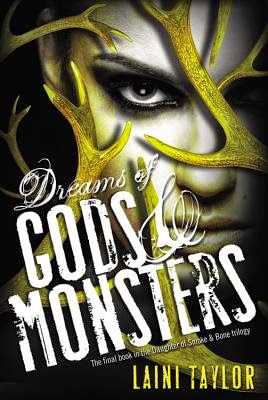
Dreams of Gods & Monsters

by Laini Taylor
First sentence: “Nerve thrum and screaming blood, wild and churning and chasing and devouring and terrible and terrible and terrible –“
Support your local independent bookstore: buy it there!
Others in the series: Daughter of Smoke & Bone, Days of Blood & Starlight
Content: There’s a lot of violence, and some mild swearing. Nothing as dire as the previous book, but it’s still hard to take, emotionally. It’s in the teen section (grade 9+) at the bookstore, but I would give the series to an 8th grader.

I’m at a loss where to begin. I suppose it’s with you reading the other two books before this one. While Taylor refreshed my memory (very eloquently) about the other books, you are missing a ton by not starting at the beginning of this story.

Also, by saying that even though this is a 600 page book, not much is extra. (M disagrees with me: she thinks Taylor could have cut out a couple of the subplots and the Epilogue and it would have been better.) Taylor picks up immediately after the events of Blood & Starlight and gives us the Apocalypse via angels. We’re introduced to a new character, Eliza, a PhD student in biology, who is on earth while everything in Eretz is falling apart. There’s something about her — I won’t tell you what — and even though she’s new to the book, she fits right into this elaborate and crazy world that Taylor has created.

There’s so many threads going on in this book, I couldn’t even begin summing up. And Taylor manages them all mostly deftly. She does introduce a new conflict when there’s 100 pages left, and it’s much too tidily wrapped up (or at least dismissed), but other than that, there’s so much too love. Mik is fantastic (there was one point where I was laughing and cheering; he and Zuzana MAKE the book), and Karou is incredible. In fact, that was the one thing I truly came away from this book with: the women rock. Seriously. And in so many different ways. They’re villains and tough and tender and loving and hurt and compassionate and just so, so complex. It’s fantastic.

The whole series is. The only thing I can say that was truly bad about this is that it’s over.

The Shadowhand Covenant

by Brian Farrey
First sentence: “It was exactly the funeral Nanni always wanted.”
Support your local independent bookstore: buy it there!
Others in the series: The Vengekeep Prophecies
Content: There’s some intense action-related moments, and a small amount of violence, but nothing else. It’s perfectly happy in the middle grade (3-5th grade) section of the bookstore.

When we last left our fair Grimjinx family, they were trying to leave behind thieving. Jaxter was off to the Dowager’s estate to become apprentice to her, and the rest of the family was becoming (mostly) clean. Six months later, things aren’t exactly happy. Jaxter and the Dowager are fighting and he’s seriously considering giving up the internship altogether. So, when he heads back for Nanni’s “funeral” (it’s Par-Goblin custom to throw a funeral when a thief retires), he’s pretty much sure that he’s going to try and find another line of work.

But then, he, his Ma and Da get summoned by the Shadowhand, a super-secret organization of thieves. Someone’s making them disappear. And it seems to be tied up with valuable relics that were stolen from the High Laird. And the Sarosans — a group of gypsy-like people who are against magic and the Palatinate, the group of mages who seem to be grabbing too much power.

Of course, Jaxter gets involved (though not because he wants to; his hand is kind of forced), and he uses his knowledge of plants and powers of deduction to help him — and his friends — out.

Much of what I loved about the first book in this series is back: I adore the Grimjinxes as a family. They’re fantastic. It’s not very often that you have amazing parents in middle grade, but Ma and Da are them. Sure, Farrey has to find a way to separate Jaxter from them so he can have adventures. But they’re so supportive and just plain good people (thieving aside, of course). And I still love how bookish Jaxter is. He’s not athletic, and he’s terrible at magic, but somehow he makes his book knowledge work for him.

I also liked the action in this one; Farrey has a good sense of action sequences, and there were a couple of moments when I was on the edge of my seat, wondering what’s going to happen next.

And Farrey does a series right: each of these books have their own plot, wrapping it up by the final pages, while having a slower over-arcing plot weave them together. The writing’s smart, the characters fun. It’s fantastic.

Slated

by Teri Terry
First sentence: “I run.”
Support your local independent bookstore: buy it there!
Content: It’s a pretty intense book, and I think the plot would be a bit difficult for younger readers to understand. But there’s nothing “objectionable” it. It’s in the YA section (grades 6-8) of the bookstore.

Kyla has no memory beyond the past six months she’s been in the hospital in London. See, she’s been Slated by the government: a process done to criminals and terrorists to remove their memories. It’s most effective the younger you are — Kyla is only 16 — and after the process, they tie your consciousness to a device called a Levo, which monitors your endorphin levels. If you get too low, you black out. And die. Obviously, it’s supposed to reform the people who have it done, make them happy, productive members of society.

Except it didn’t quite work on Kyla.

While she doesn’t have any memories of her former life, she has nightmares. And she’s not as compliant as she should be. And so, back with her “Mom” and “Dad” in their small village outside of London, she starts noticing things. Noticing things which leads to questions. And we all know that in books like this, questions are never good.

This is a much less futuristic dystopian fantasy than most, and that’s one of the things, I think, that make it stand out. (The other being that it’s set in London. It’s nice to know that Big Brother is happening over there, too!) Sure, it’s set in the future — roughly 30 or 40 years — but there’s a lot that ties it to contemporary culture. The anti-terrorism movement, which leads to a really broad definition of “terrorist”. A government that seeks to control their population. The other thing that made this one unique for me is that Kyla wasn’t (for this book, at least; it might change) a lynchpin on which the Revolution of the Evil Government resides. She’s a girl who’s lost her memory but retained her consciousness. And it’s not until her friends start disappearing that she feels she needs to take action.

That lack of action is also a downside. I’m hoping that this is mostly just a world-building book, and that there’s more going on in the next one. While I did find the situations Terry put her character in fascinating, by the end of the book, there was more unanswered questions then there were answered ones. Additionally, I think the love interest was a bit forced; there was no need for her friendship to end up as a romance, and because of that, there was no underlying chemistry between the two of them.

That said, it was unique enough to hold my attention, I am curious to see where the next book goes.

A Snicker of Magic

by Natalie Lloyd
First sentence: “‘They say all the magic is gone up out of this place,’ said Mama.”
Support your local independent bookstore: buy it there!
Content: Because the main character collects words, some of the vocabulary might be more advanced for some of the younger readers. Also, there’s a bit of a romance(ish; they’re more just really good friends though the hint is there) but it’s pretty tame. Is in the middle grade (grades 3-5) section of the bookstore.

All Felicity Juniper Pickle wants is to stop moving. Sure, she’s used to her mother’s wandering ways — the longest they’ve ever stayed in one spot has been six months — but that doesn’t mean she doesn’t long for the comforts of a true home and the ability to make friends. So when the Pickled Jalapeño (that’s their car) rolls into Felicity’s mom’s hometown of Midnight Gulch, Tennessee, Felicity hopes that they will finally settle down and call this Home.

Of course, getting her mom to settle down isn’t all that simple. And the longer they stay in town the more secrets are revealed about the town’s history. About why the ice cream there is so good. About why Felicity can actually see words floating through the air. And, mostly, about why her mother is so keen on wandering, and how Felicity can get her to stop.

And it all involves… a snicker of magic.

It’s a very quiet book, this, with a quiet sort of magic. And as I was reading this charming little story, the thought that came to me the most was that this felt a lot like Ingrid Law’s Savvy. This one is more Southern and small-town-ish than Savvy is, but at its heart, they’re quite similar. Both have a strong female character at the core, one who is determined to not only keep their family together, but to figure out how she fits in with everything else. And the magic is similar as well. Felicity sees words and “catches” them, by writing them down. (Which leads to a lot of fun word play: in addition to making words up — like spindiddly — words have textures, shapes and colors. It’s pretty cool.) The Blackberry Sunrise ice cream makes you remember. Her uncle sees colors when he plays notes. Someone in town doesn’t show up in pictures. Nothing grand, nothing life-changing, but magic nonetheless.

But it was more the feel of the book, the discovery of finding a home, a place to fit in. And Felicity’s desire to help her mother move past her divorce (dad just walked out on them), and their realization that home can mean a lot of different things. Full of delightful characters and quirky magic, it’s a delight to read.