Glory O’Brien’s History of the Future

by A. S. King
First sentence: “So we drank it – the two of us.”
Support your local independent bookstore: buy it there!
Content: There’s some swearing — including multiple f-bombs — plus some frank talk about sex. It’s definitely a more mature book, and is in the teen section (grades 9+) of the bookstore.

Eighteen-year-old Glory O’Brien has had her mother’s suicide hanging over her for practically her whole life. It’s kept her father from doing his art; he stays home, eating, and working as an on-line tech consultant. It’s kept Glory from doing much of anything, really, frozen with the expectation that she, too, will commit suicide eventually.

And it doesn’t help that no one ever talks about It. Or her mom.

Then she and her best friend (by default, since they live across the street from each other), find a dead, mummified bat in the barn. It gets turned to dust, and they mix it with beer and drink it up. And then they start seeing visions.

Glory’s visions are of a horrific patriarchal future, where women’s rights are completely taken away, and the country ends up in another Civil War. This fascinates and terrifies Glory — what’s her role in this future? How does it come to be like this? Will it? — and the act of having these visions pushes her into action.

Trippy doesn’t even begin to cover this book. It’s wild, weird, trippy, odd… King has bitten off a huge piece of cake here, and I’m not sure how well it worked for me. On the one hand, I was thinking it was a Handmaid’s Tale-esque feminist warning about what will happen if we give up the fight and stop questioning the status quo. But the longer the book went, the more I wondered if there was a point to all this, aside from spurring Glory and her dad to action. Maybe there wasn’t. And while I am glad that Glory actually made decisions and started living her life, I kind of wish there were a less trippy way of doing it.

So, in the end, even though I liked the individual elements of the book, I was unsatisfied with it as a whole.

The Map to Everywhere

by Carrie Ryan and John Parke Davis
First sentence: “Fin crouched behind a rack of bootleg flavors, trying hard to ignore the taste of rat fur and broccoli juice seeping from the grungy bottles.”
Support your local independent bookstore: buy it there!
Content: It’s kind of long, there’s some difficult made-up words, and it does take a bit of time to get into, so not really for a reluctant reader. Then again, there’s some great illustrations… Either way, it’s i the middle grade section (grades 3-5) of the bookstore.

Marrill has lived a life of adventure, following her parents around the world. Now, what was supposed to be a temporary stop in Arizona has become (mostly) permanent: her mother has cancer, and they need to stay close to doctors. But the prospect of school and a stable home doesn’t make Marrill happy.

Across the universe, Fin is the opposite: stuck in the Khaznot Quay, where he was dropped off as a baby by his mother (who then disappeared), Fin has become a master thief, mostly because he’s the guy who can’t be remembered. Literally: people look at him and as soon as they look away, they don’t remember him anymore. It’s very convenient when you tend to steal things.

But when Marrill’s and Fin’s paths cross — it has something to do with the Pirate Stream (a magical time/space continuum thing; you can sail a ship almost anywhere in the universe on it) — they end up teaming up to stop a rogue wizard from destroying the stream, and therefore the universe.

This is a perfectly fine fantasy adventure, once it got started. The main problem for me was that it took too long to get started. I almost put it down several times as I was waiting for the adventure to start, wading through the new world, and how everything connected. However, once the people and things were in place, I really did enjoy Marrill and Fin’s adventures.

I’m not sure if I’m invested in the series, but I think the kids will like it.

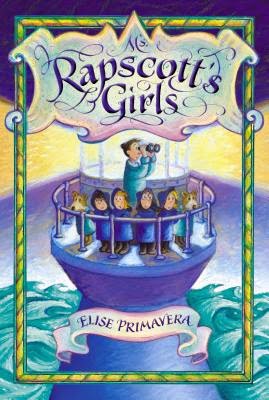
Ms. Rapscott’s Girls

by Elise Primavera
First sentence: “Attention, Busy Parents!”
Support your local independent bookstore: buy it there!
Release date: March 10, 2015
Review copy handed to me by the publisher rep.
Content: It’s a good mix of illustrations and print; while it’s out of the beginning chapter book phase, it’s a good one for reluctant readers. It will be in the middle grade (grades 3-5) section of the bookstore.

Ms. Rapscott likes things rough. An orphan at an early age, she figured out how to make her Way in Life. And this is a skill she wants to give to young girls. Especially young, neglected girls of Extremely Busy parents. At the start of this summer school term (though you wouldn’t know it by the weather at the lighthouse that serves as the school; it’s always storming), five girls are on their way — arriving by pre-paid post (yes, in boxes) — for Ms. Rapscott to mold. There’s angry Beatrice, lazy Mildred, timid Fay, and competent Annabelle as well. And, of course, Dalhlia, who was so tiny (and her parents so absent-minded) that she fell out of the box and went missing.

At first glance, it’s easy to call this one a modern-day Mary Poppins. Ms. Rapscott serves as a kind, but firm nanny (or boarding school mistress) who gives the girls cake and ice cream for dinner and pie for breakfast, and yet demands tidiness and hard work. There’s a slight magical element — flying boxes, for one, but also her assistants, two dogs who handle the day-to day operations. It definitely feels like one of those books. (I felt chastised, reading it as a busy parent, for not being more attentive to my kids. And I’m pretty attentive. Maybe I was just having a down day when I read this.)

But it’s more than that: Ms. Rapscott doesn’t just straighten up these unruly daughters of busy parents; she helps them learn to be parents. I’m not quite sure what kids will think of this — I need to get K to read it — but as a parent, I saw that Primavera was advocating for the need for variety in a kid’s life: too much pie is bad, but some pie is good. Too much TV and staying in PJs all day is bad, but sometimes, it’s what is needed. Adventure, exploring is good, and can be Learned From. But, mostly, being helpful, cheerful, and optimistic is the best. And, perhaps, that’s something we all need to be reminded of.

It’s a delightful little read.

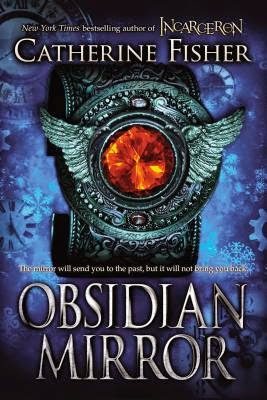
Obsidian Mirror

by Catherine Fisher
First sentence: “The boy put on the mask outside the door.”
Support your local independent bookstore: buy it there!
Content: Nothing objectionable, but it’s slow to start and is a  bit confusing. Not for the reader who gives up easily. It’s in the YA (grades 6-8) section of the bookstore.

This has been on my shelves for a long time. Seriously. I had the ARC, but gave that up, and finally, again, decided that I really needed to read this one. And I was in the mood this past weekend to indulge myself.

I shouldn’t have put it off. (Or maybe I should have: I’ve got the second one waiting to be picked up at the library. Shhhh. I know I said I wasn’t going to. But it’s CATHERINE FISHER.)

There’s three parts to this story. One is Oberon Venn, a very wealthy explorer who has spent the last two years in a depression because he was he cause of the accident that killed his wife, Leah. He will do anything to get her back. Including time travel. He and his trusty slave — there’s more to that than meets the eye — Piers are hidden out at Venn’s estate, trying to do just that: travel through time through the Obsidian Mirror.

The second player in this drama is Jacob, the son of Venn’s best fried. Who is missing and presumed dead. Or at least that’s what Jake thinks. So he’s headed, along with his unsuspecting teacher, Wharton,  to Wintercombe Abbey to force answers from Venn. Little does he know the web he will be tangled in.

The final player is the most complicated one: Sarah is possibly an escapee from an insane asylum. Or perhaps she’s a traveler from the future, a future where the mirror has destroyed the world, in order to destroy the mirror and prevent Venn from bringing his wife back.

There’s so much going on in this one, it’s hard to know where to begin. Yes, it’s slow and incredibly confusing to start with. I kept thinking “HUH?” But, I know Fisher’s work, so I stuck it out, and was richly rewarded. It’s time travel mashed with a mystery mashed with faery stories (yes, the Fey show up, and play a role), and if you give it time, it will begin to play out — it’s the first of a trilogy — in some incredible ways.

I can’t wait to read the next one.

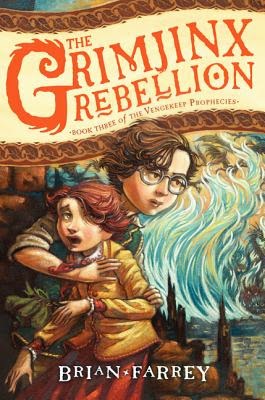
The Grimjinx Rebellion

by Brian Farrey
First sentence: “Of all the wisdom passed down through the generations of the Grimjinx clan, the bit I think about most came from Jerrina Grimjinx, wife of Corenus, our clan father.”
Support your local independent bookstore: buy it there!
Others in the series: The Vengekeep Prophecies, The Shadowhand Covenant
Content: There’s some action, and a few intense moments. The length will probably deter less confident readers, but (aside from the made up words) it’s really a page-turner. It’s in the middle grade (grades 3-5) section of the bookstore.

Jaxter thought, after he defeated the Shadowhand, that his troubles would be over. But, the High Laird has been raising taxes, and the population of the Five Provinces are getting restless. None of this bothers Jaxter very much, until the mages kidnap his sister. Who happens to be a powerful seer.

Jaxter, of course, can’t let this happen. So he, his parents, and some of his friends, head off to rescue Aubrin from the power-hungry mages and discover that they’re plotting to overthrow the High Laird and take over the provinces. Once again, Jaxter (and the whole Grimjinx clan) is in over their heads. But, true to form, they rally and figure out a way to Save the Day.

This is such a solid series: a great overarching story (elements of the first book came back again in this one), that involves themes of freedom and who has the right to rule. But it’s also grounded in family: I love the whole Grimjinx clan (even the wayward uncle) and how they pull for each other. They can do things individually, true, but as a family unit, they’re unstoppable. And I love how Jaxter’s friends got adopted into the family: they’re as important to him as his actual family. I especially like his relationship with Callie: you can tell he’s concerned about her, but there’s no romance. They’re just friends, and that’s great.

I also loved how this wrapped up, but didn’t tie everything up in a nice, neat bow. Farrey chose to leave things hanging; and I appreciated the ambiguity. Anything could happen, and that’s just great.

It’s a fantastic end to a fantastic series.

Greenglass House

by Kate Milford
First sentence: “There is a right way to do things and a wrong way if you’re going to run a hotel in a smuggler’s town.”
Support your local independent bookstore: buy it there!
Content: There’s nothing in the usual objectionable categories. However, it’s a slow book, especially at the start, and there’s some confusion sometimes when the characters switch names. That said, a good reader who loves mysteries would really like this one. It would be in the Middle Grade (grades 3-5) section of the bookstore, but I wouldn’t be adverse to putting it in the YA (grades 6-8) section either.

Milo and his parents run an inn at the top of a hill overlooking a river just outside of the fictional town of Nagspeake. The thing that makes their inn special is that it’s a safe having for smugglers. Milo and Mr. and Mrs. Pine know how to keep secrets.

However, it’s winter break, and Milo is looking forward to spending time alone with his parents. Without guests. So, he’s predictably disappointed when four guests, one right after another, show up for the winter.

Soon, they are in full swing, and have to bring up their usual cook, with her daughter, who just happens to be Milo’s age. Soon he and Meddy find themselves embroiled in an adventure and a mystery: figuring out why each of the four guests are there, their connection with the old house that Milo’s parents inherited, and who keeps stealing stuff.

The comparisons to Westing Game that I’ve read are valid. There is a mystery to solve, and it’s a quietly clever one, with a twist that I should have seen coming, but didn’t. (As we all know, I’m not the most careful of readers.) But it’s more than a mystery: it’s a lovely book, full of stories and quiet adventures (Meddy and Milo play a Dungeons & Dragons-like game for most of the book). I’m impressed that Milford wrote such a compelling book on such a small scale; because of the weather, Milo and Meddy hardly ever leave the house. It’s a very bleak landscape (Think The Dark is Rising bleak), but Milford infuses it with both warmth and mystery.

One more thing: Milo is adopted. He’s of Chinese nationality with white parents, and he feels that difference keenly at this point in his life. So, it’s not only a book with a mystery, it’s a book about belonging and family.

I loved it.

Unmade

by Sarah Rees Brennan
First sentence: “Kami Glass was standing to close to the fire.”
Support your local independent bookstore: buy it there!
Others in the series: Unspoken, Untold
Content: There’s a lot of violence, some of it brutal, plus some almost sexytimes. Not enough, however, to move it from the YA section (grades 6-8) of the bookstore.

Remember last time when I said the book was a bit of a middle book, and that the ending had me excited for the conclusion? (No? Well, neither did I?) Even so, I was able to fall back into Sorry-in-the-Vale with the Lynburns and Kami Glass with all her snarky confidence and contagious hope with ease.

Rob Lynburn has all the cards, all the power. And that has made Jared and Ash and Kami and their “side” quite desperate. Desperate enough to do desperate and dangerous things. This is an epic battle, a long, slow buildup to an intense climax. And interspersed in all that is heartache and love, loss and life, and a lot of heart.

This is a series, I think, that demands to be binge-read. And, thankfully, now you can. Sit down over a long weekend (like… Thanksgiving!) and immerse yourself in this deep, complex, wonderful world Brennan has created. Enjoy the characters, the good vs evil, the humor, the mystery, all at once without the wait.

I wish I could have. I enjoyed this book, but I think I would have enjoyed it SO much more had I read them all at once.

Vivian Apple at the End of the World

by Katie Coyle
First sentence: “There came a time when the American people began to forget God.”
Support your local independent bookstore: buy it there!
Release date: January 6, 2015
Review copy snagged from the ARC shelves at my place of employment.
Content: There is teenage drinking and a lot of swearing, including multiple f-bombs. There is also frequent off-screen violence. It’ll be in the Teen Section (grades 9+) of the bookstore.

In this sort-of future, American has been taken over by the conservative, pseudo-Christian  Church of America. Except “taken over” is too strong. It’s not like America has become a theocracy. No, it’s just that the Church of America founder, Beaton Frick, has predicted the end of the world. The rapture will come on a night in March, and all the faithful will be taken up.

Even though a good majority of Americans follow the Book of Frick, as it came to be called, Vivian Apple doesn’t. Her parents do, though. They’re faithful believers. And so, when the “rapture” comes, they disappear, leaving Vivian behind.

I’m going to stop right here for a minute. I’ve read a bazillion dystopian/post-apocalyptic novels and this is the first time I’ve come across the rapture as the cause. (At least in mainstream fiction. Is this a theme in Christian fiction?) In fact, this is what compelled me to pick the book up. I’m often curious about the way religion is portrayed in mainstream fiction, and I thought this could be an interesting take on it. And it was, even if it wasn’t necessarily a kind one. Religion and believers come off badly in this book, as people who believe anything they hear without question and are willing to commit acts of violence for the sake of their belief. More than once, I cringed at the “religion” and marveled at what I saw as pot-shots against the religious right.

But I digress.

Vivian determines that it’s all a hoax and she sets out from her hometown in Pittsburg to the Church headquarters outside of San Francisco with her friend, Harp. She just wants to know answers. They pick up a boy along the way, Peter, who seems to be on their side. Little do they know what’s waiting for them.

There is some good in this book: I really liked the tentative romance that budded between Vivian and Peter. I liked that Harp was Indian. I liked the way Vivian grew and became more willing to make decision and to Act in her own life throughout the course of the book. And I can even forgive that the book didn’t end, but rather left me hanging with more questions than answers.

But this one will be a tough sell around here.

Egg & Spoon

by Gregory Maguire
First sentence: “The heels of military boots, striking marble floors, made a sound like thrown stones.”
Support your local independent bookstore: buy it there!
Review copy provided by the publisher.
Content: There’s nothing objectionable, but it’s a bit long and slow for all but the most advanced middle grade readers. It’s not a Teen book, either, so it’s ended up in the no-man’s land of YA books (grades 6-8) at the bookstore. I’m wondering how it would go as a read-aloud, though.

Elena Rudina is a peasant in pre-Revolution Russia. Her father died in a freak accident, and her mother never quite recovered from that. Her oldest brother is a servant in the baryn’s household and is away in Russia. So when her other brother gets conscripted into the Tsar’s army, Elena decides she needs to do something about that.

Ekaterina is the daughter of semi-noble parents who have dropped her in a London boarding school and gone off gallivanting around the world. The only person who cares about her is her Great-Aunt Sophie, and she’s determined that Ekaterina is going to show up at the Tsar’s party for his godson and be presented as a possible match, which is something Ekaterina does not want.

So, it was quite fortuitous when Elena and Ekaterina meet by accident — the train stops in Elena’s village when the bridge is out — and then (again by accident) switch places. Each get exposure to a different world and are led on the adventure of a lifetime.

I really wanted to like this one. And I did, sometimes. I loved Baba Yaga in all her snarkiness. (In fact, I bookmarked a bunch of her lines. Like: “You’re not going to drink the Kool-Aid?” and “Dumb Doma remodels itself. A nasty habit, like binge shopping.” and “No wonder they call these fairy tales. Tolstoi woudl know better, and a fast train comign into a station would be involved. Blood, tears, regrets. All the fun stuff.”) I sometimes liked the adventure that Elena and Ekaterina were having. (Madame Sophia ended up being a favorite of mine as well.) But, something seemed… off… about this one. Usually I don’t mind intrusive narrators, but this time, he (though I wonder why Maguire chose that particular narrator) was annoying enough that I just wanted him to go away. And that (along with Baba Yaga) got me wondering if this is really a kids’ book, or rather a book for adults who like kids’ books. I found myself hard-pressed to come up with a kid who would enjoy this.

It reminded me most of The Girl Who Circumnavigated Fairyland in tone and style (though it’s much, much longer), And K really liked having that one read aloud to her. So, maybe there is some hope for this one. I just wish I liked it better.

Mortal Heart

by Robin LaFevers
First sentence: “For most the bleak dark months when the black storms came howling out of the north is a time of grimness and sorrow as people await the arrival of winter, which brings death, hunger, and bitter cold in its wake.”
Support your local independent bookstore: buy it there!
Others in the series: Grave Mercy, Dark Triumph
Content: Like the other two, it has death (though no murders, I think), some sex (off screen) and more mature themes. It’s in the Teen section (grades 9+) of the bookstore.

Annith is the one who was always left behind. Quiet and dutiful, the Abbess always passed her over when it was time to go on missions. First Ismae left, and then Sybella. And Annith is the one to babysit the new novices. However, when the resident seer gets ill and Annith overhears the Abbess say that Annith would be perfect for the position, Annith panics. And takes off in the middle of the night: dang it if she isn’t going to get her adventure.

She ends up being overtaken by hellequins — servants of the God Mortain, like Annith herself — and their leader Bathazar, takes it upon himself to protect her from the, shall we say, less savory of the bunch. They ride around together — nominally to get Annith to some city I can’t remember the name of right now — for a couple of weeks, falling in love. And then Annith — and this is what I liked most about the book — decides that she really wants to be Independent and Have and Adventure, so she takes off. And she does. She never really becomes as Awesome as Ismae (who is still my favorite) or Sybella, but she holds her own.

Of course there are twisty twists and swoony swoons, and over it all is some very interesting (if only vaguely) historical setting. At some point, though, the twists made my eyes roll, and the swoons stopped being swoony, and I was predicting things right and left, which is never much fun for me.

It’s not my favorite in the trilogy, though it does wrap things up nicely. Even so, it’s a good series, and one worth reading.