The BFG

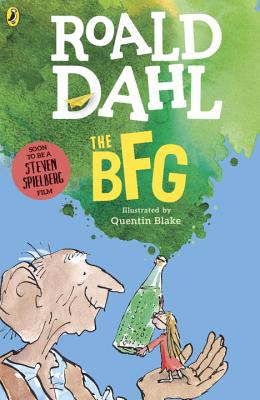
thebfgby Roald Dahl
First sentence: “Sophie couldn’t sleep.”
Support your local independent bookstore: buy it there!
Content: There’s a small bit of violence, but for the most part, it’s easy enough for the youngest of the grades 3-5 set. It’s in the Middle Grade section of the bookstore.

Sophie is up late one night in her orphanage when she sees something coming down the street. That something turns out to be a giant, who plucks her out of the orphanage and takes her back to his land. He says it’s because he needs to keep her safe,  because there are other, bigger, badder giants around. And he’s not wrong: the giants back at the stomping ground ARE bigger, badder and meaner.

(And that’s where Dahl’s overall themes come in: the BFG is the “runt” of the pack and is constantly being picked on. He’s also more evolved, and smarter, and just better than those bullies.)

Sophie experiences life with the BFG, and together they decide that the other giants need to be stopped (mostly because they eat children; though the BFG’s argument for it was pretty persuasive…). So they go to the Queen (really, my favorite part), convince her of the existence of the giants, and get her help in stopping them.

Perhaps it’s just the order I’ve read these, but this one is now my favorite. I loved the Seuss-like wordplay that went on with the way the BFG talked. I liked the friendship between Sophie and the BFG, and I thought their solution to the problem was pretty ingenious. It’s a delightful book, much less dark than Matilda or as mean as Charlie. So far, this one is the best.

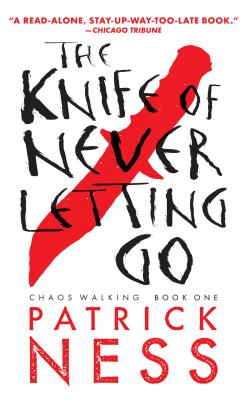
The Knife of Never Letting Go

knifeofneverby Patrick Ness
First sentence: “The first thing you find out when yer dog learns to talk is that dogs don’t got nothing much to say.”
Support your local independent bookstore: buy it there!
Content: There’s the anxiety factor plus a lot of violence plus the f-bomb a couple of times (though the main character says “eff” a lot). It’s in the Teen (grades 9+) section of the bookstore.

Todd is the last boy in Prentisstown in the New World. He’s waiting for his thirteenth birthday, which will come soon, and then he will become a man and join the other men in the town (and there’s only men). It’s an interesting place, this New World — there’s a virus that makes men’s thoughts (and only men, not women) audible, so not only is there no secrets, it’s chaotic hearing everyone else’s thoughts. But, as Todd is out gathering apples in the swamp, he encounters something he’s never experienced before: silence. Quiet. A gap in the Noise which turns out to be a girl.

Viola is part of a new wave of settlers to the New World, on the initial scouting ship. Her parents died in a crash, and when she finds Todd, she’s on the run from Aaron, who is Prentisstown’s fanatic religious leader. Then Todd is sent into exile and he and Viola are on the run, one step ahead of not only the insane Aaron, but the controlling mayor of Prentisstown and his army of fanatics.

There’s way too much to unpack in this novel in a blog post. Seriously. I’m glad I’m reading this as part of a book group, because I don’t think I could even begin to process it on my own. It’s a weird sort of mix between old-timey (the book is in a sort of dialect) Western and science fiction-y futuristic. It’s a survival story with a hint of dystopian. It’s weird and wild and gave me anxiety over and over again (!) and I practically read the whole 480 page book in two sittings. It’s engrossing and there’s so much to discuss. And even though it was written eight years ago, it’s still so very relevant.

My only complaint? The cliffhanger ending. ARGH. I’m just glad I can pick the next book up and read it right away, and I don’t have to wait for it to come out.

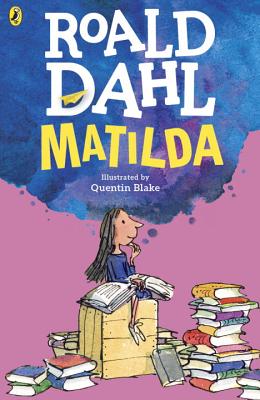
Matilda

matildaby Roald Dahl
First sentence: “It’s a funny thing about mothers and fathers.”
Support your local independent bookstore: buy it there!
Content: It’s a bit longer than Charlie, and a bit more complex. But, that said, I’d give it to a confident 8-year-old reader. It’s in the middle grade (grades 3-5) section of the bookstore.

So, I’ve read this one before, but it’s been years and years and years and even though I’ve watched the movie a bunch (it’s one of my girls’ favorites), I wasn’t quite prepared for how DARK Matilda is.

I mean, all the usual Dahl themes are there: a powerless, nice child (not poor, though that comes with Ms. Honey) is bullied (by her parents and other adults) and discovers something grand within herself in order to overcome. But, the adults are beyond awful. They’re abusive. The Wormwoods (who are hilarious in the film) are corrupt and neglectful. But, it was Miss Trunchbull, who I always condered just an annoyance, who really got me this time. She’s not annoying: she’s an abuser. And perhaps it’s where I am in my life, but that didn’t sit well with me. I’m not entirely sure why; Matilda and Ms. Honey have a happy ending, after all, and Miss Trunchbull (not to mention Mr. Wormwood) get their comeuppance. But, it kind of rang hollow for me.

That said, it’s also not as funny (or at least clever) as Charlie and the Chocolate Factory.  It was sweet — both Matilda and Ms. Honey are sweet characters amid all the lame, awful people — but it wasn’t clever. (Dark undertones!) I did enjoy it, but I’m not sure it’s my favorite. (Then again, I still have four more books to read this summer.)

The book group discussion, however, was fantastic! I had 20 kids ranging in age from 5 to 12, and they all had amazing things to say. One boy said he had read it eight times, and had some smart thoughts on it. As did many others. We talked about favorite characters and whether the Wormwoods were funny (yes) and whether Mr. Wormwood deserved the pranks (yes!). Ms. Trunchbull was deemed to be too mean to be funny, though one girl insisted that her parents would have believed her if she had told them what Ms. Trunchbull was doing. We talked a lot about the chocolate cake, and many pointed out that an 18-inch cake really isn’t that big. One girl said it was “just right”. And my favorite comments were when we were talking how Dahl makes ugly=mean and beautiful=good. One girl pointed out that ugly people can’t help being ugly and that they could be nice and beautiful people can be mean. And another girl said that maybe Dahl was just trying to make the character’s inward ugliness show outward. Both excellent.

So, maybe not my favorite, but it was a great discussion.


Charlie and the Chocolate Factory

charlieandthechocolatefactoryby Roald Dahl
First sentence: “These two very old people are the father and mother of Mr. Bucket.”
Support your local independent bookstore: buy it there!
Content: There’s one swear word (which caught me off guard!), but other than that, it’s okay. It’s pretty basic and is in the middle grade (grades 3-5) section of the bookstore.

It’s been a long time since I’ve read this; I’m not entirely sure when the last time I opened this one. Sure, I know the story, but I don’t know when I’ve interacted with the words last.

It’s weird. And kind of mean, if you think about it. Dahl sets up such an extreme: Charlie is beyond dirt poor and the others are so well off comparatively. Are Violet, Veruca, Augustus, and Mike spoiled, really? Or are they spoiled BECAUSE Charlie is their foil? He was such a crank, and that comes through loud and clear. The kids that aren’t Charlie are constantly in need of smacking, and Willy Wonka is downright rude to Mike Teavee often. Maybe he deserves it, and maybe it’s for humorous effect, but I was unsettled by it.

And what is Dahl trying to achieve here? Is he just telling a fantastical, weird story? Or does he have a POINT? (Maybe Mike Teavee’s song is the point:

“So please, oh please, we beg, we pray,
Go throw your TV set away,
And in its place you can install
A lovely bookshelf on the wall.
Then fill the shelves with lots of books,
Ignoring all the dirty looks,
The screams and yells, the bites and kicks,
And children hitting you with sticks —
Fear not, because we promise you
That, in about a week or two
Of having nothing else to do,
They’ll now begin to feel the need
Of having something good to read.
And once they start — oh boy, oh boy!
You watch the slowly growing joy
That fills their hearts.”)

Did I like it? Some of it, sure. I like that Dahl has a Seussian way with language, not letting non-existent words get in his way. But, I’m not sure I really care for this one (and the movies are both quite… weird) very much at all.

My book group discussion was pretty great. I had nine kids, the youngest was 5 (his mother was reading the books aloud to him; she came with as well) and the oldest were a couple of 10 year old boys who were almost too cool at first, but by the end were participating. We had a fun talk about favorite characters and themes and songs and what kind of candy they’d make (ones that looked like broccoli but tasted like candy!). And we designed our own golden tickets as we taste-tested chocolate.

IMG_6874

IMG_6876

It was fun! Next up: Matilda.

The Shepherd’s Crown

shepherdscrownby Terry Pratchett
First sentence: “It was born in the darkness of the Circle Sea; at first just a soft floating thing, washed back and forth by tide after tide.”
Support your local independent bookstore: buy it there!
Others in the series: Wee Free Men, A Hat Full of Sky, WintersmithI Shall Wear Midnight
Content: It’s perfectly appropriate for all ages; no swearing, some drinking by hard working adults, though it might be a bit complex, plot-wise for the younger set. It’s in the YA section (grades 6-8) of the bookstore.

I didn’t think the Tiffany Aching series needed another book to end the series, but since Sir Terry has passed away, and this came out, this one must be read. I did put it off, mostly because if I didn’t read it, the whole thing can’t end. Right?

It’s spare-er than the other Tiffany Aching books, mostly because Pratchett didn’t have as much time to fiddle with it. Still, it has a story with a decent plot, even if it feels somehow less full. Granny Weatherwax has passed on, making Tiffany  her successor, and so Tiffany is trying to balance being the witch of two steads. And her death created in the elf world: the queen is overthrown and the elves are back in the human world making mischief again. It’s a lot for one young woman to handle.

Thankfully, solutions come her way: Geoffry, the son of some lord or another, is much maligned at home, but he leaves and Tiffany takes him on as a helper. It turns out that he’s a great witch. And Tiffany takes in the elf queen once she gets thrown out, and discovers that sometimes the person you’ve always thought of as awful, may not be.

I loved it. I love Tiffany Aching so much anyway, with her practical witchiness (yes, there is magic, but being a witch in this world is such a practical affair). I loved the gender-bendiness with Geoffrey wanting to be a witch (not a wizard, which is what men Traditionally Do), and how the witches just accepted that. I appreciated that Geoffrey got a bunch of elder men, who were generally considered Useless, to help out with the Final Battle. And I loved the end. So much that I cried.

And while I am sad that there really won’t ever be any more Tiffany Aching books, I’m so very happy that Sir Terry thought up this one for us.

The Last Star

laststarby Rick Yancey
First sentence: “Many years ago, when he was ten, her father had ridden a big yellow bus to the planetarium.”
Support your local independent bookstore: buy it there!
Review copy sent to me by our publisher rep.
Others in the series: The Fifth Wave, The Infinite Sea
Content: It’s violent and intense; Yancey pulls no punches. There’s also a lot of (understandable) swearing, including f-bombs. It’s in the Teen section (grades 9+) of the bookstore.

If you can, read them all one right after the other; the impact of this one will be that much greater. Like the past two, I’m not going to go that much into plot; it’s really better if you just hit these as blind as possible.

I re-read my review for Infinite Sea, and my thoughts are mostly the same here. It’s intense. bordering on hopeless. Cassie and Zombie and Evan and Ringer and Sam are trying, against the odds, to prevent the end of the world. In many ways, it’s too late: the aliens have pitted us against ourselves:  if there’s no trust, there can be no civilization. But maybe, just maybe, they can prevent the world from completely imploding — Evan’s assured them that the aliens will start bombing the cities any day now — and keep millions more people from dying.

It was the hoping against hope that got me in this one. I read it slower; in small doses over several days this time because I couldn’t take the building hopelessness: will it work? There’s no glorious Independence Day or Men in Black climax here. Sure, it’s a small plucky (though increasingly small and increasingly desperate) team against incredible odds, but Yancey never shies away from the cost of those odds. I found that I appreciated it very much. It’s an incredibly intense series (I’m actually kind of sad the movie didn’t catch on the way Hunger Games did), and an powerfully written one.

I’m sad to see it end.

The Trials of Apollo: The Hidden Oracle

hiddenoracleby Rick Riordan
First sentence: “My name is Apollo.”
Support your local independent bookstore: buy it there!
Others in the series: Well, it’s the first one, but it helps if you’ve read Percy Jackson and the Olympians and The Heroes of Olympus series first.
Content: There’s no swearing, and only some violence. Riordan hints at an abusive relationship, but there’s nothing graphic. I’d give it to a 10-year-old who loves the Percy world. It’s in the YA section (grades 6-8) with the Heroes of Olympus and Magnus Chase because it feels right there.

I think the best way to review this is to go over the arc that A — who read it before I did — expressed.

  1. Apollo is awful, I hate this book. She’s right: Apollo is awful. But: character growth. I was glad to see Apollo change from a first-class ass to a halfway decent human being by the end. That said, there were some nice touches, even if they were annoying: the “Me Cabin” and his daily affirmation (“You are beautiful, and everyone loves you.”) both made me smile.
  2. Meg is fantastic.  A new character, a daughter of Demeter, and also the person Apollo is (accidentally) pledged to serve, she’s a great character. More Meg please.
  3. Will and Nico are adorable. All the fangirl feels. Yes please.
  4. Haiku! This one’s mine. I loved the (bad) haiku at every chapter. A’s favorite:
    Practice makes perfect
    Ha, ha, ha, I don’t think so
    Ignore my sobbing
  5. As for plot, etc? It wasn’t bad. Riordan wrapped up some loose ends that I never really considered loose ends, but it’s nice to know. He did break a couple of rules (too spoilery to tell, but left me kind of meh) that he’d set up, but other than that, it was a basic hero-quest, and I liked that it took place entirely at Camp Half Blood (over a short period of time). I liked the Big Bad he’s created (no more Huge Gods being Scary); he kept this one small and simple.

Was it the best book I’ve ever read? No. But it was lots of fun. Which is all I really wanted.

Audio book: Six of Crows

sixofcrowsby Leigh Bardugo
Read by: Jay Snyder, Brandon Rubin, David LeDoux, Lauren Fortgang, Roger Clark, Elizabeth Evans, and Tristan Morris
Support your local independent bookstore: buy it there!
Content: There is a lot of violence, some of it on the graphic side. Illusions to prostitution, and two swear words (they stood out). It’s in the YA section (grades 6-8), but I’m glad I read it. It’s probably on par with Hunger Games, so if your kid/you can handle the content of that, this one is probably okay.

I put this one off. I know I did. I know I should have read it last fall when it was Hot and Everyone was reading it. But, I was busy, and I kept putting it off. Until I was in need of a new audio book and I stumbled across this one. I finished it, went into work and declared “So THAT’S what I was missing!” Yeah.

Kaz Brekker has worked his way up in the Dregs — a criminal gang in the island city/nation of Ketterdam — and has a reputation for being brutal and willing to take anything on. So when he’s tasked with springing a scientist out of the most secure prison in the world — the Ice Fortress in Fjerda — of course he accepts. The price is right, after all. He gathers together a crew of six people — ranging from a merchant’s exiled son to a Grisha —  and they set out to achieve the impossible. Of course, they don’t get along, there’s a lot of internal mistrust and bickering. And, of course, things go badly. (I was wondering how it was all going to fit in one book. The answer is it does but it doesn’t.)

This was enormous amounts of fun. Perhaps part of that fun was the audio form: there were five different people doing the five different narrators, which helped immensely. I really enjoyed the way each one did the other characters slightly differently as well as the way each actor interpreted their own character. It definitely added something more to the book.

I have to admit that I liked this one better than the Grisha books. For whatever reason, I love heist books, I love books with twists and turns (though some of the twists were unfair; she didn’t give me enough information to see things coming and I was genuinely surprised a couple of times) and this one had both. I came to like the characters — Matthais the Fjorden had the most character growth (I wanted to throttle him in the beginning), but I loved the rest of the crew as well. I liked the diversity — it felt effortless and natural rather than an author just trying to be diverse. Bardugo expanded the narrow world she’d created in the Grisha books, and gave it much more depth, which I absolutely adored.

I’ll most definitely be picking up the next one (maybe even in audio) to see how this adventure ends.

The Raven King

ravenkingby Maggie Stiefvater
First sentence: “Richard Gansey III had forgotten how many times he had been told he was destined for greatness.”
Support your local independent bookstore: buy it there!
Others in the series: The Raven Boys, The Dream Thieves, Blue Lilly, Lilly Blue
Content: Like the others, this is intense, heavy on the swearing and violence.

I’m always a little sad when a series I’ve loved for years comes to an end. I get so invested, waiting for each one, that it almost feels anticlimactic when it actually comes to an end. I feel let down that I no longer will get to look forward to visiting with characters I love, following their story through pages.

Sometimes, my expectations are too high and while I like the ending, I’m not wholly satisfied with it. However, this was not the case with the last in the Raven Cycle. (No, I didn’t read the others in anticipation. Maybe I should have.) Maggie Stiefvater has come up with an ending that is so perfect for the series, that captures everything, that ends it so wonderfully, that I am genuinely sad that I will not get to visit this world again. (Well, I mean, I can always re-read, but there will be nothing NEW.)

The plot is really immaterial: there’s something attacking Cabeswater, Blue and the boys are dealing with Great Things and small things. There’s a new character, Henry, who has showed up as a minor character before (or at least I got that impression, since, you know, I didn’t reread), but I fell in love with him as much as I do Blue and the boys. He melded perfectly into the Raven Boys, and played a pivotal role in the narrative; he wasn’t just window dressing. And while the psychics weren’t as much a part of this — it is a YA novel after all — I did love them and Mr. Gray when they showed up. The sum total? It really was everything I could have hoped for in the end.

Maggie’s going to be at Watermark Friday night. I’m going to be a basket case, gushing at her about this. It’s going to be wonderful as this ending.

The Winner’s Kiss

by Marie Rutkoskiwinnerskiss
First sentence: “He told himself a story.”
Support your local independent bookstore: buy it there!
Others in the series: The Winner’s Curse, The Winner’s Crime
Content: There’s some sexytimes, but it’s tastefully off screen. Mostly. I am toying with moving this to the Teen section (grades 9+). (I hate doing that, especially since the other two are really pretty firmly in my 6-8th grade range. But, I also don’t want one in the Teen section and the other two in the YA section, so I may just move them all, or keep this one in YA. Frustrating.)

Spoilers for the first two, obviously.  Also: I still hate these covers with a passion. I mean, they’re pretty and all, but they’re NOT the books.

Kestrel has been arrested as a traitor to her country and shipped off to a work camp in the frozen tundra. Arin is still reeling from betrayal, when Kestrel rejected him and is throwing himself into his alliance with the Dacrans, determined to beat Valoria out of his country once and for all. He’s still in love with Kestrel, but she doesn’t seem to return his affections.

Both are determined to make the best of their situation. Both are determined to exact vengeance upon the leaders of Valoria, which includes Kestrel’s father. Neither are prepared for the directions that goal will lead them.

I don’t want to give more away from the plot (though if you’re smart, you can make some assumptions from the content…), but I’ll say this. It’s a good ending. I liked how Rutkoski wrapped things up, giving the story a complete finish, while not giving us every single little detail about the future. I love how she gave both Arin and Kestrel moments to shine, moments to grow, moments to be complex and do the unexpected. I liked that there was palpable tension, not necessarily between people but in situations. I found myself biting my nails, hoping things worked out okay. I loved how no one was black or white, and that even the bad guys were complex and interesting.

I’m definitely sad that this series is ending. It was definitely a good story.