Evicted

evictedby Matthew Desmond
First sentence: “Jori and his cousin were cutting up, tossing snowballs at passing cars.”
Support your local independent bookstore: buy it there!
Content: It’s a work of non-fiction and Desmond doesn’t hold any punches. There is talk of drug use, swearing, and some violence. It’s in the Sociology section of the bookstore.

I’ve been meaning to read this one since it came out a few years ago, but let other things get in the way until we picked it for my in-person book group. And, just like I thought, I found it to be difficult to read and yet incredibly important at the same time.

Desmond, a professor of Social Science, moved to Milwaukee, Wisconsin for a year to study the effects of poverty in the inner city, particularly through the process of evictions. And what he found is sobering. He goes into a lot of detail, following both black and white renters as well as landlords over the course of the year (though I think it may be longer), but it boils down to two things: capitalism isn’t good for everyone, and it’s important to have a stable home in order to succeed in life. The first one is this: there are lot of people getting rich off the backs of poor people. Not just the landlords, who buy the property for practically nothing and then raise the rent so it’s almost more than the renters can pay. There’s also the “business” of evictions: moving companies, storage places, and so on. Not to mention the city process: there is a whole court system to deal with this (I didn’t know that). It’s insane, and a product of our ethos here in America that believes if you can’t make it on your own, then it’s your own fault.

The second part may be obvious: constant moving is hard on children and adults. It’s hard to start over when you have to move once a year (as we did when my oldest was young), but moving two, three, four times in a school year makes it impossible for kids to keep up. And it goes for adults too. Many of the people Desmond was writing about were drug addicts (their own choice, sure), but he followed a couple of them as they tried to get out, and once they had a stable home, a secure environment, in a neighborhood that supported them, they were able to turn their lives around. I found that interesting that a home — someplace a person could come to that was secure and not falling apart, where there was heat and electricity — could mean that much. I guess, since it’s always something I’ve had, I took it for granted.

Perhaps the most interesting part of the book was the author’s note, where he talked about his methodology. He doesn’t have many answers, except that poor people are paying too much of their income in rent (more than 2/3 of their income! Which is why they get behind!) and that we (the government? non-profits? private corporations?) should invest in some stable housing for poor people. In our book group discussion, we talked about how Utah has dealt with the problem of homlessness. Maybe more cities/states can take note and move in that direction. Because, honestly, more good, stable housing for our poorest people is good for everyone.

A Room Away From the Wolves

roomawayfromthewolvesby  Nova Ren Suma
First sentence: “When the girl who lived in the room below mine disappeared into the darkness, she gave no warning.”
Support your local independent bookstore: buy it there!
Content: There is a lot of swearing, including multiple f-bombs, and abuse that could be triggering. It’s in the Teen section (grades 9+) of the bookstore.

This one is going to be tough one for me to sum up, because I am not sure what, exactly, happened. The words were very pretty and I read the whole thing, but I, for the life of me, do NOT understand what happened.

There’s a girl — Bina — whose mother remarried when she was nine to a man with two daughters who were quite abusive to Bina. And so, the summer before Bina turns 18, her mother suggests she leaves. Bina goes to a place in New York City her mother had stayed when she was young, before Bina, the Catherine House. There are 14 girls in the house, where weird things happen, and they try to bring the ghost of Catherine back, and Bina’s super confused, and… I just lost the thread of what was going on.

I suppose this was meant to be a grand metaphor for something, and I’m sure there are people out there who like this atmospheric type of book with a hugely unreliable narrator, and I did finish it, to it’s not terrible.

It’s just that I need someone to explain it to me.

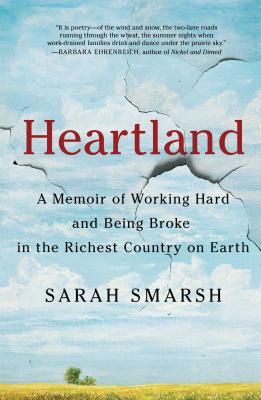
Audio book: Heartland

heartandby Sarah Smarsh
Read by the author.
Support your local independent bookstore: buy it there!
Or listen at Libro.fm
Content: There is some frank talk about abuse and drinking as well as a lot of swearing (including multiple f-bombs). It’s in the biography section of the bookstore, but I think a teenager might be interested in this.

This has been a big deal around the store, mostly because Smarsh grew up just outside of Wichita (and rumor has it she’s moved back here), and the places and people in it are pretty much staples in this community. But her story — the child of a teenage mom, growing up in a rural community on a family farm — belongs to much more than those of us here in Wichita. In fact, as I listened to her story — which sometimes got political, but mostly she kept personal — I heard echos of my own mother’s and grandmother’s story — married young, growing up in a small rural community, working hard their entire lives for just barely enough. It’s the story of many, many Americans.

Even so, Smarsh has one thing going for her that many poor do not: she is white. Sometimes, she acknowledges that fact, and tries to be more inclusive in her conclusions. But often, I felt like she was saying “look at me, look how poor we were, look how much I suffered, look at those scars” and I wanted to roll my eyes. Very few of us escape our childhoods without scars. And just because she grew up poor in Wichita and Kingman, doesn’t make her story exceptional.

Except she told it (and read it) well. So I have to give her that.

Death of Truth

by Michiko Kakutani
First sentence: “Two of the most monstrous regimes in human history came to power in the twentieth century, and both were predicated upon the violation and despoiling of truth, upon the knowledge that cynicism and weariness and fear can make people susceptible to the lies and false promises of leaders bent on unconditional power.”
Support your local independent bookstore: buy it there!
Content: It’s a small book, but dense, dealing with philosophy and politics and it doesn’t hide that it’s critical of Trump. It’s in the politics section of the bookstore.

Kakutani, who was the former chief book critic of The New York Times, decided that what the current political climate needed was a book examining how we got to the current political climate, and the inherent distrust of the media. On the one hand, yeah: this book is important. On the other hand, the only people who are going to read it are the people who think that the current political climate is problematic. So, I guess the question is: what’s the point of the book?

I did learn a few things: I had forgotten (or never learned) that the Fairness Doctrine — the policy which demanded that media give equal time to all political parties, and which I learned about while studying journalism in college — was overturned (disbanded?) in the late 1980s/early 1990s. Combine that with the Telecommunications act in 1996, which allowed for media conglomerates, and you end up with our current media climate, in which someone like Trump can call reputable papers Fake News because he disagrees with them, and in which you have a majority of Republicans who believe that the media is lying and making up stuff. Of course it’s more than that, but that’s what I found interesting about it.

(As an aside, Russell, who actually studies these things, found the book to be lacking. My take-away? This book was not meant for scholars.)

In the end, though, Kakatuni doesn’t really offer any solutions how to solve this problem. Though, in talking about it, I came up with one: Turn off the TV, shut down social media, and talk to someone, especially someone who disagrees with you. Maybe then, we can figure out how to look past this fear and let people speak their truths, and find a common ground again.

Audio Book: So Close to Being the S**t, Y’all Don’t Even Know

by Retta
Read by the author
Support your local independent bookstore: buy it there!
Listen to it at Libro.fm
Content:  Lots and lots and lots of swearing, including multiple f-bombs. It’s in the humor section of the bookstore.

I’ve said it here before: I have a weakness for celebrity memoirs, especially when read by the author. And so, even though I don’t really know a whole lot about Retta (aside from that she was Donna on Parks and Rec), I splurged for this. And I found it to be extremely delightful. She is a funny writer, but more than that, she is a funny story teller. She holds nothing back, from the way she grew up to her struggles with money and finding an acting job, to her accidental love for the LA Kings. It’s an entertaining journey with a lot of laughs along the way.

I’m not sure there’s much else to recommend it, except that it’s utterly delightful and a lot of fun. Sometimes, though, that’s exactly what you need.

Cancer Vixen

by Marisa Acocella Marchetto
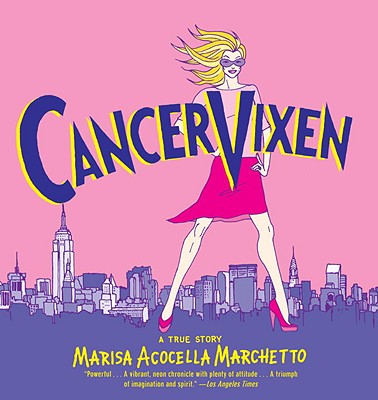
First sentence: “What happens when a shoe-crazy, lipstick-obsessed, wine-swilling, pasta-slurping, fashion-fanatic, single-forever, about-to-get-married big-city girl cartoonist (me, Marisa Acocella) with a  fabulous life finds… a lump in her breast?”
Support your local independent bookstore: buy it there!
Content:  There is swearing (no f-bombs), some tasteful nudity, and lots of naked breasts (it is about breast cancer, after all).  It would be in the adult graphic novel section of the bookstore, if we had it.

The first sentence of this one kind of says it all: Marchetto, a cartoonist who works for Glamour and the New Yorker, had a fabulous life with a new Italian boyfriend she was planning on eloping with, when she — out of the blue, because what other way does cancer happen? — is suddenly diagnosed with cancer.

Much of the book is a detailed blow-by-blow of Marchetto’s cancer treatment, and how that affected her life and  relationships. I found it interesting — I’ve never known anyone who’s gone through this before — but I wasn’t enamored with the story. It was very much “it girl” New York: all the right clothes, all the right friends, all the right things. (Though, she had a LOT of friends, which is a great thing!) I was more interested in her body image issues, especially regarding the models who kept throwing themselves shamelessly at Marchetto’s fiance, Silvano. But Marchetto didn’t really dwell on that; she brushed past it as part of her “negativity”. There was also an undercurrent of evidence why universal health care is needed: she was uninsured when she was diagnosed, and was in a panic about having to pay out of pocket for the treatment. Which turned out to be nearly $200,000. But, she didn’t dwell on that, either. It was very self-centric, and, honestly, I didn’t really care for her. (I feel bad saying that, though.) The art was a bit meh, as well, though I understand why she chose to draw it slightly cartoony; if it were more realistic, it’d be a lot more disturbing. This way, Marchetto was able to keep it from getting too dark while remaining honest about the ups and downs of cancer treatment (and her life).

Not bad, but not my favorite, either.

Audiobook: Tyrant

Shakespeare on Politics
by Stephen Grenblatt
Read by Edorado Ballerini
Support your local independent bookstore: buy it there!
Or listen on Libro.fm
Content:  There’s some in-depth Shakespeare analysis, which might make it uninteresting to some. It’s in the Shakespeare/Theater section of the bookstore, but it could go in Current Events/Politics as well.

The basic premise of this book is simple: Greenblatt, a noted Shakespearean scholar, takes a brief — by no means scholarly — look at some of the  tyrants in Shakespearean plays. He primarily looks at Richard III, Macbeth, Lear, and Coriolanus: dissecting their motives, their pasts, and their rise to tyrant-dom. It’s, on the surface, an interesting look at these four plays (there’s a bit about Julius Caesar, as well), a fascinating and well-written exploration of these characters.

But — and maybe this is my politics showing — there’s a lot of similarities between the current administration and the tyrants in these plays. It serves as a reminder that these things are never new: there have been tyrants and tyrannical behavior for a long time. And those who don’t know their history are bound to repeat it. In fact, I had to keep reminding myself that this was a work of Shakespearean analysis. Greenblatt never comes out and says “Trump is like this” but the undercurrent is there (if you choose to see it). It’s a smart analysis of the plays, and I learned a lot about them (I’ve never seen King Lear, and that is something I should fix; and I’d like to see the Richard III with Ian McKellen again), and the book is definitely worth it for that.

Escape! The Story of the Great Houdini

by Sid Fleischman
First sentence: “I have been a fiction writer by choice and instinct for a long professional life.”
Support your local independent bookstore: buy it there!
Content: There are some risque photos (Houdini did a lot of his tricks in the nude for honesty’s sake) and some intense moments. It would be in the middle reader biography section of the bookstore, if we had it.

I’ll be honest: while I enjoy illusions, I’m not obsessed with it, and while I knew who Houdini was, I really didn’t know much about his life or his magic tricks. So, when my class hit a biography section and this was on the list, I figured why not read a kids’ biography on Houdini.

(First: are kids still interested in Houdini? Hubby saw this on my nightstand and remarked “I adored Houdini as a kid.” Does that still happen?)

I learned that Houdini was a workaholic, a bit of a jerk, and definitely competitive. He’d put himself in pretty much any situation to prove that he could do whatever it was that was put before him (challenges were his favorite thing!) regardless of personal safety. Fleischman, a fellow Jew and magician, is incredibly enthusiastic about Houdini (even though he keeps the actual secrets of how Houdini performed his tricks, well, secret) and that comes through in the biography. I don’t know if it’s something I’d refer kids to in order to do research on Houdini (though maybe: Fleischman does work to debunk some of the myths surrounding Houdini, ones that Houdini himself perpetuated), but it does make for entertaining reading.

Imprisoned: The Betrayal of Japanese Americans During World War II

by Martin W. Sandler
First sentence: “It was a heroic achievement.”
Support your local independent bookstore: buy it there!
Content: There are some difficult moments, especially for younger readers. It would be in the middle grade history section of the bookstore.

I’ve known vaguely about the Japanese internment that happened during World War II for a while now (though it wasn’t something that was taught in school), but I had never read anything that detailed the actual experience of Japanese Americans in America.

My thoughts? White people are awful. (This is not a new realization. Just an additional confirmation.) My reservations about this book? It’s written by a (very nice) white guy. The book — which goes through the experiences of Japanese in America from the turn of the 20th century through World War II and afterward — seems really well-balanced and fair, and Sandler has done his research. I just couldn’t shake the feeling that this is a story that would be better told by someone who had gone through the experience, by someone who could first-hand explain the experiences of racism they had while they were trying to make a living here. Sandler doesn’t really hold those in charge accountable (really: what were the politicians thinking?!) and while he is sympathetic to the plight of the Japanese and forthright about the conditions they lived in, it lacks the emotional punch a Japanese writer could most likely give it.

Still, not a horrible book.

Module 14: Yes! We are Latinos!

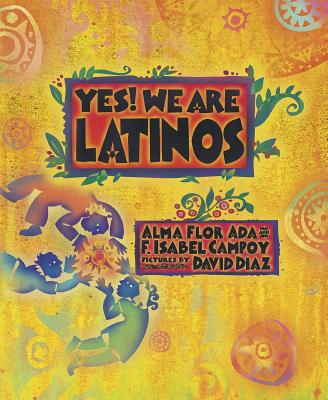
Ada, A. F. and Campoy, F. I. (2013). Yes! We are Latinos. Watertown, MA: Charlesbridge.

Genre: Poetry with non-fiction mini-essays.

Book Summary: A series of narrative poems, followed by a brief narrative non-fiction essays about different aspects of Latinx history and culture. These are not based on any one person, but are a composite of the different variety within the Latinx world.

Impressions: I loved this one! I don’t often read poetry collections (and when I do, they are usually the humorous ones. My current favorite is I’m Just No Good at Rhyming) and I didn’t quite know what to expect. What I got were some narrative poems, each telling a story about a different child’s Latinx identity. It served as a reminder that even though we (white people, the media, etc.) lump all Latinx people together, there’s a lot of diversity and richness of heritage within the culture. (And, I was reminded, that they don’t all get along!) I really enjoyed the historical information that came after each poem, which told a bit about the history and culture of the person in the poem preceding. I knew quite a bit of the information already, but it was good to be reminded of the history (and some of it recent history) and how much of the United States was originally Spanish. (And that the Brits weren’t the only oppressive colonizers in the world.) Definitely a highly recommended collection.

Review: While the review was short and more oriented to the plot than any opinions about the book, Leon-Barrera did remark that the book was “refreshing” especially because of the vast representation from the Latinx world. She also wrote, “The vignettes also help to illustrate the meaning of being mestizo–the blending of indigenous, African, and Spanish lineage-mentioned in the introduction and explored throughout.” This was something I noticed but didn’t realize was as important as it is. She also commented on the inclusion of Asians in Latin America, which, she wrote, “is often overlooked in children’s literature”.

Leon-Barrera, M. (2013). Yes! We are Latinos.  School Library Journal. 59 (8), 94.

Uses: This was used as part of our city’s Big Read a few years back. It could also be used in a poetry writing workshop for middle or high schoolers, since these are all accessible, free-verse, narrative poems.

Readalikes:

  • Enchanted Air by Margarita Engle – This is the most obvious read-alike, as it is a non-fiction memoir in verse about Engle’s childhood and her family in Cuba.
  • The Epic Fail of Arturo Zamora by Pablo Cartaya – Another Cubano novel, this one focusing on the struggle to keep history and culture and family together in America. It’s also a David vs. Goliath book, in that a big developer wants to take out Arturo’s family’s restaurant in order to put in a huge multiplex.
  • Gabi a Girl in Pieces by Isabel Quintero – A young adult book about Mexican-American culture and the struggles between older generations and their traditions and younger generations.