The Wild Robot Escapes

by Peter Brown
First sentence: “Our story begins in a city, with buildings and streets and bridges and parks.”
Support your local independent bookstore: buy it there!
Review copy provided by the publisher.
Others in the series: The Wild Robot
Content: Same as the first one: short chapters, large print, illustrations. It’s in the middle grade (grades 3-5) section of the bookstore. This one, like the first, would also make a good read-aloud.

Spoilers for the first one, obviously.

When we left our fair robot Roz, she was being airlifted off her beloved island and transported back to the city. She was reprogrammed, and then sent out to be a farm robot, helping a family. Except, she wasn’t reprogrammed enough: she remembered her life on the island and her son, Brightbill, and while she wasn’t entirely unhappy at the farm — cows are good conversationalists and Roz had a lot to do — she missed her, well, home. So, she sets out to escape, which leads her on a whole adventure trying to get back to her island.

It’s much of the same as the first book here: intrusive narrator (but again, not so much that it was bothersome) and Roz is a very sweet character to root for. I liked her adventure this time, and the different things she saw and how her story spread out and paved the way for her to get back. The ending was sweet and satisfying at the same time, which was nice.

It really is a delightful story.

The Book of Boy

by Catherine Gilbert Murdock
First sentence: “This story, like another, begins with an apple.”
Support your local independent bookstore: buy it there!
Review copy provided by the author.
Content: There is some challenging language, because it’s set in medieval times, but with the large print, short(ish) length, and illustrations, a younger kid/reluctant reader could enjoy it. It’s in the middle grade (grades 3-5) section of the bookstore.

Things that surprised me about The Book of Boy: How religious it was (though I don’t know why that did; it’s set in 1350 in Italy, and religion was a huge part of everyday life), how much I didn’t mind it’s religious nature, and how charmed I was by Boy and the pilgrim he went on a quest with.

Things I’m unsure about: the speculative(ish) element of it. See, Boy is a humpback child, and was told to keep his hump covered and hidden and never touch it. He’s shunned because of this — this felt “true”, even though I don’t know if people who didn’t look whole were shunned, but that’s what stories have always led me to believe — by everyone except a wayward pilgrim on a quest to collect the relics of St. Peter. But, once on the quest, Boy discovers that his hump is not an ordinary one, which is a blessing and a curse.

Things I really enjoyed: I loved the narrative style of the book. I think Murdock caught the inner voice of this naive character, who was doing what he was supposed to, and unsure about his own future and any changes. I loved that Boy could talk to animals, and that the animals helped him when he needed it. And I really enjoyed the whole quest: there were challenges along the way, and both Boy and the pilgrim needed each other. It was very sweet and charming.

Overall, a good book.

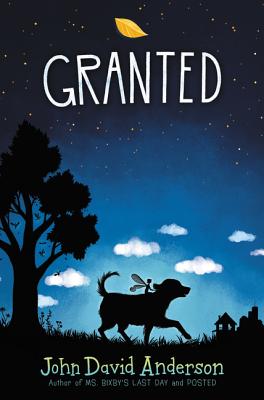
Audiobook: Granted

by John David Anderson
Read by Cassandra Morris
Support your local independent bookstore: buy it there!
Listen at Libro.fm
Content: I listened to it (it makes a great read aloud), but I’m guessing that it’s formatted pretty well for the younger readers. There are short chapters, a lot of action, and any big words are explained really well. It’s in the middle grade (grades 3-5) section of the bookstore.

Opheila Delphinium Fidgits is one of the few fairies in the Haven who has been tasked with the most special of jobs: that of being a Granter. Wishes from humans come in all the time, but the great tree only allows for a few to be granted, and Ophelia is one of those who gets to go out and make the wish come true. Except that she hasn’t… yet. Then her day comes and she sets out to fulfill what should be a routine wish: find the coin, grant the girl a bicycle. Except everything (and I mean EVERYTHING) goes wrong. And what happens changes, well, everything.

I loved listening to this one, though it took a bit to get into it. That’s partially the story’s fault: Anderson is very thorough in his world-building, and felt a need to take us all through the Haven and Ophelia’s world before sending her out into ours. But once she got into our world, the story picked up. The best character, though, was Sam the Dog. Probably mostly because of the way the narrator voiced him, but also because… well, who doesn’t love a wonderful, sweet, loveable, sometimes stupid dog character?

It really was a charming book, and a unique look at the fairy world. Quite good.


Gregor the Overlander

by Suzanne Collins
First sentence: “Gregor had pressed his forehead against the screen for so long, he could feel a pattern of tiny checks above his eyebrows.”
Support your local independent bookstore: buy it there!
Content: There are a couple of battles and some tense moments. It is in the middle grade (grades 3-5) section of the bookstore.

First a story: M read this when she was about 10 or 11 years old, and told me that it was SO good and that I needed to read it. I balked: Gregor goes underground and goes on a quest with talking cockroaches?! Ew. (I loathe cockroaches. Ugh.) She finally, after years of bugging me, gave up and moved on. However, when I saw it on the list for the science fiction/fantasy module in my children’s lit class, I remembered M’s urging and I picked it up (finally!).

And you know what? She was right. (Not the first time.) The basic premise is that Gregor, whose father has been missing for 2 years, falls into the Underland, a world where there are some humans who live in an uneasy peace with giant spiders, cockroaches, and bats, and whose mortal enemies are the giant rats. (And yes, all the animals talk.) Once there, Gregor finds out that he may be/is the Warrior who would fulfill the prophecy, perhaps bringing peace between the humans and the rats. And, oh by the way, the rats have his dad, so maybe they can rescue him, too.

Yeah, it sounds trite: there are talking animals and a prophecy (they’re all the rage!) but Collins is quite masterful in telling a story. She keeps the action moving, she makes us care about Gregor and all the other Underlanders and she even gives us a nice twist at the end that careful readers will see coming (I didn’t guess, but I wasn’t surprised). And she included Gregor’s 2-year-old sister, Boots, who is literally the best character ever. She’s funny and charming, and provides a humanity to the other characters that otherwise wouldn’t be there.

Oh, and this is a bit of a spoiler: I cried when one of the cockroaches died.

It’s just that good.

No More Dead Dogs

by Gordon Korman
First sentence: “When my dad was a helicopter pilot in Vietnam, he once rescued eight Navy SEALs who were stranded behind enemy lines.”
Support your local independent bookstore: buy it there!
Content: There is some romance (just crushes and a bit of cheek kissing) and some mild cussing. The text is pretty simple. It would be in the middle grade (grades 3-5) section of the bookstore, though I bet 6th graders would like it too.

Wallace Wallace (the poor guy getting stuck with parents who named him that!) ALWAYS tells the truth. Mostly it’s because his father was a horrible liar (well, exaggerator/storyteller) who eventually left his mom, and so Wallace decided to never do that. Unfortunately, his truth-telling doesn’t always come off well. In fact, in seventh grade English class everyone was required to read a “classic” — the made up Old Shep, My Pal — book and do a report on it. Wallace’s report, because he won’t lie: the book was awful. And please, no more dead dogs.

That report lands him in detention with the English teacher, who is also directing a play — an adaptation of, you guessed it, Old Shep — and so Wallace can’t go to football practice and instead ends up at play rehearsal. And, of course, advocates for changing the play. It’s more complex than that; it also involves pranks and Wallace being set up, and everyone not liking him, and a small middle school romance, but that’s the general picture of it.

I hadn’t ever read Gordon Korman’s books before, but I’d heard that he was funny and he gets kids. Well, maybe this was just dated — it was written in 2000 — which is often a problem with contemporary realistic fiction. But whatever the reason it really fell flat. The plot was silly (supposedly funny?). I guessed who the prankster was (was I supposed to? Or was it supposed to be a big reveal?) before the characters. I thought the kids were brats (maybe all middle schoolers are). And I just didn’t find it funny. But, humor is subjective: not everyone finds the same things amusing. So, I can forgive that. I can see how kids would eat this up: what I found annoying as an adult, they could relate to. And so I can see how it has value, even if I didn’t like it much at all.

Module 9: Capture the Flag

Messner, K. (2012). Capture the Flag. New York, NY: Scholastic.

Genre: Middle grade private eye-style mystery.

Book Summary:  Anna is the daughter of a Vermont senator, José the son of an art historian, and Henry the nephew of a huge art collector. What brought them all together was a gala for the restoration of the flag that inspired the Star Spangled Banner (I’ve seen it at the National Museum of American History… it’s… an old flag). A flag which was stolen. And since the three plucky kids are holed up in a DC airport (National? Dulles?) snowed in (I suppose that’s plausible for DC, but improbably) and stuck there, they take it upon themselves to find the missing flag.

Impressions: This one, for me, suffered from too many coincidences. BOTH the people running for president were from Vermont? All the kids were headed back to Vermont? (WHY Vermont?!) And their moms/aunts were all part of this secret art protection society (which I could never figure out what that had to do with the plot). There was a “bad” guy that turned out to be a maguffin, but I called the real culprit fairly early on, so there wasn’t any real mystery to this mystery. I’m guessing kids would like it (who doesn’t like kids outsmarting adults?) and I did like that Anna was the character that pushed the plot forward, but overall,  it just fell flat for me. There are much better art mysteries, or middle grade mysteries, out there.

Review: The Kirkus staff really liked the book, calling it “gripping” and “a sparkling start for a promising new series”. They did admit that the ways in which the kids accessed the inner workings of an airport was “improbable” but noted that this probably wouldn’t bother the target audience.

Staff. (2012). Capture the flag. Kirkus Reviews. 80 (11). Retrieved from: https://www.kirkusreviews.com/book-reviews/kate-messner/capture-flag/.

Library Uses: This one would be good on a library display of mystery books or books about U. S. artifacts or art.

Readalikes:

  • Framed by James Ponti – This is the most similar: set in Washinton, D.C. and involving an art theft. Except this one was a lot less predictable — even though there were clues throughout — and a lot more enjoyable — it was definitely action-packed! — to read.
  • The Greenglass House by Kate Milford — This one has a slight paranormal element, but mostly it’s just a mystery of figuring out who the different travelers are, and their connection to the Greenglass House and why each traveler suddenly appeared at the house on Christmas Eve.
  • Three Times Lucky by Sheila Turnage —  A delightful, quirky Southern mystery as Mo, the main character, tries to clear her best friend’s name when he discovers a dead body. It’s got fantastic characters, a lot of charm and drama, and a great mystery to solve (and the kids do solve it!) in addition.

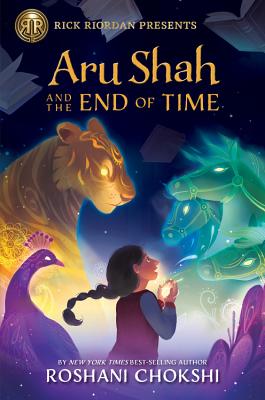
Aru Shah and the End of time

by Roshani Chokshi
First sentence: “The problem with growing up around highly dangerous things is that after a while you just get used to them.”
Support your local independent bookstore: buy it there!
Release date: March 27, 2018
Review copy provided by the publisher.
Content: There are some complex names, a little violence, and hints of crushes, but I’d give it to anyone reading the Percy Jackson series. It will be in the Middle Grade (grades 3-5) section of the bookstore.

When we saw Rick Riordan, and he was talking about his imprint, Rick Riordan Presents, one of my husband’s concerns is that the writers of these books on this imprint will just basically be telling Percy Jackson stories, superimposed on people of color and their mythologies.

And, after finishing Aru Shah and the End of Time — with its Hindu mythology — I can say that’s partly true. Aru Shah felt like a Percy Jackson book: a girl finds out she’s the daughter of a god (in this case, Indra, the god of Thunder), goes on a quest with a new-found friend and a sidekick to save the world (from the demon The Sleeper, which has awoken) , in a book full of humor, pop culture references, and non-stop action. So, yeah, in a sense that’s true. But Aru Shah is also wholly its own thing. Aru is more conflicted than Percy ever was: she, inadvertently sets off the crisis she has to save the world from, which fills her, not unexpectedly, with guilt. And while the quest part feels the same, there are notable differences: primarily being the mythology; there are a ton of stories in Hindu lore, and while I’m not familiar with all of them, I do know some, and I liked the spin that Chokshi put on them. I liked that Aru and her friend Mini’s relationship was complicated: they were reincarnated souls of former brothers, which makes them sisters, though they have different god fathers and different families in the human world. It gave a deeper, richer layer to their relationship, which I really enjoyed. Everyone in the book seemed more complex and mulit-faceted than I was expecting, which was nice.

In short, while this does feel familiar, and will to anyone who has read the Percy Jackson books, Choski has also put her stamp on the stories, which is a refreshing, welcome thing.

Joey Pigza Swallowed the Key

by Jack Gantos
First sentence: “At school they say I’m wired bad, or wired mad, or wired sad, or wired glad, depending on my mood and what teacher has ended up with me.”
Support your local independent bookstore: buy it there!
Content: It’s short, and it’s got short chapters, so probably good for reluctant readers. It’s in the middle grade (grades 3-5) section of the bookstore.

Joey Pigza has problems sitting still and focusing. It’s just the way he’s “wired”: he has an excess of energy and he just can’t focus. Unfortunately, that tends to get him in trouble, especially in school. That is, until one day when he accidentally hurts another student with scissors. Then he’s sent to a “special ed” (ugh) school in order to figure out how to behave better. Which not only involves getting Joey the right medication, but als teaching him how to focus so he can learn.

Honestly? I wanted to smack the adults in the book. I guess my parenting style is “let them be who they are” which I suppose doesn’t always translate well into strict social situations, but HONESTLY. I know Joey has ADHD, and couldn’t focus, and it was a medical condition that was interfering with his learning, but I wanted to shake every single adult that told him to sit still and be “normal”. NORMAL? Really?

But Joey, I felt so bad for him. His mother abandoned him (but came back), his grandmother was abusive, his teachers were impatient with him… he just needed some time, some caring, and some attention to help him focus. Okay, so maybe there’s a lot of class issues in this one as well: they were lower class — his mom worked at a salon — and so she didn’t have the time to sit at home and interact with him in ways that he needed. And his diet of candy and fast food also is a class thing. Maybe I’m reading too much into this one, but there’s a lot to unpack about class there, I think. And bad adulting. And about kids with ADHD.

All this from a lower-end middle grade book. Go figure.

Hello, Universe

by Erin Entrada Kelly
First sentence: “Eleven-year-old Virgil Salinas already regretted the rest of middle school, and he’d only just finished sixth grade.”
Support your local independent bookstore: buy it there!
Content: There’s some bullying. This will be in the Newbery section of the bookstore. Before that (if I had ordered it in; why didn’t I?) it would have been in the Middle Grade (grades 3-5) section of the bookstore.

Sometimes, fate works in ways that you have no control over.

Virgil is shy, quiet, and the object of bullying at school. He doesn’t really stand up for himself, and doesn’t know how to change that.

Valencia is deaf, but she doesn’t let that define her. Unfortunately, everyone else does. She doesn’t have any friends because of that.

And  Kaori, a budding psychic and fortune teller, is the one to bind everyone together.

This is a sweet story of making new friends, of figuring up how to stand up for yourself. About fate and connecting to one another. And about not being alone. It’s delightful and even if I completely missed it before it was awarded the Newbery, it’s perfectly deserving of that award.

The War That Saved My Life

by Kimberly Brubaker Bradley
First sentence: “‘Ada! Get back from that window!’ Mam’s voice, shouting.”
Support your local independent bookstore: buy it there!
Content: There is some depiction of abuse, and tense moments when there is bombing. The bookstore has it in its middle grade (grades 3-5) section, but the state awards deemed it for 6-8th graders.

I know I’ve needed to read this one for a while now, and when my class did a unit on other awards and we were instructed to read a Schneider Family Award winner, I jumped at the chance to finally cross this one off my list.

Ada was born with a club foot. And, because her mother is AWFUL, she was raised to think that somehow her foot made her less. She wasn’t allowed out in public, she couldn’t walk, and her mother shut her in a cupboard and hit her every time she did something her mother didn’t like. And then Germany threatened invasion, and the children of London were sent to the countryside. Ada wasn’t on the list; her mother really was that cruel, but she decided she couldn’t let her younger brother go by himself, and so she went too.

Once there, they were placed with Susan Smith, who had been grieving the loss of her friend, Becky (it was unstated, but I believe they were partners), for two years. Susan didn’t want children, but she made the best of it. And, that simple act changed everyone’s lives.

It is a simple book, following Ada as she figured out how to live a life. Bradley does really well at portraying a traumatized child; Ada is sullen and ungrateful and unresponsive, and has panic attacks set on by the smallest things. But Susan is patient and kind and Ada flourishes. This really is a testament to kindness and resilience and the human spirit.

Very good.