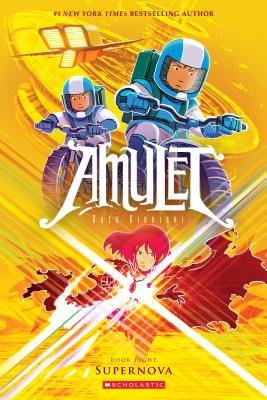
Amulet: Supernova

supernovaby Kazu Kibuishi
First sentence: “Mind if I join you, Traveler?”
Support your local independent bookstore: buy it there!
Others in the series: The Stonekeeper, The Stonekeeper’s CurseThe Cloud SearchersThe Last CouncilPrince of the ElvesEscape from Lucien, Firelight

First: I would highly suggest you read (or re-read) the other seven books in the series before tackling this one. It’s been more than two years since the last book came out, and if you’re anything like me, you won’t remember what’s going on. Also: it’s a fantastic experience reading one right after the other, seeing how Kibuishi has fit everything together and foreshadowed events throughout the series.

That said, there really isn’t much to say.  The resistance is fighting an Incredible Battle Against Impossible Odds. Emily is fighting for control with the Voice of the Amulet. Everything seems dire. And, no, it doesn’t quite end here. There’s one more (it does say “to be concluded in book nine” at the end). But, Kibuishi’s art is still amazing, and the story telling still spot-on. And the characters still worth adventuring with.

I will be incredibly sad to see this come to an end after so many years, but I’m sure it will be completely worth it.

Sanity & Tallulah

by Molly Brooks
First sentence: “Wow you’re so wrong right now that I don’t understand how we’re even friends.”
Support your local independent bookstore: buy it there!
Review copy provided by the publisher.
Release date: October 23, 2018
Content:  There’s a couple of scary moments. It will be in the  Middle Grade Graphic Novel section of the bookstore.

Sanity and Tallulah are best friends living in a space station at the edge of space. They go to school — where Tallulah excels at science and Sanity is basically comic relief — they hang out — a lot, since Tallulah’s dad is the station director and her mom is off doing border patrol — and sometimes get into trouble. But nothing major. That is until Tallulah’s illegal science experiment — a three-headed cat named Princess Sparkle Destroyer of Worlds — gets out and starts wreaking havoc on the station.

Or so they think. As Sanity & Talullah investigate further, in search of their pet, they discover that there may be something more wrong than just an escaped cat.

A super-fun adventure/mystery in which girls take the lead, this one is great for fans of Zita the Spacegirl and Amulet. It’s got an action-packed and science-filled (well, futuristic science-filled) storyline, and it’s funny as well! Brooks is definitely a graphic novelist I’d like to see more work from.

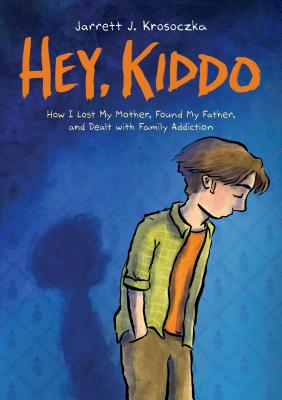
Hey Kiddo

by Jarrett J. Krosoczka
First sentence: “C’mon, get behind the wheel.”
Support your local independent bookstore: buy it there!
Review copy provided by the publisher.
Content:  This is not a light graphic novel. There’s swearing, talk of drug use and abuse, and bullying. It’s in the graphic novel section of the bookstore, but it might appeal to younger teens as well.

I was told by my publisher rep that this one was incredibly powerful. I trust her judgement and opinion, but I didn’t fully appreciate what she meant.

In this graphic novel that was initially inspired by his TED Talk , illustrator and author Krosoczka puts down into pictures — grays and browns with a splash of orange — what his childhood was like. He was the grandson of  Polish immigrants — Joe and Shirley, the hardworking types who mostly showed tough love more than actual love. He was born to their second daughter (they had five children in all), and went to live with them  when he wa about three because his mother couldn’t take care of them. He writes about how this effected his life: the not knowing nothing about his father — not even his name — or much about his mother, where she was, or whether or not she’d show up. He talks about addiction and how it played a role in his life — not as a user, but as someone who loved a user. But, for me, it wasn’t just about his mother, it was about his grandparents as well. How they struggled to raise him (and their other children; Jarrett’s mom wasn’t the only teenage pregnancy in their family) and how they tried to make it day-to-day. Krosoczka doesn’t hold anything back, and I appreciated that. The through line was his art. And one of the things his grandparents did right was support his passion and talent for drawing. Even though they weren’t always the kindest to him, and even though it was weird being raised by his grandparents (it was the 1980s/1990s after all), it came through how much they loved him.

It also was nice that he didn’t pass judgement on his mom in the book. He could have railed on her for abandoning him, for never being there, for not being able to conquer her addiction to heroin. But he didn’t. He was honest about his feelings towards her — the times in his life that he craved her attention as well as the times when he was angry with her — but he didn’t pass judgement on her. I found that refreshing. It’s good to have stories of kids who are living with their grandparents because their parents can’t handle it. It’s good to have stories of forgiveness (because he does, eventually forgive his family for not being perfect). And it’s good to have stories about kids of drug addicts where the kids turn out okay.

It’s definitely worth reading.


Flocks

by L. Nichols
Support your local independent bookstore: buy it there!
Review copy provided by the publisher.
Content: There is some mild swearing and two f-bombs, plus some drinking and self harm and illusions to sex. It’s in the graphic novel section of the bookstore.

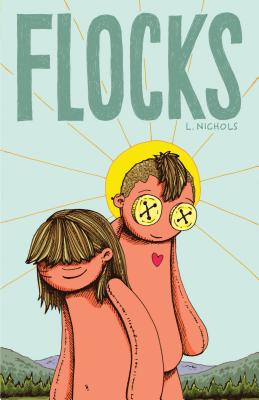
I’ll be up front: Nichols is a transgender man who was assigned female at birth in Louisiana and raised in a very religious Southern Baptist family.This is his story.

It’s not just a story of feeling out of place in a religious society — he tried very very hard to pray the gay away from the time he was young — but also feeling out of place in his own body. The only place he felt at home and at peace was in nature. He graduated from high school and went to MIT (the first in his family to go to college) where the sense of displacement both increased and decreased. Decreased because he was among friends who accepted him and cared about him for who he was; increased because he loathed his body — he began cutting himself — and couldn’t figure out why (that is, until he had a realization that it was because he wasn’t male enough). It’s a very personal story, as one would expect from a memoir, but one that raises some interesting questions about religion and community.

I loved Nichols’ art as well. Everyone is drawn fairly realistically except him, and he’s in this doll-esque shape, which I loved because it allowed him to not only be the gender he was assigned at birth (while simultaneously demonstrating his obvious discomfort with himself) but it allows the reader to empathize more with him as a character. It’s quite clever, and I loved it.

I also loved that this made me think, not just about trans people, but about how communities include and exclude others and the benefits and disadvantages of that. I appreciated his (inadvertent) critique of religion vs. God and it made me want to be more open and kind to others. We’re all struggling here, why add hate to the pile?

Excellent.

Sheets

by Brenna Thummler
First sentence: “It’s difficult to list, in order, the things I hate.”
Support your local independent bookstore: buy it there!
Review copy picked up at CI6
Release date: August 28, 2018
Content: There is a slight romance, and some bullying. It’ll be in the middle grade graphic novel section of the bookstore.

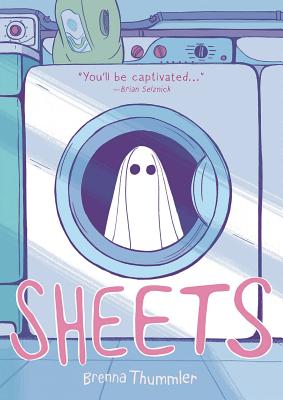
Marjorie Glatt’s mother has recently died and her father has gone into mourning. Which means that 13-year-old Marjorie is left taking care of everything: school, her five-year-old brother, and running the family laundromat. It’s a lot for a 13-year-old to take on, especially when one of the town’s residents, Mr. Saubertuck, keeps trying to put her out of business so he can start his 5-star spa and yoga center.

Walter is a recently deceased ghost, who doesn’t like being a ghost. So, he skips ghost town (yes, there is a ghost town!) and heads to the nearby city where he finds the Glatt’s laundromat, which turns out to be a ghost’s paradise. What they discover is that a girl and a ghost can, in fact, help each other out, and make both of their lives easier.

This is a super charming little graphic novel. It deals with a tough subject — grief and death — but in such a way that it’s accessible to kids and gets them to think  (and laugh!) in ways that a prose novel wouldn’t have. I love Thummler’s illustrations, from the ghosts who have personalities in spite of being covered with sheets to Marjorie and Mr. Saubertuck.

Delightful.

Monstress: Awakening

by Marjorie Liu and Sana Takeda
Support your local independent bookstore: buy it there!
Content: Lots of f-bombs and graphic violence and some nudity. It’s in the graphic novels section of the bookstore.

I really had no idea what to expect when going into this one; I just knew that Liu had won the Eisner for writing and I figured I should give the story a try.

It’s… a lot.

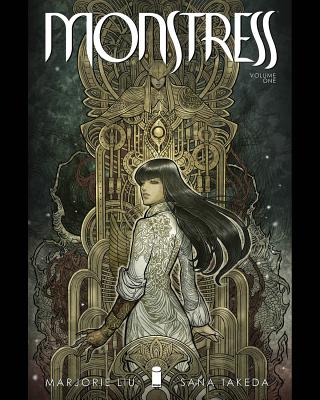
It’s set in this world where humans have been at work with Arcanics, who are a human/animal mix. It’s a racial war: the humans feel the Arcanics are sub-human and are trying to wipe them out. Throw into the mix the Cumaea — witch women who aren’t on anyone’s side, but use the Arcanics for their own purpose (and who I kept calling chimera) and you’ve got a hot mess of violence. Maika Halfwolf is our main character, possibly an Arcanic, but also possibly something else, who breaks into the Cumaea stronghold and (after killing pretty much everyone) absconds with a mask that awakens a demon she barely can control, in hopes to sway the tide of this war.

I think.

As I said, it’s a lot. I’m not entirely sure if I got all the plot or even the people straight. I don’t know if I liked it, but I’m not sure this one is meant to be liked. It’s super feminist — a ton of female characters of all shapes and sizes and stripes and in positions of power and not, and there are very few male characters at all. And it’s super pretty to look at; the art is gorgeous and elaborate and incredible. There is a lot to think about: it’s dealing with slavery and power and racism and seclusion and what circumstances can do to individuals.

But…

I don’t know. I’ve thought about it quite a bit over the time since I finished it, so that’s definitely something. It’s definitely one of the more unique and challenging graphic novels I’ve read recently.

Faith: Hollywood and Vine

by Jody Houser, Francis Portela, and Marguerite Sauvage
Support your local independent bookstore: buy it there!
Content:  There is your usual superhero blow-em-up fare, plus some awkward moments. This would be in the graphic novel section of the bookstore if we had it.

So, in my graphic novel class this summer, we (well, me and a couple other students) ended up talking a lot about representation by women (and diversity, though not as much) in the comics/graphic novels world. One of the other students said that Valiant did an okay job with representation, but mentioned Faith as a good example of a plus-size superhero where weight didn’t really come into play. I was curious, so I picked it up.

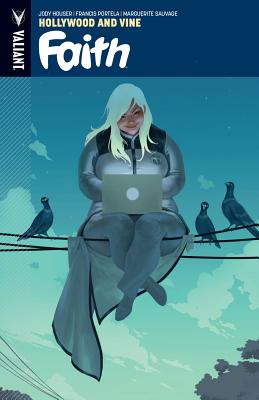
After a traumatic experience and a bad breakup, Faith Herbert aka Zephyr (she’s a psiot who can fly and has some telekinetic ability)  has moved from New York to LA to try and do things on her own. Donning an alias, Summer Smith, she gets a job as a content writer for a culture blog/website. Even though she hasn’t made many friends and her ex has a reality TV show, Faith is doing pretty well. That is, until she discovers that psiots are disappearing and that there’s a tie-in to the new, hot sci-fi show on TV. So, of course it’s up to Faith (with some help from a few friends) to save the day.

On the one hand, yeah: it was refreshing to see an atypical superhero doing cool and amazing things and being comfortable in her own body (or at least not having her body be the center of the story line). But, and maybe this is me, I think much of what was “revolutionary” by that is diminished by the fact that everyone else in the book is skinny and/or super built. What’s the point of making the main character look more realistic if everyone else (from her crushes to the love interest to the bad guys to her co-workers) is “normal” and she’s the odd woman out? I kept noticing that she was always the fat one, and felt — even though it’s written/drawn by women — that somehow they were trying to draw attention to her size. So, even though the plot wasn’t about her weight, the book, ultimately, ended up being about her weight. Which made me sad. (To be fair, maybe it’s just me?)

That said, I liked the story. I liked Faith, and her fangirlness. I liked her daydreams and her awkwardness and her moral code. And I liked the resolution in the end.

It wasn’t a bad graphic novel and I am glad I read it.

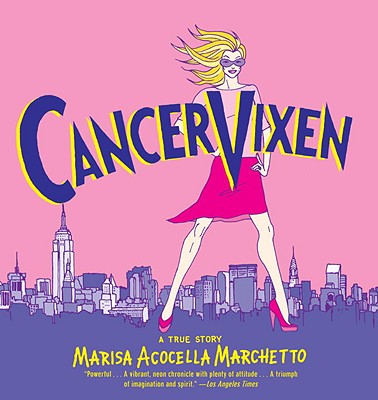
Cancer Vixen

by Marisa Acocella Marchetto
First sentence: “What happens when a shoe-crazy, lipstick-obsessed, wine-swilling, pasta-slurping, fashion-fanatic, single-forever, about-to-get-married big-city girl cartoonist (me, Marisa Acocella) with a  fabulous life finds… a lump in her breast?”
Support your local independent bookstore: buy it there!
Content:  There is swearing (no f-bombs), some tasteful nudity, and lots of naked breasts (it is about breast cancer, after all).  It would be in the adult graphic novel section of the bookstore, if we had it.

The first sentence of this one kind of says it all: Marchetto, a cartoonist who works for Glamour and the New Yorker, had a fabulous life with a new Italian boyfriend she was planning on eloping with, when she — out of the blue, because what other way does cancer happen? — is suddenly diagnosed with cancer.

Much of the book is a detailed blow-by-blow of Marchetto’s cancer treatment, and how that affected her life and  relationships. I found it interesting — I’ve never known anyone who’s gone through this before — but I wasn’t enamored with the story. It was very much “it girl” New York: all the right clothes, all the right friends, all the right things. (Though, she had a LOT of friends, which is a great thing!) I was more interested in her body image issues, especially regarding the models who kept throwing themselves shamelessly at Marchetto’s fiance, Silvano. But Marchetto didn’t really dwell on that; she brushed past it as part of her “negativity”. There was also an undercurrent of evidence why universal health care is needed: she was uninsured when she was diagnosed, and was in a panic about having to pay out of pocket for the treatment. Which turned out to be nearly $200,000. But, she didn’t dwell on that, either. It was very self-centric, and, honestly, I didn’t really care for her. (I feel bad saying that, though.) The art was a bit meh, as well, though I understand why she chose to draw it slightly cartoony; if it were more realistic, it’d be a lot more disturbing. This way, Marchetto was able to keep it from getting too dark while remaining honest about the ups and downs of cancer treatment (and her life).

Not bad, but not my favorite, either.

Fullmetal Alchemist

by Hiromu Arakawa
Support your local independent bookstore: buy it there!
Content: There’s violence and some mild swearing as well as some graphic injury images. It’s in the manga section at the bookstore.

So I read this one kind of weirdly… I could only get my hands on volume 2 at the bookstore,  so K suggested I watch the anime to catch me up on the story, and then I read volume 2 (and put a hold on volume 3, but volume 4 isn’t available at the library, so maybe I’ll just finish the story watching the anime, because — believe it or not — I’m invested in this one…) Maybe that’s the way to go — watching the anime before reading — because I found myself more invested in this manga than I have in the past ones I’ve read.

This one’s the story of the Elric brothers, young, talented alchemists who had a devastating accident while attempting to use alchemy to bring their mother back from the dead. Edward (he’s the actual boy) lost a leg but his brother, Alphonse (he’s the armor), lost his entire body. Edward was able to save Alphonse by putting his soul in the armor, but it cost him his arm. And so, now, they’re searching the world for something — possibly the Philosopher’s Stone — to make them both (but mostly Alphonse) whole again. On their adventures, they meet dangerous people (not the least of which are the seven deadly sins personified, though I’ve only met Lust, Greed, and Envy so far) and fight to keep together.

Oh, I really liked this manga (K finally recommended one I really, really liked!). I liked the relationship between the brothers, and I liked the side characters. This is a huge, complex story that just got huger and more complex, and even though I’ve only read one, I’m dying to know what happens and how it all plays out. If it just means watching the anime, I definitely will finish this one.


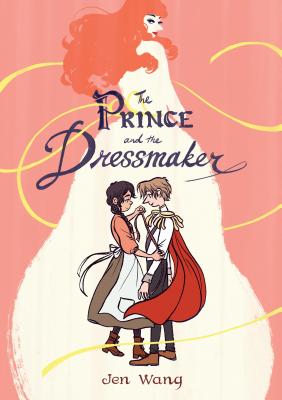
The Prince and the Dressmaker

by Jen Wang
First sentence: “The prince is holding a ball!”
Support your local independent bookstore: buy it there!
Content: There are some more mature themes, and it’s in the teen graphic novel/graphic novel section of the bookstore, but I think if there was a 4/5th grader who was interested in the subject, they could certainly read it.

Frances is a dressmaker in Paris in around the turn of the 20th century. She works for a tailor, but has dreams of creating her own fashion line, if only she can meet the right people. When she designs a dress for a client for the prince’s ball celebrating his 16th birthday, it captures the attention of a mysterious patron. Frances jumps at the offer: it’s her chance to get noticed.

The mysterious patron turns out to be the prince himself, who has a secret he keeps from everyone except Frances: he likes to wear dresses and wants Frances to make it possible for him to go out in public. He becomes his alter-ego, Lady Crystallia, who, dressed in Frances’s creations, becomes the talk of the town. This, however creates a conflict: Frances wants credit for her designs, but Prince Sebastian is afraid of what his family and his people are going to think if they discover that he is Lady Crystallia.

I’m actually not sure if this fits under the LGBT umbrella, since Sebastian is actually attracted to Frances (I thought for a long time that he was gay, since he wasn’t interested in any of the girls that his parents were proposing he marry), but the ending is ambiguous (aside from a couple of kisses), so maybe it does? It does fall under the “let people be themselves” umbrella. Setting it in the late 19th century, Wang heightens society’s disapproval of someone breaking gender norms, which is really the point. Sebastian wants to wear dresses. Why should it matter who he is attracted to? Sebastian wants to wear dresses. Why should that affect how he relates to those around him or even, eventually, govern? Sebastian wants to wear dresses. Why should that make him less of a person? The ending is a bit too quick for me: initially everyone rejects Sebastian, but they come around pretty quickly (or maybe lots of time passed and I just missed it because it was a graphic novel)…

Wang’s art is charming, as always, and I found the book, overall, to be a delight to read.