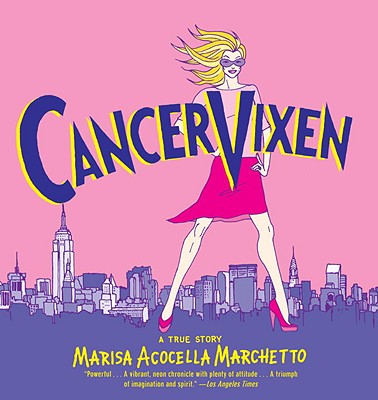
Cancer Vixen

by Marisa Acocella Marchetto
First sentence: “What happens when a shoe-crazy, lipstick-obsessed, wine-swilling, pasta-slurping, fashion-fanatic, single-forever, about-to-get-married big-city girl cartoonist (me, Marisa Acocella) with a  fabulous life finds… a lump in her breast?”
Support your local independent bookstore: buy it there!
Content:  There is swearing (no f-bombs), some tasteful nudity, and lots of naked breasts (it is about breast cancer, after all).  It would be in the adult graphic novel section of the bookstore, if we had it.

The first sentence of this one kind of says it all: Marchetto, a cartoonist who works for Glamour and the New Yorker, had a fabulous life with a new Italian boyfriend she was planning on eloping with, when she — out of the blue, because what other way does cancer happen? — is suddenly diagnosed with cancer.

Much of the book is a detailed blow-by-blow of Marchetto’s cancer treatment, and how that affected her life and  relationships. I found it interesting — I’ve never known anyone who’s gone through this before — but I wasn’t enamored with the story. It was very much “it girl” New York: all the right clothes, all the right friends, all the right things. (Though, she had a LOT of friends, which is a great thing!) I was more interested in her body image issues, especially regarding the models who kept throwing themselves shamelessly at Marchetto’s fiance, Silvano. But Marchetto didn’t really dwell on that; she brushed past it as part of her “negativity”. There was also an undercurrent of evidence why universal health care is needed: she was uninsured when she was diagnosed, and was in a panic about having to pay out of pocket for the treatment. Which turned out to be nearly $200,000. But, she didn’t dwell on that, either. It was very self-centric, and, honestly, I didn’t really care for her. (I feel bad saying that, though.) The art was a bit meh, as well, though I understand why she chose to draw it slightly cartoony; if it were more realistic, it’d be a lot more disturbing. This way, Marchetto was able to keep it from getting too dark while remaining honest about the ups and downs of cancer treatment (and her life).

Not bad, but not my favorite, either.

Fullmetal Alchemist

by Hiromu Arakawa
Support your local independent bookstore: buy it there!
Content: There’s violence and some mild swearing as well as some graphic injury images. It’s in the manga section at the bookstore.

So I read this one kind of weirdly… I could only get my hands on volume 2 at the bookstore,  so K suggested I watch the anime to catch me up on the story, and then I read volume 2 (and put a hold on volume 3, but volume 4 isn’t available at the library, so maybe I’ll just finish the story watching the anime, because — believe it or not — I’m invested in this one…) Maybe that’s the way to go — watching the anime before reading — because I found myself more invested in this manga than I have in the past ones I’ve read.

This one’s the story of the Elric brothers, young, talented alchemists who had a devastating accident while attempting to use alchemy to bring their mother back from the dead. Edward (he’s the actual boy) lost a leg but his brother, Alphonse (he’s the armor), lost his entire body. Edward was able to save Alphonse by putting his soul in the armor, but it cost him his arm. And so, now, they’re searching the world for something — possibly the Philosopher’s Stone — to make them both (but mostly Alphonse) whole again. On their adventures, they meet dangerous people (not the least of which are the seven deadly sins personified, though I’ve only met Lust, Greed, and Envy so far) and fight to keep together.

Oh, I really liked this manga (K finally recommended one I really, really liked!). I liked the relationship between the brothers, and I liked the side characters. This is a huge, complex story that just got huger and more complex, and even though I’ve only read one, I’m dying to know what happens and how it all plays out. If it just means watching the anime, I definitely will finish this one.


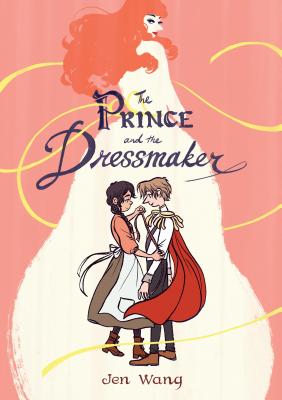
The Prince and the Dressmaker

by Jen Wang
First sentence: “The prince is holding a ball!”
Support your local independent bookstore: buy it there!
Content: There are some more mature themes, and it’s in the teen graphic novel/graphic novel section of the bookstore, but I think if there was a 4/5th grader who was interested in the subject, they could certainly read it.

Frances is a dressmaker in Paris in around the turn of the 20th century. She works for a tailor, but has dreams of creating her own fashion line, if only she can meet the right people. When she designs a dress for a client for the prince’s ball celebrating his 16th birthday, it captures the attention of a mysterious patron. Frances jumps at the offer: it’s her chance to get noticed.

The mysterious patron turns out to be the prince himself, who has a secret he keeps from everyone except Frances: he likes to wear dresses and wants Frances to make it possible for him to go out in public. He becomes his alter-ego, Lady Crystallia, who, dressed in Frances’s creations, becomes the talk of the town. This, however creates a conflict: Frances wants credit for her designs, but Prince Sebastian is afraid of what his family and his people are going to think if they discover that he is Lady Crystallia.

I’m actually not sure if this fits under the LGBT umbrella, since Sebastian is actually attracted to Frances (I thought for a long time that he was gay, since he wasn’t interested in any of the girls that his parents were proposing he marry), but the ending is ambiguous (aside from a couple of kisses), so maybe it does? It does fall under the “let people be themselves” umbrella. Setting it in the late 19th century, Wang heightens society’s disapproval of someone breaking gender norms, which is really the point. Sebastian wants to wear dresses. Why should it matter who he is attracted to? Sebastian wants to wear dresses. Why should that affect how he relates to those around him or even, eventually, govern? Sebastian wants to wear dresses. Why should that make him less of a person? The ending is a bit too quick for me: initially everyone rejects Sebastian, but they come around pretty quickly (or maybe lots of time passed and I just missed it because it was a graphic novel)…

Wang’s art is charming, as always, and I found the book, overall, to be a delight to read.

Watchmen

by Alan Moore
Support your local independent bookstore: buy it there!
Content: There is graphic violence, swearing (no f-bombs though) and nudity (and sort-of on-screen text). It’s in the graphic novel section of the bookstore.

I wrote about this one ten years ago when I first read it, but I thought I’d write my thoughts that I turned in as well.

Intellectually, I know the Watchmen is a classic work of not only comic storytelling, but also a classic work of literature. However, while I can respect what Moore and Gibbons are doing, I didn’t like the experience. Partially it was the art; Gibbons’ art was completely subservient to the text, lacking very little originality. I did find the panel in issue 4, , the moment when the test chamber went off (9) and the particles dissolved Dr. Manhattan and the following few panels to be incredibly striking. But otherwise, I found the moment-to-moment and scene-to-scene art slowed down the narrative, especially through volume nine. I understand that, thematically, Moore is reflecting the world he saw when this was written in 1987 — a very sexist, homophobic (issue 11, p. 9, among others), and bleak world — and critiquing the way we use superheroes in our cultural life: None of the characters are honorable or admirable (like Superman or Captain America) or even serving the cause of justice, even if it’s in a vigilante manner (Batman). The backstories we learn (I’ll admit; I didn’t read the “excerpts” in the end; and felt like they were filer that added no substance to the actual plot line) don’t take away from the feeling that the characters are mostly individuals without any integrity in what they do. I wish he had allowed the women (all two of them) to be more than just sex objects — Sally, whose most significant characteristics were that she is aging and that the Comedian raped her (issue 2, p. 5-7), and her daughter, Laurie, whose sole purpose is to be a companion to her lovers, both Dr. Manhattan (issue 5, p. 11) and Dan Dreiberg (most of issue 7, but specifically p. 28). This is a reflection of both the mid-1980s society and popular culture, but doesn’t excuse the lack of development of these characters. Admittedly, Moore isn’t putting up hyper-masculinity as an ideal: Neither of the hyper-masculine characters of the Comedian and Ozymandias are admirable characters, while Rorschach, who would not be considered “masculine” at all — being called “queer” (issue 5, p. 27) and “runt” (issue 6, p. 8) among others — also happens to be the moral center of the series. He is the one who realizes that someone is creating a plot against “costumed adventurers” (issue 1, p. 12) to get them out of the way and in the end refuses to compromise his ideals forcing Dr. Manhattan to kill him (volume 12, p. 14). I did like the ending; while Ozymandias “gets off”, Dr. Manhattan’s prophecy that “Nothing ends, Adrian. Nothing EVER ends” (issue 12, p. 27) is fulfilled in the very final panel, where readers see Rorschach’s journal detailing everything delivered to the newspaper, and the final image (issue 12, p. 32) is the same as the cover of issue one and the first image the readers see (p.1). True, there is a lot to think about and discuss — is it right to kill off millions of people just to save the world? — but it was not an enjoyable reading experience. If this had been my first foray into graphic novels, it might have turned me off on the format completely. Thankfully, it wasn’t.

Peter & Ernesto: A Tale of Two Sloths

by Graham Annable
First sentence: “Rabbit.”
Support your local independent bookstore: buy it there!
Content: There’s a lot of pictures, and simple words on each page. It’s in the Beginning Chapter Book section (grades 1-2) of the bookstore.

I have to admit that I picked this one up primarily because the title makes me smile. Making two sloths the subject of a graphic novel? How delightful! How absurd! And that perfectly describes the book.

Peter & Ernesto are two sloths, friends living in a tree together. They have their games and traditions, and it’s all good. That is, until the day that Ernesto decides he wants to see more of the sky than the small patch above their tree. So, he leaves. He has some interesting adventures, and makes a lot of new friends, as he explores all the sky. Peter, on the other hand, is worried when Ernesto doesn’t come back. So he follows him, at least until he can’t. Then he waits until Ernesto comes back. And when he does, he shares all the things he learned by being away.

it’s super simple, and the illustrations and text reflect that. I adore Annable’s sloths; while they’re more cartoonish than actual renditions, it captures the, well, slothiness of the animal. And I like the dichotomy between Ernesto — who is more adventuresome — and Peter, who is just a bundle of anxiety. It’s delightful. My favorite interaction is when Ernesto meets a fox and a raccoon when he’s exploring a mountain sky. They say,  “I thought sloths were lazy.” And Ernesto replies, “We’re content. There’s no need to move much when you’re content. But I’m not content. So I’ve been traveling.” I love that sentiment.

It really was a charming little beginning graphic novel.

Scarlett Hart: Monster Hunter

by Marcus Sedgwick and Thomas Taylor
First sentence: “The Academy announced that another monster is on the loose.”
Support your local independent bookstore: buy it there!
Content: There’s some precarious situations, but not much else. It’s in the middle grade graphic novel section of the bookstore.

It’s been a while since I’ve read a graphic novel that was this fun. Scarlett Hart is the daughter of two former monster hunters, who died in the line of duty. Even though she’s underage, and could lose her home to the Academy if they find out, she is a talented monster hunter, and with the help of her trusty butler, Napoleon, has been taking on the monsters in London.

There has been an uptick in monsters lately, though, and the dastardly (which really is the best word) Count Stankovic is out to discredit Scarlett (and get her permanently banned from the Academy). However, treachery lies deeper than that, and soon London is under attack. Can Scarlett stop it before everything is destroyed?

Seriously. This is just so much fun. It’s got a great steampunk feel, with cars and some other great inventions. It’s got a lot of humor — Napoleon and his relationship with his car! — as well as some great action sequences as well. It was just a delight to read. And I wouldn’t mind revisiting Scarlett and her world again!

March (Book Two and Three)

by John Lewis, Andrew Aydin, and Nate Powell
First sentence: “Brother John — Good to see you.”
Support your local independent bookstore: buy it there (book 2, book 3).
Others in the series: March (Book One)
Content: There is a lot of violence, and use of the n-word. It’s in the non-fiction area of the graphic novel section of the bookstore.

This picks up where March (Book One) leaves off. Lewis is part of student non-violent protests in Nashville in the early 1960s, but soon leaves that to join the Freedom Riders: a group of African Americans who, in 1961-1962, put supposed desegregation to the test. They rode Greyhound buses though the south, stopping at cities in Virginia, Georgia, Alabama, and Mississippi, with — as you would guess — pretty disastrous results. They were yelled at, beaten, arrested, thrown in jail, loaded up in cars and left in Klan territory, and the buses were blown up… let’s just say that, in short, white people in the south were TERRIBLE people.

All through this, Lewis (and others) preached the gospel of non-violence (which just makes white people look like terrorists. Really.): they didn’t fight back, they didn’t talk back, they just exercised their right (!) to do what they feel they had a right to do.

The book also follows Lewis through the March on Washington in 1963. (I didn’t know he was there, or even that he spoke! In fact, there’s a side note by him that out of everyone who spoke, he was the only one still living.) It was fascinating, learning about the politics behind that march, and about Robert Kennedy’s change of heart as well.

It’s a well-done graphic novel, one that is still very timely to read. As a white person, it definitely made me more aware of what people went through in the 1960s to get just basic rights, and I’m more aware now of how those rights aren’t still completely equal

March (Book Three) picks up after the church bombing the beginning of 1964 and goes through the march from Selma to Birmingham. My thoughts are pretty much the same as after reading book two: white people are so entrenched in their “way of life” that they can’t abide by change at all. And the thing I kept coming back to was that, in the intervening 54 years, that white people are still entrenched in their “way of life”, we just call it by different things now. It’s still racism. And it still is wrong. This one was difficult to read, and made me think, over and over, that an eye for an eye just makes everyone blind. I hope I’d have the courage to stand up to those who use their power to make others “less than”, those who call others “animals” or “dirty” or “from s-hole countries”, those who want to abuse their power to keep themselves in power… even if it means sacrificing my life. John Lewis and all those who stood by him are true heroes, and I wish there were more people like them now.

Excellent.

My Hero Academia

by Kohei Horikoshi
Support your local independent bookstore: buy it there!
Content: There’s some violence. And it’s a manga, so you have to read it backwards which might be a bit of a challenge (it was for me). It would be in the manga part of the graphic novel section of the bookstore, if we carried it.

K has been obsessed with My Hero Academia (though she watches the anime version and reads them online) for a while now, and when I had a chance to read graphic novels for my class, she talked me into reading this.

It’s basically an alternative Japan where everyone has “quirks” (think X-men mutant-type quirks; in fact one of the reviews I read criticized this for being an X-men knock off, which I can see). Everyone, that is, except Izuku, a 15-year-old quirkless kid… who wants to be a hero. He wants to get into the top school — U. A. High School for heroes — he wants to have a quirk. He wants to be like his personal hero, All Might. Except he can’t without a quirk. Things change for him, though, when he does a selfless act, and All Might — who in real life is completely wasted away — gives Izuku his powers. Which means two things: Izuku gets in to U. A…. but he doesn’t quite know how to control his powers. Yet.

This was so much fun! (Once I got the hang of reading a manga. K had to explain it to me.) Seriously. I loved Izuku and some of the other kids he met at U. A.  Horikoshi has created some fun characters, and I’m curious to see what they will be doing next, since volume 1 was just Izuku (called Deku by his friends) getting his powers and getting into school. The whole series was a bit cheeze-tastic, which I don’t mind at all. In fact, I found it charming.

And I think I might pick up the next one. (K’s urging me to do it!)

Be Prepared

by Vera Brosgol
Support your local independent bookstore: buy it there!
Review copy provided by the publisher.
Content: There’s some awkward pranks, some light bullying, and some kissing. It’s in the middle grade graphic novel section of the bookstore.

Loosely based on Brosgol’s youth, Be Prepared follows 10-year-old Vera to Russian camp, nominally so she can “fit in”. Being Russian, she doesn’t quite mesh up with her friends at home, so she figures she’d have a better chance to fit in at a camp where everyone is Russian. Except, once she gets there she finds out that being the new kid isn’t any fun. Everyone already knows the camp traditions, rules, and has friends. She’s perpetually the third wheel and is often pushed around, especially by the older girls she bunks with.  It’s awkward and embarrassing, and Vera just wants to go home.

I can completely empathize with the feeling of not fitting in, feeling awkward, and not knowing how to make friends, and Brosgol captures that perfectly. But, thankfully, she manages to figure things out by the end of camp, mostly by being herself, which is always a good thing for kids to read about. She manages the awkward with humor — there are some laugh-out-loud moments! — and she makes even the annoying kids and the bullies be multi-dimensional.

There is a bit of a cliffhanger at the end of this one, so I hope Brosgol gives us a sequel!

All Summer Long

by Hope Larson
Support your local independent bookstore: buy it there!
Review copy provided by the publisher.
Release date: May 1, 2018
Content: There’s a little bit of romance, and just some themes of growing up in general. It will be in the middle grade graphic novel section of the bookstore, but the sweet spot for this one is 6-7th graders, I think.

It’s the summer after 7th grade, and Bina’s not looking forward to it. Her best friend, Austin, is off to soccer camp for a month, and Bina’s afraid that summer will be boring without him. They’ve always spent the summer together, making their own fun, but they seem to be… growing up. And things aren’t the same.

Though, eventually Bina finds her own things to do: she makes friends with Austin’s older sister, Charlie, gets some babysitting gigs, and practices her guitar. It’s not the way it was with Austin, but it doesn’t suck.

The underlying conflict in the book is Austin and Bina’s friendship: they’ve been friends forever, but Austin’s been getting some grief from other boys (toxic masculinity is the worst!) for being friends with a girl, and so he attempts to push Bina away — which is part of the reason he’s been acting weird toward her. Larson treats all this with kindness and humor, and puts across a message that it’s okay to be friends with whomever you want to be with. Period. It’s wonderful.

And Larson also captures what it’s like to be young and faced with a long summer of doing… nothing. I like that the parents are concerned and responsible, but not hovering (they also change the Netflix password, so Bina can’t just watch TV all summer… that’s not a bad idea!) and Bina has some freedom to go out and find her own fun, but within reason.

It’s really a delightful graphic novel.