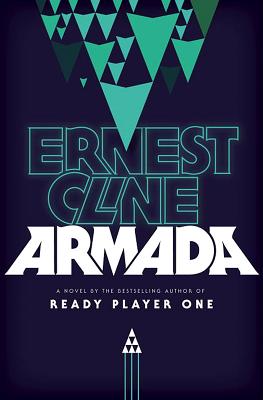
Armada

by Ernest Cline
First sentence: “I was staring out the classroom window and daydreaming of adventure when I spotted the flying saucer.”
Support your local independent bookstore: buy it there!
Release date: July 14, 2015
Review copy pilfered off the ARC shelves at my place of employment.
Content: There’s a lot of swearing, of all sorts. If you have a problem with that, then you probably shouldn’t be reading this. It’ll be in the Science Fiction/Fantasy section of the bookstore.

When I was a kid, one of my favorite movies to quote was The Last Starfighter. (I know: there’s no accounting for taste.) I swear my brothers and I watched it over and over again the summer of 1985 or 1986) and there were lines that incorporated themselves into our everyday lingo (“I’ve always wanted to fight a desperate battle against incredible odds.”). But, when I tried to show it to my kids, I cringed: it’s a pretty bad movie.

So, when I started Armada by Ernest Cline, I cringed: he’s pretty much riffing off the idea behind Last Starfighter (and Ender’s Game): video games, believe it or not, have been training for the impending alien invasion, and since the mid-1970s (it’s set in 2017, as far as I could figure), the top players of the game Armada have been recruited to serve as the Earth’s Defense.

Zack Lightman is one of those players. He’s been obsessed with games, and specifically Armada, since was was old enough to realize that his father — who died when Zack was barely one — was a gamer and Zack wanted to emulate him. Zack’s crawled up the ranks in Armada, until he’s the 6th highest ranked player in the world. And then: he sees a spaceship, one straight from Armada. That’s when his life gets really weird.

Like Ready Player One, this one has a litmus test. If you like/get the following passage, this book is probably for you:

In that moment, I felt like Luke Skywalker surveying a hanger full of A-, Y-, and X-Wing Fighters just before the Battle of Yavin. Or Captain Apollo, climbing into the cockpit of his Viper on the Galactica‘s flight deck. Ender Wigging arriving at Battle School. Or Alex Rogan, clutching his Star League uniform, staring wide-eyed at a hanger full of Gunstars.

I won’t give away too much more of the plot except to say this:  it took a while to get into it, but I was glad I kept with it. I liked the direction that Cline took it in the end.  A good read.
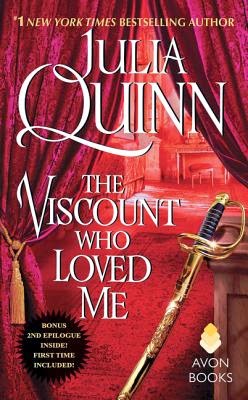
The Viscount Who Loved Me

by Julia Quinn
First sentence: “Anthony Bridgerton had always know he would die young.”
Support your local independent bookstore: buy it there!
Content: Um… yeah…. it’s definitely an Adult book. *blush*

I’ve always said that I prefer plot and character development with my sex (in books). So, I went into this one (a YAckers read, of course) with hopes that it would be, at the very least, entertaining.

And, thankfully, I was rewarded. (Yay!)

The basic plot is was this: Anthony Bridgerton is a rake of the worst sort. It’s 1814, in the height of the Jane Austen era, when chaperones were needed and etiquette was severely structured, and Lord Bridgerton is running around making love to all sorts of women. (Unsavory women, too!) So, of course Kate Sheffield was not going to let him any where near her sister Edwina (seriously: WHAT KIND OF NAME IS EDWINA?), even though she’s the catch of the season and Bridgerton has got it into his head to marry. And everyone knows he gets what he wants.

Except, what he wants turns out to be Kate. *wink wink* *nudge nudge*

And that’s about all the plot there is. There’s a lot (a LOT) of sassy banter between Kate and Anthony and a lot (a LOT) of innuendo and under-the-surface desire before he’s caught with his mouth on her breast, sucking the “venom” out of a bee sting (at which point I was howling with laughter), and they were forced to marry. And then the real fireworks started. Two whole chapters of a sex scene (why was there a chapter break in between?) in which Anthony desires his wife and she lets him have his way with her. (I am SURE there’s a feminist objection here, but honestly, I couldn’t see it for the blatant disregard for the time period.) It was bad. It was so horrible and awful and blush-worthy, I couldn’t stop reading. It was just so bad it turned the corner into good. (Or at least deliciously mock-worthy.) Everyone murmured.   Or had husky voices. It was just too, too delightful.

There were some honestly good bits along the way. I really enjoyed the Bridgerton dynamic as a family: there’s a croquet game that was honestly a lot of fun to read. And Quinn made them a close-knit, loving family which is not something you often see. And there was a bit of depth in both Kate and Anthony; Quinn did manage to give them some fears and insecurities, so they weren’t completely one-dimensional.

Not usually my type of book, but it ended up being a great diversion.

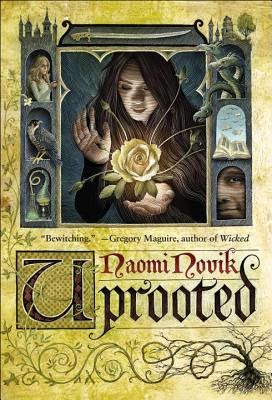
Uprooted

by Naomi Novik
First sentence: “Our Dragon doesn’t eat the girls he takes, no matter what stories they tell outside our valley.”
Support your local independent bookstore: buy it there!
Review copy given to me by the publisher rep.
Content: There’s one graphic, but not explicit, sex scene. It’ll be in the science-fiction/fantasy section of the bookstore.

I picked this one up because our Random House rep said it was based on Beauty and the Beast, and we all know how much I love a fairy tale retelling. But, I didn’t count on how engrossing this book would be.

The rep was right: it is loosely based on Beauty and the Beast, but it’s so much more than that. In this valley in Polyna, their resident wizard, who goes by the Dragon, takes one girl every ten years to his tower. When he’s done with them, they don’t come back to the villages, so everyone (of course) assumes the worst. This year, a picking year, everyone guesses that he will take Kasia, our narrator’s, Neishka, best friend. But the Dragon comes, and he picks Neishka instead.

At first, this is terrifying: Neishka isn’t refined, she isn’t skilled for much of anything (except getting dirty), and she doesn’t want to be in the castle with this scary magician. But, as the book goes on, she discovers hidden talents inside herself: she’s a witch, one that is just as powerful as the Dragon, albeit wielding a different sort of magic from him. And its the combination of their magic that is able to confront the real evil in their country: the Wood.

I don’t want to give away much more than that, because this one is best discovered page by page. Novik has a way of pulling one into the story; this started out as a treadmill book (read twice a week for a half hour), but soon became the one I was spending all my time with. I wanted to experience Neishka’s story as it unfolded, with all the twists and turns and slow reveals and intricate pay offs.

M texted, recently, looking for a “Laini Taylor-esque” book, and honestly, this is what I thought of when she asked for that. Novik’s world-building is solid and always in the service of the story, rather than something separate. And, while her words aren’t gorgeous or lyrical, they’re more than pedestrian. They serve the characters and the plot, and make the whole work together just marvelously.

Just about perfect.

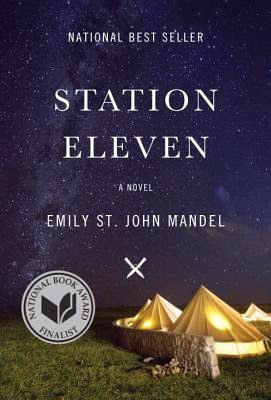
Station Eleven

by Emily St. John Mandel
First sentence: “The king stood in a pool of blue light, unmoored.”
Support your local independent bookstore: buy it there!
Content: There are a half-dozen f-bombs, spread throughout the second half of the book. It’s a bit meandering, but otherwise, it’s a good crossover story, and I’d give it to a teen interested in the post-apocalyptic genre. It’s in the Fiction section of the bookstore.

It’s difficult, I think, to write a linear plot for Station Eleven. There’s a pandemic, obviously: the world has to end somehow. An aside: I think it’s interesting that the way the world ends in fiction these days is through sickness or climate change rather than some horrific nuclear event. Times have changed since Canticle for Leibowitz.

Anyway, a pandemic — Georgia Flu — sweeps through the world, with a 99% fatality rate. It kills you within 48 hours of catching it, so it doesn’t take long. That simple thing, changes the world. Station Eleven follows an actor, Arthur, and everyone his life touches — ex-wives, son, paparazzi, best friend, the child actors he was in King Lear with — before and through the pandemic, exploring the connections between them and the way everyone handles the New World.

The book was less about the pandemic or the world collapsing as it was about the connections between people. The action flipped between before the pandemic to 20 years after, only vaguely hitting upon time in-between. There was enough movement to keep me interested; the huge cast of characters were always doing something, and the non-linear plot helped with that as well. I think it was an intriguing reflection on the way our lives touch one another, how seemingly random occurrences to one person have great significance to another. Admittedly, there were times when I didn’t get the connections: the paparazzi’s story, for example, was so disconnected from the rest, I wondered why his was included. But for the most part, I found the book to be an intriguing examination of connection and humanity in a time of crisis.

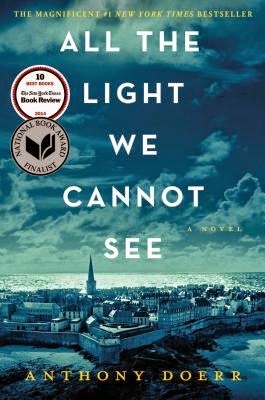
All the Light We Cannot See

by Anthony Doerr
First sentence: “At dusk they pour from the sky.”
Support your local independent bookstore: buy it there!
Content: There is some graphic (read: Nazi) violence and about a half-dozen f-bombs. It’s not a difficult read, even for it’s length, and if there’s a teen interested in WWII, it would be a good one to give. It’s in the adult fiction section of the bookstore.

I’ve kind of been avoiding this one. It was a slow build, but eventually EVERYONE was reading this. And we all know how much I love reading books that everyone is reading. (Not.) At least when it comes to adult books, anyway. I just don’t trust Everyone. (No interest in Gone Girl. Or The Girl on the Train. At. All.)

But this was picked for my in-person book group, and so I was kind of obligated to read it. I didn’t go in expecting much of anything, so I was pleasantly surprised when the chapters were short. And the story was engaging. And that the 500+ page book wasn’t one that was going to bog me down.

In fact, if I dare say this: I enjoyed it. Immensely.

This is, at its simplest, the story of two kids, a blind French girl and an orphan German boy, during World War II. Werner, the boy, is an orphan resigned to growing up in this mining town, working the mines, even though he’s a technical genius. Then, he gets drafted into the German Army, which in 1939 isn’t the happiest place. Marie-Laure is a French girl, living in Paris, with her father who works at the Museum of Natural History. When the Germans invade, they end up in Saint-Malo with Marie-Laure’s great-uncle Etienne. Then her father gets called back to Paris and goes “missing”. Their stories meet, finally, in August 1944, when the town of Saint-Malo is set on fire.

The story, however, is immaterial in this book. No, what’s important, I think are the characters. They way they interconnect with each other, with themselves. And the little acts of goodness — of light — that thread throughout the book. It’s a very dark time, World War II, but this is an incredibly hopeful book. Its short chapters are lyrical and evocative, and the suspense building up to August 1944 — every section or so, Doerr gives us a glimpse of what is happening — is palpable.

My only real complaint is that I could have done without the two epilogues, one in 1974 and the other in 2014. I felt no need to know what the characters were up to after the story ended, and it felt forced and not nearly as emotional as the rest of the book. But that’s a small complaint in the wake of the story.

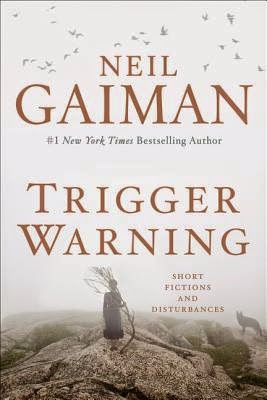
Trigger Warning

by Neil Gaiman
First sentence: “There are things that upset us.”
Support your local independent bookstore: buy it there!
Review copy snagged from the ARC shelves at my place of employment.
Content: This collection is fairly tame, ranging from simpler stories to more complex ones. I’d give it to anyone who has the attention span long enough to get through the stories and who likes short works of speculative fiction. It’s in the science fiction/fantasy section of the bookstore.

I like Neil Gaiman’s writing. I do. I even actually think I like his short stories better than his longer works of fiction. But I think what I like best is listening to the audio of him reading his work. It’s only then that I feel I “get” what he’s trying to say.

Which means, that while I enjoyed this work of short fiction — and I did love some of the stories immensely. Namely, “The Thing about Cassandra” and “The Truth Is a Cave in the Black Mountains” and “A Calendar of Tales” (September fits me quite nicely) and “The Sleeper and the Spindle”. All were elegant and lovely and charming and thoroughly enjoyable.

But there was something missing. And, thinking back on it, that something was Gaiman reading his own stories, enrapturing me with his interpretation of the written word.

Perhaps, then my enjoyment would have crossed over into love.

Audiobook: Funny Girl

by Nick Hornby
Read by Emma Fielding
Support your local independent bookstore: buy it there!
Content: Aside from the dozen f-bombs (entirely from 2 characters), this one is relatively tame. And because it deals with a character in her early 20s, it probably will have some good teen crossover. It’s in the adult fiction section of the library.

Several things conspired to actually get me to read an adult book (shock!). One, I had just finished my previous audiobook and was looking for something new. Two, the Pop Culture Happy Hour podcast (which I have come to love) announced that they were doing a book group discussion of this one in March. And three, I figured I should read Nick Hornby sometime, and this seemed like a good place to start.

It’s 1964, and Barbara Parker is looking at a bleak future. Sure, she just won the Miss Blackpool title but she wants MORE out of life. She wants to be like her heroine, Lucille Ball. So she returns the title, and takes off for the big city, hoping for her break. And, after some bad scrapes and name change — she’s Sophie Straw now — it eventually comes in the form of a BBC TV sitcom, Barbara [and Jim]. She becomes famous, with all the strings that are attached to that, as well as the ups and downs.

On the one hand, I have to admit that I found this a very male-centric, sexist, chauvinistic book. Barbara/Sophie is reduced to her looks (blonde, curvy, busty), as are all of the women in the book. The men drive the action, and Sophie is just reacting to them, much of the time. It’s also incredibly homophobic, even though one of the characters — Bill, a writer on the series — is definitely gay, and another — Tony, Bill’s writing partner — is probably bisexual. This really bothered me, until I realized that Hornby was being true to the time period. The 1960s, especially the mid-1960s when it’s set, was incredibly sexist and homophobic. This proved true by the end of the book, when the characters (and Hornby) were much less annoying.

I also felt like it went on too long, especially the ending. I didn’t really feel a need for the huge epilogue-y ending chapters; I felt the book could have ended when the series ended, and I wouldn’t have missed a whole lot.

That said, I did find it entertaining. I wonder if that had a lot to do with Fielding’s narration. She was a brilliant narrator, working in regional accents and speech affectations so I could get a sense not only of who was speaking but of their character. Sophie’s Blackpool accent, especially, endeared me to her in a way I don’t think would have come through on the page. And it was sometimes laugh-aloud funny. Not consistently, and not enough, but it was there.

I’m not sure I liked it enough to read another Hornby (unless there’s one that you strongly recommend?) but it wasn’t an unpleasant experience either.

The Calligrapher’s Daughter

by Eugenia Kim
First sentence: “I learned I had no name on the same day I learned fear.”
Support your local independent bookstore: buy it there!
Content: It’s pretty long and involved, and some off-screen sex (both married and extra-marital). It’d be in the adult section of the bookstore.

Najin Han was born in 1910, soon after the Japanese invasion (I suppose) of Korea.The daughter of a talented calligrapher, she was supposed to be raised in the traditional manner: to be a servant to men, without the education or opportunities men have.

But, because her mother was Christian, and because Najin was curious, she ended up having more opportunities than she “should” have. She went to school, learned both English and Japanese.She spent time in the exiled court (thanks to some terrific maneuvering from her mother and a well-placed aunt). She got trained to be a teacher and a midwife. So when her husband — an arranged marriage, of course — goes to America for theological training and she gets stuck in Korea, she has Options.

Based on her parent’s lives, Kim writes a fascinating story about life in early-20th century Korea. There was much I didn’t know, from the way the Japanese took over the Korean culture, trying to suppress it to the fact that Christianity was in Korea fairly early on.

I enjoyed reading this one, though there were times that I skimmed — I didn’t care when Kim switched into other points of view; Najin’s story was the one I was most interested in — but for the most part I found this to be a fascinating portrait of a country and time we don’t hear much about.

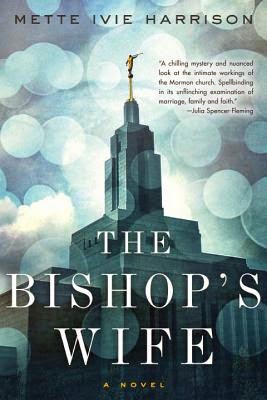
The Bishop’s Wife

by Mette Ivie Harrison
First sentence: “Mormon bishop’s wife isn’t an official calling.”
Support your local independent bookstore: buy it there!
Review copy snagged from the ARC shelves at my place of employment.
Content: There’s a few instances of mild swearing, but it is a murder mystery, and there are some pretty adult situations at the end of the book. It’s in the mystery section of the bookstore.

When this one came into the store, I knew I needed to read it. First, because I have enjoyed Harrison’s fantasies in the past, but mostly because, as the bookstore’s resident Mormon, I was interested in seeing what this one was about.

It’s published by Soho Crime, a division of Penguin/Random House, and it’s being touted as a mystery. Which, on one level, it is.

Our main character is Linda Wallheim, the wife of a bishop of a small Draper, Utah, ward. Her children are mostly grown and gone; her last boy is a senior in high school. She still hasn’t gone back to work, and so one of the tasks her husband gives her is to go visit people he feels need extra help and care. That’s how Linda gets mixed up in not one, but two tricky situations in the ward. One is the disappearance of a woman who left behind a husband and a 5-year-old girl. This is the really messy one, that doesn’t end well at all. The other is support to a woman whose husband is dying, and whose first wife died in what turns out to be a long-hidde murder. Linda is over her head, true, but she perseveres, and manages to solve both.

That’s the simple explanation. But, as mysteries go, this one is pretty pedestrian. I went through a couple of suspects before I settled in on who eventually committed the murder. And so, at the end, I wasn’t surprised, but that’s okay. See, for me, this book was a lot less about the murder and a lot more about Harrison’s portrayal of Mormon women.

Perhaps it’s because I’m the right age, the right target audience, the right sensibilities, but I was thoroughly drawn in by Harrison’s portrait of all the varying opinions, ideas, thoughts, and beliefs of members of the church. She shows that there are good people who are doing good things there are crazy people doing crazy things, there are dangerous people doing evil things. There are people who believe strongly, there are people who are questioning but still want to believe, there are people who don’t believe any more. Harrison also does a fantastic job of putting our religion (she’s LDS too, obviously) out there in a way that’s accessible to people who aren’t familiar with our faith. She’s most interested in the roles women play in the church, and in each other’s lives, and that’s what spoke the most to me.

I’m not quite sure who else would enjoy the book, though,. I tweeted Harrison when I finished, and she admitted she’s been getting a lot of flack for the book, which (unfortunately) doesn’t surprise me. But, I do hope this book finds readers and creates discussion.

Because it’s worth thinking about.

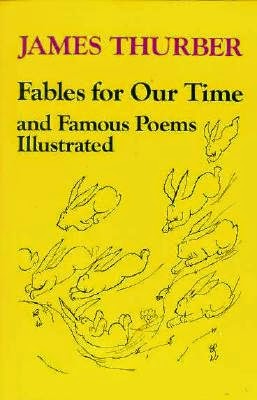
Fables for Our Time

by James Thurber
First sentence: “Once upon a Sunday there was a city mouse who went to visit a country mouse.”
Content: There’s nothing overt, and no swearing. It’d probably end up in the poetry section of the bookstore.

I think I’ve vaguely heard of Thurber before this book was picked for my in-person book group. But I’d never really paid him much attention. So I didn’t really have any expectations going into this.

It’s a series of short fables followed by illustrated poems (the poems are by other people). Pretty simple, right? The fables are pretty standard: animals doing human-like things. But the twist was that they had pretty… unusual… morals.

Things like “It’s not so easy to fool little girls nowadays as it used to be.”

And: “Early to rise and early to bed makes a male healthy and wealthy and dead.”

And: “Never allow a nervous female to have access to a pistol, no matter what you’re wearing.”

And: “The male was made to lie and roam, but woman’s place is in the home.” (The title of that one was “The Stork Who Married a Dumb Wife.”)

And at that point, I decided that Thurber — no matter what time period he’s writing in (the 1930s) is horribly sexist and doesn’t deserve to be read.

That’s a bit harsh. I get that these are satire (which I have a hard time with, anyway), and that they’re supposed to be stereotypes. But STILL. I was more impatient than amused. Stop it already with the sexist crap.