Hag-Seed

by Margaret Atwood
First sentence: “The house lights dim.”
Support your local independent bookstore: buy it there!
Content: There’s some swearing, including multiple f-bombs. It’s in the adult fiction section, but it has crossover appeal for those who are theater/Shakespeare fans.

Felix is the best, most innovative, most desired director around, and he’s on the cusp of Something Great with his interpretation of The Tempest. But, just as he was getting started with that, an unforseen bit of treachery outs Felix from his role. He’s sent off to the wilderness, where he finds, eventually, a job as a theater teacher in a correctional facility. He finds enjoyment teaching the felons (it’s a minimum security prison) the ins and outs of Shakespeare. And then, he learns that those who betrayed him are coming to visit, and he realizes that his Time Has Come; revenge is nigh.

Yes, if this sounds like the plot of The Tempest, you are correct. Very much so. And, I think, the better you know the play, the better this book is. As one who has seen it (once), and knows the general plot, but not all the intricacies of the play, I… enjoyed it. I liked the Fletcher Correctional Players best; I liked how they interpreted Shakespeare, rewriting the play to fit them. My favorite part of the book, perhaps, is the end, when the players come up with plausible futures for their characters. So, it was accessible and enjoyable to someone with a passing knowledge of the play. I do wonder, though, if you’ve never been exposed to The Tempest at all, if you’d be able to get into and enjoy this. (Just wondering…)

Thoroughly enjoyable, especially if you’re interested in a different approach to Shakespeare.
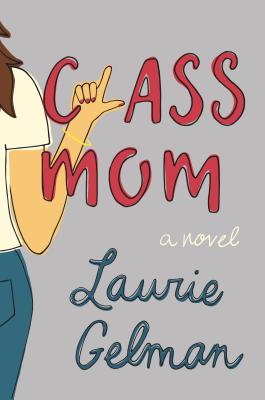
Class Mom

by Laurie Gelman
First sentence: “I click Send on my laptop, sit back in my chair, and grimace.”
Support your local independent bookstore: buy it there!
Content: There are a dozen or so f-bombs as well as a lot of other mild swearing. It’s in the adult fiction section of the bookstore.

I picked this one up because I wanted something light an funny, and everyone at work told me this was, well, light and funny. And the premise – an older mom who had a child later in life is class mom of her son’s kindergarten class with all the politics that accompanies that — sounded pretty amusing.

But the execution, was, for me, less than amusing. Sure, the class emails were supposed to be funny, and sometimes they got a smile from me, but that’s about it. But most of the book surrounded Jen Dixon’s (the class mom of the title) overly dramatic life. Parents are really this petty? (Admittedly, I’m kind of out of the parenting little kids game now.) And truthfully, Jen’s life was a little, well, boring. (Real life often is!) Granted, I finished the book, so it wasn’t awful, but in the end I was kind of like… meh. It was okay. Nothing horrible, but nothing spectacular either.

Sourdough

by Robin Sloan
First sentence: “It would have been nutritive gel for dinner, same as always, if I had not discovered stuck to my apartment’s front door a paper menu advertising the newly expanded delivery service of a neighborhood restaurant.”
Support your local independent bookstore: buy it there!
Release date: September 5, 2017
Content: There’s several instances of swearing, including a handful of f-bombs. It’s in the adult fiction section of the bookstore.
Review copy provided by the publisher.

Lois Clary is a Millennial, stuck programming in a tech job in San Francisco. It’s a get up, go to work life, one that, while isn’t bad, isn’t fulfilling either. And then she discovers Clement Street Soup and Sourdough, and is in love. With the food. Run by a couple of immigrant brothers, it’s something that fills her soul. So, when they unexpectedly have to leave the country, they leave her the starter for the sourdough. It’s that small act that changes Lois’s world. She learns to bake sourdough, and discovers that the starter itself is a bit magical. But more than that, Lois finds a purpose in life, a meaning to everything. She becomes involved with an underground experimental farmer’s market, and works on teaching a robot arm how to cook. There’s a bit of conflict with big business and some over-anxious scientists, but for the most part, this is Lois’s story, her discovering there’s more to life than sitting in a cubical.

Which is really the point of this. It lies at the intersection of those who bake/love baking and those who “get” or are technologically savvy. There’s a strong sense of needing to get out of working with computers to find satisfaction in life, but there’s also a sense that technology is inevitable and working with it instead of fighting it is the way to go. It’s a fascinating balance, and Sloan handles it beautifully.

In the end, this isn’t a deep novel (then again, neither was Mr. Penumbra’s 24-Hour Bookstore), but it was a thoroughly enjoyable one. Now to go find a good loaf of sourdough to eat! (Or, maybe I should find myself a starter and learn how to make one…)

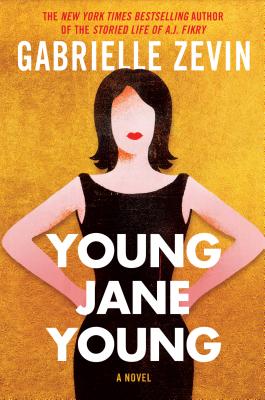
Young Jane Young

by Gabrielle Zevin
First sentence: “My dear friend Roz Horowitz met her new husband online dating, and Roz is three years older and fifty pounds heavier than I am, and people have said that she is generally not well preserved, and so I thought I would try it even though I avoid going online too much.”
Support your local independent bookstore: buy it there!
Review copy provided by the publisher.
Content: There’s swearing, including several f-bombs, as well as some off-screen sex. It will be in the adult fiction section of the bookstore.
Release date: August 22, 2017

The relationship between mothers and daughters (and between women in general) is not a new topic for fiction. It’s been Done.  And yet, Zevin — through this tale of an intern, Aviva, who has an affair with her boss, who just happens to be a congressman — manages to make this tired trope fresh. We get the story from four perspectives: Rachel, Aviva’s mother ; Aviva — both then and now, as Jane; Ruby, the intern’s daughter; and the congressman’s wife. It’s a unique way of telling the story, in bits and pieces (you don’t get Aviva’s then perspective until the very end, and it comes as a sort of “choose your own adventure” tale, one in which she wishes she could change her decisions), and from different perspectives. Choices have consequences, more so for women in these situations (so, whatever did happen to Monica Lewinsky?) than for men. It’s a fascinating study of our scandal-obsessed culture (really, are famous people’s private lives really news?) and how we’re much more willing to forgive men than we are women. (I think that’s the most biting thing: that Aviva is much more harshly judged than the congressman ever was.) And how relationships between mothers and daughters are not always straightforward. And what one person says isn’t always what the other person hears.

I love the way Zevin spins a story, and the way she is able to make characters pop to life. She doesn’t dumb down the kids (or make them too precocious; Ruby was the right balance of nerdy and eager), and she makes everyone sufficiently complicated.

Definitely highly recommended.

A Man Called Ove

by Fredrik Backman
First sentence:”Ove is fifty-nine.”
Support your local independent bookstore: buy it there!
Content: There’s swearing, including some f-bombs. It’s in the adult fiction section of the bookstore.

Ove’s beloved wife died six months ago. And he’s been at a loss ever since. He’s gone to work, but since he was terminated, he’s really lost all purpose. So, he’s decided to kill himself. That is, until his new neighbors — Parvanah and her husband and children — decide to nose their way into Ove’s life.

It’s a simple plot, but it’s not the plot that makes this this book a good one. I have one HUGE quibble with it though: Ove is NOT fifty-nine. I know it says that in the first sentence, but he doesn’t act like a 59-year-old. he acts like mt grandpa did when he was 85 or so. So, once I aged Ove up about 20 years in mt mind, I was able to sit back and enjoy the story. I loved Parvanah, and her big heart and stubborn refusal to leave Ove alone. Ove reminded me of my grandpa, and so I knew there was a good heart under his crusty exterior, but I enjoyed the unfolding of the story, and the way those in his life included him. It was heart-warming and a lovely reminder that there are good people out there.

A very good story.

A Conjuring of Light

by V. E. Schwab
First sentence: “Delilah Bard – always a thief, recently a magician, and one day, hopefully, a pirate — was running as fast as she could.”
Support your local independent bookstore: buy it there!
Others in the series: A Darker Shade of Magic, A Gathering of Shadows
Content: Swearing (including f-bombs) and violence mostly. It’s in the Science Fiction/Fantasy section of the bookstore.

Spoilers for the other two, obviously.

When I finished the second book, I told one of my co-workers, who is also in love with this series, that I wasn’t as happy with the second book. But, I said, it’s a middle book in a trilogy. I bet (I hope!) the third will be great.

And it is.

One of the Antari (those are blood magicians, of which there are only three… now…), Holland, has unleashed a bit of sentient magic on the Londons. It came from Black London (and it’s Kell’s fault as well, thinking Holland was dead and pushing him into Black London), and it’s possessed Holland and taken over White London. And now it — Osaran is its name — has it’s sights on Red London. And maybe even Gray. And it’s up to Kell, Lilah, Rhy, and everyone, really, to stop it. If it CAN be stopped.

It’s a long book — 600 pages — but it flies by, and Schwab spares no one. It’s vicious and emotional and heartbreaking and exciting. It’s just a sweeping epic story, (mostly) well-told, and definitely one I’d recommend.


The Light We Lost

by Jill Santopolo
First sentence: “We’ve known each other for almost half our lives.”
Support your local independent bookstore: buy it there!
Review copy provided by the publisher.
Release date: May 9, 2017
Content: There’s a lot of swearing, including a bunch of f-bombs. Plus sexytimes, though tasteful. It’s in the adult fiction section of the bookstore.

When she was 21, on 9/11, Lucy met the person she thought would be her True Love. Her one and only. The person she would spend the rest of her life with. And for a while, she and Gabe were happy. They were together, enjoying each other, being in love. And then their interests diverged: Lucy was working on a children’s TV show based in New York, and Gabe got a job with the Associated Press to travel the world into war zones and take pictures. And suddenly, their lives weren’t headed in the same direction.

Lucy was heartbroken.

But then she met Darren, someone who she realized she could build a life with. She’s moved on. Until, Gabe shows up again in her life. And something drastic happens, and she has to make a life-altering decision.

I’ve had a difficult time writing this one. Partially because it left me without words. It’s well-written, but it’s not brilliant, partially because it’s cut through with New York-ness, which wore on me after a bit. It does hit all my buttons, and Santopolo does know how to write about heartbreak and loss and captured the excitement of first love, and how difficult it is to let that go.

But even so, it’s not something that will stay with me.

Homegoing

by Yaa Gyasi
First sentence: “The night Effia Otcher was gorn into the musky heat of Fanteland, a fire raged through the woods just outside her father’s compound.”
Support your local independent bookstore: buy it there!
Content: There’s non-graphic sex, a lot of swearing, violence, and general difficult situations. It’s in the adult fiction section of the bookstore.

A good, powerful look at two sisters, separated at birth — one eventually sold into slavery in America, and the other remaining in Africa — and the subsequent generations. It’s a powerful look at choices (made by and for individuals) and how those can affect not only individual lives but also generations. It’s a unique way to tell a story — every chapter is a different person, progressing through the generations — and both the writing and the actual storytelling are excellent.

It’s a haunting read, but a good one.

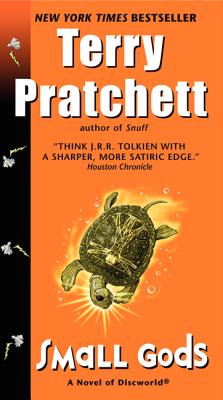
Small Gods

by Terry Pratchett
First sentence: “Now consider the tortoise and the eagle.”
Support your local independent bookstore: buy it there!
Content: It’s kind of stream of consciousness, without any chapters… but if you’re okay with that, then there’s nothing else to stop you. It’s in the Science Fiction/Fantasy section of the bookstore.

Outside of the Tiffany Aching books, I’ve never spent anytime in Discworld. I knew about it, of course, but I’ve never read any of the other ones. And this seemed like, well, a decent enough place to start.

It’s slow to start, and took a very meandering route to a plot. (I’m not entirely sure it really HAD a plot…)  There’s a god, Om, who used to be a Big Deal, and while he has a lot of followers (there’s a whole country and a citadel and a whole religion), he doesn’t have a lot of, well, belief. And so, he’s been relegated to being a turtle for a few years. That is, until he’s accidentally dropped by an eagle into the citadel gardens and meets Brutha. Who is just a simple novice. And who can hear Om talking in his head.

And he goes on an adventure (of sorts) to figure things out.

There’s a bit more to it than that, but it’s all a bit complex and somewhat convoluted. I will say this: it’s not Tiffany Aching, but Pratchett makes a person care about the characters. I loved Om and Brutha, and even some of the other characters. And he gently pokes fun at religion and theocracies and philosophy. It’s not my favorite Pratchett (give me the Nac Mac Feegle any day), but it was an enjoyable one to read.

A Study in Scarlet

studyinscarletby Arthur Conan Doyle
First sentence: “In the year 1878 I took my decree of Doctor of Medicine of the University of London, and proceeded to Netley to go through the course prescribed for surgeons in the Army.”
Support your local independent bookstore: buy it there!
Content: There’s some mild swearing, violence (but most of it just talked about), and some, well, murder. It’s in the mystery section of the bookstore.
So, for  book group this month, we didn’t really want to read something long (it’s a busy month for all of us), and we were thinking classics, and I hit upon the idea of each of us reading a different Sherlock Holmes short story (or two). I decided to start at the beginning (mostly because I’ve read short story knock offs of this, and I wanted to see how Sherlock’s Study in Pink held up) and read “A Study in Scarlet”.

I have read many of these stories before, though it’s been a long (!) time, and I can’t be considered a fan of Doyle’s or Holmes’s. Which means, I don’t remember the stories. At all.

Things that struck me: Holmes is much less of a jerk than he is in the BBC series. (I think he was arrogant in the old Jeremy Brett series — it’s been forever since I’ve watched those — but he wasn’t insufferable.) He’s smarter than you, but he’s not insufferable about it. He calmly explains his methodology to Watson not because Watson is stupid but because Holmes wants him to understand how he does things. He does thing Lestrade and Gregson are stupid, but that’s because they’re police and they aren’t putting the time that Holmes is in learning how to be a good detective.

Doyle also explains EVERYTHING. It wasn’t so much a mystery for the reader to solve but rather explains everything in detail, including things Holmes could never know. (See: the first five chapters of part 2.) I wanted to be able to at least attempt to solve it myself, but I guess standards for mysteries were different in the 19th century. Which leads me to the ridiculous anti-Mormon chapters. (See: the first five chapters of part 2.) They were SO pointless (except, as Hubby tells me, sensational anti-Mormon literature was in vogue in London during that time), and even though it eventually wound its way back to the story, they really didn’t serve ANY purpose. (Not to mention being wildly inaccurate: at one point, Doyle had the characters fleeing Salt Lake City headed toward Nevada and going through deep gorges and tall canyons. Hon, if you’re headed out of Salt Lake and you’re going through canyons, you’re going toward Wyoming. Toward Nevada, you’ve got nothing but desert. And that’s just the geography. I won’t even get into the religion part.)

So, did I like it? Well, it was okay. It wasn’t bad, but it didn’t knock my socks off. Maybe it was the wrong one to randomly pick (I think I like Study in Pink better….), but it wasn’t terrible, either. Maybe I’ll read another one just to see if they get any better.