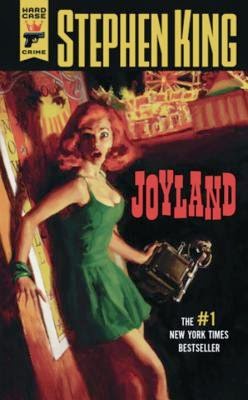
Audiobook: Joyland

by Stephen King
Read by Michael Kelly
Support your local independent bookstore: buy it there!
Content: Lot of language, including a dozen or so f-bombs (and that was just in the first half). It’s in the adult mystery section of the bookstore.

I was wandering around the store, looking for something to listen to, and I asked a coworker for a recommendation. I had been listening to a lot of humor, and I wanted something with more… weight. This is what she suggested to me. She pitched it as a coming-of-age novel, no horror, a slight mystery.

And so I went for it.

And got about a third of the way into it before I bailed. It’s the story of the summer of 1973, a boy from Maine who worked at a third-tier amusement park in North Carolina and his experiences that summer. By the time I bailed, his long-term girlfriend broke up with him and he’d saved a kid from choking to death. And there was an illusion to a grisly murder four years before. But that’s it. And I think that’s why I bailed when something better came along. It was meandering — a ton of foreshadowing, which just made me annoyed — and circular, and while Devin was okay as a main character, I just didn’t really care. That, and King introduced the murder fairly early on and then just let it hang there. Which drove me nuts. What’s the purpose of the murder? Why wait until nearly halfway through to bring it back up?

*sigh*

I really am ruined for adult books. Either that, or I’m just reading the wrong ones.

The Madman of Piney Woods

by Christopher Paul Curtis
First sentence: “The old soldiers say you never hear the bullet that kills you.”
Support your local independent bookstore: buy it there!
Content: There’s nothing, language wise. However, Curtis tackles some pretty heavy issues: slavery, of course; but also Irish immigration, abuse, racism. It’s in the middle grade (grades 3-5) section of the bookstore, but I would exercise caution about giving this to sensitive children. Good for discussion, though.

It’s 1901, and Benji is a pre-teen in the all-black town of Buxton, Canada. He has a couple of younger siblings that get on his nerves, a best friend who is a good orator, and is both an aspiring newsman and someone who loves the woods. Red is a pre-teen in the nearby town of Chatham. His grandmother was an Irish immigrant, and he’s positively scared of her wrath. He spends his days in school, with his friends — one of whom has an alcoholic, abusive father — and at home dealing with his grandmother.

They’re the most unlikely of friends, but when they do meet, they hit it off.

Which comes in handy the night that the Madman of Piney Woods — a local homeless black veteran of the Civil War — is shot. It’s up to Benji and Red to make everything turn out, if not okay, then at least better than it could have ended.

Perhaps I should have taken the time, once I figured out that this was set in the same place, to reread Elijah of Buxton. Maybe I would have connected to it better. But, I think the main problem I have with this one is that the plot took a long time to show up. It’s told in alternating chapters, one Benji (who was more interesting than Red), one Red. And it took FOREVER for them to meet. (More than halfway through the book!). Once they met, the plot picked up, and I was able to finish fairly quickly. I did appreciate that Curtis was exploring ideas and themes that are tough to manage: the way humans treat other people being the primary theme. It’s an important thing to expose kids to, and to do so with a bit of a mystery story (more or less) is a good thing.

But that wasn’t enough to make me love this book, even though I really wanted to.

The Bridge of San Luis Rey

by Thornton Wilder
First sentence: “On Friday noon, July the twentieth, 1714, the finest bridge in all Peru broke and precipitated five travelers into the gulf below.”
Support your local independent bookstore: buy it there!
Content: There’s really nothing, but because it’s a classic, it would be in the adult fiction section of the bookstore.

For my in-person last month, we wanted to read a classic. We looked at this huge long list of modern-day American classics some guy put up (I can’t remember right now who it was or why), and chose this one (mostly because it was the shortest). I know very little about Thornton Wilder; I’ve seen Our Town a couple of times (and never really “got” it) but that was the extent of my knowledge.

This story is a short one, a series of short vignettes about five people who died in a (fictional) bridge collapse in Lima, Peru in 1714. They were loosely interconnected, and the framework is about this monk who spent time researching their stories. I think it was supposed to be about the randomness of life and death, that both good and people can die at any moment and how it really doesn’t matter how you live your life.

Whatever.

Seriously. That’s how I ended up feeling at the end. I read the words, but none of them registered in my brain. I didn’t connect with any of the characters, the plot was nonexistent. I do have to admit that it may have been me (why else would it be on all the “you must read” lists?), because this isn’t the first book lately that I’ve gone “huh?” when I’ve finished. Slumps will do that to you.

Or maybe it’s the book. Either way, I finished it, but that’s about all I can say.

November 2014 Round-Up

Ah, November is over. I don’t know where the month went. (I say that a lot, don’t I?) But somehow between all the days — it was a better month for me — the month flew by. I did manage to get a lot read, which helped me fall out of a slump. The other thing that helped with the slump was discovering Serial. A story told over the course of  40-minute podcasts, one a week, it details reporter Sarah Koenig’s investigation into a 1999 murder of a 17 year old girl, Hae. It’s not only a fascinating story to listen to (and one I have become a bit obsessive about), it’s a fantastic bit of reporting. Seriously. Check it out, if you already hadn’t.

My favorite book this month:

Poisoned Apples

I loved this book. Seriously.

As for the rest….

Non-Fiction

Food, a Love Story (audio)
Neil Patrick Harris: Choose Your Own Autobiography (audio)
Rethinking Normal
Some Assembly Required (DNF)
Stiff (audio)

YA:

The Cure for Dreaming
Egg & Spoon
I’ll Give You the Sun
Mortal Heart
Unmade
Vivian Apple at the End of the World
Yaqui Delgado Wants to Kick Your Ass

Middle Grade

The Blood of Olympus
Brown Girl Dreaming
Rain Reign
Thursdays With the Crown

Graphic Novels

Hidden
The Monster on the Hill
Odd Duck

What were your favorites this month?

Audiobook: Food, A Love Story

by Jim Gaffigan
read by the author
Support your local independent bookstore: buy it there!
Content: There’s some mild swearing, but its quite seldom. It’s in the humor section of the bookstore.

I love food. I  love to laugh. And yeah, I kind of like Jim Gaffigan’s humor, though I’m new to it (and only in book form, having quite enjoyed Dad is Fat.) All that adds up to a “yeah, I guess I’ll pick up the audio version of his new book” mentality.

There’s really not much to say about this book beyond that it’s hilarious and a lot of fun to listen to. Gaffigan isn’t a foodie (he’s an “eatie”) and so there’s really not luscious descriptions of making food or of recipes (there is one — how to make a hot dog — and it’s quite hilarious) or how food changes lives. No, I imagine it’s just a series of stand-up bits (which is why I think this works better in audio. Plus he does voices, which end up adding to the humor) based on Gaffigan’s love of eating… everything. (And, yes, for those who are actually fans, he does have a chapter on Hot Pockets.)

Some highlights: the chapter on steak, or desserts, or breakfast foods, or on bacon. He hates vegetables and thinks kale is the worst thing ever. It’s really an every-person’s (read: non-food snob) tribute to the joy of eating. And the only down side? I often got hungry while I was listening to it.

Enjoyable, to say the least.

Unmade

by Sarah Rees Brennan
First sentence: “Kami Glass was standing to close to the fire.”
Support your local independent bookstore: buy it there!
Others in the series: Unspoken, Untold
Content: There’s a lot of violence, some of it brutal, plus some almost sexytimes. Not enough, however, to move it from the YA section (grades 6-8) of the bookstore.

Remember last time when I said the book was a bit of a middle book, and that the ending had me excited for the conclusion? (No? Well, neither did I?) Even so, I was able to fall back into Sorry-in-the-Vale with the Lynburns and Kami Glass with all her snarky confidence and contagious hope with ease.

Rob Lynburn has all the cards, all the power. And that has made Jared and Ash and Kami and their “side” quite desperate. Desperate enough to do desperate and dangerous things. This is an epic battle, a long, slow buildup to an intense climax. And interspersed in all that is heartache and love, loss and life, and a lot of heart.

This is a series, I think, that demands to be binge-read. And, thankfully, now you can. Sit down over a long weekend (like… Thanksgiving!) and immerse yourself in this deep, complex, wonderful world Brennan has created. Enjoy the characters, the good vs evil, the humor, the mystery, all at once without the wait.

I wish I could have. I enjoyed this book, but I think I would have enjoyed it SO much more had I read them all at once.

Vivian Apple at the End of the World

by Katie Coyle
First sentence: “There came a time when the American people began to forget God.”
Support your local independent bookstore: buy it there!
Release date: January 6, 2015
Review copy snagged from the ARC shelves at my place of employment.
Content: There is teenage drinking and a lot of swearing, including multiple f-bombs. There is also frequent off-screen violence. It’ll be in the Teen Section (grades 9+) of the bookstore.

In this sort-of future, American has been taken over by the conservative, pseudo-Christian  Church of America. Except “taken over” is too strong. It’s not like America has become a theocracy. No, it’s just that the Church of America founder, Beaton Frick, has predicted the end of the world. The rapture will come on a night in March, and all the faithful will be taken up.

Even though a good majority of Americans follow the Book of Frick, as it came to be called, Vivian Apple doesn’t. Her parents do, though. They’re faithful believers. And so, when the “rapture” comes, they disappear, leaving Vivian behind.

I’m going to stop right here for a minute. I’ve read a bazillion dystopian/post-apocalyptic novels and this is the first time I’ve come across the rapture as the cause. (At least in mainstream fiction. Is this a theme in Christian fiction?) In fact, this is what compelled me to pick the book up. I’m often curious about the way religion is portrayed in mainstream fiction, and I thought this could be an interesting take on it. And it was, even if it wasn’t necessarily a kind one. Religion and believers come off badly in this book, as people who believe anything they hear without question and are willing to commit acts of violence for the sake of their belief. More than once, I cringed at the “religion” and marveled at what I saw as pot-shots against the religious right.

But I digress.

Vivian determines that it’s all a hoax and she sets out from her hometown in Pittsburg to the Church headquarters outside of San Francisco with her friend, Harp. She just wants to know answers. They pick up a boy along the way, Peter, who seems to be on their side. Little do they know what’s waiting for them.

There is some good in this book: I really liked the tentative romance that budded between Vivian and Peter. I liked that Harp was Indian. I liked the way Vivian grew and became more willing to make decision and to Act in her own life throughout the course of the book. And I can even forgive that the book didn’t end, but rather left me hanging with more questions than answers.

But this one will be a tough sell around here.

Graphic Novel Round-Up, November 2014

I spent a Saturday recently just reading graphic novels to help me out of the slump. I think it might have worked; I feel much more interested in reading a full-length book now. Also, both A and K picked some of these up and found themselves completely engrossed. So, it’s a good batch.

Odd Duck
by Ceci Castellucci and Sara Varon
Support your local independent bookstore: buy it there!
Content: There’s nothing. And the words/ideas are pretty simple. It’s good for reluctant readers as wel as those who just want a good, short story. It’d be in the middle grade graphic novel section of the bookstore.

Theodora is an ordinary duck. She does her ordinary duck exercises in the morning, goes for her ordinary duck walk (because she doesn’t like to fly), and reads ordinary duck books in the afternoon. She lives a nice, quiet life and is very happy.

That is, until Chad moves in next door. Chad is not an ordinary bird. He does not do his exercises in an ordinary way (if at all), He dyes his feathers weird colors. He does art (gasp)! Theodora is not happy. But then, come winter, she and Chad bond (because they don’t fly south). They discover that they have things in common, and that they really enjoy each other’s company. And that maybe being different isn’t so bad.

It’s a charming little graphic novel, full of adorable art and sweet little lessons, but it’s never heavy-handed or didactic. Perfect for younger and reluctant readers.

Monster on the Hill
by Rob Harrell
Support your local independent bookstore: buy it there!
Content: Linguistically, it’s more challenging. But it’s probably on par with the Amulet books, which means it’s probably good for 3rd grade and up. Content-wise, there’s some monster violence, but that’s it. It’d be in the middle grade graphic noel section of the bookstore.

In this version of 1860s England, there are monsters that terrorize every town. But never fear: that’s what the townspeople want. (Seriously.) But, in Stoker-on-Avon, they have a problem: their monster, Raymond, doesn’t do anything but moan and complain. It’s bringing the town down. So, the town leaders send the eccentric Dr. Charles Wilkie (and a street urchin, Timothy, hitches along for the ride) to convince Raymond to buck up and do his job.

This leads to a road trip, a lot of bonding, some lessons learned, and a giant battle against an unstoppable foe before everything is set to rights again.

This one had me eating out of the palm of its hand. I loved Raymond — he was delightfully pathetic — and his schoolmate, Noodles (aka Tentaculor) and their relationship. There was so much that had me just laughing out loud. True, there could have been a female character (just one? Please?)  or perhaps some diversity (though it was England in 1860-something), but for the most part, I found this simply charming.

Hidden
by Loïc Dauvillier, Marc Lizano, and Greg Salsedo
Support your local independent bookstore: buy it there!
Content: It’s about the Holocaust, so there will definitely be things to discuss. It glosses over the worst of the horrors; there’s a passing image of a concentration camp survivor, as well as illusions to other horrors. Even so, it’s very kid-appropriate. It’s in the middle grade graphic novel section of the bookstore.

This one is your standard Holocaust fare. Mostly. Framed as a story a grandmother is telling her granddaughter about the time when she was a child, Dauvillier focuses mostly on the Resistance and the people in France who helped those who were Jews get away.

It’s a very tender story of a young girl, Dounia (the grandma) whose parents were taken to the concentration camps in 1942, near the end of the war. Even though Dounia hides during the inital raid, the neighbors (some of whom are part of the reistance), know they’ll be back, looking for her. So, they arrange for her to live with a woman in the country. In the act of escaping, the neighbor’s husband is caught, though he’s only arrested and released. He manages to find his way back to his wife and Dounia. Her main concern, though, is finding her parents again and so they keep looking, especially once France is liberated. Eventually, they do find her mother, and the story ends.

I liked this one well enough, but (possibly because it’s tamed down a bit) it lacks the emotional punch that other Holocaust books have. Still, it’s a good introduction to the topic.

The Blood of Olympus

by Rick Riordan
First sentence: “Jason hated being old.”
Support your local independent bookstore: buy it there!
Others in the series:  The Lost HeroThe Son of NeptuneMark of Athena, The House of Hades
Content: There’s some mild kissing and lots of fantasy violence. It’s in the YA section (grades 6-8) of the bookstore, but it’s more than appropriate for Percy Jackson fans of all ages.

The doors of Hades have been sealed, but Gaea is awakening anyway. Our heroes have split up: seven on the Argo II trying to go get to Athens to stop Gaea, the other two (plus Coach Hedge) are shadow-traveling the Athena Parthenon to Camp Half-Blood as a goodwill gesture from the Roman camp to the Greek camp. Both sets are facing Great Odds: monsters and minor gods that have switched sides as well as Octavian and the Roman camp’s impending invasion of Camp Half-Blood. Will they be able to stop everyone in time?

It’s a good ending. Not a great ending, not a fantastic book, but a good, solid one. It was a nice send-off to characters I’ve come to know and love for 10 years. And I was more than happy to take this ride with them. I was glad that the unsung characters — Piper, Reyna, and especially Nico — got a chance to shine. I enjoyed the whole book well enough, but I REALLY enjoyed the Reyna/Nico chapters. I just felt like that was where the more interesting story was, with saving Camp Half-Blood and fighting Orion and Octavian, and they were just awesome. Period. Everything else paled in comparison.

I do have some theories about the end (which ticked off A, by the way) but I’m not going to go into my theories here. I have some complaints about the sort of writer Riordan’s become; he’s become much too much of a formula writer for my taste. But I understand the demands of publisher’s and fans and the constraints of storytelling and I’m still more than happy to give everything he writes a read.

I will be sad to see this series end; it’s been a good ride.

Yaqui Delgado Wants to Kick Your Ass

by Meg Medina
First sentence: “Yaqui Delgado wants to kick your ass.”
Support your local independent bookstore: buy it there!
Content: There’s some mild swearing. The real reason it ended up in the Teen (grads 9+) section is for the bullying and the violence. It’s pretty graphic and the fallout is pretty severe.

Piddy Sanchez is starting a new school. It’s one of those inner city schools in a Hispanic neighborhood in Queens, the kind that justifies every bad stereotype there is. Just a few weeks in, and someone informs Piddy that Yaqui Delgado — whom Piddy has neither seen nor spoken with — is going to kick her ass. Why? Because she thinks Piddy is flirting with her boyfriend. (She’s not.)

It’s this threat, among other things, that begins defining Piddy’s life. She doesn’t feel like she can talk to her mother, who is working extra shifts to try and provide for the both of them. She does turn to her aunt Lila, but even then she keeps the awful details to herself.

It’s a harsh journey, one that I wouldn’t wish on any kid. I did like that there was a range of diverse people in this one; not all white characters were “good” and not all Latin@ ones were “bad”. There was a wide range of personalities, and the color of the skin just happens to be incidental. I also enjoyed how Piddy embraced her culture and loved her neighborhood.

I was glad for the solution to this one, as well. No one really “learned their lesson” and the bully wasn’t reformed and they didn’t become friends and live happily ever after. No, it was much more realistic and messy and showed that sometimes the best option isn’t always the most noble one.

It was a tough read, emotionally raw especially for me (because of the whole daughter thing), but I’m glad I did.