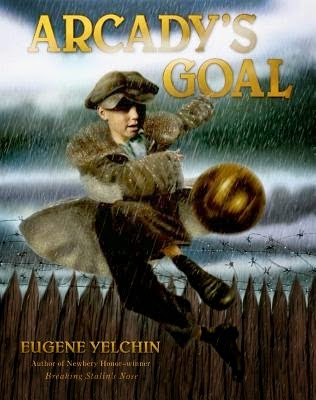
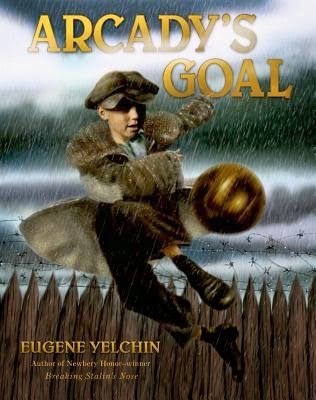
Arcady’s Goal

by Eugene Yelchin
First sentence: “I’m a risk taker.”
Support your local independent bookstore: buy it there!
Content:

Arcady is the best soccer player. Period. So much so, that when the inspectors of the home he’s been placed in come, the director makes a show out of Arcady’s skills. He — Arcady calls him Butterball — puts Arcady up against increasingly larger players, expecting him to beat them. And he does.

But, when one inspector, who’s not quite like the others, comes to visit, Arcady ends up being adopted. Which is not something Arcady bargained on. Nor he he bargain that his new father, Ivan Ivanovich, comes with secrets of his own.

One of the things Yelchin does best is humanize Stalin’s Russia. It’s so easy to push everything from that era off into Things/People were Bad. And Stalin put everyone in concentration camps. But, Yelchin gives us the stories of the children — Arcady ended up in a home because his parents were taken for being enemies of the state — and how Stalin’s policies affected everyday life. They’re simple stories, but they paint a picture of a people who were wronged — even if they weren’t taken — by their leader.

It’s a simple little book, full of illustrations. And there’s a lot of talk about soccer, so there’s an appeal for the soccer lovers. But mostly it’s a portrait of a relationship between to damaged people, and the path to healing.

2014 Advent: Nativity Displays

For years, there was a virtual advent tour going around the blog, 24 days  of Christmas stuff at various spots. I don’t know what happened to it this year, whether I just missed signing up for it, or it doesn’t exist this year, but I realized this past week that it doesn’t feel like Christmas without a Christmas-y post on the blog.

I also realized that one of the things I haven’t shared here was my collection of nativities. Our church put on a huge nativity display this year, and while my collection isn’t the biggest or the fanciest or the coolest (there were some pretty neat ones I should have snapped pictures of), I’m still quite proud of it.

This one is the oldest one we own. I don’t know where my parents got it, but it was “mine” as a kid, and they actually gave it to me my freshman year of college, when I had bout of homesickness. I’ve been displaying it every year, ever since.

We do have a few international ones:

We didn’t pick this up in Ireland, but loved the stone, Celtic feel of it. The star is a Moravian star, which we picked up on one of our many trips to Pennsylvania.

This one we actually got in Rothenberg, Germany, when we went there on a day trip the summer of 1999. It gets used twice a year, once on story night, and once on Christmas Eve. Which is probably why it’s not turning as well as it used to.

This one we also got in Germany, when some diplomat friends of ours were going to Israel and asked if they could get anything for us. We said a nativity, and this is what the brought back. Yes, I do sense the irony of putting it up in front of the Game of Thrones books.

And this one my brother brought back from Venezuela for me. It usually sits high out of the kids’ reach at home, but I liked this arrangement so much, I think we need to figure out a way to do this at home as well.

This one, out of all of the displays, gets the most use. The girls, when they were younger, loved playing with it, rearranging the pieces, switching the hair on the wise men and shepherds. It’s gotten used for church, and sometimes I’m surprised the backdrop is still standing, or that the angel still has her wings (she lost her halo years ago, though.)

These next few we either just picked up at the store because we liked it, or were given to us.

In the “homemade” category, we have:

I made the ornament, as well as the picture frame above it.

This one was the handiwork of my sister-in-law.

And these, my mom made. I figured the best way to show them off was to put up our crazy nativity puppet play we do every year. It’s good for a laugh or three.

And that’s ours. Do you have any nativities that are special to you?

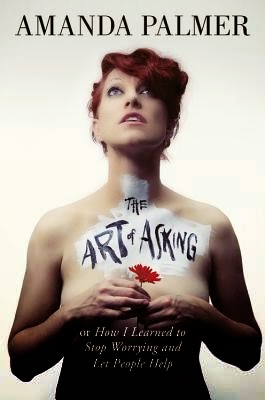
Audiobook: The Art of Asking

by Amanda Palmer
Read by the author
Support your local independent bookstore: buy it there!
Content: Amanda doesn’t check her language. There’s a ton of swearing, of all shades. And she’s pretty frank about pretty much everything. It’s in a couple of sections at the bookstore: self-help (which it really isn’t) and biography (where it fits a bit better).

When this book came in, the conversation with one of my bosses as I was shelving this went something like this:

Her: “I saw Amanda Palmer once. She was intense.”
Me: “I didn’t know who she was until she started dating Neil Gaiman.”
Her: “You know, she’s her own person.”

That last sentence really does sum up this book quite nicely: Amanda Palmer is, for better or worse, her own person. And she is not ashamed of any of it.

Nominally an expansion of her TED talk, it’s more a meandering look into what makes Amanda Palmer tick. On the surface, it’s not a book for everyone. Amanda is frank, which means that sometimes she (and her music) will rub you the wrong way. BUT, she is frank. Which means she’s honest, and that gives the book a refreshing clarity. She talks about a lot of things: her time as a street performer, her music, her relationship with Neil Gaiman, but at its heart, it comes down to one thing: she is interested in the connections between people and how we ask for things.

Because of who she is, this is framed in music terms: a musician asking her fans for support, help, love, money. But what she says — that there are ways to ask that isn’t begging, and that it’s the connections (what she calls the net) that makes asking possible — is applicable for just about everyone. It got me thinking about gifts and connections, and how we work at relationships, and about how I’m much too hesitant to ask for things. At one point, she says that asking without condition is a gift, because it allows the other person to give. That’s something that resonated with me.

I enjoyed the audio version of this quite a bit as well: while Amanda’s voice was sometimes difficult for me to hear (which is entirely my fault), I loved hearing snatches of her music (I prefer her later, ukulele songs to the Dresden Dolls stuff) and her Neil Gaiman voice (seriously: she had a slightly British affection when she had him talking. It was quite adorable). But, mostly, I felt like she was in the car with me, explaining her life view, and how, just maybe, it might make my life a little bit better.

Highly recommended.

The Grimjinx Rebellion

by Brian Farrey
First sentence: “Of all the wisdom passed down through the generations of the Grimjinx clan, the bit I think about most came from Jerrina Grimjinx, wife of Corenus, our clan father.”
Support your local independent bookstore: buy it there!
Others in the series: The Vengekeep Prophecies, The Shadowhand Covenant
Content: There’s some action, and a few intense moments. The length will probably deter less confident readers, but (aside from the made up words) it’s really a page-turner. It’s in the middle grade (grades 3-5) section of the bookstore.

Jaxter thought, after he defeated the Shadowhand, that his troubles would be over. But, the High Laird has been raising taxes, and the population of the Five Provinces are getting restless. None of this bothers Jaxter very much, until the mages kidnap his sister. Who happens to be a powerful seer.

Jaxter, of course, can’t let this happen. So he, his parents, and some of his friends, head off to rescue Aubrin from the power-hungry mages and discover that they’re plotting to overthrow the High Laird and take over the provinces. Once again, Jaxter (and the whole Grimjinx clan) is in over their heads. But, true to form, they rally and figure out a way to Save the Day.

This is such a solid series: a great overarching story (elements of the first book came back again in this one), that involves themes of freedom and who has the right to rule. But it’s also grounded in family: I love the whole Grimjinx clan (even the wayward uncle) and how they pull for each other. They can do things individually, true, but as a family unit, they’re unstoppable. And I love how Jaxter’s friends got adopted into the family: they’re as important to him as his actual family. I especially like his relationship with Callie: you can tell he’s concerned about her, but there’s no romance. They’re just friends, and that’s great.

I also loved how this wrapped up, but didn’t tie everything up in a nice, neat bow. Farrey chose to leave things hanging; and I appreciated the ambiguity. Anything could happen, and that’s just great.

It’s a fantastic end to a fantastic series.

The Terrible Two

by Mac Barnett and Jory John, illustrated by Keven Cornell
First sentence: “Welcome to Yawnee Valley, an idyllic place with rolling green hills that slope down to creeks and cows as far as the eye can see.”
Support your local independent bookstore: buy it there!
Review copy snagged from the ARC shelves at my place of employment.
Release date: January 13, 2015
Content: It’s a bunch of silly pranks. Simple writing and lots of illustrations make it good for younger and reluctant readers. It will be in the Middle Grade (grades 3-5) section of the bookstore.

Miles Murphy is The King of the Pranks. Or, at least he was back in his old school. But in his new one? Not so much. Oh, he tries to become the king again. But in small Yawneee Valley, Miles is finding it difficult to get a good prank in. He keeps being thwarted by someone else. Soon, it’s an all-out prank war, the like Yawnee Valley has never seen.

As soon as I saw this one, I snagged it; Mac Barnett is one of my favorite picture book writers, and I figure he and his friend (or so the bios say) Jory John had to produce something worth reading. I was right (of course!). It’s hilarious. Silly and stupid. Dumb and amusing.

It’s perfect.

Really. It’ll be great for the reluctant readers who need something silly to keep them turning pages. (Plus: illustrations!) It’s got some great conflict, a hilarious buffoon of an adult to root against, and the best. ever. prank. at the end.

What more could you ask for in a book?

Absolutely nothing.

State of the TBR Pile: December 2014

I know it’s a bit early for resolutions, but I have one. Next year, I’m going to control this mess:

Seriously. There are books several years old on this shelf that NEED to be read. So I’m going to stop checking books out from the library (*sigh*) at least until I can get a bit of a handle on this shelf.

However, I do have a few books out from the library that I need to finish, so this month, I’m going to try and read:

Marina, by Carlos Ruiz Zafon
Glory O’Brien’s History of the Future, by A. S. King
The Map to Everywhere, by Carrie Ryan and John Parke Davis
Absolutely Almost, by Lisa Graf

Hopefully, I can finish them in what’s left of 2014, and then I can start the new year fresh.

What’s on your TBR pile this month?

Graphic Novel Round Up, December 2014

In Real Life
by Cory Doctorow and Jen Wang
Support your local independent bookstore: buy it there!
Content: There’s a couple instances mild swearing and because it’s about economics and gaming, it’s in the teen section of the bookstore. That said, A (who is in 5th grade) read it, understood most of it (at least the general idea), and really liked it. It’s in the teen graphic novel section of the bookstore.

I’ve never read anything by Cory Doctorow, but I was intrigued by this when it came into the store, and after reading a review of it for the Cybils blog I knew I needed to pick this one up.

Anda is a gamer. Which makes her a bit of an anomaly in her new school in Flagstaff, Arizona. So when a woman comes to their tech class, inviting them all to join this new online gaming community, Coarsegold, Anda jumps at the chance. Once inside the game, though, she soon finds out things are not all coming up roses. She hooks up with another player, Sarge, who introduces Anda to the world of gold farming. Actually, Anda and Sarge’s job is to kill off those who are gold farming — harvesting virtual gold for real money.

But then Anda befriends one of the gold farmers, a Chinese boy who goes by the English name, Raymond. She discovers that he’s being forced to work for hours on end without a break, for very little money and no health coverage. So, she gets Involved.

I enjoyed much about this foray into the gaming world. I enjoyed Anda as a character, and that Jen Wang drew her realistically. Even her avatar, which was slimmer and “whiter” than Anda was, wasn’t Barbie perfect. I enjoyed the fact that the introduction to the gamer world was a girl, as well. Especially with gamer-gate, acknowledging that girls are gamers, too (and good at it) is a good thing. Doctorow mentions in his introduction that this is not just about gamers, but it’s also about economics and making a difference. And I could see that as well; it’s a primer how electronic transactions take place and a reminder that in this world, no one is truly ever disconnected from anyone else.

Fascinating.

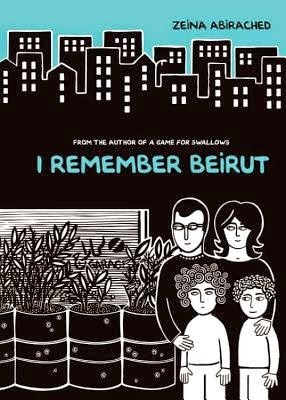
I Remember Beirut
by Zeina Abirached
Support your local independent bookstore: buy it there!
Others in the series (loosely speaking): A Game for Swallows
Content: Much like Hidden, this is about the effects of war on everyday people. It’s pretty matter-of-fact, but it feels like an older graphic novel. It’d be in the teen graphic novel section of the bookstore.

This is basically Abirached’s memories of growing up during the war in Lebanon. Her  house was in the middle of what she called “no man’s land”, which was a zone in between the worst of the fighting and the safer places in Beirut. Her memories are organized roughly chronologically, and range from the mundane — how they showered — to the macabre — her brother loved collecting bits of schrapnel — to the sad — when a neighbor had to move because their house got blown up.

Done in the same stark black and white drawings, it’s a reminder that no war is without casualties, and that sometimes those casualties are the everyday lives of people who aren’t even involved in the fighting. 

Sugar

by Jewell Parker Rhodes
First sentence: “Everybody likes sugar.”
Support your local independent bookstore: buy it there!
Bought and signed by the author at KidLitCon 2014
Content: This one would be appropriate (and probably okay, difficulty-wise) for kids third grade and up. It’s in the middle grade section (grades 3-5) of the bookstore.

It’s 1871, and slavery is supposed to be over. However, for ten-year-old Sugar, on a sugar plantation in Louisiana, it doesn’t feel like it. Sure, the former slaves are free to go if they can, but they’re paid so little that it’s almost impossible for them to leave. And then the plantation owner, Mr. Wills, decides that he needs more workers, so he hires some Chinese to come and supplement the former slaves.

For Sugar, her life revolves around sneaking out to play with Billy, the owner’s son, and trying not to get under Mrs. Beale’s feet. And planting and cutting sugar cane. Once the Chinese arrive, however, Sugar’s world is expanded: one of them speaks English and she befriends them. In fact, she is the bridge that gets the whole working community to work together rather in competition. There’s a passage about halfway through that pretty much sums up what I think Rhodes was getting at in this book:

“How come I ca’t decide who I can see? How come I can’t decide my friends?”
“We don’t trust these men, Sugar.”
“I like Chinamen. Reverend, don’t you preach ‘Treat folks like you want to be treated’?”
“Well, now,” says Reverend, not looking at me, twiddling his thumbs.
“Sugar,” says Mister Beale, “folks get along best with folks like them. Always been that way.”
“Seems cowardly.”

Of course, things aren’t easy for Sugar and her friends: it is 1871 in the South, and white people — especially the former Overseer — are reluctant to change and adapt. There is some tragedy in this book, but it is a middle grade book, after all, and the tragedy is kept simple and appropriate.

It’s the overall message of friendship and inclusion that made this slim historical fiction book worth reading.

Dear Committee Members

by Julie Schumacher
First sentence: “Dear committee members, Over the past twenty-odd years I’ve recommended god only knows how many talented candidates for the Bentham January residency — that enviable literary oasis in the woods south of Skowhegan: the solitude, the pristine cabins, the artistic camaraderie, and those exquisite hand-delivered satchels of apples and cheese…”
Support your local independent bookstore: buy it there!
Content: It’s very much an adult book in sensibility; not to mention about a half-dozen f-bombs dropped in frustration throughout the novel. It’s in the adult fiction section of the bookstore.

This one has been on my radar for a while; I even was given an ARC by the publishing rep when they came to talk about the lineup a long while back. I just didn’t get around to it until my book group foist it upon me, saying the same thing everyone else did: It’s hilarious. You’ll love it.

It’s the story of Jay Fitger, a tenured English professor at a small liberal-arts college in the Midwest, told entirely through his letters of recommendation (and other letters) for various people. At the outset, it’s a brilliant work of fiction: you get a thorough sense of Jay and the kind of professor (and person!) he is through the letters. Also, you get a sense of not just the passing of time, but also the kind of responses he’s getting, without seeing those. These are entirely one-sided letters, and yet I felt like I got a complete picture of everyone in Jay’s life, from his ex-wife and ex-girlfriend (both on campus) to the woman he had an affair with and modeled a despicable character in one of his (bad) novels after. I knew these people (at least on the surface) from the way Jay wrote to them (and about them) in his letters.

But that wasn’t enough for me to love this one. No, I didn’t find it funny because it hit too close to home; my husband is a professor in a small department in a struggling liberal arts college in the Midwest, and the things Jay was dealing with were just too familiar to be funny. In fact, I think this book is funnier the further away from academia you are. (Or at least the English department; the person who chose the book is a biochemistry professor.) But for those of us in the humanities, or at struggling small colleges, it’s just not funny. It’s Truth. And, at least for me right now, Truth wasn’t what I wanted to read.

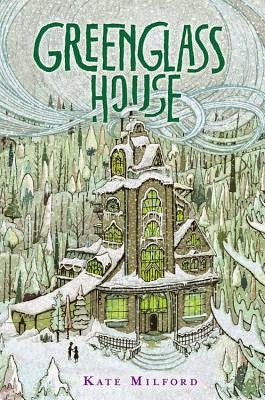
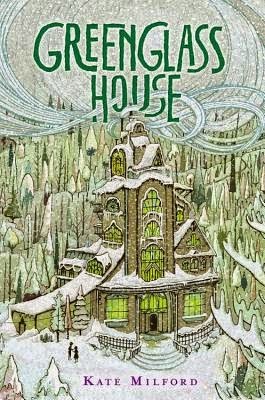
Greenglass House

by Kate Milford
First sentence: “There is a right way to do things and a wrong way if you’re going to run a hotel in a smuggler’s town.”
Support your local independent bookstore: buy it there!
Content: There’s nothing in the usual objectionable categories. However, it’s a slow book, especially at the start, and there’s some confusion sometimes when the characters switch names. That said, a good reader who loves mysteries would really like this one. It would be in the Middle Grade (grades 3-5) section of the bookstore, but I wouldn’t be adverse to putting it in the YA (grades 6-8) section either.

Milo and his parents run an inn at the top of a hill overlooking a river just outside of the fictional town of Nagspeake. The thing that makes their inn special is that it’s a safe having for smugglers. Milo and Mr. and Mrs. Pine know how to keep secrets.

However, it’s winter break, and Milo is looking forward to spending time alone with his parents. Without guests. So, he’s predictably disappointed when four guests, one right after another, show up for the winter.

Soon, they are in full swing, and have to bring up their usual cook, with her daughter, who just happens to be Milo’s age. Soon he and Meddy find themselves embroiled in an adventure and a mystery: figuring out why each of the four guests are there, their connection with the old house that Milo’s parents inherited, and who keeps stealing stuff.

The comparisons to Westing Game that I’ve read are valid. There is a mystery to solve, and it’s a quietly clever one, with a twist that I should have seen coming, but didn’t. (As we all know, I’m not the most careful of readers.) But it’s more than a mystery: it’s a lovely book, full of stories and quiet adventures (Meddy and Milo play a Dungeons & Dragons-like game for most of the book). I’m impressed that Milford wrote such a compelling book on such a small scale; because of the weather, Milo and Meddy hardly ever leave the house. It’s a very bleak landscape (Think The Dark is Rising bleak), but Milford infuses it with both warmth and mystery.

One more thing: Milo is adopted. He’s of Chinese nationality with white parents, and he feels that difference keenly at this point in his life. So, it’s not only a book with a mystery, it’s a book about belonging and family.

I loved it.