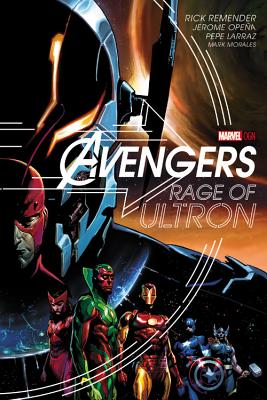
Avengers: Rage of Ultron

by Rick Remender, Jerome Opena, Pepe Larraz, Mark Morales
Support your local independent bookstore: buy it there!
Content: It’s geared toward adults, but I could see a teen who was interested in the Avengers being okay with reading this. It’s in the Graphic Novel section of the bookstore.

I am running a Graphic Novel book group for teens (really, for whomever comes) this summer, and I wanted a Marvel Avengers one to start the group off (because of the movie). I did a lot of asking and digging to figure out if there was a stand-alone that those who aren’t into the universe (read: me) and who have only seen the movies (again: me) could understand. In the end, I settled on this one.

And on many levels I was right: it was a stand-alone (mostly; the ending was a bit ambiguous) and it gave me enough information to understand the story on its own terms, even if I didn’t know how it fit into the larger Marvel universe.

But: these are not your movie Avengers. And that was the biggest hurdle for me.

It’s a similar story to Age of Ultron: a robot was created by Hank Pym, and then when homicidal, deciding that humanity was worthless and needed to be exterminated. One of my favorite panels in this GN was the opening one: a “voice over” (what does one call it when it’s in book form?) of Ultron declaring humanity worthless while Captain America rushes around saving people from Ultron’s destruction. It’s intense and nicely done.

The Avengers beat Ultron, of course, and send him out into space. Then the story fast-forwards to sometime in the future, where Ultron has taken over the moon of Titan, enslaving the people there, and Starfox (Hubby had to explain about the Titans; good thing I have him around) comes back to a new group of Avengers, who are arguing about whether or not Artificial Intelligence counts as “life”. Some, like The Vision, argue that it is; that turning them “off” is tantamount to killing them. But AI like Ultron prove Pym’s point: they can’t be trusted. (I actually really liked the whole discussion of artificial intelligence and found it fascinating.) Ultron follows Starfox back and starts a big fight, one that eventually consumes all of the Avengers.

What I found most interesting were the underlying themes running through the GN: should AI be considered alive and be granted the same rights? To what point should the creator be responsible if the AI goes, well, crazy? I found it interesting that Pym called Ultron his “son” and felt, ultimately, responsible for Ultron’s actions, though I think he took it a bit too far.

The art was fantastic, with strong lines and bold colors. And there were some panels — the one I’ve mentioned at the beginning as well as one near the end of the book — that were simply amazing.

I don’t know if this is going to catapult me into reading other Avengers (or Marvel, aside from Ms. Marvel) GNs, but I really did enjoy reading this one.

Magonia

by Maria Dahvana Headley
First sentence: “I breathe in.”
Support your local independent bookstore: buy it there!
Review copy provided by the publisher.
Content: There’s a bunch of swearing, including several f-bombs. It’s in the Teen section (grades 9+) but I wouldn’t be adverse to giving it to an 8th grader as long as they knew about the language going in.

Aza Ray has spent the nearly sixteen years of her life struggling to breathe. It’s a miracle she’s even lived this long, since she’s got a weird disease (named after her, unfortunately) that basically renders her allergic to air. She’s managed okay, with the help of her family, and her BFF, Jason. But, now, on the eve of her 16th birthday, things are getting weird. Jason maybe wants to be more than BFFs. It’s getting harder and harder to breathe. And weirdest of all? She’s seeing ships in the sky.

There are spoilers ahead. You’ve been warned. Because, for better or for worse, this is about to get REALLY trippy.

See: Aza Ray is seeing ships in the sky because there’s a country of bird people up there, called Magonia. And Aza is one of them. (Which is, duh, why she’s having trouble breathing regular earth air.) She was kidnapped as a baby and placed in a human home; whether it’s to punish her mother (according to her mother) or to save her (according to the bird-person who kidnapped her) remains to be seen. It’s really because Aza has this super-singing power that will either save Magonia or destroy the world. Or both. The problem is that she just can’t give up her human life (even though she DIED), and she just can’t quite kill off the humans.

I didn’t really know what to expect going into this, except that there’s a bit quote from Neil Gaiman on the cover and that everyone (at least on Edelweiss) is loving it. I completely — pun intended — missed the boat on this one. Seriously. I thought the premise was at best a drug-induced fantasy and at worst stupid. I thought the conversation was trying to hard to be John Green-esque and it sounded forced. I thought the plot was lame, even though it wrapped up nicely, and that the romance between Jason and Aza was forced. And even though I love fantasy, this just was NOT my thing.

But, as I said: it’s getting tons of love, so that may just be me not getting it.

Bone Gap

by Laura Ruby
First sentence: “The people of Bone Gap called Finn a lot of things, but none of them was his name.”
Support your local independent bookstore: buy it there!
Content: There’s some intense situations, some creepiness, and some on-screen, tasteful sex. It’s also pretty mature in its themes. For those reasons, it’s in the Teen (grades 9+) section of the bookstore.

Bone Gap is one of those places that everyone knows everyone else’s business and opinions once formed aren’t so easily changed. So, everyone knows that the Rudes are hopeless and mean. That Charlie Valentine is just plain weird. And that Priscilaa — who insists upon being called Petey — is homely. And that Sam and Finn are okay without their mom, who ran off, but they could be better. And that the strange newcomer, Roza, is the most beautiful girl ever.

They also know that Finn’s not the most reliable person; he’s kind of spacey, like his mom, and so when he says some guy in a black SUV took Roza, no one believes him. They chalk it up to “women are always leaving those boys”. They assume that Roza wants to go. But Finn? Finn knows different. So, he sets about trying to find Roza, not because he loves her but because his brother does and his brother can’t quite bring himself to find her. Little does Finn know that looking for Roza will change everything.

I have been sitting here, staring at the screen, trying to figure out what to say about this book. It’s not that I didn’t like it; I did. But I didn’t love it like I felt I should.

My favorite part?  The women. I loved them. I loved Roza and her desire to be Seen for herself and not for her beauty. I loved Petey and her fierceness. I wished there were more women to love, because Ruby knows how to write them whole and complex, people rather than stereotypes.  I liked that they saved themselves, even though the men weren’t worthless louts or even helpless. It was something that was just Done, that they rose up and just did that. They were my kind of women. I also loved the idea that what we assume about other isn’t always the Truth. That there’s more to people than what we see.

But aside from that, I didn’t really love it. Maybe it was the whole magical realism thing; that genre and I have never really quite gotten along. I think I prefer my magic overt: if there’s going to be something strange going on, then give me magic with Rules. I didn’t understand what was going on until the book was nearly done, and that left me feeling, well, stupid.

So, I didn’t enjoy it as much as others on the interwebs, but I still think it’s a novel worth reading.

Unusual Chickens for the Exceptional Poultry Farmer

by Kelly Johnson
illustrated by Katie Kath
First sentence: “My great-uncle Jim had your flyer in his barn.”
Support your local independent bookstore: buy it there!
Review copy swiped off the ARC shelves at my place of employment.
Content: There’s some tricky words, and I’m not sure whether or not the epistolary format will turn off reluctant readers or encourage them. There’s a lot of fun illustrations and some good chicken facts, though. It’s in the middle grade (grades 3-5) section of the bookstore, but I’d probably give it to a confident 2nd grade reader.

Sophie Brown and her parents have just moved from the bustling city of Los Angeles to a farm in the middle of nowhere California. It was a move partially because of necessity — her dad lost his job and hasn’t been able to find a new one — and partially out of happenstance — Sophie’s dad’s uncle died and left him the farm. So, they’re trying to figure this whole thing out. And it’s not going terribly well. That is, until Sophie discovers a catalog for “exceptional” chickens. Turns out, that Uncle Jim was not only a farmer (he had a vegetable garden and some grape vines) but he raised, well, unusual chickens.

The chickens are not quite magical, and they’re based on real chickens, but they’re not quite normal either. (One lays glass eggs, for example.) Sophie is given instructions by the person who runs the catalog on how to catch and care for the chickens, but someone is trying to steal Sophie’s chickens. The question is: will she figure out how to keep the chickens (without divulging their magical properties)? And can she stop the thief from stealing her chickens?

The cleverest thing about this book is the format: Sophie’s story spills slowly over the course of the book through letters she writes to her dead abuela, dead great-uncle Jim, and the chicken place. (It’s kind of unusual her writing to dead people, but it works. She doesn’t really expect an answer back.) It’s a very one-sided story, and we only get snippets of things other than chickens: her mother’s free-lance writing, or her father’s failing search for a job. But, the tone is light, and there is a mystery to be solved with the chicken thief. But what really comes through is Sophie’s voice. She’s a determined child, someone who is willing to figure things out and solve problems. She’s spunky. And she’s half Latina. All of which makes for a charming book, a fun read, and a book worth checking out.

The Darkest Part of the Forest

by Holly Black
First sentence: “Down a path worn into the woods, past a stream and a hollowed-out log full of pill bugs and termites, was a glass coffin.”
Support your local independent bookstore: buy it there!
Content: There’s a few f-bombs and some teen drinking at the beginning. And some intense kissing, not to mention violence. It’s in the Teen section (grades 9+) of the bookstore.

Siblings Hazel and Benjamin have grown up in Fairfold, where they know that faeries are in the forest. They know not to mess with the fairies, but since Ben was blessed (cursed) to make gorgeous music as a child and Hazel has always been drawn to the forest, they really didn’t listen. They made up stories about the prince that was in the glass coffin, they fought some bad faeries, and Hazel even made a bargain with the Alderking to help with Ben getting some musical training.

But all that was in the past. Hazel, now 16, is reckless with boys’ hearts and Ben stopped making music years ago.

And now the prince in the coffin is awake and Hazel’s life is falling apart. The question is whether or not Hazel can figure things out before her life is completely destroyed.

I love Black’s storytelling. Wholly and completely. She pulls you into the world she creates, and makes you believe everything she writes. I loved Hazel in her brokenness, and her relationship with Ben. I loved that there were faerie characters and human characters in all shades of the rainbow (both in terms of skin color and morality). I loved the myth she spun around the town and these characters, and the way she worked with the whole idea of the fey.

I just loved the book. Period.

First Sunday Daughter Reviews: June 2015

Summer is upon us, which means library programs — they changed ours this year: everyone tracks time rather than books, which is okay, I think. It encourages the younger ones to read longer books. — and more activity, so less time for reading.

Still, everyone seems to have gotten books in.

M put this up on Facebook:

I knew she would like Uprooted; I’m glad I was right.

C hasn’t read much, mostly because the book she wants to read

I used to have but can’t seem to find now. And she recommended it to a patron at the library last week, so she can’t check it out, either.

We have taken in a foster daughter (long story) (her name also begins with M, so I need to figure out what to call her on here…), and she was interested in reading this

She ended up not liking it terribly much, saying it was trying too hard to be cool. On the other hand, she stayed up until 2:30 one night finishing it.

I gave A a Books on the Nightstand summer bingo card, and she went to the library with it. She checked out a ton of books, and then promptly discarded them all to read this

Which she’s really enjoying. You gotta go with what you love, I guess.

And K picked up a huge pile of graphic novels (of course). The one she’s gone back to a couple of times was this one

She says it’s weird, but she likes it.

What are your kids reading this summer?

Dragons Beware!

by Rafael Rosado and Jorge Aguirre
Support your local independent bookstore: buy it there!
Others in the series: Giants Beware!
Content: There’s nothing that a capable third grader couldn’t handle, and I would have willingly read this aloud to a second- or first-grader. It’s in the Middle Grade Graphic Novel section of the bookstore.

There are a few graphic novels that my girls — especially K — will go to over and over and over again, thoroughly immersing themselves in the story each time. Giants Beware! is one of them, and so when I brought home the sequel every single one of my girls was super excited. (K wins, though. She practically grabbed the book out of my hands and ran off to read it.)

And none of us were disappointed with the story line. After “slaying” the giant, Claudette, Gaston, and Marie have basically gone back to their lives. However, things have changed: Claudette is still trying to prove herself to her father and is living it up as a hero in Mount Petit Pierre. Marie has been locked in a tower by her mother, her princess lessons intensified, with a camp of foppish princes at the base. And Gaston (who my heart went out to) decided to give up his love, cooking, and try to be more like his father and sister, determined to be a warrior and a blacksmith.

Then ?, the wizard, escapes from his prison, and heads toward Mount Petit Pierre, bent on revenge. Claudette and Gaston’s dad takes off for ? to get his sword back from the dragon ?. And, of course, Claudette, Gaston, and Marie follow him.

A quick aside: one of the running themes throughout the book is that it’s really quite impossible to do something on your own. EVERYONE (well, maybe except Gaston and Marie) in this book starts off thinking that they need to protect everyone else and just do things on their own. But, in the end, it’s only together that they succeed. I loved that.

Of course, there are adventures on the way. I don’t think you need to have read Giants Beware (though why haven’t you??) before you read this one, but it is better if you do know the story, if only to get the little illusions dropped throughout the book. I love how it’s paced, with epic battle scenes at the end, and everyone playing a different role. Which is something else I loved: Gaston finally stops trying to be what he thinks he “should” be and embraces his passion. Marie is awesome in her own way: she’s not a warrior, but without her, they wouldn’t have succeeded. And Claudette learns patience and a willingness to work with others. They’re all better off for their adventure.

It was an absolutely delightful read. Hopefully, there will be more!

The Viscount Who Loved Me

by Julia Quinn
First sentence: “Anthony Bridgerton had always know he would die young.”
Support your local independent bookstore: buy it there!
Content: Um… yeah…. it’s definitely an Adult book. *blush*

I’ve always said that I prefer plot and character development with my sex (in books). So, I went into this one (a YAckers read, of course) with hopes that it would be, at the very least, entertaining.

And, thankfully, I was rewarded. (Yay!)

The basic plot is was this: Anthony Bridgerton is a rake of the worst sort. It’s 1814, in the height of the Jane Austen era, when chaperones were needed and etiquette was severely structured, and Lord Bridgerton is running around making love to all sorts of women. (Unsavory women, too!) So, of course Kate Sheffield was not going to let him any where near her sister Edwina (seriously: WHAT KIND OF NAME IS EDWINA?), even though she’s the catch of the season and Bridgerton has got it into his head to marry. And everyone knows he gets what he wants.

Except, what he wants turns out to be Kate. *wink wink* *nudge nudge*

And that’s about all the plot there is. There’s a lot (a LOT) of sassy banter between Kate and Anthony and a lot (a LOT) of innuendo and under-the-surface desire before he’s caught with his mouth on her breast, sucking the “venom” out of a bee sting (at which point I was howling with laughter), and they were forced to marry. And then the real fireworks started. Two whole chapters of a sex scene (why was there a chapter break in between?) in which Anthony desires his wife and she lets him have his way with her. (I am SURE there’s a feminist objection here, but honestly, I couldn’t see it for the blatant disregard for the time period.) It was bad. It was so horrible and awful and blush-worthy, I couldn’t stop reading. It was just so bad it turned the corner into good. (Or at least deliciously mock-worthy.) Everyone murmured.   Or had husky voices. It was just too, too delightful.

There were some honestly good bits along the way. I really enjoyed the Bridgerton dynamic as a family: there’s a croquet game that was honestly a lot of fun to read. And Quinn made them a close-knit, loving family which is not something you often see. And there was a bit of depth in both Kate and Anthony; Quinn did manage to give them some fears and insecurities, so they weren’t completely one-dimensional.

Not usually my type of book, but it ended up being a great diversion.

Uprooted

by Naomi Novik
First sentence: “Our Dragon doesn’t eat the girls he takes, no matter what stories they tell outside our valley.”
Support your local independent bookstore: buy it there!
Review copy given to me by the publisher rep.
Content: There’s one graphic, but not explicit, sex scene. It’ll be in the science-fiction/fantasy section of the bookstore.

I picked this one up because our Random House rep said it was based on Beauty and the Beast, and we all know how much I love a fairy tale retelling. But, I didn’t count on how engrossing this book would be.

The rep was right: it is loosely based on Beauty and the Beast, but it’s so much more than that. In this valley in Polyna, their resident wizard, who goes by the Dragon, takes one girl every ten years to his tower. When he’s done with them, they don’t come back to the villages, so everyone (of course) assumes the worst. This year, a picking year, everyone guesses that he will take Kasia, our narrator’s, Neishka, best friend. But the Dragon comes, and he picks Neishka instead.

At first, this is terrifying: Neishka isn’t refined, she isn’t skilled for much of anything (except getting dirty), and she doesn’t want to be in the castle with this scary magician. But, as the book goes on, she discovers hidden talents inside herself: she’s a witch, one that is just as powerful as the Dragon, albeit wielding a different sort of magic from him. And its the combination of their magic that is able to confront the real evil in their country: the Wood.

I don’t want to give away much more than that, because this one is best discovered page by page. Novik has a way of pulling one into the story; this started out as a treadmill book (read twice a week for a half hour), but soon became the one I was spending all my time with. I wanted to experience Neishka’s story as it unfolded, with all the twists and turns and slow reveals and intricate pay offs.

M texted, recently, looking for a “Laini Taylor-esque” book, and honestly, this is what I thought of when she asked for that. Novik’s world-building is solid and always in the service of the story, rather than something separate. And, while her words aren’t gorgeous or lyrical, they’re more than pedestrian. They serve the characters and the plot, and make the whole work together just marvelously.

Just about perfect.

May 2015 Round-Up

It’s the end of May?  When did that happen?? Somehow, summertime is upon us (well, as per schedule; the weather leaves something to be desired, even if it is helping with the drought conditions), as is summer reading. I’ve printed out a copy of the Books on the Nightstand Summer Bingo card, which A saw and wanted her own. So she and I are racing to see who can get a bingo first. K’s signed up for the library’s summer reading program, and I’m getting things in place for summer programs at work (which would be easier if people would respond to emails!).

As for my favorite book? I’ve been dying to share this one with you for MONTHS. I cannot express how much this book is ME.

Circus Mirandus

Seriously. So very much my sort of book.

As for the rest?

YA

Cuckoo Song
An Ember in the Ashes
The Kiss of Deception
Scarlett Undercover

Middle Grade

Bayou Magic 
Lost in the Sun
Momo
Moonpenny Island
Smek for President (audio)
The Tapper Twins Go to War

Non-Fictiom

How to Be a Heroine

Adult Fiction

Station Eleven

What was your favorite book this month?