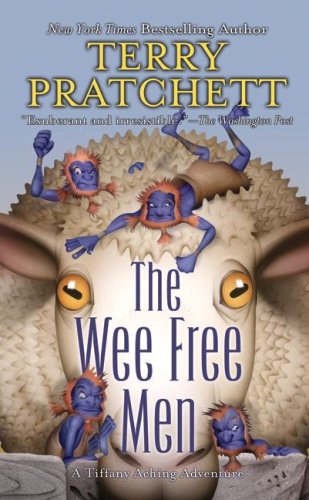
Audiobook: The Wee Free Men

by Terry Pratchett
read by Stephen Briggs
ages: 9+
Support your local independent bookstore: buy it there!

I first read The Wee Free Men two years ago, and thoroughly enjoyed every bit of the time I spent with the book. It’s hilarious, adventuresome, cool, and Tiffany Aching, even when she’s just 11 years old, is a force to be reckoned with. There’s a power in her, a determination. I love that in this world, all it takes to be a witch is powers of observation and the knowledge that you’re the only one who can do anything about the situation.

There’s magic, of course, but it’s not flashy magic. It’s quite, subtle, and still there, even after you know how it’s done.

That said, I loved hearing this book read aloud. Even more so than when I read it. It’s fine reading it and all, but nothing — nothing! — is funnier than someone doing a spot-on Scottish accent for the Nac Mac Feegle. And the voice for Toad? So deadpan, so hilarious. I laughed. So hard. Often. And I actually got the section near the end when Tiffany goes up against the Queen; something which I remember eluding me when I read it. Perhaps because listening to it means I go through things more carefully than when I read them? Whatever it is, listening to the audiobook made this books so much more loveable and enjoyable than it already was.

Which means, of course, that I’m going to have to listen to the rest of the Tiffany Aching books.
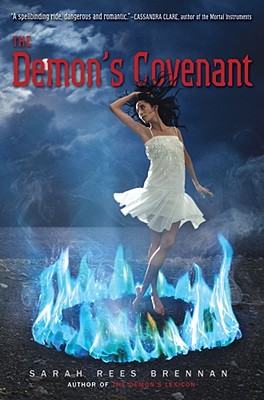
The Demon’s Covenant

by Sarah Rees Brennan
ages: 14+
First sentence: “”Any minute now,’ Rache said, ‘something terrible is going to happen to us.'”
Support your local independent bookstore: buy it there!

First step: read The Demon’s Lexicon. Second step: come back and read this. Because there isn’t any way I can write this part without spoiling the first book.

Picking up a month where we left off… Alan and Nick are back in Mae and Jamie’s life, primarily because Gerald — new leader of the magician’s Obsidian Circle — is trying to recruit Jamie to be part of the circle. This, for many reasons, completely freaks Mae out, and so she calls the Ryves brothers back to help keep Jamie safe. Except, Nick isn’t exactly the safest person in the world, being a freed demon. That creates its own problems: Alan is making bargains with magicians and demons, Mae is finding she’s falling in love with both the brothers, Jamie is actually becoming friends with Nick. And there’s a whole lot else going on that’s completely impossible to sum up.

It’s slow getting started, but picks up about a third of the way into it. At one point I was flabbergasted, wondering where on earth Brennan was going with the storyline, how it all would work out. It’s one of those instances where the right narrator makes the book; it’s from Mae’s point of view this time, and that makes all the difference. Especially when the book all comes together in the end.

Also, as Charlotte pointed out, Brennan does write some very swoon-inducing prose. Very much so. Very, very much so. But she’s not just skilled in writing swoon; the book is SO much better than that. There’s angst and surliness, yes; but, there’s also mystery, and adventure, and magic, and surprise zombies (it’s not a party until someone brings the surprise zombies), and an ending that will — I promise — leave you begging for the next installment.

Which begs the question: how long do we have to wait, and what can we do to make Sarah Rees Brennan write faster?

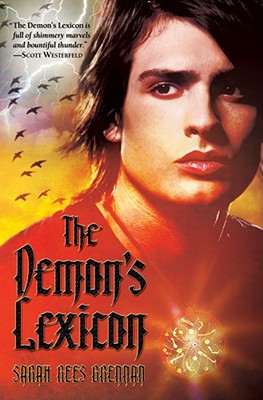
The Demon’s Lexicon

by Sarah Rees Brennan
ages: 14+
First sentence: “The pipe under the sink was leaking again.”
Support your local independent bookstore: buy it there!

Brothers Nick and Alan are on the run from magicians who are hunting them. Have been for most of their lives. That, and taking care of their mother (who was driven mad by magic) takes up most of their time. That is until Mae and her brother Jamie come into their lives. Jamie, it seems, has a third level demon mark, which essentially means he’s ripe for possession.

Perhaps we should take a break here and explain that in this world, demons are spirits who long to possess human bodies and experience human lives. In exchange for this, they grant magicians unlimited power. The magicians don’t really see anything wrong with this, but for Nick, Alan, and their “side”, it’s kind of evil to give away human bodies to demons in exchange for power. I can see their point.

As a result of Mae and Jamie (among other things), Alan gets a demon mark, and so the four of them (unfortunately, in Nick’s opinion) set about trying to remove the marks. This involves hunting down a Circle of magicians and killing a couple, since only a magician’s blood will remove the marks. Thus begins an interesting adventure, full of suspense and intrigue, a bit of romance (and Brennan knows how to write romance), and a spectacular twist at the end, one that, in retrospect I should have seen coming yet it completely blew me away.

The only really drawback is that one of the main characters, Nick, is so very unlikable. It’s a turn off at the beginning of the book; you just want to smack the kid upside the head. But, give it time: he will grow on you, he does have a few redeeming qualities. And then there’s Alan, who’s an enigma: he keeps secrets from Nick, he’s up to something, but you never quite know what. They’re an interesting and appealing pair, these brothers. Mae isn’t too bad herself, either: with her fiery temper and determination (not to mention pink hair).

All of which makes for a very compelling book.

The Wee Free Men

by Terry Pratchett
ages: 12+
First sentence: “Some things start before other things.”

 Yes, I’m here in Cincinnati, enjoying the lull in the reunion (there’s an awesome uncle who make a great playmate, and the rest of us thoroughly enjoy the downtime… though they do come away really wound up)… it’s been fun being with family.
And I managed to get a bit of reading done in the cracks. In fact, it was kind of hard to get it read because I’d leave it lying around, and I’d come back and find it had been snatched up by one family member or another. Which is a testament to how fun this little novel is.
Tiffany is a nine year old girl, the daughter of sheepherder, who isn’t really noticed by much of anything, especially now that Granny Aching has died. That is, until the day when she saw a monster come out of the river. She hit the monster with a frying pan, and the path of her life was changed: she was a witch. That, and her younger brother was stolen by the Queen of Faeries. Tiffany, being the sort of girl she is, decides not to wait for help, and tackles the problem head-on… with the help of the Nac Mac Feegle, the Wee Free men.
But this book isn’t about plot, really. It’s a wonderful example of character- and world-building. The characters — from Tiffany down to the Nac Mac Feegle — are fully drawn and exciting and interesting and engaging. Which makes the book thoroughly entertaining.
I’m going to have to leave it at that… this has taken me a lot longer than I thought it would, mostly because conversation around me is more interesting than the review I’m writing. Needless to say, I’m going to read the next two in the Tiffany Aching series. Terry Pratchett is definately an author — and Discworld a world — worth checking out.

Enter Three Witches

Novelizing Shakespearean plays. Novel idea, right? I have this feeling that the recent “trend” (I’ve read three different takes on three different plays in the last four months) isn’t really new; that somewhere out there other authors have taken on Shakespeare and tried to make him more accessible.

If not, then why not? He’s just loaded with story ideas…

This one, by Caroline B. Cooney takes on Macbeth. It’s not exactly a happy play; but as far as tragedies go, I like this one best. Granted, it’s been years since I’ve read or seen it (and since I couldn’t remember it well, I kept wondering how the book measured up; but it isn’t necessary to understand the book), but I remember thinking that it was not only a good, cohesive play (it makes more sense than Hamlet!), but it’s got enough of the supernatural in there to scare you silly.

I think that Cooney did a marvelous job re-creating the mood of the play. The narration flips back and forth between characters, some of whom are Shakespearean. We follow Lady Mary (who isn’t in the play), daughter of the Thane of Cawdor (who is), and ward of Macbeth and Lady Macbeth. We learn about Swin, the cook; Ildred, Lady Macbeth’s lady-in-waiting, as well as Seyton and Fleance (who are mentioned in the play, but has an expanded role). It’s a complicated thing, flitting between narrators, and generally I find it distracting. But I think it helps with the mood in this case; we are supposed to feel a measure of confusion and uncertainty, and having different people tell us different aspects of the story helps with that. I also like that the book feels spooky. The undercurrent of the witches are there… and Macbeth’s (and others) descent from the noble to the cursed is visible and affecting.

I did have a few issues with the book — Lady Mary as a main character was fairly weak; she spent much of the book lurking around wondering what she should do. It’s understandable; being the 14-year-old daughter of a traitor leaves her in a precarious situation. Still, it wasn’t until the last third of the book that I actually began to like her as a character. I liked the other narrators, though, so they kept me going when Lady Mary was uninteresting. And the plot point where Ildred became pregnant and had a baby which was killed in the course of the book, I felt like it came from nowhere. I did go back and read some sections after finishing and realized that the hints were there, but they were sufficiently subtle that I completely missed them. So, it may just be me.

Overall, though, I liked the book and think it’d be a good companion read with the play. (Maybe I’ll even get around to reading/seeing it again someday.)