Series Books

Last week, we studied graphic novels and series books. I didn’t think these warranted their own post, so here they are…
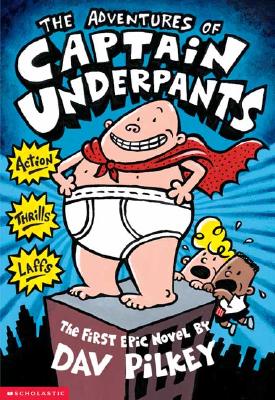
The Adventures of Captain Underpants
by Dav Pilkey
Support your local independent bookstore: buy it there!
First sentence: Don’t know, since my copy was missing the first 14 pages…
Content: Simple sentences, lots of illustrations, and some bad puns (and underwear humor). It’s in the beginning chapter book (grades 1-2) section of the bookstore.

I don’t know how I made it this far, with kids and as a bookseller, and not have read any of the Captain Underpants books. I mean, I knew about them and all… and even some of my girls have read them. I just never did.

(If you don’t know the plot: a couple of 4th grade kids at an elementary school hypnotize their very mean principal and turn him into the hero Captain Underpants, except he’s not very good, so they have to go save him a lot.)

My thoughts? It was very silly. There’s not much else besides silly. I can see why kids like these: they read fast, and they’re silly. Pretty much it. At least I get it now?

Ivy and Bean
by Annie Barrows, illustrated by Sophie Blackall
First sentence: “Before Bean met Ivy, she didn’t like her.”
Support your local independent bookstore: buy it there!
Content: Simple words and illustrations. It’s in the beginning chapter book (grades 1-2) section of the bookstore.

This is another series I’ve sold and my kids have read, but I’ve never bothered with. It’s about how Bean, an adventurous 7-year-old, and Ivy, a more imaginative 7-year-old became friends.

I thought it was cute. Bean reminded me a lot of Ramona, especially in her relationship with her older sister, Nancy (who’s 11). Bean’s kind of rude, rambunctious, mischievous, and definitely prone to getting into trouble. She becomes friends with Ivy, who is a more creative, imaginative child, one day when she tries to play a trick on Nancy that backfires and Ivy comes to her rescue. They then combine their interests and try to place a spell on Nancy. I think Barrows captured the crazy imagination and “games” (as my kids called them) of 7-year-olds, and it made for a very delightful book.

Warriors: Into the Wild
by Erin Hunter
First sentence: “A half moon glowed on smooth granite boulders, turning them silver.”
Support your local independent bookstore: buy it there!
Content: It’s got more words and characters than other series books; it’s probably better for older readers. Warriors, and all the accompanying series have their own section at the bookstore.

So, I have to admit: I’ve been wondering what all the fuss is about this series. We sell it hand over fist (so much that it, like Magic Treehouse, has its own shelf!), and so there must be something about it that appeals to kids.

But, for the life of me, I don’t know what that is. The basic plot is that in this forest there are for clans of cats, that are always at odds with each other over territory (because food is scarce) and a house cat named Rusty decides to run away and join one of the clans. I’m sure something else happens, but honestly? I couldn’t finish it.

It’s not just that the writing was terrible. (Okay, it was passable, but it got really grating after a while.) It’s that I just didn’t care about the cats. I don’t care about their hyper masculinity (and all the warrior cats were male, the female cats were called “queens” and relegated to the nursery, except for the overall leader, which just seemed like a bone they threw) and their territorialism (really? This is what kids are reading? No wonder we’re so divided. If the ThunderCat Clan and the RiverCat Clan can’t get along, there’s no hope for us!) and the monologuing… It was all just Very Bad.

Though, I suppose, if I were an 8- or 9-year-old kid, I might think differently. (I checked: none of my kids ever read these. I wonder what that says about us?)

The Wild Robot Escapes

by Peter Brown
First sentence: “Our story begins in a city, with buildings and streets and bridges and parks.”
Support your local independent bookstore: buy it there!
Review copy provided by the publisher.
Others in the series: The Wild Robot
Content: Same as the first one: short chapters, large print, illustrations. It’s in the middle grade (grades 3-5) section of the bookstore. This one, like the first, would also make a good read-aloud.

Spoilers for the first one, obviously.

When we left our fair robot Roz, she was being airlifted off her beloved island and transported back to the city. She was reprogrammed, and then sent out to be a farm robot, helping a family. Except, she wasn’t reprogrammed enough: she remembered her life on the island and her son, Brightbill, and while she wasn’t entirely unhappy at the farm — cows are good conversationalists and Roz had a lot to do — she missed her, well, home. So, she sets out to escape, which leads her on a whole adventure trying to get back to her island.

It’s much of the same as the first book here: intrusive narrator (but again, not so much that it was bothersome) and Roz is a very sweet character to root for. I liked her adventure this time, and the different things she saw and how her story spread out and paved the way for her to get back. The ending was sweet and satisfying at the same time, which was nice.

It really is a delightful story.

Gregor the Overlander

by Suzanne Collins
First sentence: “Gregor had pressed his forehead against the screen for so long, he could feel a pattern of tiny checks above his eyebrows.”
Support your local independent bookstore: buy it there!
Content: There are a couple of battles and some tense moments. It is in the middle grade (grades 3-5) section of the bookstore.

First a story: M read this when she was about 10 or 11 years old, and told me that it was SO good and that I needed to read it. I balked: Gregor goes underground and goes on a quest with talking cockroaches?! Ew. (I loathe cockroaches. Ugh.) She finally, after years of bugging me, gave up and moved on. However, when I saw it on the list for the science fiction/fantasy module in my children’s lit class, I remembered M’s urging and I picked it up (finally!).

And you know what? She was right. (Not the first time.) The basic premise is that Gregor, whose father has been missing for 2 years, falls into the Underland, a world where there are some humans who live in an uneasy peace with giant spiders, cockroaches, and bats, and whose mortal enemies are the giant rats. (And yes, all the animals talk.) Once there, Gregor finds out that he may be/is the Warrior who would fulfill the prophecy, perhaps bringing peace between the humans and the rats. And, oh by the way, the rats have his dad, so maybe they can rescue him, too.

Yeah, it sounds trite: there are talking animals and a prophecy (they’re all the rage!) but Collins is quite masterful in telling a story. She keeps the action moving, she makes us care about Gregor and all the other Underlanders and she even gives us a nice twist at the end that careful readers will see coming (I didn’t guess, but I wasn’t surprised). And she included Gregor’s 2-year-old sister, Boots, who is literally the best character ever. She’s funny and charming, and provides a humanity to the other characters that otherwise wouldn’t be there.

Oh, and this is a bit of a spoiler: I cried when one of the cockroaches died.

It’s just that good.

The World of Pooh

worldofpoohby A. A. Milne
First sentence: “If you happen to have read another book about Christopher Robin, you may remember that he once had a swan (or the swan had Christopher Robin, I don’t know which) and that he used to call this swan Pooh.
Support your local independent bookstore: buy it there!
Content: These are meant to be read aloud, and we started our girls on them when they were around 4 years old. That said, they’re delightful for anyone.

I was in need of comfort reading, and so what better thing than to pull out Pooh Bear, who hasn’t been read in several years. At least since K was 4 or 5. Which is definitely too long.

I’d forgotten how enjoyable and silly and wonderful these stories are. (And how faithful the Disney movie is!) I loved all the characters from the passive-aggressive grump Eeyore to the simple yet profound Pooh Bear to the small and anxious Piglet. The stories are so delightful and they made me laugh, which is something I needed. I read one or two stories each night, and I looked forward to visiting the animals every night.

It’s definitely a classic. And one that I should revisit again soon.

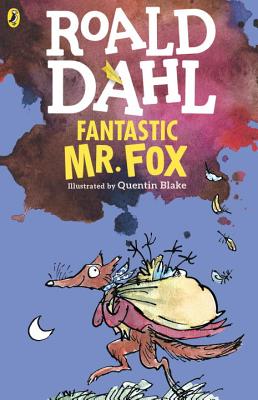
Fantastic Mr. Fox

fantasticmrfoxby Roald Dahl
First sentence: “Down in the valley there were three farms.”
Support your local independent bookstore: buy it there!
Content: It’s short, it’s sweet, and it’s simple. So, even though there are no children as protagonists, it’s in the Middle Grade (grades 3-5) section of the bookstore.

The plot is simple: Mr. Fox steals poultry from the farmers Boggis, Bunce and Bean. Who, according to the book, are awful, ugly (of course), greedy people. So, they decide that they will make it their business to get rid of Mr. Fox. But, he proves too clever by half, the end.

I really don’t have much more to add, since my opinion of it hasn’t changed in six years. But, I do want to mention the book group discussion. It was a LOT of fun. First off, the kids liked it a LOT more than I did, deciding that it was just a lot of silly fun. In the process of prepping for the book group, I came across this website called Teaching Children Philosophy. And they had a module on Fantastic Mr. Fox, which proved to be the jumping ground for a really interesting discussion. Which almost made the meh book worthwhile.

It’s been a LOT of fun doing the Dahl book club this year. The kids were great, and the discussions a ton of fun. Hopefully, I can find something just as grand next year.

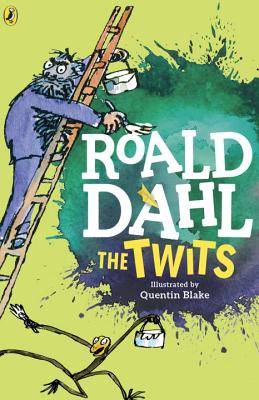
The Twits

thetwitsby Roald Dahl
First sentence: “What a lot of hairy-faced men there are around nowadays.”
Support your local independent bookstore: buy it there!
Content: This one’s slim, with lots of illustrations and simple words. It’s perfect for those younger readers who want an introduction to Dahl and for reluctant readers. It’s in the middle grade (grades 3-5) section of the bookstore.

For the record: I’m beginning to think that Dahl wrote kids books so he could be grumpy about parenting and social trends and disguise it as “humor” for kids.

This time, he’s upset about beards, about cruel adults (he’s always upset about cruel adults; I also think he thinks most adults are cruel), and about the mistreatment of animals (which is a new one).

The plot: the Twits are horrible people. They’re ugly (as are all horrible people in Dahl’s books), they treat each other horribly, they treat their pet monkeys abominably. and then they get their comeuppance. End of story.

And yet, it was funny. The Twits’ pranks on each other were pretty silly and (mostly) harmless. The way the monkeys got back was absolutely brilliant (if implausible), and I admit, I did laugh. (K on the other hand, would HATE this book. She has a real problem with humor at the expense of other people.)

I’ll be interested to see what the kids think of it at book group.

The Wild Robot

wildrobotby Peter Brown
First sentence: “Our story begins on the ocean, with the wind and rain and thunder and lightning and waves.”
Support your local independent bookstore: buy it there!
Release date: April 5, 2016
Review copy provided by the publisher.
Content: It’s fairly large print, with illustrations. It’s good for third grade and up (and is in the middle grade section of the bookstore), but would make a great read-aloud for younger kids.

After a hurricane, the ROZZUM unit 7134 robot washes up on the shore of an uninhabited island. The robot is inadvertently activated by some otters, and Roz (as she introduces herself) comes on. She doesn’t know that she isn’t supposed to be on the island, so she sets about trying to figure out what this place is and how to fit in. She initially meets resistance from the animals: they call her a monster and try to run her off the island. But, through time and some cleverness, Roz learns to adapt. She makes friends with the beavers. She accidentally orphans a goose, but then adopts him as her son. She learns how to fit in.

There really isn’t much to this book; there’s a lot of narration and an intrusive narrator that I didn’t mind terribly much. Because of that, I think this would probably make a better read-aloud than one kids are going to want to pick up. That said, I tossed it in K’s direction for a book report, and so far she’s enjoying it. It helps, I think, that the chapters are short (some as little as one page) and there are illustrations liberally scattered throughout.

In the end, I found I really liked it. I came to really care about Roz and her relationship with the animals. And while I didn’t really care for the abrupt ending (sequel, anyone?), I cared about the journey. And it was an interesting mix of tech — Roz was able to use her computer database to find out answers — and nature — the winter was rough, animals (even though they were talking) died.

A very intriguing book, in the end.

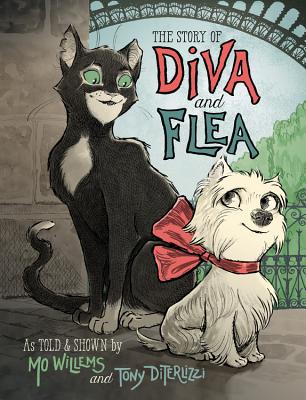
The Story of Diva and Flea

by Mo Willems, illustrated by Tony DiTerlizzi
First sentence: “This is Diva’s story.”
Support your local independent bookstore: buy it there!
Review copy picked up at Children’s Institute.
Content: It’s perfect for the beginning chapter crowd, though there are some difficult words. It’s with the other beginning chapter books at the bookstore.

I have a confession: I didn’t want to read this. I adore Willems as a picture book writer, and I was afraid that he wouldn’t be able to pull a longer story off. So, I put off reading this until the day came when I thought to myself, “I need some Mo Willems in my life today” and so I picked it up.

I shouldn’t have worried.

The one thing I adore about Willems is that he knows how to write both to adults and children at the same time. His stories — no matter if they’re Knuffle Bunny or Elephant & Piggie — embrace humor and characters and themes that both adults and kids can relate to. And while he is simple, he never ever talks down to his readers. And he brought all of that to the table with this one. It’s an endearing story of a friendship between an adventuresome cat and a shy dog. It’s a story about reaching outside your comfort zone and the wonders that you will see when you do. It’s a story about Paris.

But, most of all, it’s a story with a lot of heart and with some gorgeous illustrations DiTerlizzi. And it’s practically perfect in every way.

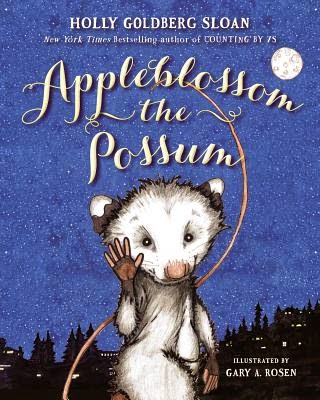
Appleblossom the Possum

by Holly Goldberg Sloan
First sentence: “One moment she’s calm and cozy with a knee in her nose and a tail around her neck.”
Support your local independent bookstore: buy it there!
Review copy acquired at CI3 and signed by the author (squee!).
Release date: August 11, 2015
Content: It’s pretty basic: simple language (though there are a few difficult words thrown in), and a lot of white space and illustrations. It’s probably appropriate for a strong 2nd grade reader and up. I think it’d make a great read-aloud for younger children, as well.

The store’s publisher rep warned me, when she highlighted this book (and I got all excited), that this is a departure for Sloan. And she’s right: talking possums is a bit of a departure for Sloan. But that’s really the only departure; many of the themes — of family and resilience — are the same.

Appleblossom is the youngest of Mama Possum’s first litter (which is why Appleblossom and all her siblings have A names). She’s happy when she’s younger, hanging out with her brothers and sisters, and learning acting lessons from Mama. It was scary, especially the lessons about People monsters and Dog monsters, but she knew she had her family with her. And then the day came that Mama left. (It’s the wild. It happens.) Appleblossom and two of her brothers — Antonio and Amlet (because Hamlet isn’t an A name) — decide that they don’t really want to go off on their own so they stick together in their neighborhood. And then tragedy strikes: Appleblossom falls down a chimney into a house. With a Dog.

First off: I think this is one of those books that would be better read aloud. The way the book is written feels like a story one would tell around a campfire or at bedtime, rather than a book to lose yourself in. The language Sloan uses to describe the people world, and the characters of the possums — the brothers end up meeting their dad, Big Poss — as well as the simple adventures the possums have all lent the story an air of whimsy that lends itself more to reading aloud.

Given that framework, it’s a wonderful tale. It’s full of adventure and humor and charming artwork. I think (even though I didn’t absolutely love it like I did Sloan’s other books), given its intended audience, it’s absolutely perfect.

The Wand & the Sea

by Claire Caterer
First sentence: “Holly Shepard was unlike most twelve-year-olds in that she didn’t at all mid sharing a cramped cottage bedroom with her pudgy, snoring, laptop-loving younger brother.”
Support your local independent bookstore: buy it there!
Others in the series: The Key & the Flame
Review copy provided by the author’s publicist.
Content: It’s kind of slow to start, and the fantasy is more Narnia-esque than Harry Potter or Percy Jackson. Even so, there’s nothing content-wise, and if there’s a 9- or 10-year-old who likes Narnia, they’ll probably love this. It’s in the middle grade (grades 3-5) section of the bookstore.

It’s been a year since siblings Holly and Ben and their British friend Everett have been to the magical land of Anglielle, where Holly can do magic, and where they’re caught up in a good versus evil battle. They’re determined to get back, but this time, the portal they used before won’t work. This time, it’s the water element that’s highlighted. This time, they need to rescue their friends, who have been imprisoned by the king, and try and find the other adepts, who have been exiled from Anglielle.

Of course, it’s not a simple thing: Everett is still playing the role of the sulky somewhat traitor (think Edmund), the prince Avery’s loyalties are still in question. They do meet a group of pirates, on the ship the Sea Witch, that are quite fascinating. And when Holly finally confronts the Big Bad Guy, it’s pretty intense.

I went back and re-read my review/reaction to the first book in the series, and it seems I liked it. I had a less positive experience this time around; the first book didn’t stay with me as much, and it’s been a couple of years, and it took me longer to get into this story. Still, it’s channeling Narnia quite well, and in the end, the adventure was satisfying, while leaving room for another sequel. (I’m starting to suspect there will be four in all; one for each element.)

Not bad, overall.