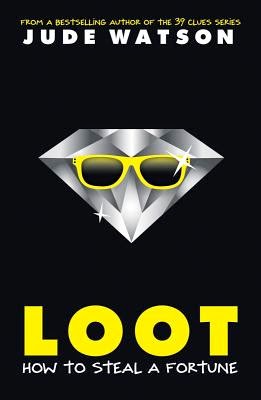
Loot: How to Steal a Fortune

by Jude Watson
First sentence: “No thief likes a full moon.”
Support your local independent bookstore: buy it there!
Content: The only think I can think of is that it’s a bit intense, action-wise. Probably on par with the Percy Jackson books. There’s no swearing, no romance. It’s happily in the middle grade (grades 3-5) section of the bookstore.

This book — combined with The Great Greene Heist (it’s a trend! Does two books make a trend?) — has gotten me thinking about the implausible versus the impossible. It is implausible that Jackson Green could have thrown together a crew to scam less-than-intelligent adults into exposing a blackmailing scheme. It is highly impossible, however, that 12-year-old March McQuin could have gotten together a crew in order to steal back 7 Moonstones that his illustrious thief father, Alfie, stole 12 years before. (Granted, the premise behind the Heist Society books by Ally Carter is also impossible.)

Impossible, however, doesn’t mean “bad”.

In fact, Watson has put together quite a ripping tale. After Alfie’s death during a heist in Amsterdam, March discovers he has a 12-year-old twin sister, Julia, that he didn’t know about. And then, at Alfie’s funeral, March and Julia are confronted by the woman from whom the moonstones were stolen. She’s offered them $7 million in order to steal them back. In a week. They’re up against incredible odds: Alfie’s old partner, who has just recently gotten out of jail, are after the stones as well.

Even though the premise is impossible, Watson does a fantastic job keeping up the pace. The chapters are short, the pacing quick, making it a perfect read for reluctant readers. Plus, it’s action-packed with chases (both in the car and on foot) and rooftop falls as well as planning and executing some pretty amazing heists.

No, it’s not a story that could actually “happen”. But it was still a lot of fun.

The Glass Sentence

by S. E. Grove
First sentence: “It happened long ago, when I was only a child.”
Support your local independent bookstore: buy it there!
Review copy provided by the publisher.
Content: There’s nothing objectionable or scary. It is, however, nearly 500 pages and it’s small type and that can be intimidating. (A was initially intimidated. I think I’ve convinced her to read it.) It’s also kind of slow-moving, with a lot of tricky names, so probably not the best book for a reluctant reader.

I think the best place to start with this one is Megan Whalen Turner’s quote on the back cover: “Not since Philip Pullman’s The Golden Compass have I seen such an original and compelling world built inside a book.”

That’s quite a lot for a book to live up to (MWT! Philip Pullman! Original! Compelling!) but you want to know something? She was right. So very, very right.

In 1799, something happened, and the whole world shifted. It came to be known as the Great Disruption, and what it did was cause different parts of the globe to be in different time periods. Europe was stuck in the middle ages, the Northwest Territory in a prehistoric ice age. What we know as the 13 colonies stayed in linear time, for the most part, though they never developed much farther than that. Past the Mississippi River and into Mexico is what is known as the Baldlands, a hodgepodge of raiders and outlaws, except for three cities which are known as the Triple Era, with people and creatures spanning 3000 years in the same place.

Pretty cool, no?

It’s no wonder that in this world explorers and map-makers are held in the highest esteem. And Sophie Tam’s uncle, Shadrack Elli, is one of the best. He’s been raising his niece ever since her parents — also explorers — disappeared. She’s learned to live without knowing about her parents, and she’s learned how to read the maps that Shadrack makes. So when he’s kidnapped, she’s really the only person who can save him.

The world is brilliant, and the use of maps and magic (of sorts, though kind of not really “magic” as you’re thinking about it; it’s more future techonology) are refreshingly unique. But, once the plot starts going (which, admittedly takes a while), it picks up and becomes one of those books you can’t put down. I was thrilled with the world, with Sophie and her friend Theo and their increasingly intense and urgent adventure. I thought that Grove captured an interesting balance between the older people — like Shadrack — and their expertise and the younger ones — like Sophie — who were able to see things in a new and different light. I loved the use of time and Ages and invented words; I haven’t seen this kind of  creativity in naming things since Harry Potter. I also loved that the “bad guy” wasn’t wholly evil. That while they did some morally questionable things, it wasn’t a pure black and white thing. There’s layers here: yes, it’s a middle grade fantasy adventure, but it’s also so much more.

I can’t wait for the sequel.

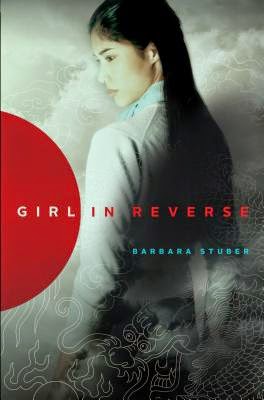
Girl In Reverse

by Barbara Stuber
First sentence: “Say it, Lily.”
Support your local independent bookstore: buy it there!
Content: There’s some mild swearing and kissing. It’s probably a more complicated plot than the Middle Grade section warrants, so it’s in the YA section (grades 6-8) of the bookstore.

Lillian Firestone is an adopted daughter of Chinese heritage. Which makes her a target in Kansas City in 1951, the height of the Korean War. She took the bullying and name-calling when she was younger, but now that she’s 16, she’s taking a stand. Sort of. She walked out of class and school one day, and that act started a domino chain of events that led to the discovery of her birth parents.

There’s art involved and a lot of Chinese culture as Lily goes on this journey.

(I’m tired. Can you tell?)

I wanted to like this book. I love the cover, I love the ideas, the conflict. But I could never connect with Lily. She drove. me. nuts. Completely. And so I started skimming, skipping ahead just to see what happens. And yeah, everything’s tied up in a nice little bow.

It had potential, and I’m sure some readers will really love the art and China elements. But I wasn’t really one of them.

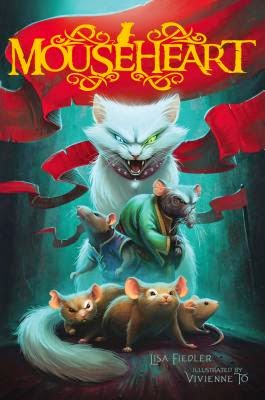
Mouseheart

by Lisa Fielder, illustrated by Vivienene To
First sentence: “The young rat prince knew he was taking a monumental risk.”
Support your local independent bookstore: buy it there!
Review copy given me by our Simon & Schuster rep, via my boss.
Content: There are some mild scary parts, and some mild violence, but really, it’s quite happy in the middle grade (grades 3-5) section of the bookstore.

I have to admit that I was a little turned off by the cover. It just looks so…. I don’t know. Juvenile, maybe. Or lame, perhaps. But, either way, I was completely unprepared for the awesome found inside.

I do have to qualify the word “awesome”: if you don’t like fantasy or talking rats, you may not find this awesome at all. The thing is: usually I don’t either. I liked  The Tale of Despereaux well enough, and Mrs. Frisby and the Rats of NIMH okay, but I didn’t like Redwall, and I have studiously stayed away from the Warriors series. So, talking animals, not exactly my thing.

But the story of a pet-store bred mouse, Hopper, who — ends up beneath the subways of Brooklyn in the sewers — got to me. Perhaps it was his insecure optimism that won my heart over. Or the fact that his sister, Pinkie, was a bully and my mom-sense (kind of like Spidey-sense) kicked in. Or perhaps it was that he found a civilization of rats underground that has a tentative peace with feral cats. Or maybe it was the prophecy of the Chosen One, and the complications that brings.

What I really enjoyed was the way that Fiedler had the rats interact with the human world. How they taught themselves to read, and how Hopper figured out the subway system. How they used cast-off items (and some scavenged ones, too) to furnish their world. It was fantastic.

Maybe, too, I was just in the mood for a straight-up fantasy adventure with talking rats and a mouse with a heart of gold. I didn’t know that I was, but I found I couldn’t put this one down.

All These Things I’ve Done

by Gabrielle Zevin
First sentence: “The night before my junior year — I was sixteen, barely — Gable Arsley said he wanted to sleep with me.”
Support your local independent bookstore: buy it there!
Content: There’s talk of sex and a lot of kissing, but nothing graphic. And there’s talk of violence, but again, nothing graphic. It’s in the YA section (grades 6-9) of the bookstore.

This one is a hard one to sum up, partially because the world Zevin created is so complex. It’s futuristic, but not exactly a post-apocalyptic or dystopian. It’s a world where things are strictly rationed, and coffee and chocolate and books are illegal. So, much like alcohol in the 1920s, there is a strong black market for those items. And our main character, Anya Balanchine (her friends call her Annie), is part of the Balanchine mafia family that has a strong presence in the chocolate market. Her father was the head of the family until he was shot and killed (in front of her) when she was 9. Annie and her older brother, Leo (who is slightly mentally disabled due to another hit meant for her father that killed their mother and disabled Leo) and younger sister Natalya have been raised the past 7 years by their grandmother, whose health is slowly failing.

Over the course of the year, things spin out of control for Annie. Her ex-boyfriend, Gable, ends up poisoned by chocolate, and Annie ends up in juvenile prison because of that. She falls for and dates the son of the assistant DA, in spite of the extreme pressure to break it off. She stresses about Leo, especially since he begins working for the family. And her grandmother finally passes away.

All that managed to fill up the book, which I wanted to like very much. But, aside from world creation, there really isn’t much there. Annie is a fascinating character, but I got tired of her waffling. I wanted her to step up and take charge. It’s not good when the most interesting character is the head of the Japanese mafia family who shows up for probably 10 pages. I hoped for more out of this one, and was disappointed.

I might give the second one in the series a try, just to see if it gets any better.

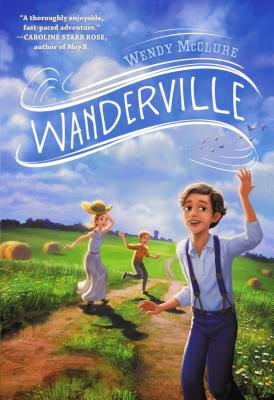
Wanderville

by Wendy McClure
First sentence: “Jack didn’t notice the smoke until there was far too much of it.”
Support your local independent bookstore: buy it there!
Content: There’s a some bullying and a fire that kills a family member of a main character, but that’s about it. It’s short enough to be a beginning chapter book, but it might be too challenging for most 1st and 2nd graders. Definitely belongs in the middle grade (3-5th grade) section of the bookstore.

Jack lives in a walk up in New York City in 1904. Their family is poor, but making it. That is, until a fire takes both their building and the life of Jack’s older brother. Frances and her younger brother Harold are orphans and living off the charity of one of the many orphanages in the city. Both find themselves on a train headed west, as part of the efforts of the Society for Children’s Aid and Relief Office. But, as all three find out, the best intentions of adults don’t always translate into good things for kids.

Faced with being separated from her brother, and looking forced labor in the eye, Frances, Harold and Jack decide to jump off the train before they reach their final destination. They’re wandering the Kansas prairie when they find Alexander, another orphan train escapee. He’s decided to start his own town, called Wanderville, and while it doesn’t look like much (or anything, really) it’s not his own. Unfortunately they way they get supplies is by “liberating” them from the nearby town. Which, obviously, is going to lead to trouble.

I wanted to like this one. It’s got a good idea — exploring the world of the orphans from the orphan train — and it’s set here in Kansas. I was hoping that it’d be a good contribution to historical/Kansas middle grade fiction. But it’s not. Perhaps it was me, but I didn’t like the characters, and felt the text itself was too condescending and predictable. I felt that if I had a checklist I would have ticked every single cliche off.  Bully on the train? Check. Evil man exploiting the system for his own gain? Check. Rugged and slow cop? Check. Sisterly figure who always knows better than the boys? Check. Adorable 7-year-old who is Wiser Than His Years? Check.) That’s not to say that kids won’t like it. I’m sure many will.

I just didn’t.

Mark of the Dragonfly

by Jaleigh Johnson
First sentence: “Micah brought the music box to her on the night of the meteor storm.”
Support your local independent bookstore: buy it there!
Review copy handed to me by one of my bosses, who told me to “get on it”.
Content: There’s some violence (none of it fatal), and a bit of an innocent crush. But no language. The reading level is probably a confident 3rd grader/4th grade level. It’s happily in the middle grade (3-5th grade) section at the bookstore.

Piper is a scrapper. She lives in a scrap town at the edge of the Meteor Fields, and runs out after storms, looking for salvageable items — things that have come through from other worlds to hers — in order to sell for pennies. She wants more from her life, especially after her father’s death in the Dragonfly Terrritories’ factories, but she doesn’t quite know where to start.

Then, after a particularly violent meteor storm in which her best friend, Micah, is seriously injured, Piper finds a girl. She’s not-quite-dead and bears the Mark of the Dragonfly, which means she’s protected by the king. Piper revives her, and when a sinister man (whom the girl, Anna, calls “the wolf”) comes looking for the girl, she and Piper escape. Only to find themselves on the 401, the main train connecting the northern Marrow kingdom with the southern Dragonfly one.

Once on the train, though, Piper’s and Anna’s problems don’t go away. They meet a whole host of characters and are being chased by slavers and raiders (and the wolf) on their quest to figure out who Anna is, and what Piper’s budding powers can do.

I know I didn’t do the book summary justice. I’m not sure, however, if anyone can. There’s a lot going on in this book. It does have things going for it: Piper is a complex heroine, stubborn and intelligent, a combination of drive and pluck that made her very likable. My only complaint is that Johnson chose to introduce a romance element (however slight) with a boy. I felt it was unnecessary to the whole story, and it didn’t add anything. However, I thought the relationship between Piper and Anna was incredibly well-written. It became a sisterly bond and one that was very realistic and interesting. And the world — from the objects falling from the sky, to the cool train — was fascinating. The book did feel incomplete — is it the first of a series? — and there were many threads left hanging, but it was a good, solid contribution to middle grade fantasy.

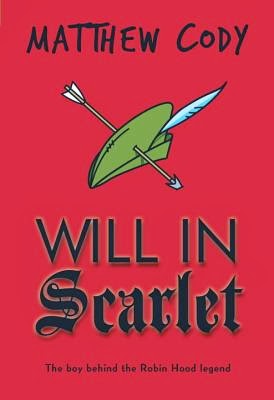
Will in Scarlet

by Matthew Cody
First sentence: “In the year 1192, while King Richard the Lionheart was on his way home from fighting in far-off Jerusalem, the lords of Shackley Castle were out hunting wolves by moonlight.”
Support your local independent bookstore: buy it there!
Review copy provided by the publisher because this was a book group pick.
Content: There is some violence, and the word count/comprehension is pretty high. My 4th grader wasn’t interested in taking the time to read it, though it’s probably within her reading/comprehension level. Even though it’s in the middle grade (3-5th grade) section of the bookstore, it may be more suitable for older readers.

William Shackely is the only son of the lord of the manor. And, at 13, he’s ready to become a Man. Under his uncle’s guidance he’s pretty sure he can take over running the lands. That is, until Sir Guy, a toadie of Prince John and a despicable human being, comes in and takes over the Shackley Castle. All of a sudden, Will finds himself landless, and on the run.

He ends up stranded in Sherwood Forest, taken captive by the Merry Men, who are led by none other than… Gilbert. (There is this guy named Rob, though, drunk in the corner.) Will’s pretty sure they just want him for ransom, so (against the better judgement of a girl named Much — though the readers only know she’s a girl; the characters, being boys/men, are clueless) he convinces them to go back and raid Shackley Castle. It’s on that raid that he finds out that drunken Rob is actually a charismatic leader, a good planner, and someone worth fighting with (and for).

I’ll spoil it for you: Rob turns out, by the end, to be Robin Hood. But, getting there was a less than enjoyable experience. I have to admit that I’m shallow: my biggest problem with the book was the font. I didn’t think I was so affected by something that simple, but from the get-go, the layout (it’s crowded, the typeface smallish) bothered me. But it was also not what I had expected. I wanted Robin Hood. The whole myth and legend. And while elements of it were there (Sir Guy, the Sheriff of  Nottingham, Sherwood Forest, Little John) too much of it — including Robin himself — was missing. And while there was action (the first chapter starts out with a pretty intense wolf hunt), it wasn’t paced well. It’d be exciting for a bit, and then pages and pages of Will’s inner struggle with his desire for revenge.

There were some bright spots. I enjoyed Much as a character; she did hold her own with all the guys. And I liked that there really wasn’t a romance. But, mostly, it just feel flat for me.

Which was disappointing.

How to Catch a Bogle

by Catherine Jinks
First line: “The front door was painted black, with a shiny brass knocker that made a satisfying noise when Alfred used it.”
Support your local independent bookstore: buy it there!
Review copy off the ARC shelves at my place of employment.
Content: There’s a few mild swear words and some very intense moments. I’d put it in the middle grade (3-5th grade) section of the bookstore, but I’d be wary about giving it to a sensitive younger kid.

Imagine a Dickensian London, complete with orphans, pickpockets, unsavory doctors, toshers, and blackmailing landladies. And then add… bogles.

What are bogles, you might ask?

Well, it’s what our fair heroine, Birdie, and her master, Arthur, call the paranormal creatures that they get rid of for the people of  London town. Not everyone believes in them, but Arthur and Birdie know one thing: if there’s children disappearing, it’s most likely a bogle.

(I’ll let you read the book to find out how to catch them, though.)

There isn’t much plot to this one in terms of plot; Birdie and Arthur catch bogles until they meet a woman of Society who decides that bogle catching is an unsuitable occupation for a girl. (Birdie objects.) They catch more bogles until things become Sufficiently Dangerous (that’s when the unsavory doctor comes in). There’s a bit of excitement, a kidnapping, and some hauntings before it’s all over. No, this one’s mostly about atmosphere. It’s a dark book — bogles are not nice creatures — and very  much the dirty London of Dickens’ time.

I loved it.

I know: I don’t usually like atmospheric books, or Dickens for that matter. But the combination of a clever take on the paranormal and the plucky character of Birdie was enough of a combination for me to fall head over heels for this one. It’s a perfect stand alone story (though it — like many this Cybils season — says it’s a “Book one”), one that is perfect for those who love historical fiction as well as the paranormal.

(Just for the record: because this is a Cybils nominee, I’ve been asked to make sure y’all know this is my opinion only, and not that of the panel.)

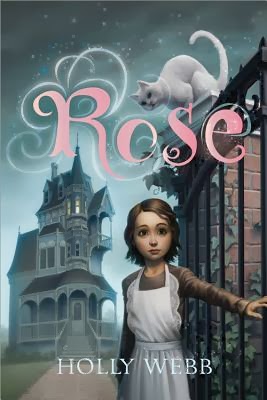
Rose

by Holly Webb
First sentence: “Rose peered out the corner of the window at the street below, watching interestedly as two little girls walked past with their nursemaid.”
Support your local independent bookstore: buy it there!
Review copy sent to me by the publisher for the Cybils.
Content: Aside from the creepy person kidnapping orphans (but it’s really not that scary), there isn’t anything untoward in this book. It would happily sit in the middle grade (3-5th grade) section of the bookstore.

Rose lives in St. Bridget’s Home for Abandoned Girls in London, with no idea, really, where she came from or who she is. (She’s named after the rose bush that was blooming the day she was found in a fish basket in the churchyard.) She really doesn’t have much hope of ever being adopted, so she trudges on, one day after another. Then one day, a housekeeper for a wealthy alchemist/magician arrives, and Rose ends up as a maid in the house. And she discovers that she has a talent for magic. It turns out, too, that orphan children are disappearing from the London streets. No one is really concerned — they’re orphans, after all — but when a friend of hers from St. Bridget’s goes missing, Rose knows she has to do something. And with the help of the magician’s apprentice, maybe she can.

This is, in many ways, a book that’s already been written. Orphan? Check. Plucky lower class girl outsmarting the gentry? Apprentice story? Check. Check. Evil magician stealing children? Check. It should have been by-the-numbers boring.

And yet, it wasn’t. Partially because of the writing — Webb does know how to keep the pages turning — but mostly because Rose is such an endearing character. She’s neither snarky nor plucky. She just does what Needs To Be Done. She’s hardworking, but doesn’t have any desire to be Great. She’s not terribly smart — she has no idea how she’s doing what she’s doing — but she is willing to learn. And she is, above all, loyal to those she calls her friends.

She is, for all purposes, a Hufflepuff.

And that is why I loved her. The story is good, as well. I think this is a first in a series, but it doesn’t need to be. I can see a lot of kids loving it — boys too, if they can get past the title and cover — because it’s quite accessible.

A true winner. (Go Hufflepuff!)

(Just for the record: because this is a Cybils nominee, I’ve been asked to make sure y’all know this is my opinion only, and not that of the panel.)