The Circuit

by Francisco Jimenez
First sentence: “‘La frontera’ is a word I often heard when I was a child living in El Rancho Blanco, a small village nestled on barren, dry hills several miles north of Guadalajara, Mexico.”
It’s out of print, unfortunately. I found a copy at the library.
Content: It’s a series of short chapters, fictional but with an autobiographic feel. It’s in the teen section at the library, but I really can’t figure out why.

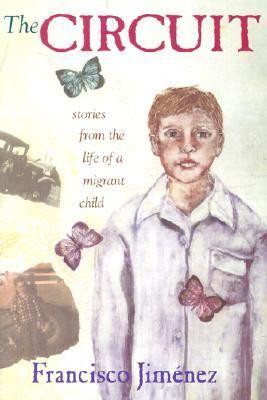
This is basically the fictionalized autobiography of Jimenez. He doesn’t bother to change the names of his family (maybe of the other characters?) or even of the situations he finds himself in over the time that his family — he’s the second of seven children — spent as migrant workers in California. This book covers the time they entered the United States (his father had a green card; his mother, older brother, and he were all undocumented. His younger siblings were all born in the United States) through the time when, in high school, his older brother was picked up by ICE. (Though he doesn’t go into what happened after. Just that he was picked up.)

Jimenez does an amazing job making the migrant worker’s life come to life on the page: the back-breaking labor, the constant moving to follow the work. Not just for his parents — there was a scene when his father was sitting in their meager tent, smoking cigarette after cigarette, cursing the rain that wouldn’t stop and that was ruining the crops and therefore their livelihood that really brought it home to me — but also for the children, how they couldn’t start school until after the cotton crop in November, how they moved often so he went to multiple schools in the course of one school year.

It makes one think about where one’s food come from. Who is out there picking the crops, and what kind of conditions they live in. And yes, it made me think about immigration — this story took place beginning in the 1940s — and the way they are treated, not just by the government but also by business owners. It’s not an easy thing, politically, but I think we often forget that there are people on the other end.

At any rate, it was a fascinating little book.
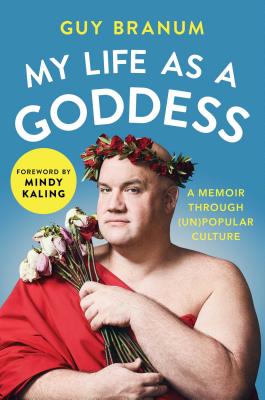
Audio book: My Life as a Goddess

by Guy Branum
Read by the author.
Support your local independent bookstore: buy it there!
Listen to it at Libro.fm
Content: There was a bunch of swearing, including many f-bombs, and frank talk about sex. It’s in the humor section of the bookstore.

I have, in fact, mentioned my weakness for celebrity memoirs, especially if I can listen to it on audio. They just hit my happy button. And I’ve just found out that I enjoy them, even if I don’t know who the celebrity is! (As in this case.) I found out about thins one through Pop Culture Happy Hour when it was recommended by my favorite crank, Glen Wheldon. (Who actually has a reference in this book…) Anyway. This is basically Guy’s story about how he went from the boring farm town in the Sacramento Valley (I really enjoyed his diversions about agriculture!) to being a stand-up comic and a comedy writer. It was quite hilarious, but also introspective and touching. I think one of the things I like best about these kind of books is hearing someone else’s story, learning how they got to where they are today. Branum didn’t have an easy life; he was often ostracized as a child (not to mention his sister, who was really only alluded to) and his parents — especially his father — cut him off when he came out. He made a wrong turn going to law school, and I liked knowing that other people make wrong turns and turn out okay. I also thought his rant about the cultural biases against clubs (I may never listen to Shape of You by Ed Sheeran the same way again. Or Bohemian Rhapsody).

I loved every moment listening to Guy tell his story (the best bits where when he cracked himself up). A delightful book.

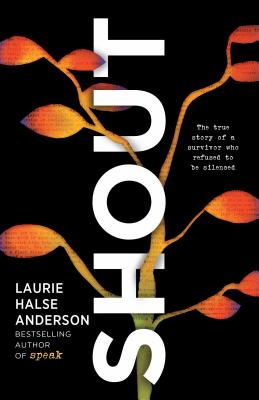
Shout

by Laurie Halse Anderson
First sentence: “this book smells like me”
Support your local independent bookstore: buy it there!
Review copy provided by the publisher.
Content: There is talk about rape and sexual abuse, and swear words, including f-bombs. It’ll be in the Teen section (grades 9+) of the bookstore.

I didn’t think
about where Speak
came from, though I have read that
several times
and respect it.

So when I learned that it
was inspired by Anderson’s story
I was shook
and also inspired;
she had a tough childhood,
but worked out a path
and made a successful
life.

But what really got me
about this book —
what made me angry —
was all the stories she heard
in response to the book
both from girls who read it
and can now speak their truth,
and from adults,
who want to keep kids from that truth.

In the end,
what will stay with me
is the beauty of the words
as well as the
power
of the story.

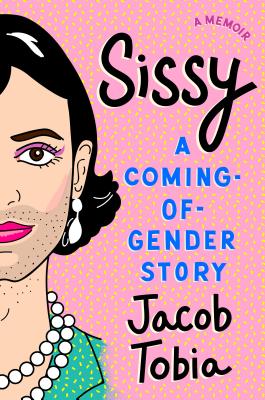
Sissy

by Jacob Tobia
First sentence: “I never really got to have a childhood.”
Support your local independent bookstore: buy it there!
Review copy provided by the publisher.
Release date: March 5, 2019
Content: There is swearing, including multiple f-bombs, and some talk of sex. It will be in the Biography section of the bookstore.

Jacob Tobia (they/them) is a lot of things: a writer, an activist, a performer, a producer. What they are not is someone who fits into what society has defined as “male” and “female”. This memoir, which is absolutely delightful to read, follows Tobia through their childhood, as they struggle with their “male” body and their desires to present more feminine.

To be honest, I have no idea if I’m even talking about this correctly. I really did enjoy reading Tobia’s book, and it made me think about the way I was raised and the things that I have either consciously or unconsciously inherited from society, and the way I look at other people. But, aside from being challenging — not a challenging read, but it did give me things to think about — it was highly entertaining. Tobia has a great writing voice, and the book is fun and funny as well as heartbreaking at times. It’s made me think about trans people (especially since my nephew is trans) and the ways in which society at large just isn’t equipped to handle people who don’t feel they fit within a binary system. (And it’s little things, like gendered bathrooms, or a pregnant co-worker who says “We found out the gender; it’s a boy!” that are making me think.)

I think Tobia has an important story that is not only relevant, but entertainingly told and highly engaging as well.

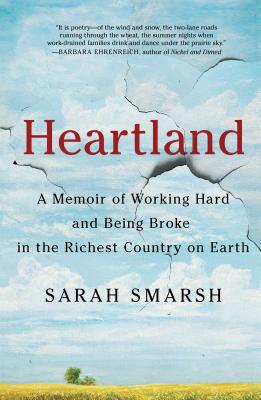
Audio book: Heartland

heartandby Sarah Smarsh
Read by the author.
Support your local independent bookstore: buy it there!
Or listen at Libro.fm
Content: There is some frank talk about abuse and drinking as well as a lot of swearing (including multiple f-bombs). It’s in the biography section of the bookstore, but I think a teenager might be interested in this.

This has been a big deal around the store, mostly because Smarsh grew up just outside of Wichita (and rumor has it she’s moved back here), and the places and people in it are pretty much staples in this community. But her story — the child of a teenage mom, growing up in a rural community on a family farm — belongs to much more than those of us here in Wichita. In fact, as I listened to her story — which sometimes got political, but mostly she kept personal — I heard echos of my own mother’s and grandmother’s story — married young, growing up in a small rural community, working hard their entire lives for just barely enough. It’s the story of many, many Americans.

Even so, Smarsh has one thing going for her that many poor do not: she is white. Sometimes, she acknowledges that fact, and tries to be more inclusive in her conclusions. But often, I felt like she was saying “look at me, look how poor we were, look how much I suffered, look at those scars” and I wanted to roll my eyes. Very few of us escape our childhoods without scars. And just because she grew up poor in Wichita and Kingman, doesn’t make her story exceptional.

Except she told it (and read it) well. So I have to give her that.

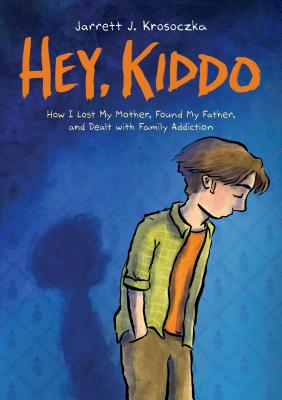
Hey Kiddo

by Jarrett J. Krosoczka
First sentence: “C’mon, get behind the wheel.”
Support your local independent bookstore: buy it there!
Review copy provided by the publisher.
Content:  This is not a light graphic novel. There’s swearing, talk of drug use and abuse, and bullying. It’s in the graphic novel section of the bookstore, but it might appeal to younger teens as well.

I was told by my publisher rep that this one was incredibly powerful. I trust her judgement and opinion, but I didn’t fully appreciate what she meant.

In this graphic novel that was initially inspired by his TED Talk , illustrator and author Krosoczka puts down into pictures — grays and browns with a splash of orange — what his childhood was like. He was the grandson of  Polish immigrants — Joe and Shirley, the hardworking types who mostly showed tough love more than actual love. He was born to their second daughter (they had five children in all), and went to live with them  when he wa about three because his mother couldn’t take care of them. He writes about how this effected his life: the not knowing nothing about his father — not even his name — or much about his mother, where she was, or whether or not she’d show up. He talks about addiction and how it played a role in his life — not as a user, but as someone who loved a user. But, for me, it wasn’t just about his mother, it was about his grandparents as well. How they struggled to raise him (and their other children; Jarrett’s mom wasn’t the only teenage pregnancy in their family) and how they tried to make it day-to-day. Krosoczka doesn’t hold anything back, and I appreciated that. The through line was his art. And one of the things his grandparents did right was support his passion and talent for drawing. Even though they weren’t always the kindest to him, and even though it was weird being raised by his grandparents (it was the 1980s/1990s after all), it came through how much they loved him.

It also was nice that he didn’t pass judgement on his mom in the book. He could have railed on her for abandoning him, for never being there, for not being able to conquer her addiction to heroin. But he didn’t. He was honest about his feelings towards her — the times in his life that he craved her attention as well as the times when he was angry with her — but he didn’t pass judgement on her. I found that refreshing. It’s good to have stories of kids who are living with their grandparents because their parents can’t handle it. It’s good to have stories of forgiveness (because he does, eventually forgive his family for not being perfect). And it’s good to have stories about kids of drug addicts where the kids turn out okay.

It’s definitely worth reading.


Flocks

by L. Nichols
Support your local independent bookstore: buy it there!
Review copy provided by the publisher.
Content: There is some mild swearing and two f-bombs, plus some drinking and self harm and illusions to sex. It’s in the graphic novel section of the bookstore.

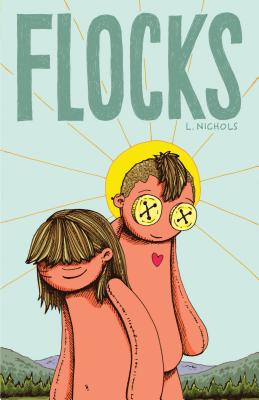
I’ll be up front: Nichols is a transgender man who was assigned female at birth in Louisiana and raised in a very religious Southern Baptist family.This is his story.

It’s not just a story of feeling out of place in a religious society — he tried very very hard to pray the gay away from the time he was young — but also feeling out of place in his own body. The only place he felt at home and at peace was in nature. He graduated from high school and went to MIT (the first in his family to go to college) where the sense of displacement both increased and decreased. Decreased because he was among friends who accepted him and cared about him for who he was; increased because he loathed his body — he began cutting himself — and couldn’t figure out why (that is, until he had a realization that it was because he wasn’t male enough). It’s a very personal story, as one would expect from a memoir, but one that raises some interesting questions about religion and community.

I loved Nichols’ art as well. Everyone is drawn fairly realistically except him, and he’s in this doll-esque shape, which I loved because it allowed him to not only be the gender he was assigned at birth (while simultaneously demonstrating his obvious discomfort with himself) but it allows the reader to empathize more with him as a character. It’s quite clever, and I loved it.

I also loved that this made me think, not just about trans people, but about how communities include and exclude others and the benefits and disadvantages of that. I appreciated his (inadvertent) critique of religion vs. God and it made me want to be more open and kind to others. We’re all struggling here, why add hate to the pile?

Excellent.

Audio Book: So Close to Being the S**t, Y’all Don’t Even Know

by Retta
Read by the author
Support your local independent bookstore: buy it there!
Listen to it at Libro.fm
Content:  Lots and lots and lots of swearing, including multiple f-bombs. It’s in the humor section of the bookstore.

I’ve said it here before: I have a weakness for celebrity memoirs, especially when read by the author. And so, even though I don’t really know a whole lot about Retta (aside from that she was Donna on Parks and Rec), I splurged for this. And I found it to be extremely delightful. She is a funny writer, but more than that, she is a funny story teller. She holds nothing back, from the way she grew up to her struggles with money and finding an acting job, to her accidental love for the LA Kings. It’s an entertaining journey with a lot of laughs along the way.

I’m not sure there’s much else to recommend it, except that it’s utterly delightful and a lot of fun. Sometimes, though, that’s exactly what you need.

Cancer Vixen

by Marisa Acocella Marchetto
First sentence: “What happens when a shoe-crazy, lipstick-obsessed, wine-swilling, pasta-slurping, fashion-fanatic, single-forever, about-to-get-married big-city girl cartoonist (me, Marisa Acocella) with a  fabulous life finds… a lump in her breast?”
Support your local independent bookstore: buy it there!
Content:  There is swearing (no f-bombs), some tasteful nudity, and lots of naked breasts (it is about breast cancer, after all).  It would be in the adult graphic novel section of the bookstore, if we had it.

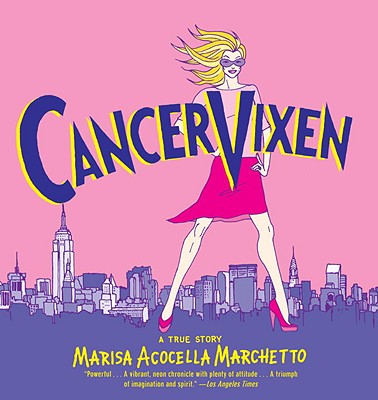
The first sentence of this one kind of says it all: Marchetto, a cartoonist who works for Glamour and the New Yorker, had a fabulous life with a new Italian boyfriend she was planning on eloping with, when she — out of the blue, because what other way does cancer happen? — is suddenly diagnosed with cancer.

Much of the book is a detailed blow-by-blow of Marchetto’s cancer treatment, and how that affected her life and  relationships. I found it interesting — I’ve never known anyone who’s gone through this before — but I wasn’t enamored with the story. It was very much “it girl” New York: all the right clothes, all the right friends, all the right things. (Though, she had a LOT of friends, which is a great thing!) I was more interested in her body image issues, especially regarding the models who kept throwing themselves shamelessly at Marchetto’s fiance, Silvano. But Marchetto didn’t really dwell on that; she brushed past it as part of her “negativity”. There was also an undercurrent of evidence why universal health care is needed: she was uninsured when she was diagnosed, and was in a panic about having to pay out of pocket for the treatment. Which turned out to be nearly $200,000. But, she didn’t dwell on that, either. It was very self-centric, and, honestly, I didn’t really care for her. (I feel bad saying that, though.) The art was a bit meh, as well, though I understand why she chose to draw it slightly cartoony; if it were more realistic, it’d be a lot more disturbing. This way, Marchetto was able to keep it from getting too dark while remaining honest about the ups and downs of cancer treatment (and her life).

Not bad, but not my favorite, either.

Lighter Than My Shadow

by Katie Green
Support your local independent bookstore: buy it there!
Review copy provided by the publisher.
Content: There’s some disturbing images and language, as well as depictions of sexual assault. It’s in the graphic novel section of the bookstore.

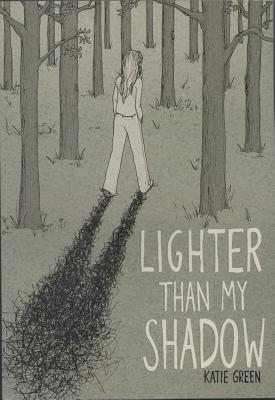
This is a graphic memoir depicting Green’s journey and experience with eating disorders. She frames it as reflections from an adult perspective, looking back on her childhood, teens, and twenties as she struggles with anorexia and binge eating. It’s a very frank look — both at the way she perceived herself, but also the small things others around her, from her family to her friends to other students, said that contributed to her negative self-image.

Green tries many treatments, from the hospital to therapy to alternative therapy, but nothing seems to work. She thinks she’s “cured” at one point, but it’s really just a different manifestation for her need for control, which is the root problem.

Green’s not saying that her experience is typical of all anorexic’s experiences. But, that there is something of value in telling her story. And I think there is. I could see some of myself in her; while I have never been anorexic, I do have an inherent dislike of my body, and while I try not to pass that on to my girls, there are times when I’m afraid I have through little things I have unintentionally said.  I want them to have a healthy relationship with food, with their body, and reading books like this help me figure out how to help them have that.

I also really liked how the art reflects the story; Green does amazing things with darkness and shadow and fading images. It not only helped tell the story, it intensified it, giving a depth to this particular story that wouldn’t have come through in a prose book.

A very, very good book.